You're viewing free preview questions — 4 questions previewing here — subscribe to unlock 82 more, plus the Full Question Bank, Mock Papers & Worksheets.Upgrade
Separation Techniques — Free MYP3 Sciences Practice Questions

1QuestionChoosing Appropriate Separation MethodsConcept Practice
2 marks~3 minCriterion A
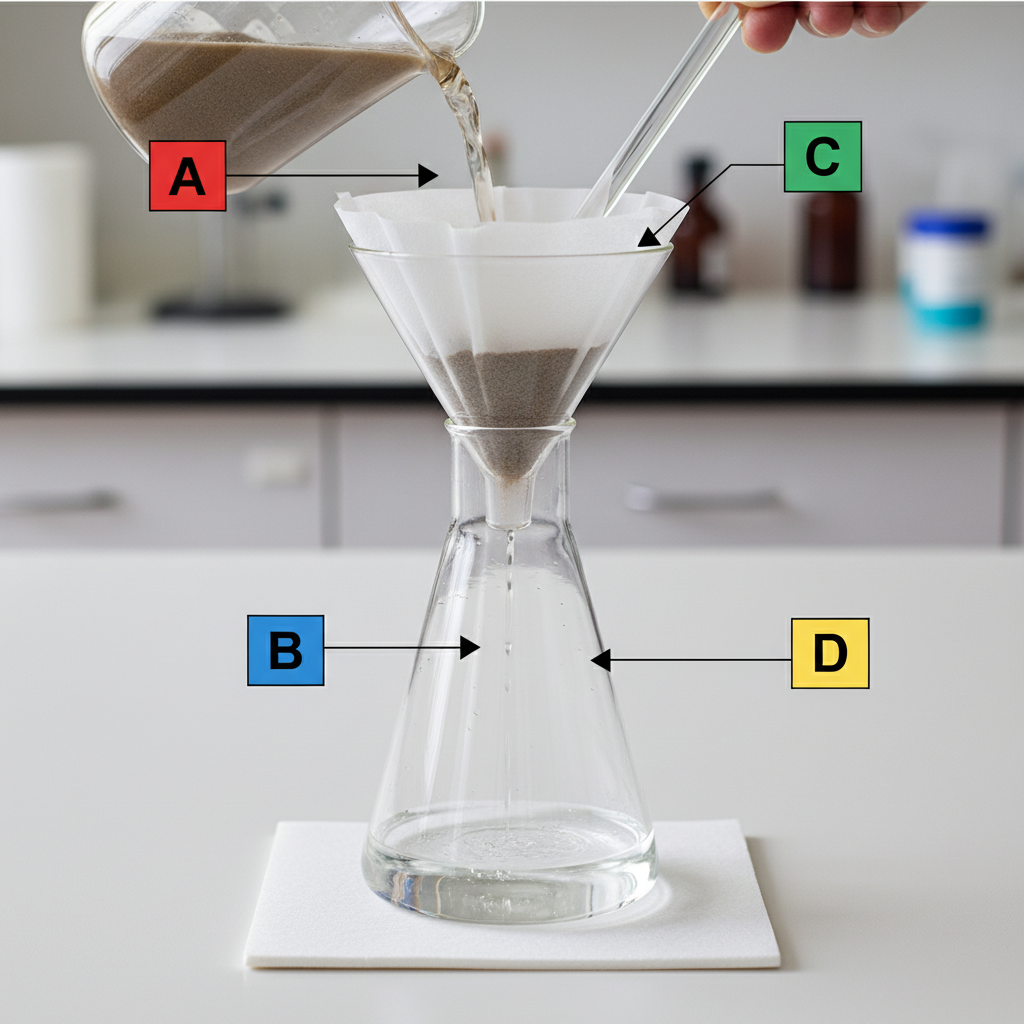
The diagram below shows a labelled filtration setup used to separate a mixture of sand and water.
a
Identify the labelled part where the solid residue collects. [1]
b
Explain why the liquid filtrate passes through the filter paper but the sand does not. [1]

Solutions
2QuestionChoosing Appropriate Separation MethodsAssessment Practice
3 marks~5 minCriterion C
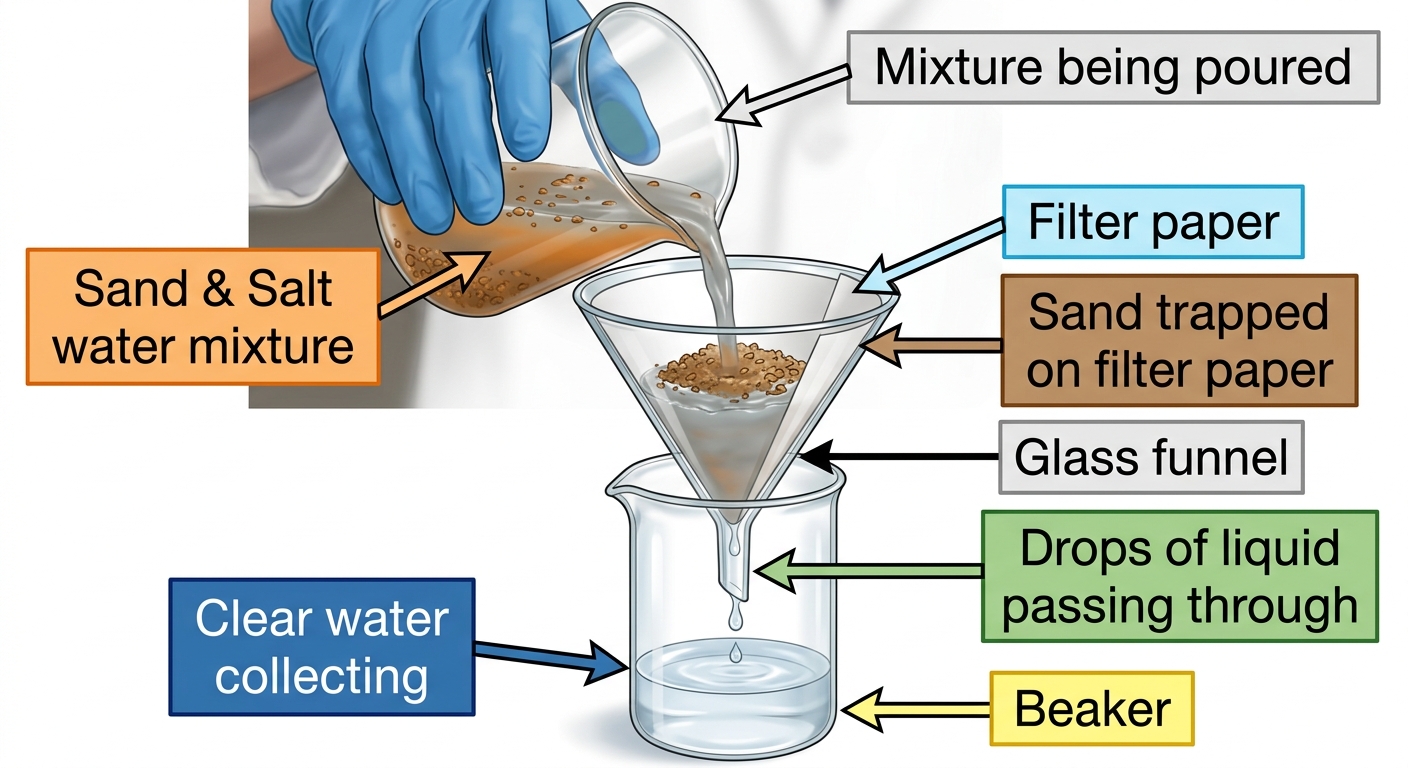
A mixture of sand and salt water is poured through filter paper in a funnel. Sand remains on the filter paper while liquid collects in the beaker below.
a
Identify the separation technique shown. [1]
b
Explain why sand is retained on the filter paper while salt water passes through. [1]
c
A student claims that filtration could also be used to separate salt from salt water. Evaluate this claim, referring to particle size. [1]
Solutions
3QuestionChoosing Appropriate Separation MethodsAssessment Practice
6 marks~9 minCriterion D
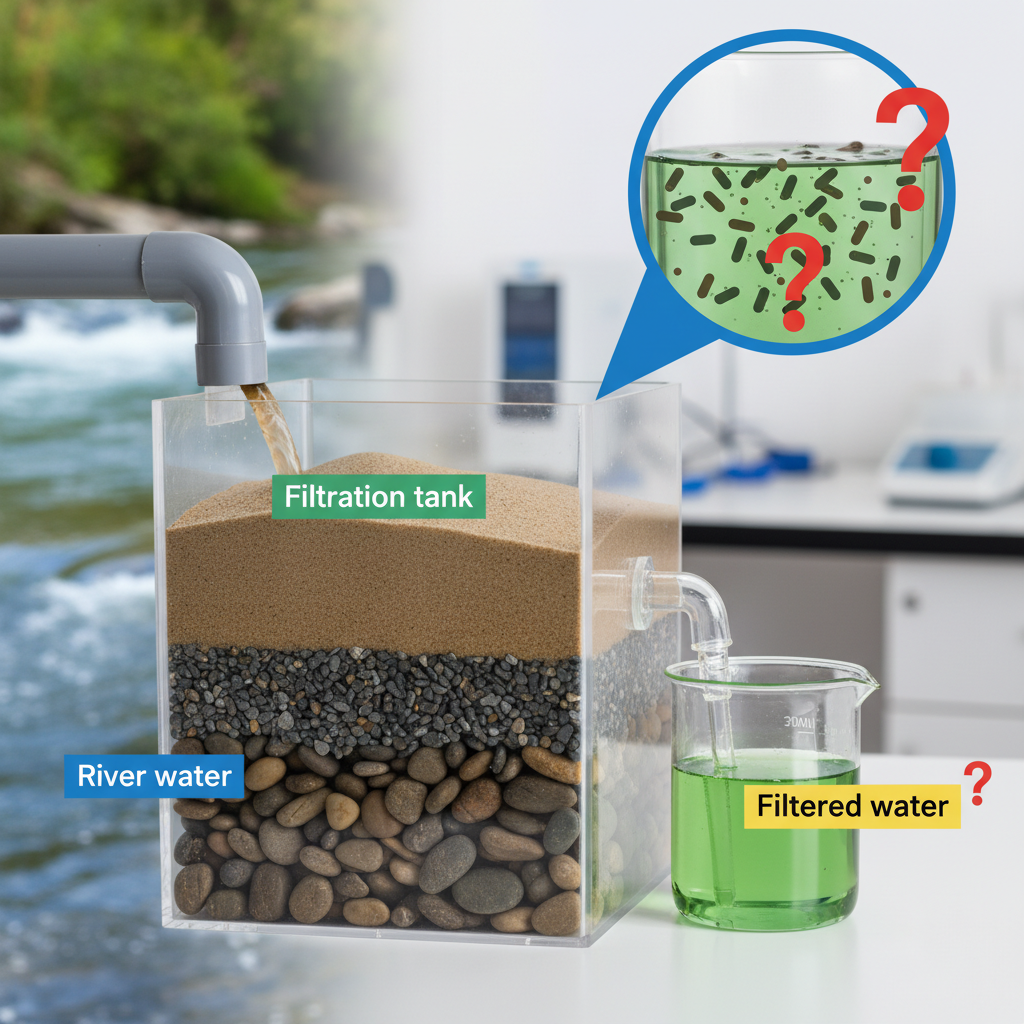
A local water treatment plant uses filtration to remove visible particles from river water. Tests show that harmful bacteria are still present after filtration.
a
Explain why filtration alone cannot remove bacteria from the water. [2]
b
Describe one additional method that could remove or destroy bacteria, and explain how it works. [2]
c
A plant manager is choosing between UV treatment and chlorination for large-scale use. Identify one limitation of each method and explain which method you would recommend, giving a reason for your choice. [2]
Solutions
4QuestionFiltration and EvaporationAssessment Practice
5 marks~8 minCriterion B
A group of students investigates how filter pore size affects the time taken to filter 100 mL of water. Their results are shown in the graph below.
| Pore size (mm) | 0.1 | 0.5 | 1.0 | 2.0 |
|---|---|---|---|---|
| Filtration time (s) | 400 | 200 | 100 | 50 |
a
Calculate the filtration rate in mL/min for each pore size. Use the formula: [2]
b
Describe the relationship between pore size and filtration rate shown by your results. [2]
c
A student predicts that a filter with a pore size of 4.0 mm would have a filtration rate of 240 mL/min. Analyse the data to explain whether this prediction is supported. [1]
Solutions
That's every free question here — 4 of 86.
+82 more questions, plus Mock Papers & Worksheets, are waiting in Premium.