You're viewing free preview questions — 6 questions previewing here — subscribe to unlock 82 more, plus the Full Question Bank, Mock Papers & Worksheets.Upgrade
Back

How body systems work together — Free MYP3 Sciences Practice Questions

Free questions

Open in full, with answers, mark scheme and examiner insights.

Question 1Criterion B · Easy · 3 marksrevisionprep.com

Transport of nutrients and oxygen to cells

A student wants to find out how the volume of water a plant gets each day affects how fast red dye moves up its stem. She uses three identical plants and gives them 10 mL, 20 mL or 30 mL of water a day. She then puts each stem in red dye and records the time for the dye to rise 5 cm.
(a)
State the independent variable. [1]
(b)
Explain why the time taken for the dye to rise 5 cm is the dependent variable. [1]
(c)
One plant is on a sunny windowsill and the others are in a shaded corner. Explain how this could make her results unfair. [1]

revisionprep.com

Summary Answer

Not available for this question.

Model Answer

Not available for this question.

Marking Scheme

Not available for this question.

Examiner Insights

Not available for this question.

Question 2Criterion A · Easy · 2 marksrevisionprep.com

Case studies of system interactions in daily life
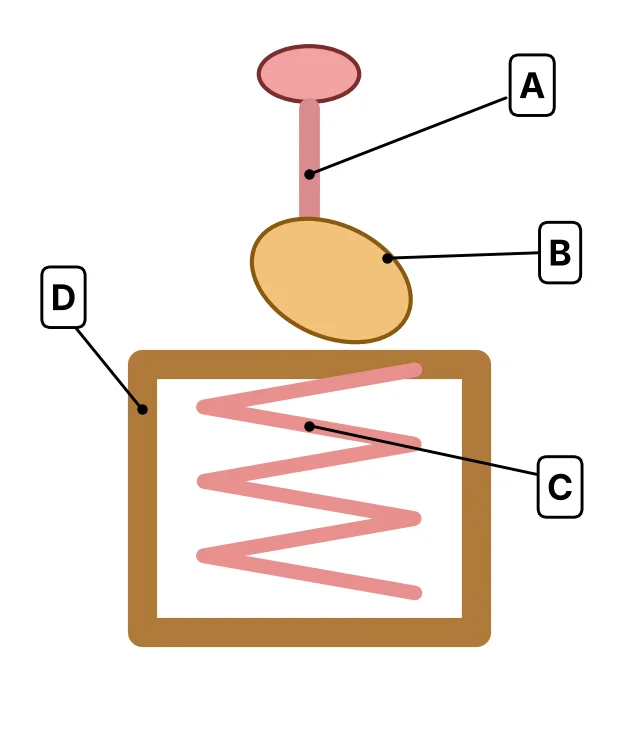
The diagram shows the human digestive system. Four parts are labelled A, B, C and D. A is the long tube that carries food from the mouth, B is the stretchy bag that mixes food with acid, C is the long coiled tube where most food is absorbed and D is the wide tube at the end that absorbs water.
Question diagram
(a)
Name part C. [1]
(b)
Explain one reason why part C is important for the body. [1]

revisionprep.com

Summary Answer

Not available for this question.

Model Answer

Not available for this question.

Marking Scheme

Not available for this question.

Examiner Insights

Not available for this question.

Question 3Criterion D + C · Medium · 6 marksrevisionprep.com

How systems work together in the human body

Scientists can now grow kidneys in a laboratory using pig cells. A hospital has 10 of these kidneys but 30 patients need one. Some patients refuse a pig-cell kidney for religious reasons. Each kidney costs 50 000 dollars and the hospital's transplant budget is 600 000 dollars.
(a)
Calculate the percentage of the 30 patients who can receive a laboratory-grown kidney. [1]
(b)
Give one positive effect and one negative effect of this technology for patients. [2]
(c)
A manager must decide who gets the 10 kidneys. Analyse the issues of cost, fairness and religious belief in this decision. [3]

revisionprep.com

Summary Answer

Not available for this question.

Model Answer

Not available for this question.

Marking Scheme

Not available for this question.

Examiner Insights

Not available for this question.

Question 4Criterion A + C · Medium · 4 marksrevisionprep.com

Consequences of system failure

When a person loses a lot of body water (dehydration), the blood volume falls. The table shows a person's resting heart rate as they lose body water.
Question diagram
(a)
Describe how the heart rate changes as more water is lost. [1]
(b)
Explain why a smaller blood volume makes the heart beat faster. [2]
(c)
Suggest how the kidneys respond to dehydration and why this helps. [1]

revisionprep.com

Summary Answer

Not available for this question.

Model Answer

Not available for this question.

Marking Scheme

Not available for this question.

Examiner Insights

Not available for this question.

Question 5Criterion C · Challenge · 9 marksrevisionprep.com

Transport of nutrients and oxygen to cells

Maya and Sam each measure their heart rate and the amount of blood their heart pumps with each beat.

Maya: sitting 70 beats per minute and 60 mL; walking fast 100 beats per minute and 80 mL; running 150 beats per minute and 90 mL.
Sam: sitting 65 beats per minute and 65 mL; walking fast 90 beats per minute and 75 mL; running 130 beats per minute and 85 mL.
(a)
Describe how Maya's heart rate and blood pumped per beat change from sitting to running. [2]
(b)
Sam's heart pumps more blood with each beat than Maya's when sitting. Suggest why a fitter person's heart can pump more blood with each beat. [2]
(c)
Explain why running needs a higher heart rate than sitting. Use the words respiration, oxygen and carbon dioxide. [3]
(d)
Maya says: "A faster heart rate means a person is fitter." Evaluate her claim using the data. [2]

revisionprep.com

Summary Answer

Not available for this question.

Model Answer

Not available for this question.

Marking Scheme

Not available for this question.

Examiner Insights

Not available for this question.

Question 6Criterion C + A · Challenge · 6 marksrevisionprep.com

Interaction between digestive and circulatory systems

The data shows how fast five people absorb glucose in the small intestine and their blood sugar level 10 minutes after eating.

PersonABCDE
Glucose absorbed (mg per minute)120150180200220
Blood sugar (units)110125140150160
(a)
Describe the relationship between the rate of glucose absorption and the blood sugar level. [2]
(b)
Person F absorbs 170 mg per minute. Estimate F's blood sugar level. Show your working. [2]
(c)
Explain whether the data support the idea that the digestive system and the circulatory system work together to raise blood sugar. [2]

revisionprep.com

Summary Answer

Not available for this question.

Model Answer

Not available for this question.

Marking Scheme

Not available for this question.

Examiner Insights

Not available for this question.

That's every free question here — 6 of 88.

+82 more questions, plus Mock Papers & Worksheets, are waiting in Premium.

Upgrade
