You're viewing free preview questions — 6 questions previewing here — subscribe to unlock 77 more, plus the Full Question Bank, Mock Papers & Worksheets.Upgrade
Back

Skeletal and muscular systems — Free MYP3 Sciences Practice Questions

Free questions

Open in full, with answers, mark scheme and examiner insights.

Question 1Criterion A · Easy · 2 marksrevisionprep.com

Functions of the human skeleton

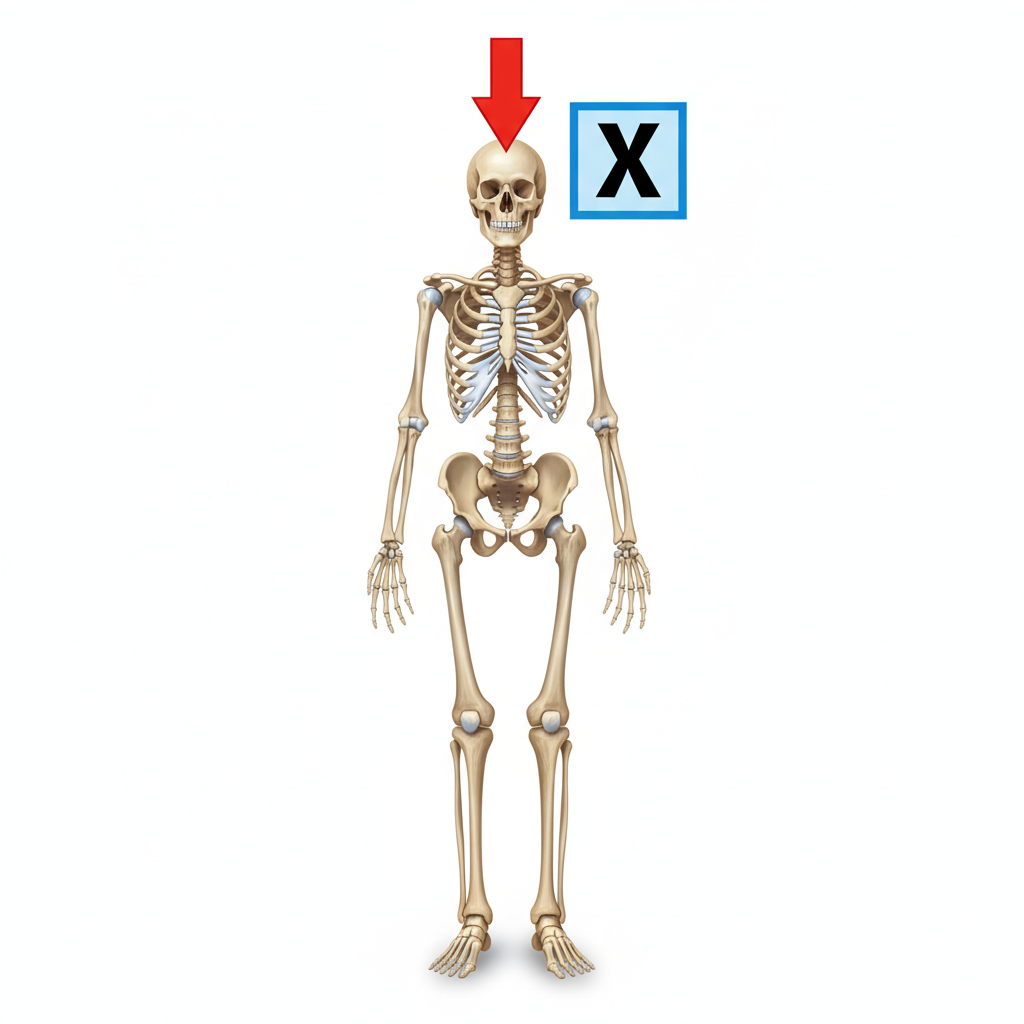
The diagram shows a human skeleton. One bone, labelled X, is at the top.
Question diagram
(a)
Name the bone labelled X. [1]
(b)
Explain how the shape of bone X helps it to do its main job. [1]

revisionprep.com

Summary Answer

Not available for this question.

Model Answer

Not available for this question.

Marking Scheme

Not available for this question.

Examiner Insights

Not available for this question.

Question 2Criterion A · Easy · 2 marksrevisionprep.com

How muscles work in pairs (antagonistic muscles)
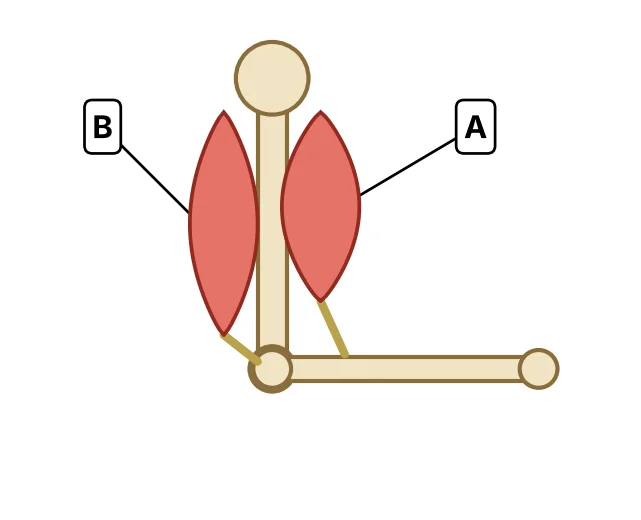
The diagram shows the upper arm with two muscles, A and B. A is on the front of the upper arm. B is on the back of the upper arm.
Question diagram
(a)
A flexor is a muscle that bends a joint. State which muscle, A or B, is the flexor at the elbow. [1]
(b)
Explain how muscle B straightens the arm. [1]

revisionprep.com

Summary Answer

Not available for this question.

Model Answer

Not available for this question.

Marking Scheme

Not available for this question.

Examiner Insights

Not available for this question.

Question 3Criterion B · Medium · 6 marksrevisionprep.com

Types of joints and their movement

A student thinks that stretching before exercise increases how far people can bend forward. She plans to use a sit-and-reach box, which measures how far a person can reach along a ruler while sitting with the legs straight.
(a)
Write a testable hypothesis for the investigation. [1]
(b)
Identify the independent variable and the dependent variable. State two variables that must be controlled. [2]
(c)
Describe a method the student could use to collect reliable results. [2]
(d)
Explain one way the student could make the results more reliable. [1]

revisionprep.com

Summary Answer

Not available for this question.

Model Answer

Not available for this question.

Marking Scheme

Not available for this question.

Examiner Insights

Not available for this question.

Question 4Criterion D + C · Medium · 4 marksrevisionprep.com

Major muscles in the human body

Many coaches say that a warm-up reduces muscle injuries. A sports scientist followed 100 players who did a 10-minute warm-up and 100 players who did not. In one season, 8 of the players who warmed up had a muscle strain and 20 of the players who did not warm up had a muscle strain.
(a)
Calculate the percentage of players with a muscle strain in each group. [1]
(b)
Explain how a warm-up could reduce the chance of a muscle strain. [2]
(c)
State one reason why this study may not prove that warm-ups cause the lower number of strains. [1]

revisionprep.com

Summary Answer

Not available for this question.

Model Answer

Not available for this question.

Marking Scheme

Not available for this question.

Examiner Insights

Not available for this question.

Question 5Criterion A + C · Challenge · 6 marksrevisionprep.com

Functions of the human skeleton

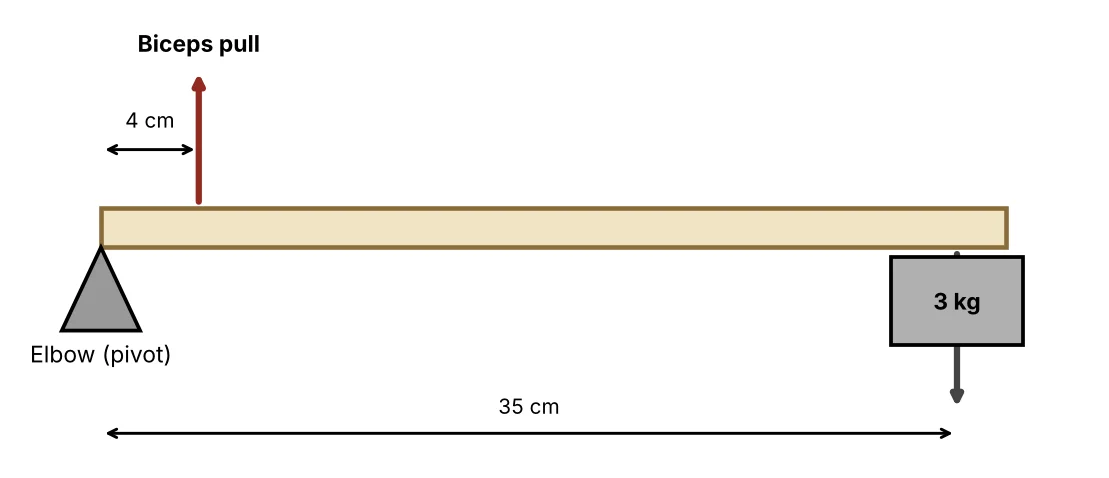
The diagram shows a forearm holding a 3 kg mass. The elbow is the pivot. The biceps pulls up at a point 4 cm from the elbow. The mass is 35 cm from the elbow. Use g = 10 N/kg.
Question diagram
(a)
Calculate the weight of the 3 kg mass. [1]
(b)
Calculate the upward force the biceps must pull with to hold the arm still. Use turning effects (moments). [2]
(c)
Compare the biceps force with the weight. Explain what this shows about how the forearm works as a lever. [3]

revisionprep.com

Summary Answer

Not available for this question.

Model Answer

Not available for this question.

Marking Scheme

Not available for this question.

Examiner Insights

Not available for this question.

Question 6Criterion C + A · Challenge · 8 marksrevisionprep.com

Protection, support and movement

Engineers test a human femur. They apply a force along the length of the bone (parallel) and then at right angles to the bone (perpendicular). Each test is repeated four times and the force needed to break the bone is recorded.

Force along the bone (N): Trial 1 850, Trial 2 820, Trial 3 880, Trial 4 860

Force across the bone (N): Trial 1 310, Trial 2 290, Trial 3 320, Trial 4 300
(a)
Calculate the mean breaking force for each direction. [2]
(b)
Explain why the two mean values are different. Use the data in your answer. [2]
(c)
A person is running. Analyse the data to predict which direction of force the femur experiences most often. Explain how the structure of the bone supports your prediction. [4]

revisionprep.com

Summary Answer

Not available for this question.

Model Answer

Not available for this question.

Marking Scheme

Not available for this question.

Examiner Insights

Not available for this question.

That's every free question here — 6 of 83.

+77 more questions, plus Mock Papers & Worksheets, are waiting in Premium.

Upgrade