You're viewing free preview questions — 5 questions previewing here — subscribe to unlock 69 more, plus the Full Question Bank, Mock Papers & Worksheets.Upgrade
Ethical implications — Free MYP4 Biology Practice Questions

1QuestionEnvironmental Ethics of GM OrganismsConcept Practice
2 marks~3 minCriterion D
Bt corn has been genetically modified to produce a toxin (Cry protein) that kills certain insect pests. Following its widespread commercial release, scientists observed unexpected effects on non-target insect populations in surrounding ecosystems.
a
Identify one ethical issue raised by the environmental release of Bt corn. [1]
b
Explain why predicting the long-term ecological impacts of GM crops such as Bt corn is challenging. [1]


Solutions
2QuestionRegulation and Bioethics in BiotechnologyAssessment Practice
2 marks~3 minCriterion D
In a drought-prone region of sub-Saharan Africa, smallholder farmers face repeated crop failures. A biotechnology company has developed a genetically modified (GM) drought-resistant maize variety that could prevent food shortages. However, national regulations require a mandatory 5-year environmental impact study before any GM crop may be approved for cultivation.
Discuss the ethical conflict between the farmer's urgent need for food security and the regulatory requirement for long-term environmental assessment before approving GM drought-resistant maize. [2]
Discuss the ethical conflict between the farmer's urgent need for food security and the regulatory requirement for long-term environmental assessment before approving GM drought-resistant maize. [2]

Solutions
3QuestionEnvironmental Ethics of GM OrganismsConcept Practice
2 marks~3 minCriterion A
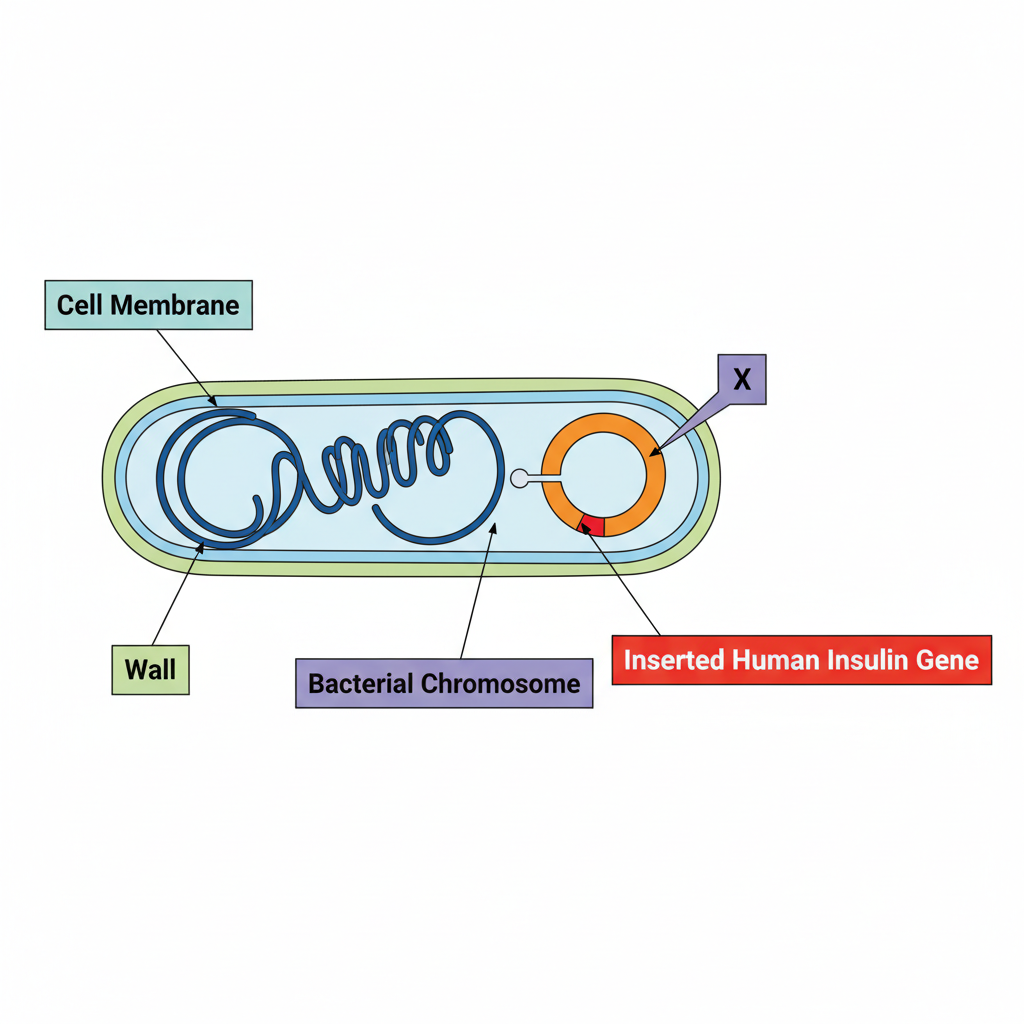
The diagram below shows a genetically modified bacterium used in the commercial production of human insulin. A rod-shaped prokaryotic cell is visible, containing a large circular chromosome and a smaller circular structure labelled X. A highlighted segment within X represents an inserted human gene.
a
Identify the organism shown in the diagram. [1]
b
Describe the role of structure X in enabling the bacterium to produce human insulin. [1]
Solutions
4QuestionHuman Cloning and Moral ConcernsAssessment Practice
3 marks~5 minCriterion C
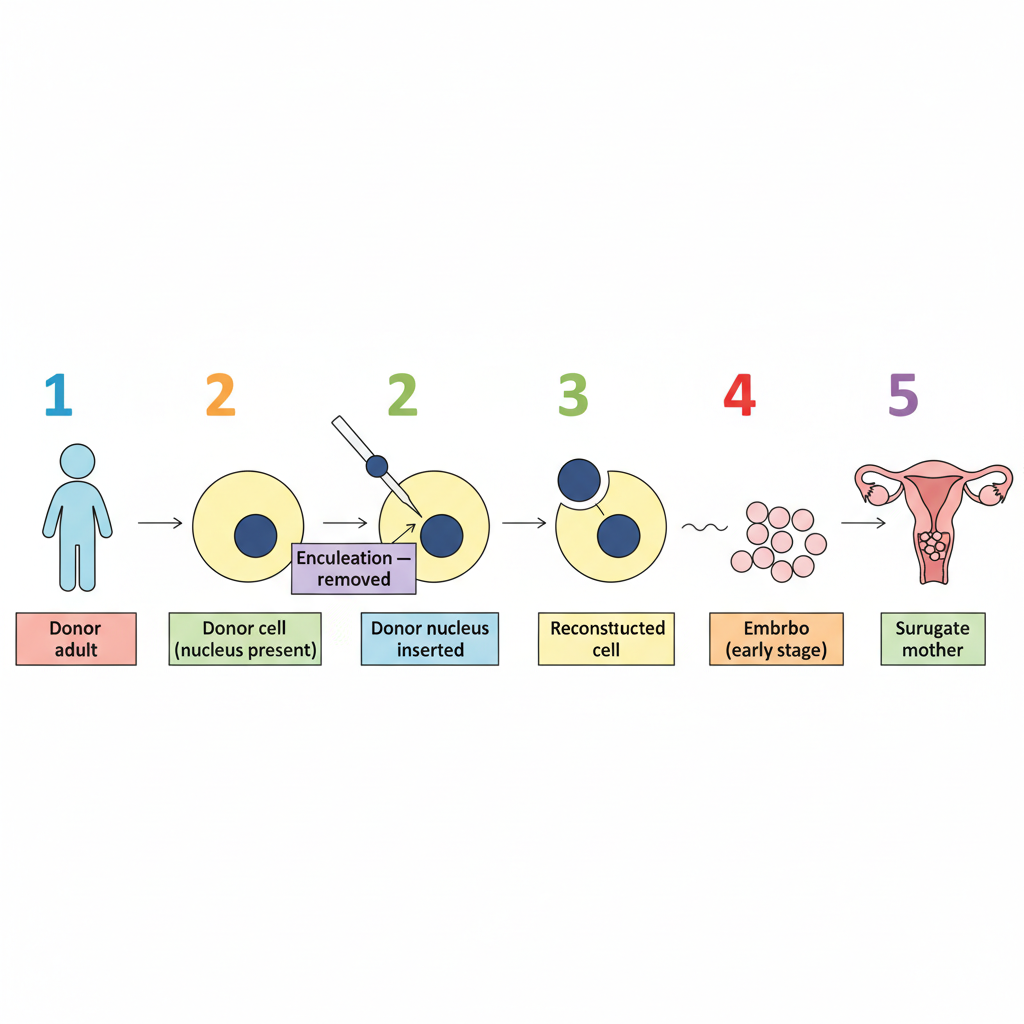
The diagram below illustrates the five steps of somatic cell nuclear transfer (SCNT) used in human cloning: (1) a somatic donor cell is taken from an adult human; (2) an egg cell is enucleated; (3) the donor nucleus is inserted into the enucleated egg cell; (4) the reconstructed cell is stimulated to divide, forming an embryo; (5) the embryo is implanted into a surrogate mother.
a
Describe the role of the enucleated egg cell in the SCNT process. [1]
b
Explain why the clone is genetically identical to the somatic donor and not to the egg cell donor. [1]
c
A scientist argues that the clone is not truly "100% genetically identical" to the somatic donor. Evaluate this claim. [1]
Solutions
5QuestionHuman Cloning and Moral ConcernsAssessment Practice
6 marks~9 minCriterion A
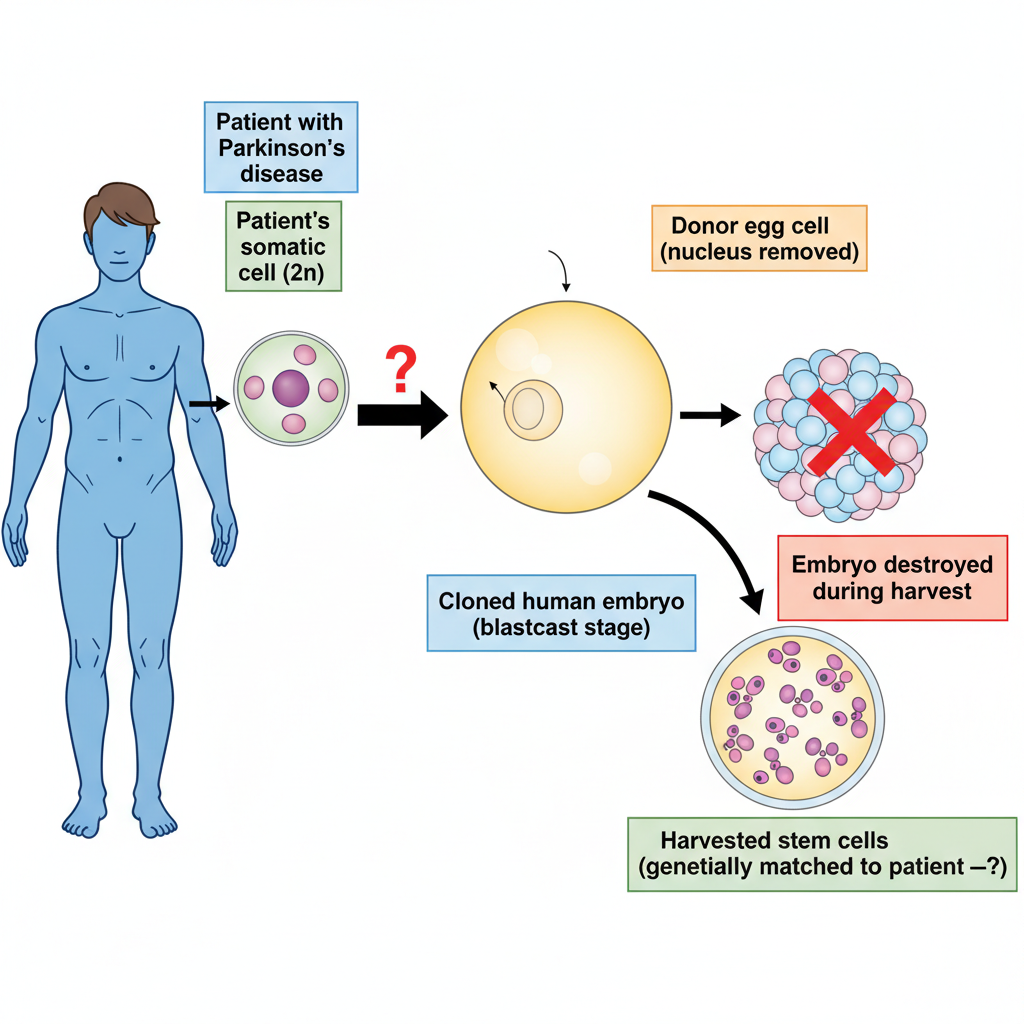
A patient advocacy group proposes using somatic cell nuclear transfer (SCNT) to create cloned human embryos from which stem cells would be harvested to treat Parkinson's disease. The embryos would be destroyed during the process.
a
Explain how SCNT produces stem cells that are genetically matched to a specific patient. [2]
b
Discuss the ethical conflict between the potential medical benefits of this therapy and the moral concerns raised by the destruction of human embryos. [2]
c
Analyse how differing cultural or religious perspectives could prevent the universal application of SCNT-based therapies. Use one specific example to support your analysis. [2]
Solutions
That's every free question here — 5 of 74.
+69 more questions, plus Mock Papers & Worksheets, are waiting in Premium.