RevisionPrep
Log inGo Premium

Biology

Free Version

Evolution, Inheritance and Reproduction

6 subtopics · 461 exam-style questions

“Pick a subtopic to start practising.”
AdaptationNatural SelectionTheory of Evolution (Charles Darwin)Evidence of EvolutionDNA, Genes and InheritanceReproduction and Life Cycles

Sample questions from Evolution, Inheritance and Reproduction

  1. Theory of Evolution (Charles Darwin)[3 marks]
    The table summarises observations of five Galápagos finch species living on the same large island.

    SpeciesBeak shapeMain foodLarge ground finchdeep, blunt and stronghard seedsWarbler finchthin and pointedsmall insectsCactus finchlong and slightly curvedcactus flowers and nectarWoodpecker finchstraight, strong and chisel-likeinsect larvae under bark (uses a cactus spine as a tool)Vegetarian finchshort, thick and curvedbuds and fruit\begin{array}{|l|c|c|}\hline \text{Species} & \text{Beak shape} & \text{Main food} \\ \hline \text{Large ground finch} & \text{deep, blunt and strong} & \text{hard seeds} \\ \hline \text{Warbler finch} & \text{thin and pointed} & \text{small insects} \\ \hline \text{Cactus finch} & \text{long and slightly curved} & \text{cactus flowers and nectar} \\ \hline \text{Woodpecker finch} & \text{straight, strong and chisel-like} & \text{insect larvae under bark (uses a cactus spine as a tool)} \\ \hline \text{Vegetarian finch} & \text{short, thick and curved} & \text{buds and fruit} \\ \hline\end{array}

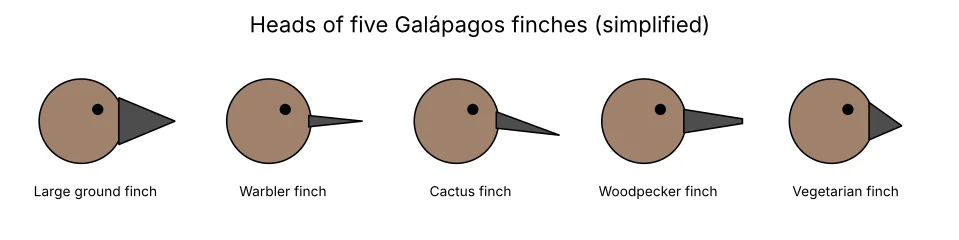
    The diagram shows the heads of the five species.

    (a) Identify the general relationship between beak shape and type of food shown in the table. [1]

    (b) A new population is found on an island where the main food is large nuts with very hard shells. Predict the most likely beak shape and justify your prediction using the table. [2]
    Diagram for a Theory of Evolution (Charles Darwin) practice questionPractise this subtopic
  2. Natural Selection[7 marks]
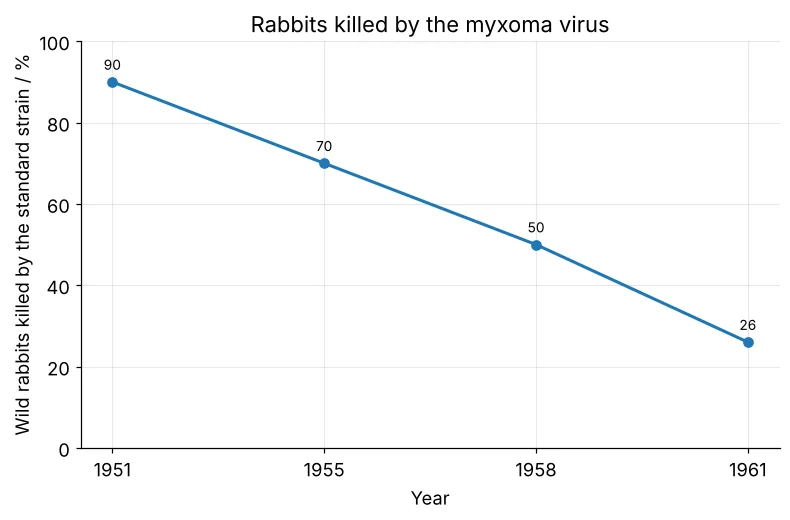
    In 1950 the myxoma virus was released in Australia to control rabbits. At first it killed more than 99% of infected rabbits. Scientists later infected samples of wild rabbits with the same standard laboratory strain of the virus.

    Year1951195519581961Wild rabbits killed by the standard strain / %90705026\begin{array}{|l|c|c|c|c|}\hline \text{Year} & 1951 & 1955 & 1958 & 1961 \\ \hline \text{Wild rabbits killed by the standard strain / \%} & 90 & 70 & 50 & 26 \\ \hline\end{array}

    The graph shows these data.

    (a) Describe the trend shown by the data. [2]

    (b) Explain how the virus acted as a selection pressure on the rabbit population. [3]

    (c) Explain why the scientists used the same standard laboratory strain of the virus each year. [2]
    Diagram for a Natural Selection practice questionPractise this subtopic
  3. Adaptation[2 marks]
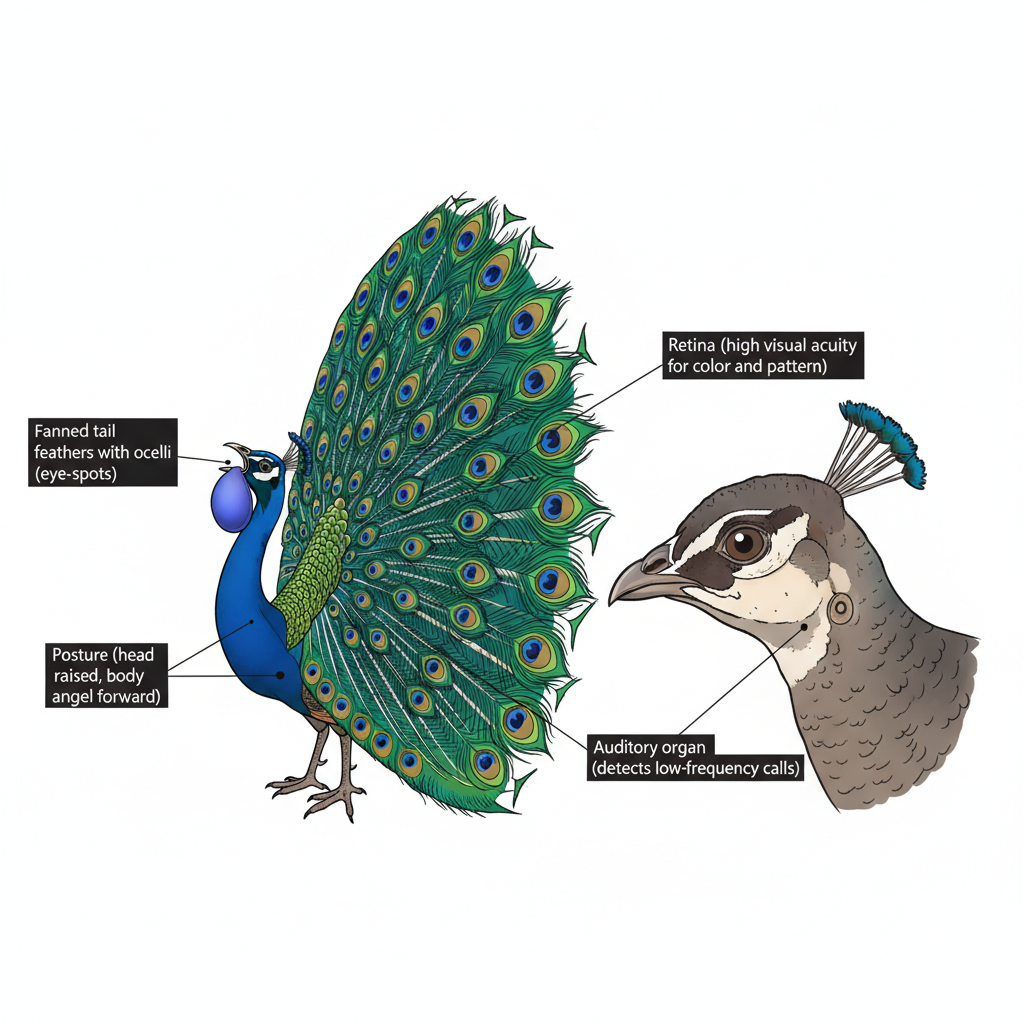
    The image shows a peacock displaying to a peahen. The labels point to the fanned tail with eye-spots, the male's upright posture, the peahen's eye and the peahen's auditory organ.

    (a) Identify two features of the display shown in the image that the peahen detects. [2]
    Diagram for a Adaptation practice questionPractise this subtopic
  4. Evidence of Evolution[3 marks]
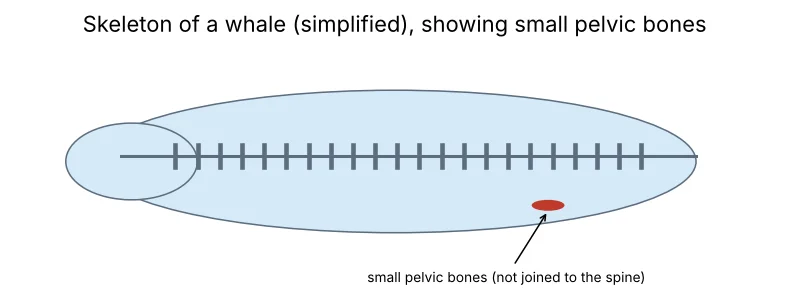
    Some organisms have structures that are reduced in size and have little or no function. Examples include the pelvic bones of whales, the small hind-limb spurs of pythons and the coccyx (tail bone) of humans.

    The diagram shows a whale skeleton with its small pelvic bones.

    (a) State the term used for structures like these. [1]

    (b) Explain how the pelvic bones of whales provide evidence that whales evolved from four-legged ancestors. [2]
    Diagram for a Evidence of Evolution practice questionPractise this subtopic
  5. DNA, Genes and Inheritance[6 marks]
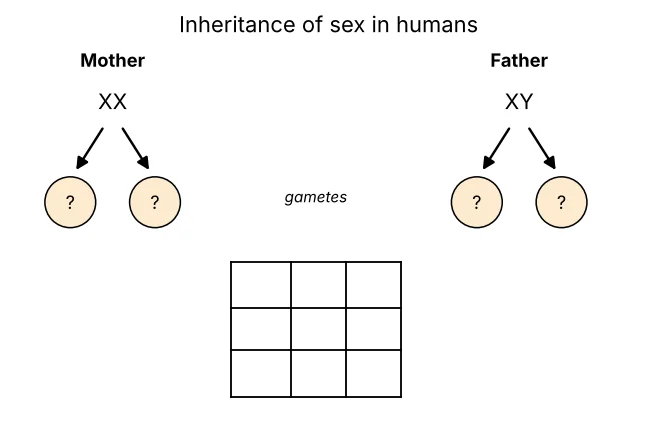
    The diagram shows a genetic cross for sex determination in humans.

    (a) Complete a Punnett square to show how sex is inherited. [2]

    (b) Explain why there is a 50% chance that any child will be a boy. [2]

    (c) A family already has three girls. State the probability that their next child is a boy, and explain your answer. [2]
    Diagram for a DNA, Genes and Inheritance practice questionPractise this subtopic
  6. Reproduction and Life Cycles[3 marks]
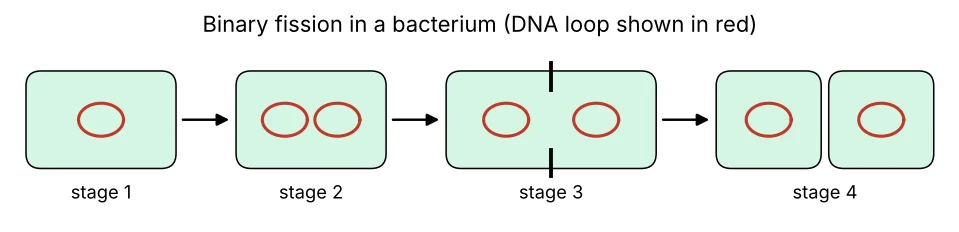
    The diagram shows a bacterium reproducing by binary fission.

    (a) State whether binary fission is sexual or asexual reproduction. [1]

    (b) Explain why the two cells produced are genetically identical. [2]
    Diagram for a Reproduction and Life Cycles practice questionPractise this subtopic

Every question, revision note and worksheet for Evolution, Inheritance and Reproduction — with Premium.

Unlock Full Access