You're viewing free preview questions — 6 questions previewing here — subscribe to unlock 110 more, plus the Full Question Bank, Mock Papers & Worksheets.Upgrade
Back

Natural Selection — Free MYP4 Biology Practice Questions

Free questions

Open in full, with answers, mark scheme and examiner insights.

Question 1Criterion A · Band 1-2 · Easy · 3 marksrevisionprep.com

Mechanism of Natural Selection

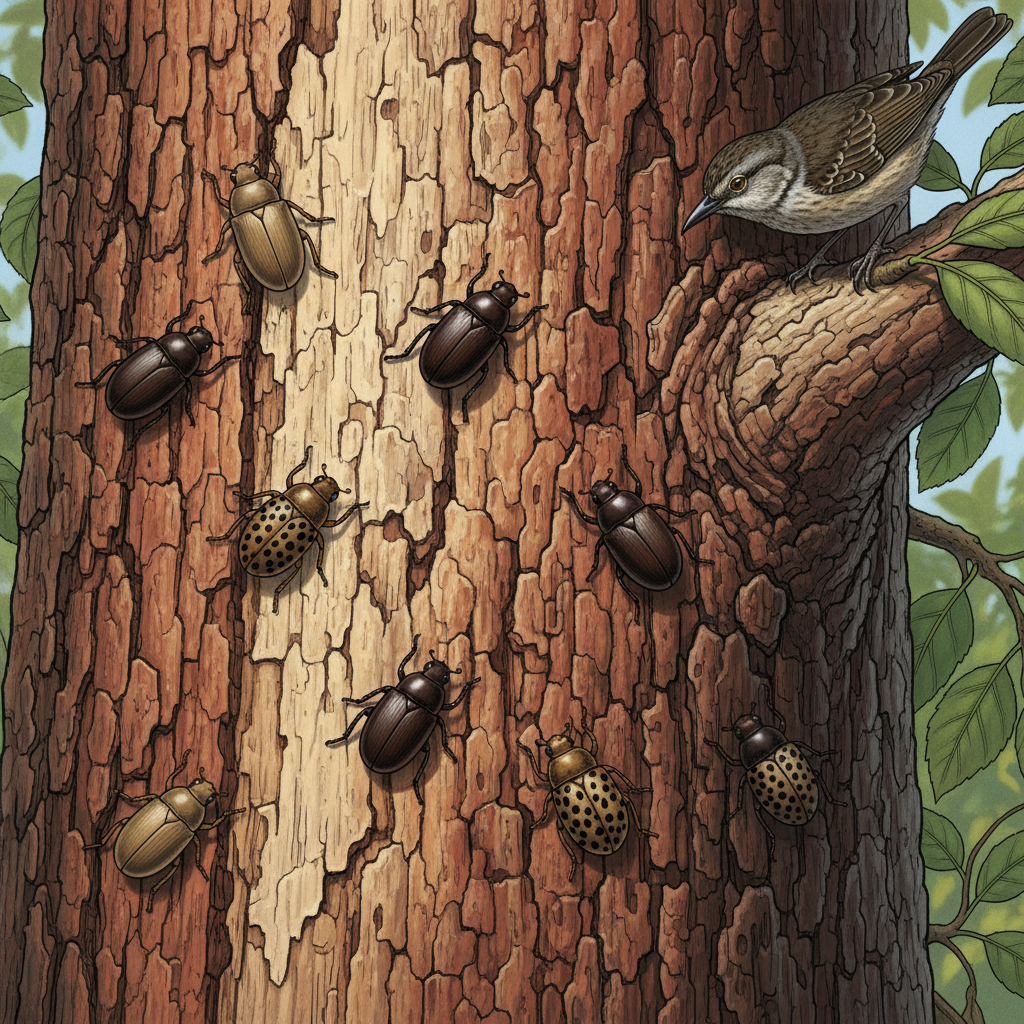
The picture shows beetles of one species resting on a tree trunk, with a bird that eats them. The beetles vary in colour: light brown, dark brown and spotted.
Question diagram
(a)
State the term for the differences in colour between beetles of the same species. [1]Criterion A (i) · Level 1-2
(b)
Most of the trunk is dark brown. Predict which colour of beetle the bird is least likely to see, and give a reason. [2]Criterion A (ii) · Level 1-2

revisionprep.com

Summary Answer

Not available for this question.

Model Answer

Not available for this question.

Marking Scheme

Not available for this question.

Examiner Insights

Not available for this question.

Question 2Criterion C + A · Band 3-4 · Easy · 7 marksrevisionprep.com

Selection Pressures in Ecosystems

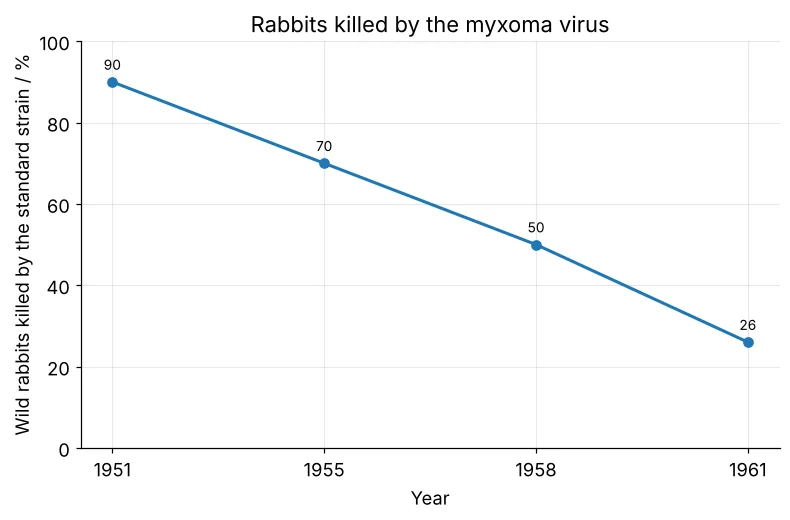
In 1950 the myxoma virus was released in Australia to control rabbits. At first it killed more than 99% of infected rabbits. Scientists later infected samples of wild rabbits with the same standard laboratory strain of the virus.

Year1951195519581961Wild rabbits killed by the standard strain / %90705026\begin{array}{|l|c|c|c|c|}\hline \text{Year} & 1951 & 1955 & 1958 & 1961 \\ \hline \text{Wild rabbits killed by the standard strain / \%} & 90 & 70 & 50 & 26 \\ \hline\end{array}

The graph shows these data.
Question diagram
(a)
Describe the trend shown by the data. [2]Criterion C (ii) · Level 3-4
(b)
Explain how the virus acted as a selection pressure on the rabbit population. [3]Criterion A (ii) · Level 3-4
(c)
Explain why the scientists used the same standard laboratory strain of the virus each year. [2]Criterion C (iv) · Level 3-4

revisionprep.com

Summary Answer

Not available for this question.

Model Answer

Not available for this question.

Marking Scheme

Not available for this question.

Examiner Insights

Not available for this question.

Question 3Criterion B + C · Band 3-6 · Medium · 8 marksrevisionprep.com

Mechanism of Natural Selection

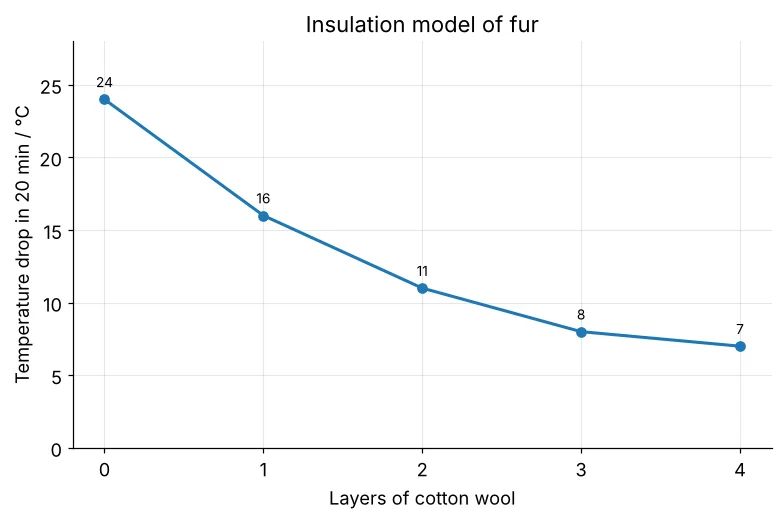
A student models fur thickness in mammals from cold climates. She fills five identical boiling tubes with 20 cm³ of water at 70 °C and wraps each in a different number of layers of cotton wool (0 to 4). She records the temperature drop after 20 minutes.

Layers of cotton wool01234Temperature drop / °C24161187\begin{array}{|l|c|c|c|c|c|}\hline \text{Layers of cotton wool} & 0 & 1 & 2 & 3 & 4 \\ \hline \text{Temperature drop / °C} & 24 & 16 & 11 & 8 & 7 \\ \hline\end{array}

The graph shows these data.
Question diagram
(a)
Identify the independent and dependent variables. [2]Criterion B (iii) · Level 3-4
(b)
Explain how two variables should be controlled. [2]Criterion B (iii) · Level 5-6
(c)
Describe the trend in the results and explain how it links to natural selection in Arctic mammals. [3]Criterion C (ii) · Level 5-6
(d)
Suggest one limitation of using boiling tubes as a model of a mammal. [1]Criterion C (iv) · Level 3-4

revisionprep.com

Summary Answer

Not available for this question.

Model Answer

Not available for this question.

Marking Scheme

Not available for this question.

Examiner Insights

Not available for this question.

Question 4Criterion A + C · Band 1-6 · Medium · 5 marksrevisionprep.com

Differential Reproduction and Fitness

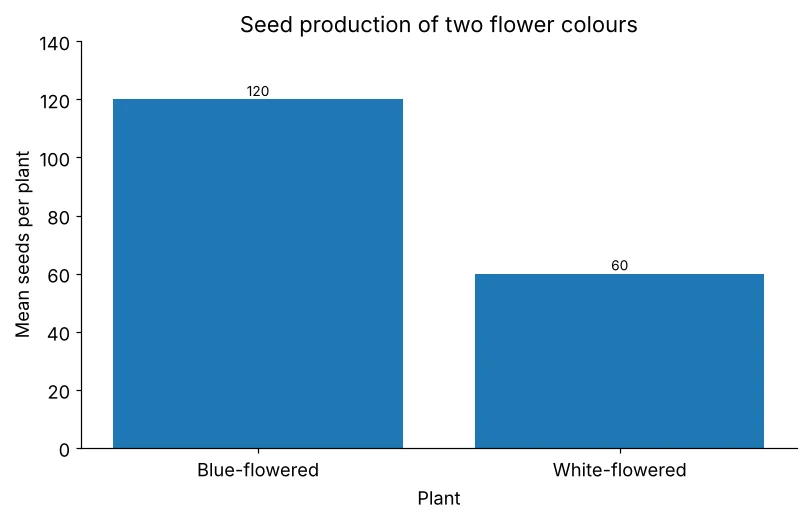
A plant species has blue-flowered and white-flowered forms. Both survive equally well. Bees visit blue flowers more often. A student counted seeds: blue-flowered plants produced a mean of 120 seeds and white-flowered plants a mean of 60 seeds.

The graph shows these data.
Question diagram
(a)
Calculate the ratio of seeds produced by blue to white plants. [1]Criterion C (i) · Level 1-2
(b)
Explain how natural selection can act on flower colour even though both forms survive equally well. [3]Criterion A (ii) · Level 5-6
(c)
Suggest why white flowers might still persist in the population. [1]Criterion A (iii) · Level 3-4

revisionprep.com

Summary Answer

Not available for this question.

Model Answer

Not available for this question.

Marking Scheme

Not available for this question.

Examiner Insights

Not available for this question.

Question 5Criterion A + D · Band 3-8 · Challenge · 9 marksrevisionprep.com

Selection Pressures in Ecosystems

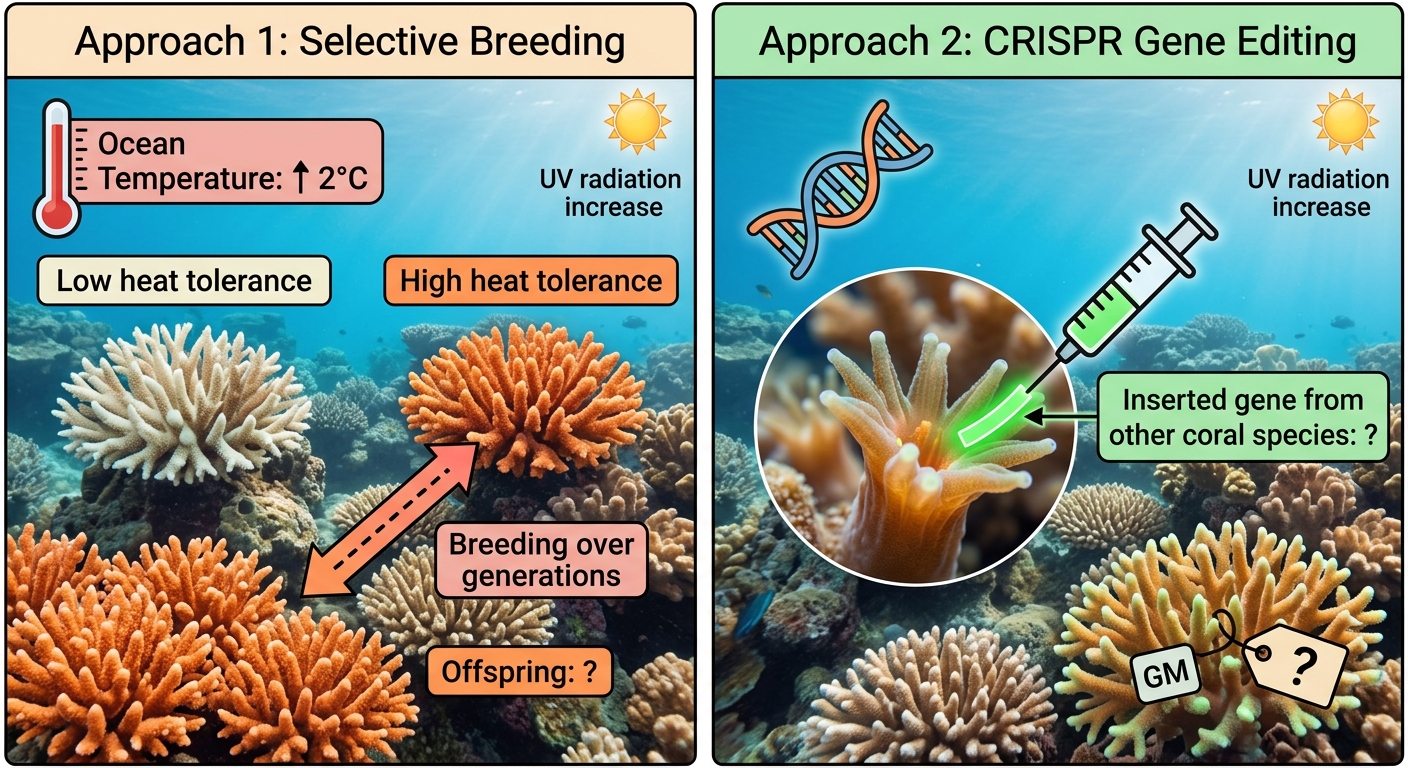
The picture compares two ways of helping a threatened coral survive warmer seas. Approach 1: corals with naturally higher heat tolerance are bred together over several generations. Approach 2: a heat-tolerance gene from another coral species is inserted into the threatened coral using gene editing.
Question diagram
(a)
Explain how natural selection alone could increase heat tolerance in a wild coral population as the sea warms. [3]Criterion A (ii) · Level 5-6
(b)
Compare how approaches 1 and 2 would affect the genetic variation of the coral population. [2]Criterion A (iii) · Level 3-4
(c)
Evaluate whether releasing gene-edited corals into the wild is justified. Include two perspectives. [4]Criterion D (ii) · Level 7-8

revisionprep.com

Summary Answer

Not available for this question.

Model Answer

Not available for this question.

Marking Scheme

Not available for this question.

Examiner Insights

Not available for this question.

Question 6Criterion D + A · Band 5-8 · Challenge · 7 marksrevisionprep.com

Differential Reproduction and Fitness

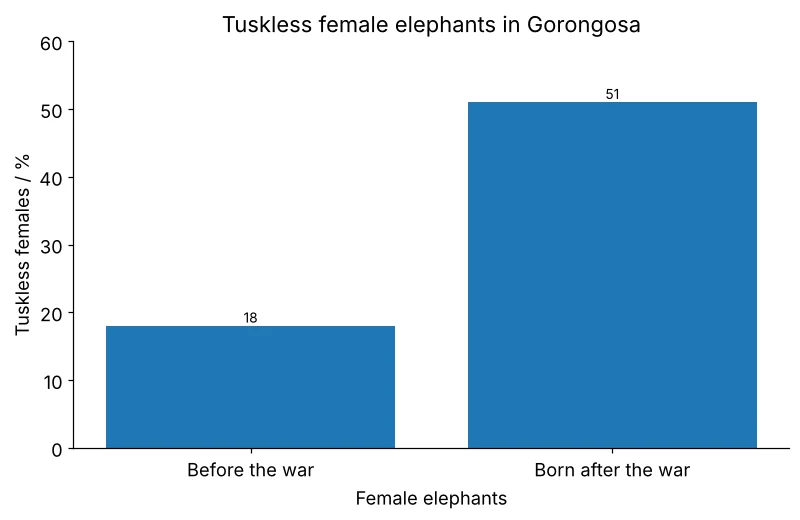
In Gorongosa National Park, Mozambique, about 90% of elephants were killed for their ivory during a war between 1977 and 1992. Tuskless elephants were rarely shot. Before the war about 18% of females were tuskless; among females born after the war, about 51% were tuskless.

The graph shows these data.
Question diagram
(a)
Explain the increase in tuskless females. [3]Criterion A (ii) · Level 5-6
(b)
Elephants use tusks to dig for water and strip bark. Discuss the consequences of this change for the elephants and for people, and evaluate how science can help. [4]Criterion D (ii) · Level 7-8

revisionprep.com

Summary Answer

Not available for this question.

Model Answer

Not available for this question.

Marking Scheme

Not available for this question.

Examiner Insights

Not available for this question.

That's every free question here — 6 of 116.

+110 more questions, plus Mock Papers & Worksheets, are waiting in Premium.

Upgrade