You're viewing free preview questions — 6 questions previewing here — subscribe to unlock 24 more, plus the Full Question Bank, Mock Papers & Worksheets.Upgrade
Back

Theory of Evolution (Charles Darwin) — Free MYP4 Biology Practice Questions

Free questions

Open in full, with answers, mark scheme and examiner insights.

Question 1Criterion A · Band 1-4 · Easy · 3 marksrevisionprep.com

Development of the Theory of Evolution by Natural Selection

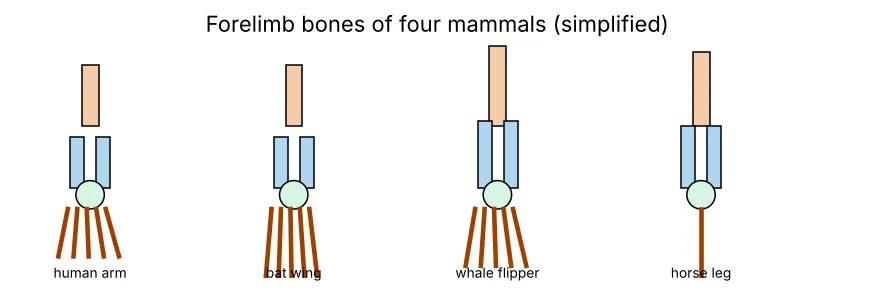
The forelimbs of a human (arm), a bat (wing), a whale (flipper) and a horse (leg) are used for very different functions. Yet each contains one upper bone (humerus), two lower bones (radius and ulna), a group of wrist bones and five digits or their remains.

The diagram shows the forelimb bones of the four mammals.
Question diagram
(a)
State the term used for structures that have the same basic arrangement but different functions. [1]Criterion A (i) · Level 1-2
(b)
Explain how these forelimbs support the idea that these mammals share a common ancestor. [2]Criterion A (ii) · Level 3-4

revisionprep.com

Summary Answer

Not available for this question.

Model Answer

Not available for this question.

Marking Scheme

Not available for this question.

Examiner Insights

Not available for this question.

Question 2Criterion A + C · Band 3-4 · Easy · 3 marksrevisionprep.com

Voyage of the HMS Beagle and Observations

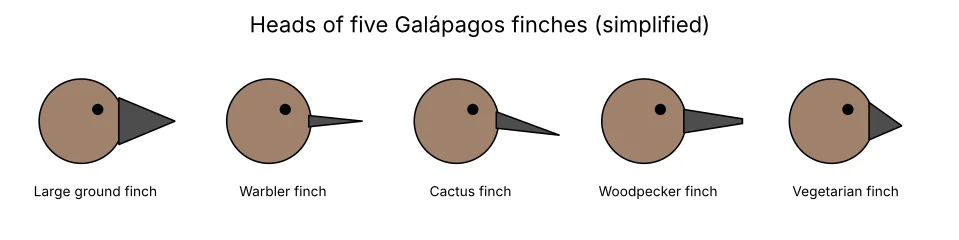
The table summarises observations of five Galápagos finch species living on the same large island.

SpeciesBeak shapeMain foodLarge ground finchdeep, blunt and stronghard seedsWarbler finchthin and pointedsmall insectsCactus finchlong and slightly curvedcactus flowers and nectarWoodpecker finchstraight, strong and chisel-likeinsect larvae under bark (uses a cactus spine as a tool)Vegetarian finchshort, thick and curvedbuds and fruit\begin{array}{|l|c|c|}\hline \text{Species} & \text{Beak shape} & \text{Main food} \\ \hline \text{Large ground finch} & \text{deep, blunt and strong} & \text{hard seeds} \\ \hline \text{Warbler finch} & \text{thin and pointed} & \text{small insects} \\ \hline \text{Cactus finch} & \text{long and slightly curved} & \text{cactus flowers and nectar} \\ \hline \text{Woodpecker finch} & \text{straight, strong and chisel-like} & \text{insect larvae under bark (uses a cactus spine as a tool)} \\ \hline \text{Vegetarian finch} & \text{short, thick and curved} & \text{buds and fruit} \\ \hline\end{array}

The diagram shows the heads of the five species.
Question diagram
(a)
Identify the general relationship between beak shape and type of food shown in the table. [1]Criterion C (ii) · Level 3-4
(b)
A new population is found on an island where the main food is large nuts with very hard shells. Predict the most likely beak shape and justify your prediction using the table. [2]Criterion A (iii) · Level 3-4

revisionprep.com

Summary Answer

Not available for this question.

Model Answer

Not available for this question.

Marking Scheme

Not available for this question.

Examiner Insights

Not available for this question.

Question 3Criterion D + A · Band 3-6 · Medium · 8 marksrevisionprep.com

Development of the Theory of Evolution by Natural Selection
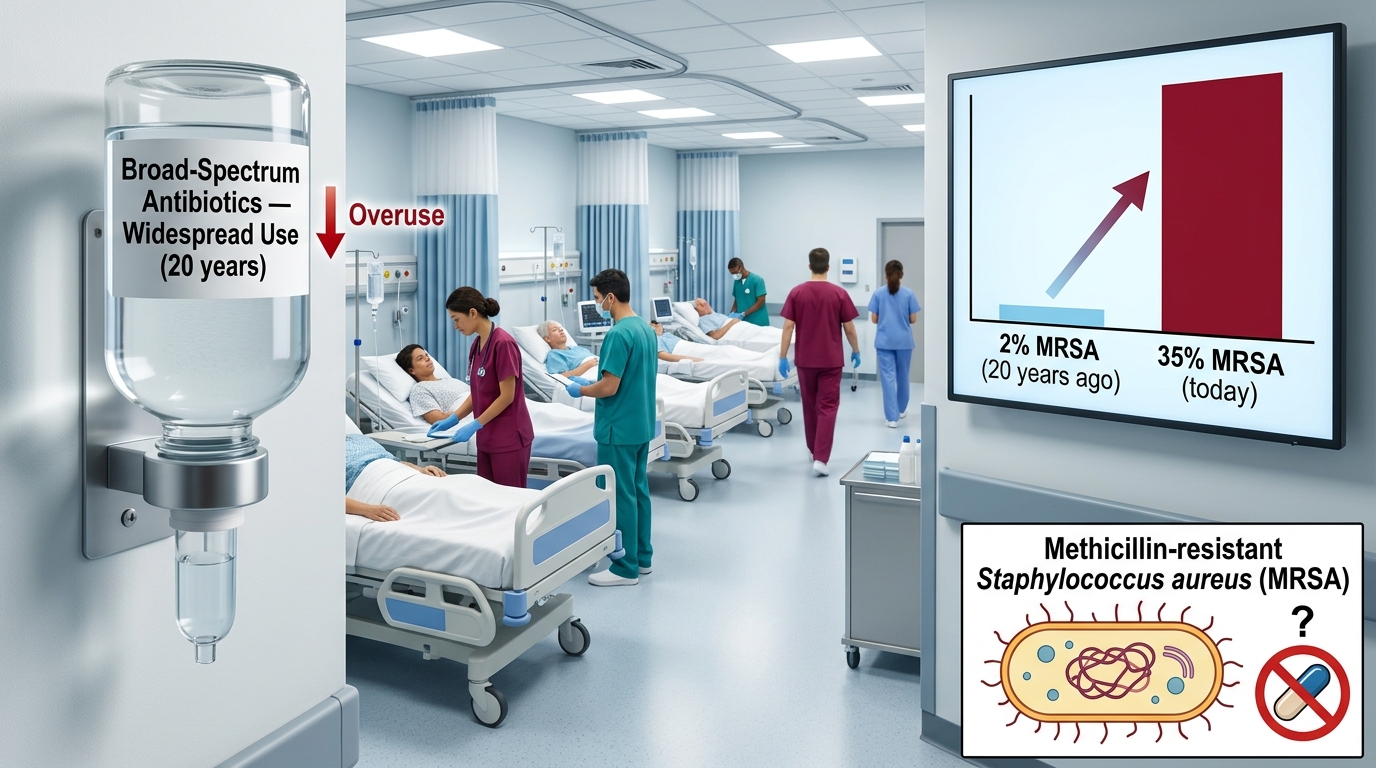
A large hospital has used broad-spectrum antibiotics as the first treatment for bacterial infections for 20 years. Over this time the proportion of Staphylococcus aureus infections caused by methicillin-resistant S. aureus (MRSA) has risen from 2% to 35%, as shown in the image.
Question diagram
(a)
Explain, using natural selection, how heavy antibiotic use increased the proportion of MRSA infections from 2% to 35%. [3]Criterion A (ii) · Level 5-6
(b)
Outline two ways in which hospitals use science to slow the spread of MRSA. [2]Criterion D (i) · Level 3-4
(c)
Discuss the implications of restricting the use of broad-spectrum antibiotics in hospitals. [3]Criterion D (ii) · Level 5-6

revisionprep.com

Summary Answer

Not available for this question.

Model Answer

Not available for this question.

Marking Scheme

Not available for this question.

Examiner Insights

Not available for this question.

Question 4Criterion B · Band 3-6 · Medium · 8 marksrevisionprep.com

Voyage of the HMS Beagle and Observations

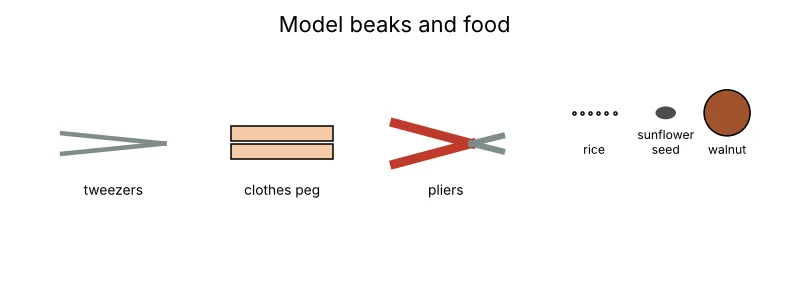
In a class model of Darwin's finches, tools represent beak types: tweezers (thin, pointed beak), a clothes peg (medium beak) and pliers (deep, strong beak). The 'food' is rice grains, sunflower seeds and whole walnuts in their shells, spread on a tray. A 'bird' has 20 seconds to move food into a cup using only its tool.

The diagram shows the model beaks and the food.
Question diagram
(a)
State a research question for this investigation. [1]Criterion B (i) · Level 3-4
(b)
Formulate a hypothesis about which tool will collect the most walnuts, and explain it using scientific reasoning. [2]Criterion B (ii) · Level 5-6
(c)
Explain how the independent variable will be changed and how the dependent variable will be measured. [2]Criterion B (iii) · Level 5-6
(d)
Identify two variables that must be controlled and explain why each must be kept the same. [2]

(e) Identify one safety risk in this investigation and describe how to reduce it. [1]
Criterion B (iii) · Level 5-6

revisionprep.com

Summary Answer

Not available for this question.

Model Answer

Not available for this question.

Marking Scheme

Not available for this question.

Examiner Insights

Not available for this question.

Question 5Criterion A · Band 5-8 · Challenge · 6 marksrevisionprep.com

Development of the Theory of Evolution by Natural Selection

Three fossil sequences are described below.

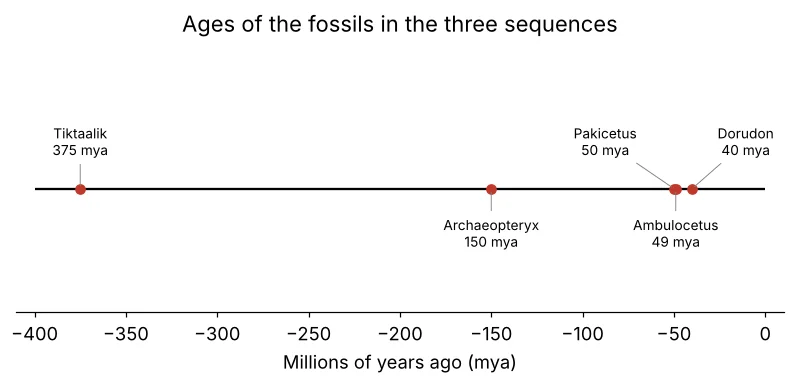
Sequence 1, fish to land vertebrate: Tiktaalik (about 375 million years ago) had fins with fish-like scales but also a neck and a flat skull; later fossils show limbs with digits.

Sequence 2, dinosaur to bird: Archaeopteryx (about 150 million years ago) had feathers and wings, but also teeth, a long bony tail and claws on its wings; later bird fossils show shorter tails and no teeth.

Sequence 3, land mammal to whale: Pakicetus (about 50 million years ago) walked on land; Ambulocetus (about 49 million years ago) had large webbed hind limbs; Dorudon (about 40 million years ago) lived only in water and had tiny hind limbs.

The timeline shows the ages of the fossils.
Question diagram
(a)
For one sequence, identify a feature that changes, describe the change, and explain how it supports gradual change by natural selection. [3]Criterion A (ii) · Level 5-6
(b)
Evaluate whether the fossil record provides convincing evidence for evolution. [3]Criterion A (iii) · Level 7-8

revisionprep.com

Summary Answer

Not available for this question.

Model Answer

Not available for this question.

Marking Scheme

Not available for this question.

Examiner Insights

Not available for this question.

Question 6Criterion C + A · Band 1-8 · Challenge · 6 marksrevisionprep.com

Voyage of the HMS Beagle and Observations

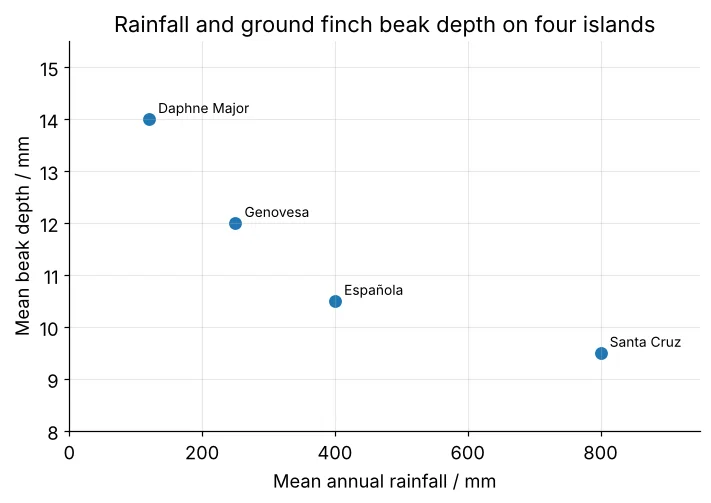
The data below show simplified data for ground finch populations on four Galápagos islands.

IslandMean annual rainfall / mmMean beak depth / mmMain seeds eatenDaphne Major12014.0hardGenovesa25012.0mixedEspan˜ola40010.5mixedSanta Cruz8009.5soft\begin{array}{|l|c|c|c|}\hline \text{Island} & \text{Mean annual rainfall / mm} & \text{Mean beak depth / mm} & \text{Main seeds eaten} \\ \hline \text{Daphne Major} & 120 & 14.0 & \text{hard} \\ \hline \text{Genovesa} & 250 & 12.0 & \text{mixed} \\ \hline \text{Española} & 400 & 10.5 & \text{mixed} \\ \hline \text{Santa Cruz} & 800 & 9.5 & \text{soft} \\ \hline\end{array}

The graph shows these data.
Question diagram
(a)
Describe the relationship between rainfall and mean beak depth. [1]Criterion C (ii) · Level 1-2
(b)
Explain this relationship using scientific reasoning. [2]Criterion A (ii) · Level 5-6
(c)
A student's hypothesis is: "Low rainfall causes finches to evolve deeper beaks." Evaluate the validity of this hypothesis using the data. [3]Criterion C (iii) · Level 7-8

revisionprep.com

Summary Answer

Not available for this question.

Model Answer

Not available for this question.

Marking Scheme

Not available for this question.

Examiner Insights

Not available for this question.

That's every free question here — 6 of 30.

+24 more questions, plus Mock Papers & Worksheets, are waiting in Premium.

Upgrade