You're viewing free preview questions — 5 questions previewing here — subscribe to unlock 43 more, plus the Full Question Bank, Mock Papers & Worksheets.Upgrade
Respiratory — Free MYP4 Biology Practice Questions

1QuestionProcess of breathingConcept Practice
2 marks~3 minCriterion A
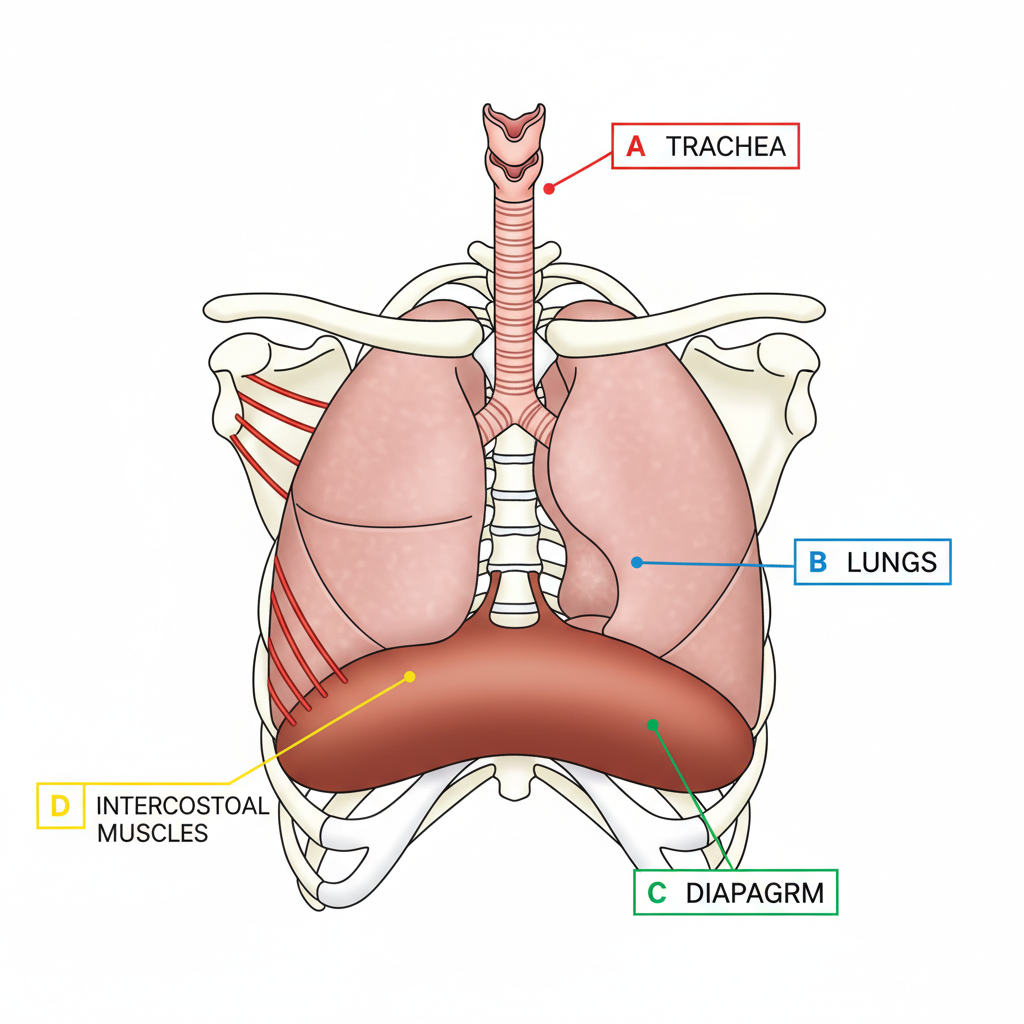
The diagram shows a cross-section of the human thoracic cavity during inhalation. Four structures are labelled:
A: trachea
B: lungs
C: diaphragm
D: intercostal muscles
A: trachea
B: lungs
C: diaphragm
D: intercostal muscles
a
Identify the labelled structure that contracts and flattens to increase the volume of the thoracic cavity during inhalation. [1]
b
Explain how the contraction of this structure causes air to enter the lungs. [1]

Solutions
2QuestionProcess of breathingAssessment Practice
4 marks~6 minCriterion A
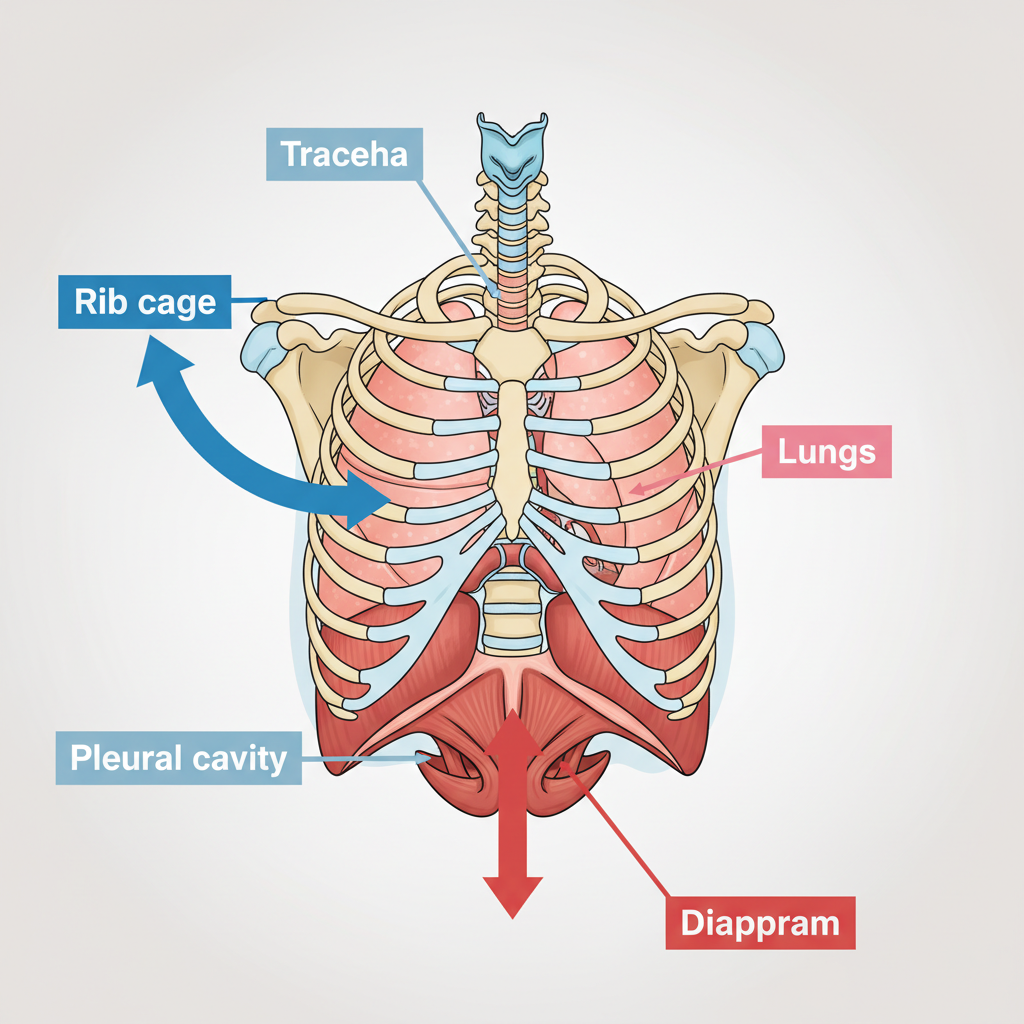
The diagram below shows the thoracic cavity during inhalation, with the rib cage raised and the diaphragm flattened.
a
Identify the two muscles that contract during inhalation and describe the movement each produces. [1]
b
Explain how these muscle contractions cause a change in thoracic volume and, using Boyle's law, explain the resulting pressure change inside the lungs. [2]
c
A student claims that air would still enter the lungs even if intrapulmonary pressure only fell to exactly atmospheric pressure. Evaluate this claim. [1]
Solutions
3QuestionProcess of breathingAssessment Practice
6 marks~9 minCriterion C
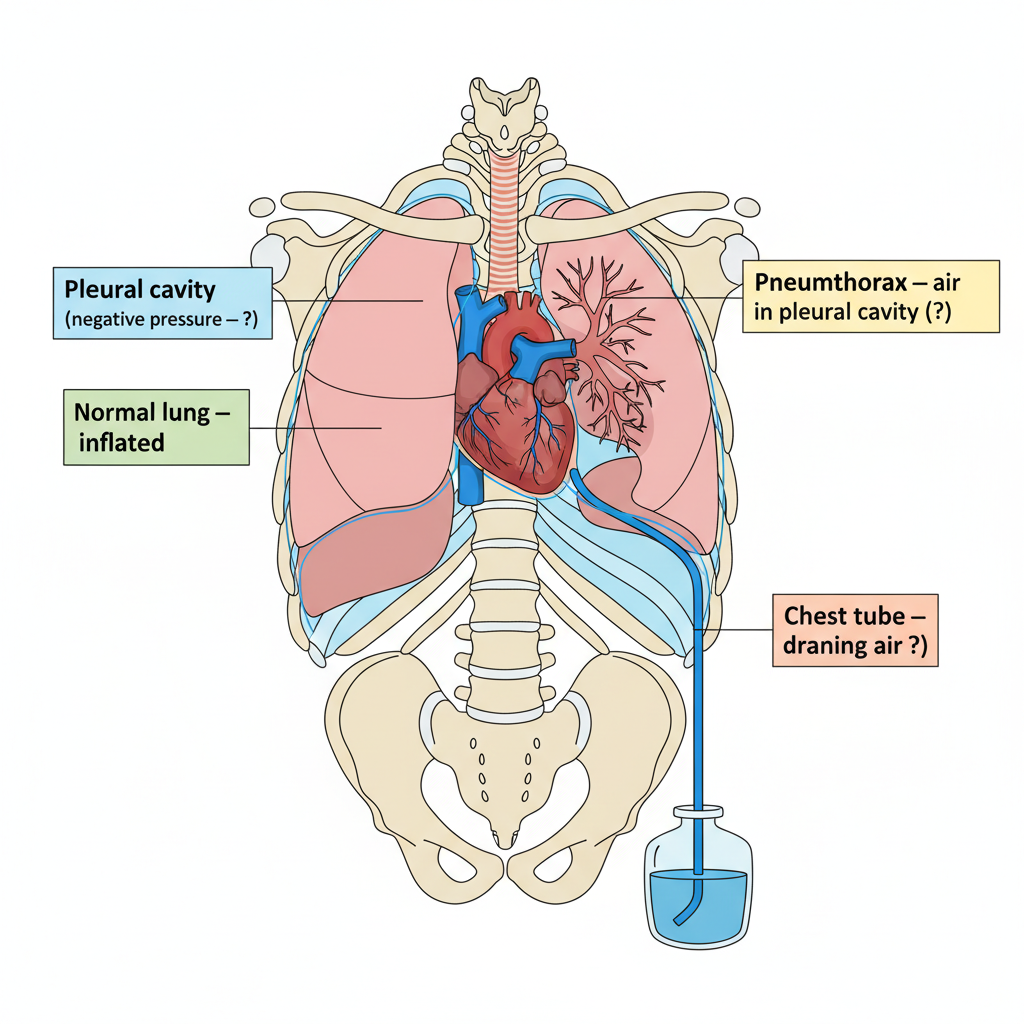
A 45-year-old patient arrives at the emergency department following a car accident with a collapsed lung (pneumothorax). Air has entered the pleural cavity, eliminating the normal pressure difference between the pleural space and the atmosphere. The attending doctor inserts a chest tube to remove this air and restore normal breathing mechanics.
a
Explain how negative intrapleural pressure keeps the lungs expanded and facilitates air entry during inhalation. [2]
b
Explain how inserting a chest tube restores normal breathing mechanics in this patient, and describe one health consequence of leaving a pneumothorax untreated. [2]
c
Analyse the ethical tension a doctor faces when performing an emergency chest tube insertion on a patient who is unconscious and unable to provide informed consent. [2]
Solutions
4QuestionMain organsAssessment Practice
6 marks~9 minCriterion C
A 45-year-old patient with a 20-year smoking history is diagnosed with chronic bronchitis and emphysema. Spirometry reveals a significantly reduced (forced expiratory volume in 1 second), though diffusion capacity () testing shows an even greater proportional decline.
a
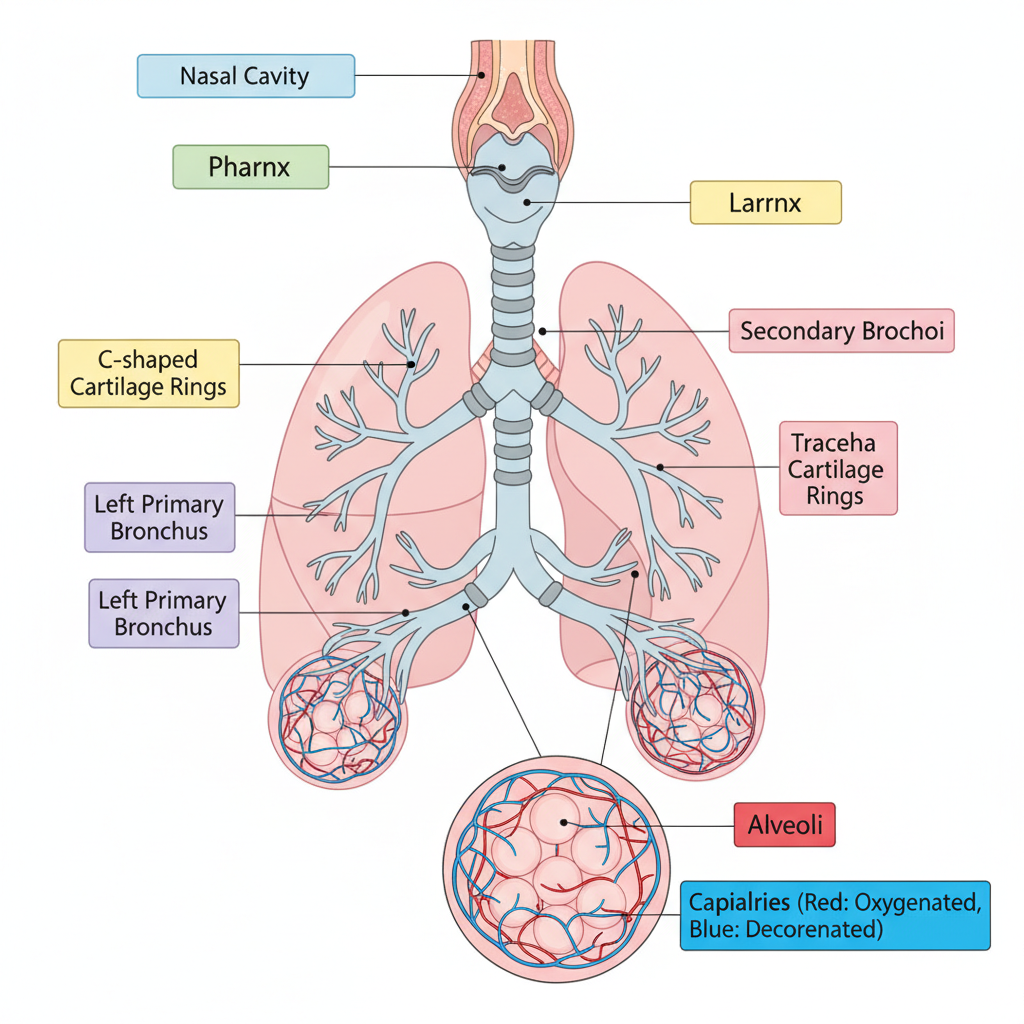
Describe the mechanisms by which chronic smoking damages the trachea, bronchi, and alveoli. [2]
b
Explain how the structural damage caused by emphysema reduces the efficiency of gas exchange in the alveoli, with reference to Fick's law of diffusion. [2]
c
Using the spirometry data above, discuss the limitations of relying solely on to evaluate the full extent of smoking-related respiratory damage. [2]
Solutions
5QuestionMain organsAssessment Practice
6 marks~9 minCriterion D
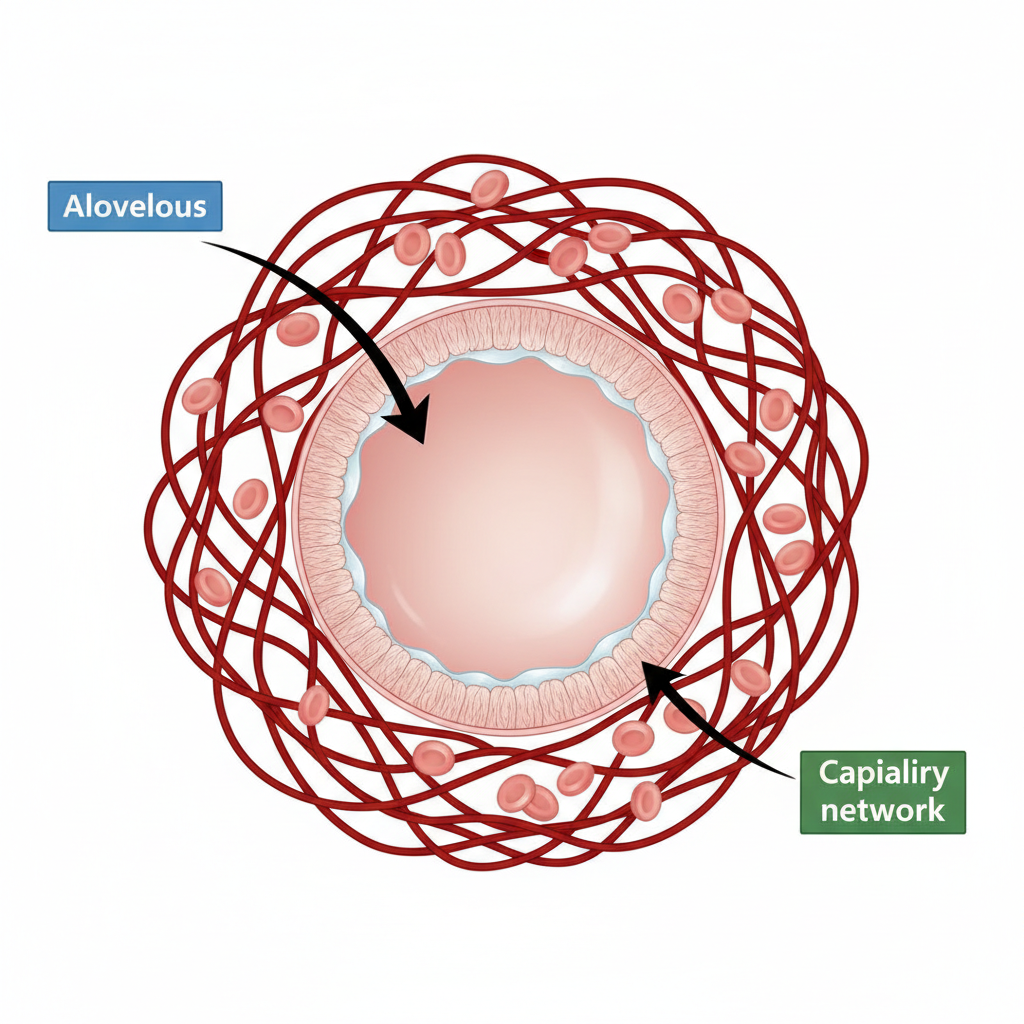
The diagram below shows a single alveolus surrounded by a capillary network. The alveolar wall consists of a single layer of epithelial cells coated with surfactant.
Gas exchange data for healthy and emphysema-affected lungs are summarised below.
Condition: Healthy / Emphysema
Oxygen diffusion rate (mL/min): 250 / 90
Alveolar surface area (m²): 80 / 50
Alveolar wall thickness (μm): 0.5 / 2.0
Gas exchange data for healthy and emphysema-affected lungs are summarised below.
Condition: Healthy / Emphysema
Oxygen diffusion rate (mL/min): 250 / 90
Alveolar surface area (m²): 80 / 50
Alveolar wall thickness (μm): 0.5 / 2.0
a
Explain how two structural features of the alveolus contribute to efficient gas exchange. [2]
b
Analyse the data to explain how the changes in surface area and wall thickness in emphysema account for the observed reduction in oxygen diffusion rate. [2]
c
Evaluate whether the partial pressure gradient alone is sufficient to explain the rate of oxygen diffusion across the alveolar–capillary membrane, referring to both healthy and emphysema conditions. [2]
Solutions
That's every free question here — 5 of 48.
+43 more questions, plus Mock Papers & Worksheets, are waiting in Premium.