You're viewing free preview questions — 6 questions previewing here — subscribe to unlock 72 more, plus the Full Question Bank, Mock Papers & Worksheets.Upgrade
Back

Respiratory System and Gas Exchange — Free MYP4 Biology Practice Questions

Free questions

Open in full, with answers, mark scheme and examiner insights.

Question 1Criterion A · Band 1-4 · Easy · 5 marksrevisionprep.com

Ventilation: the mechanism of breathing

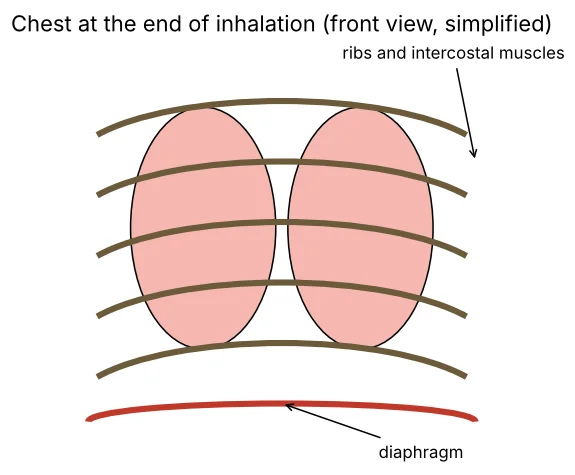
At rest, breathing out is mostly passive.

The diagram shows the chest at the end of inhalation.
Question diagram
(a)
Describe what happens to the diaphragm and to the external intercostal muscles during exhalation at rest. [2]Criterion A (i) · Level 1-2
(b)
Explain how these changes cause air to leave the lungs. [2]Criterion A (i) · Level 3-4
(c)
Suggest why breathing out at rest needs very little energy from muscle contraction. [1]Criterion A (ii) · Level 3-4

revisionprep.com

Summary Answer

Not available for this question.

Model Answer

Not available for this question.

Marking Scheme

Not available for this question.

Examiner Insights

Not available for this question.

Question 2Criterion A · Band 1-2 · Easy · 2 marksrevisionprep.com

Structure and Function of the Lungs

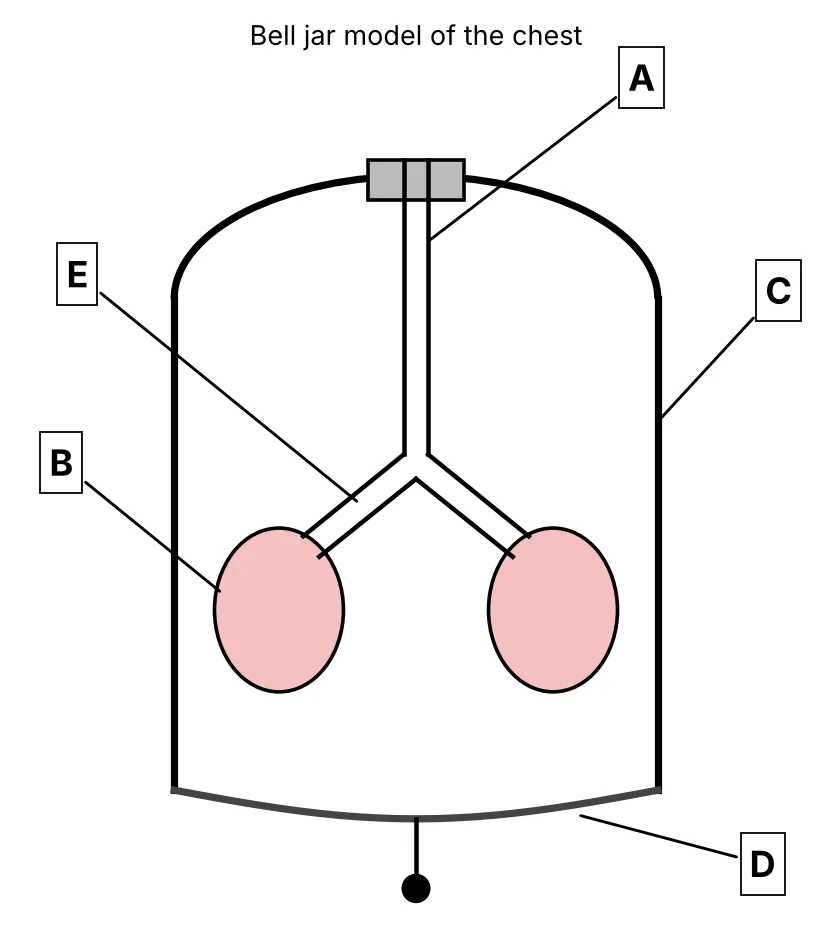
The diagram shows a bell jar model of the human chest. Part D is a rubber sheet that can be pulled down using the handle.

(a) Identify the parts of the human body represented by B and D. [2]
Question diagram

revisionprep.com

Summary Answer

Not available for this question.

Model Answer

Not available for this question.

Marking Scheme

Not available for this question.

Examiner Insights

Not available for this question.

Question 3Criterion A + C · Band 1-6 · Medium · 7 marksrevisionprep.com

Ventilation: the mechanism of breathing
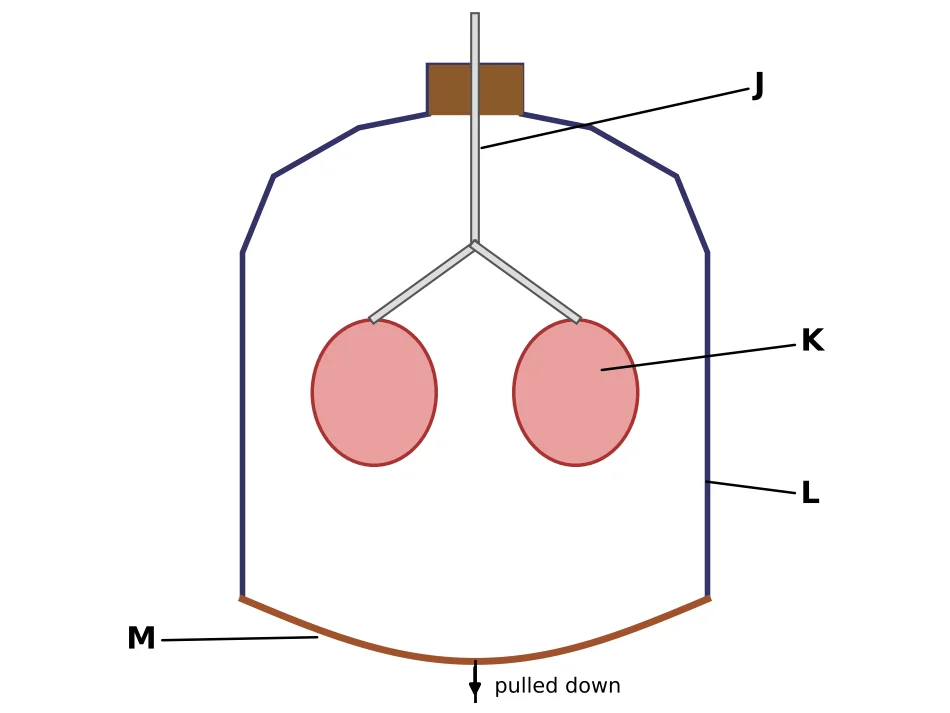
The diagram shows a bell-jar model used to show how we breathe. The rubber sheet at the bottom is being pulled down.
Question diagram
(a)
State the part of the body represented by J, K, L and M. [2]Criterion A (i) · Level 1-2
(b)
Explain why the balloons inflate when the rubber sheet is pulled down. [2]Criterion A (ii) · Level 3-4
(c)
Evaluate the bell-jar model as a way of representing breathing in humans. Give one strength and two limitations. [3]Criterion C (iv) · Level 5-6

revisionprep.com

Summary Answer

Not available for this question.

Model Answer

Not available for this question.

Marking Scheme

Not available for this question.

Examiner Insights

Not available for this question.

Question 4Criterion C + A · Band 1-6 · Medium · 7 marksrevisionprep.com

Respiratory diseases and the effects of smoking

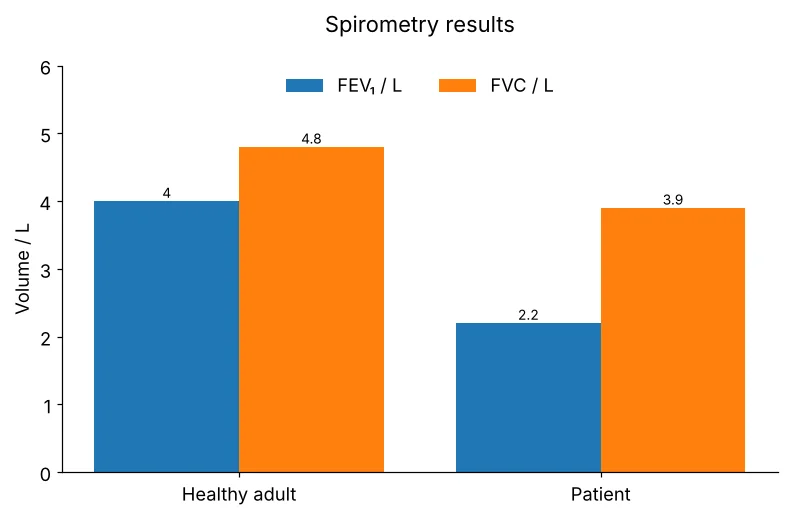
A spirometry test was carried out on a healthy adult and on a patient with chronic bronchitis. FEV₁ is the volume of air forced out in the first second of a breath out; FVC is the total volume that can be forced out.

Healthy adult: FEV₁ 4.0 L, FVC 4.8 L, FEV₁/FVC 0.83
Patient: FEV₁ 2.2 L, FVC 3.9 L

The graph shows these data.
Question diagram
(a)
Show that the FEV₁/FVC ratio for the patient is 0.56. [1]Criterion C (i) · Level 1-2
(b)
A ratio below 0.70 shows that the airways are narrowed. Describe the differences between the patient and the healthy adult, using the data. [2]Criterion C (ii) · Level 3-4
(c)
Explain how inflammation and extra mucus in chronic bronchitis produce this pattern of results. [2]Criterion A (ii) · Level 5-6
(d)
Evaluate whether this single test is enough to diagnose chronic bronchitis. [2]Criterion C (iii) · Level 5-6

revisionprep.com

Summary Answer

Not available for this question.

Model Answer

Not available for this question.

Marking Scheme

Not available for this question.

Examiner Insights

Not available for this question.

Question 5Criterion D + A · Band 3-8 · Challenge · 8 marksrevisionprep.com

Respiratory diseases and the effects of smoking
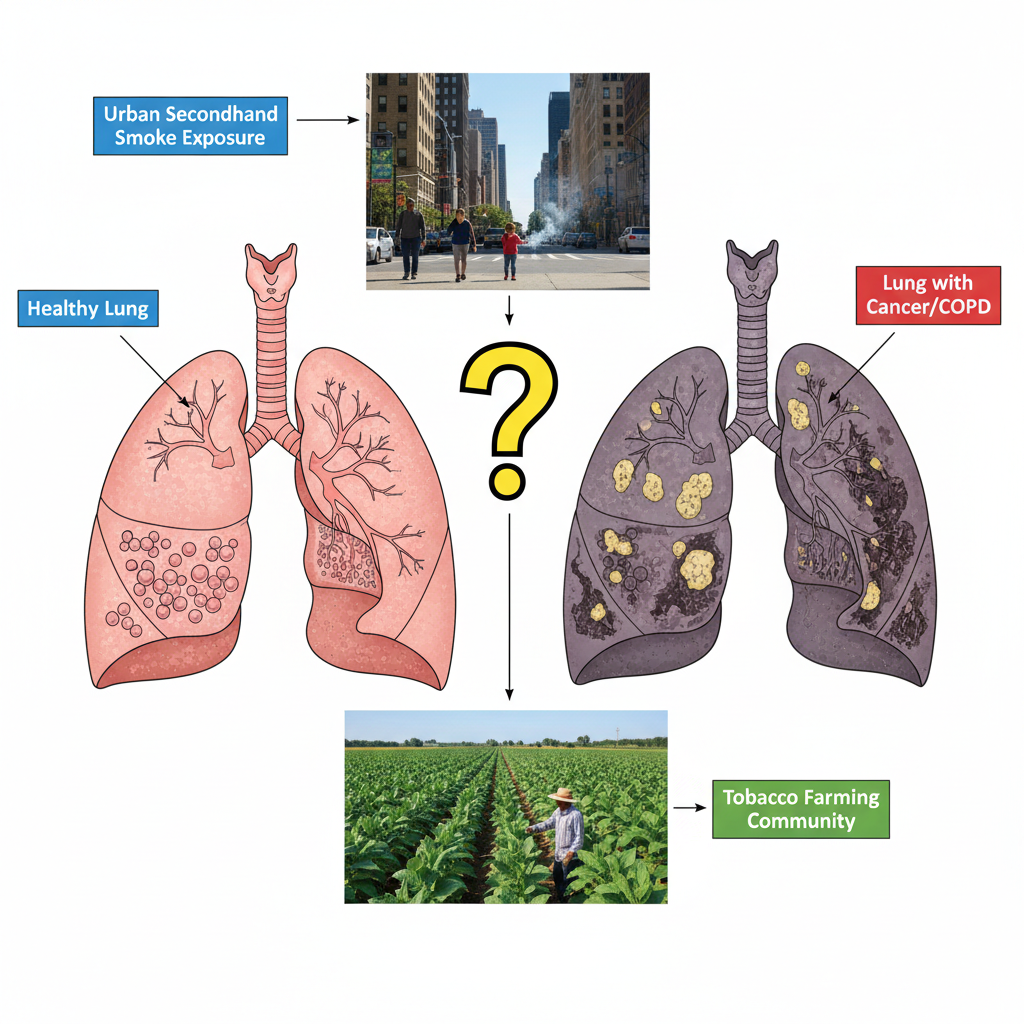
A government is considering a nationwide ban on selling tobacco to reduce respiratory disease. Studies predict that smoking would fall by 40% over 20 years. Tobacco farms currently cover 15% of the country's farmland.
Question diagram
(a)
Describe two ways tobacco smoke damages the respiratory system, naming the disease each causes. [2]Criterion A (i) · Level 3-4
(b)
Explain how the ban could also reduce respiratory disease in people who have never smoked. [2]Criterion D (i) · Level 5-6
(c)
Evaluate the proposed ban. Refer to health, economic and environmental implications. [4]Criterion D (ii) · Level 7-8

revisionprep.com

Summary Answer

Not available for this question.

Model Answer

Not available for this question.

Marking Scheme

Not available for this question.

Examiner Insights

Not available for this question.

Question 6Criterion B · Band 1-8 · Challenge · 10 marksrevisionprep.com

Gas Exchange and Role of Alveoli

Limewater turns cloudy when carbon dioxide bubbles through it. The more carbon dioxide in the air bubbled through, the sooner it turns cloudy. A student wants to investigate how the duration of exercise affects the amount of carbon dioxide in exhaled air, by breathing out through a straw into 10 cm³ of limewater after different periods of skipping.
(a)
State a focused research question for this investigation. [1]Criterion B (i) · Level 1-2
(b)
Formulate a hypothesis and explain it using scientific reasoning. [2]Criterion B (ii) · Level 3-4
(c)
Explain how the student should manipulate the variables and collect sufficient, reliable data. [3]Criterion B (iii) · Level 5-6
(d)
Design a method, including safety precautions. [4]Criterion B (iv) · Level 7-8

revisionprep.com

Summary Answer

Not available for this question.

Model Answer

Not available for this question.

Marking Scheme

Not available for this question.

Examiner Insights

Not available for this question.

That's every free question here — 6 of 78.

+72 more questions, plus Mock Papers & Worksheets, are waiting in Premium.

Upgrade