You're viewing free preview questions — 4 questions previewing here — subscribe to unlock 100 more, plus the Full Question Bank, Mock Papers & Worksheets.Upgrade
Making and Testing Salts — Free MYP4 Chemistry Practice Questions

1QuestionUsing Acid + Base Acid + Metal Acid + Carbonate ReactionsConcept Practice
2 marks~3 minCriterion A
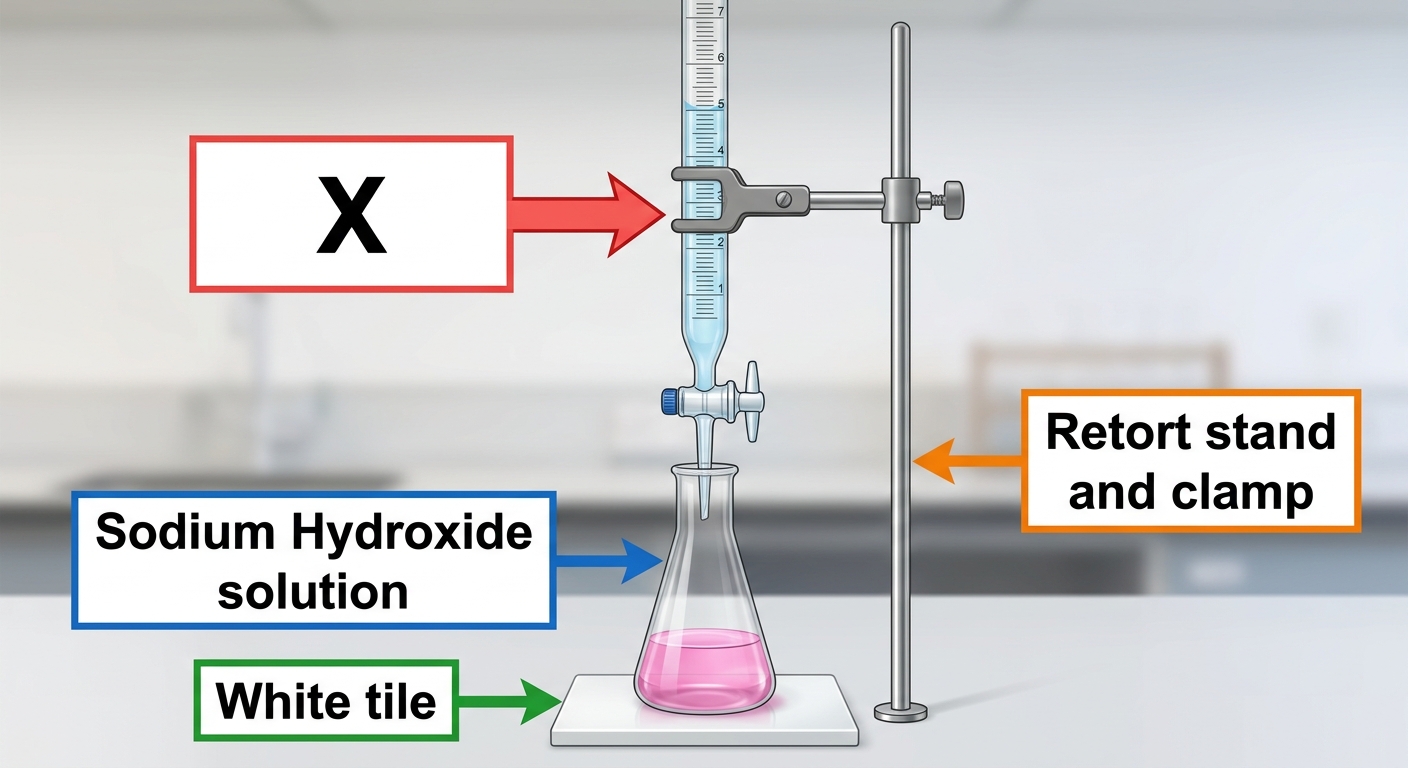
A titration is performed to prepare a pure sample of sodium chloride. A burette filled with hydrochloric acid () is clamped above a conical flask containing sodium hydroxide solution () and a few drops of phenolphthalein indicator. The conical flask rests on a white tile. Equipment label X indicates the burette.
a
Identify the colour change of phenolphthalein that signals the endpoint of this titration. [1]
b
Explain why the white tile is placed beneath the conical flask during the titration. [1]

Solutions
2QuestionFiltering Crystallizing and Drying a SaltAssessment Practice
6 marks~9 minCriterion D
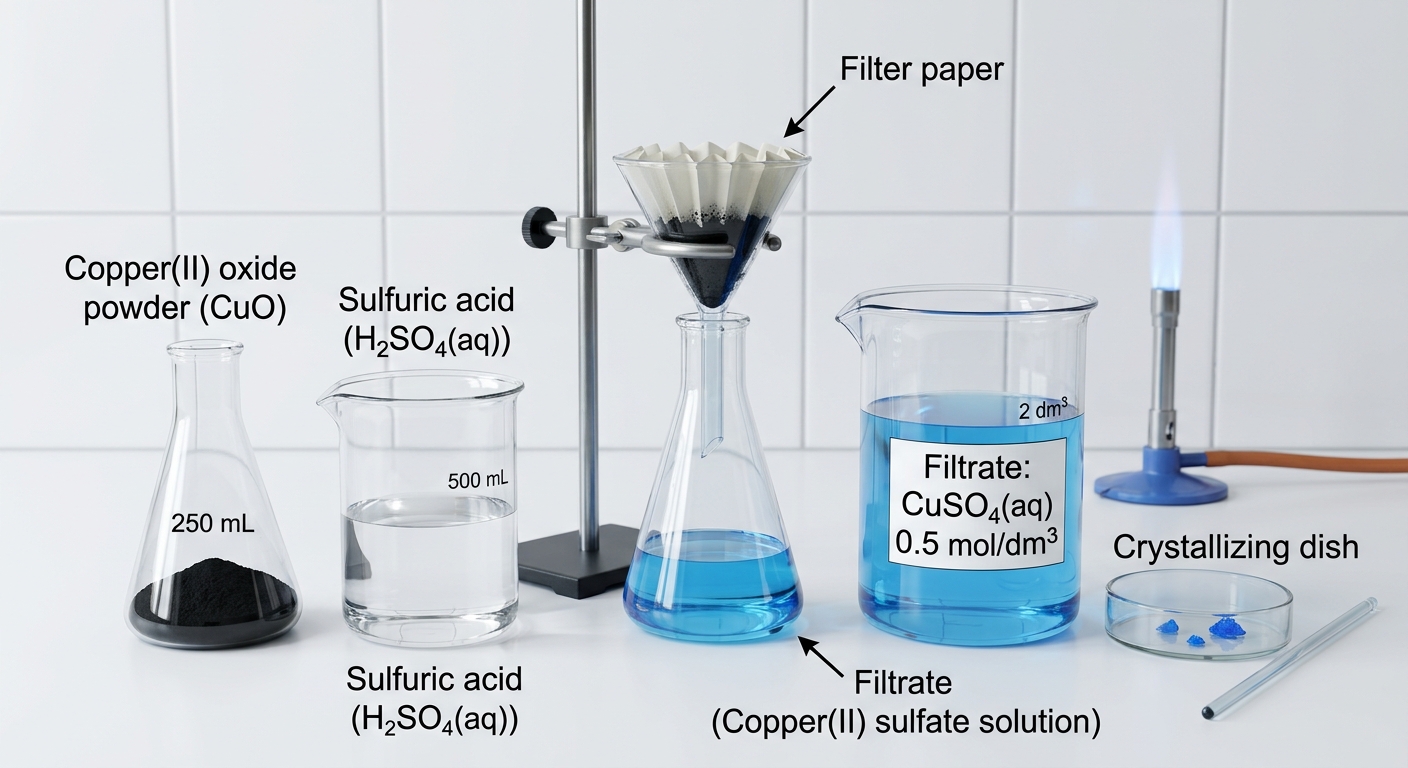
A school chemistry class reacts copper(II) oxide with sulfuric acid to produce copper(II) sulfate crystals. After filtering and crystallising, of filtrate remains, containing dissolved copper(II) sulfate (, ) at .
a
Calculate the mass of present in the filtrate. [2]
b
Explain the environmental risks of pouring this filtrate into a river, referring to the toxicity of copper ions to aquatic organisms and the process of bioaccumulation. [2]
c
Analyse two possible methods for disposing of the filtrate responsibly in a school laboratory, and justify which method is more appropriate. [2]
Solutions
3QuestionPreparing Soluble Salts Using Different MethodsAssessment Practice
6 marks~9 minCriterion C
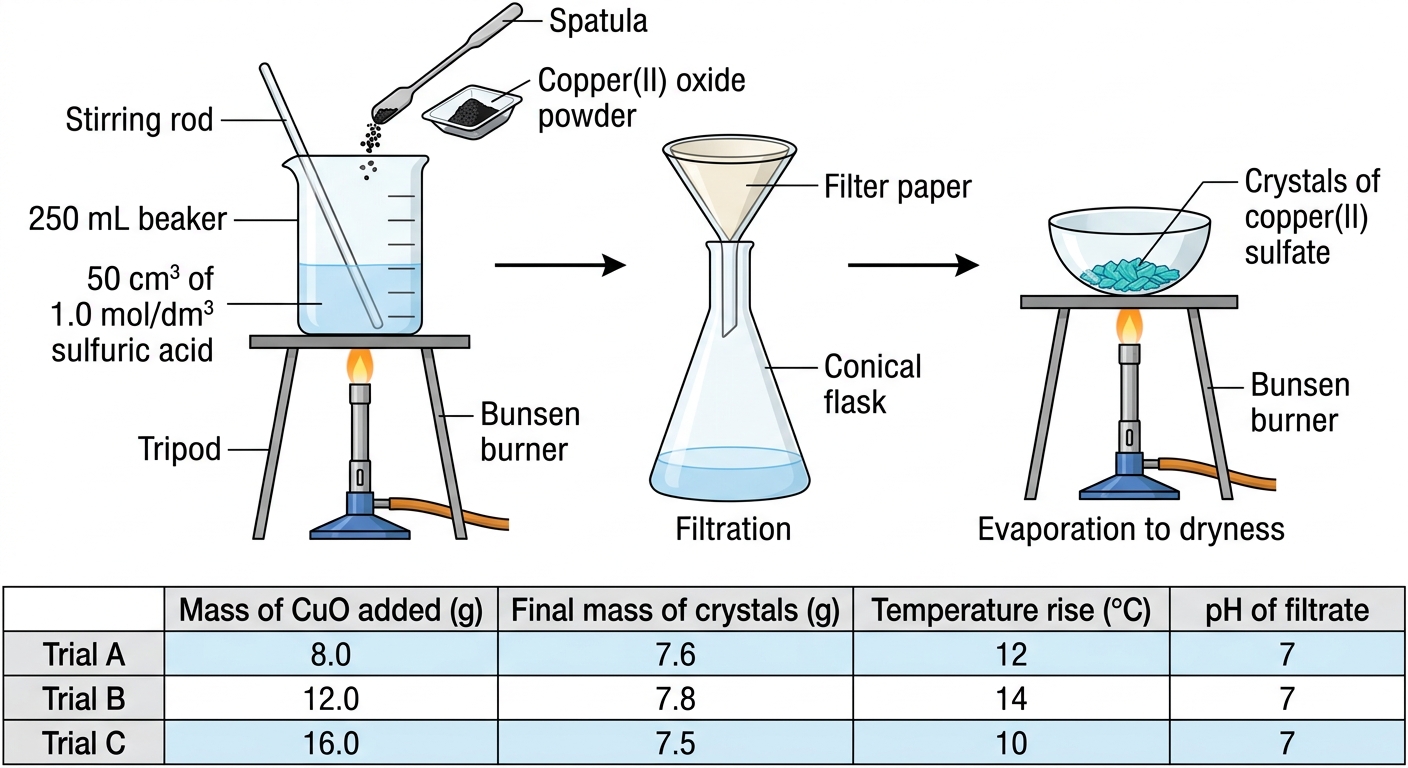
A student hypothesises that using excess insoluble base always produces the highest yield of soluble salt. Three trials prepared copper(II) sulfate crystals by adding copper(II) oxide powder to 50 cm³ of 1.0 mol/dm³ sulfuric acid. The mixture was heated, stirred, filtered, and the filtrate evaporated to obtain crystals.
Trial A: 8.0 g CuO added — crystal mass: 7.6 g, pH of filtrate: 7
Trial B: 12.0 g CuO added — crystal mass: 7.8 g, pH of filtrate: 7
Trial C: 16.0 g CuO added — crystal mass: 7.5 g, pH of filtrate: 7
The theoretical maximum yield of copper(II) sulfate from 50 cm³ of 1.0 mol/dm³ is 7.98 g.
Trial A: 8.0 g CuO added — crystal mass: 7.6 g, pH of filtrate: 7
Trial B: 12.0 g CuO added — crystal mass: 7.8 g, pH of filtrate: 7
Trial C: 16.0 g CuO added — crystal mass: 7.5 g, pH of filtrate: 7
The theoretical maximum yield of copper(II) sulfate from 50 cm³ of 1.0 mol/dm³ is 7.98 g.
a
Calculate the percentage yield for Trial B using:
[2]
[2]
b
Using all three trials, evaluate the student's hypothesis. In your answer, identify which trial(s) support and which refute the hypothesis, and explain the role of excess base in determining the final crystal yield. [4]
Solutions
4QuestionUsing Acid + Base Acid + Metal Acid + Carbonate ReactionsAssessment Practice
3 marks~5 minCriterion B
When metal carbonates react with dilute hydrochloric acid, carbon dioxide gas is produced, observed as effervescence. The results for four carbonates are summarised below.
| Carbonate | ||||
|---|---|---|---|---|
| Reactivity of metal | Very high | High | Low | High |
| Effervescence rate | Very fast | Fast | Slow | Fast |
a
State the general relationship between the reactivity of the metal in the carbonate and the observed rate of effervescence. [1]
b
Deduce which two carbonates in the table would produce the most similar rate of effervescence, and justify your answer using the data provided. [1]
c
Explain, in terms of carbon dioxide production, why the reactivity of the metal in the carbonate affects the rate of effervescence observed. [1]
Solutions
That's every free question here — 4 of 104.
+100 more questions, plus Mock Papers & Worksheets, are waiting in Premium.