You're viewing free preview questions — 4 questions previewing here — subscribe to unlock 76 more, plus the Full Question Bank, Mock Papers & Worksheets.Upgrade
Sustainability and recyling of materials — Free MYP4 Chemistry Practice Questions

1QuestionLife cycle of materials (production → use → disposal)Concept Practice
2 marks~3 minCriterion A
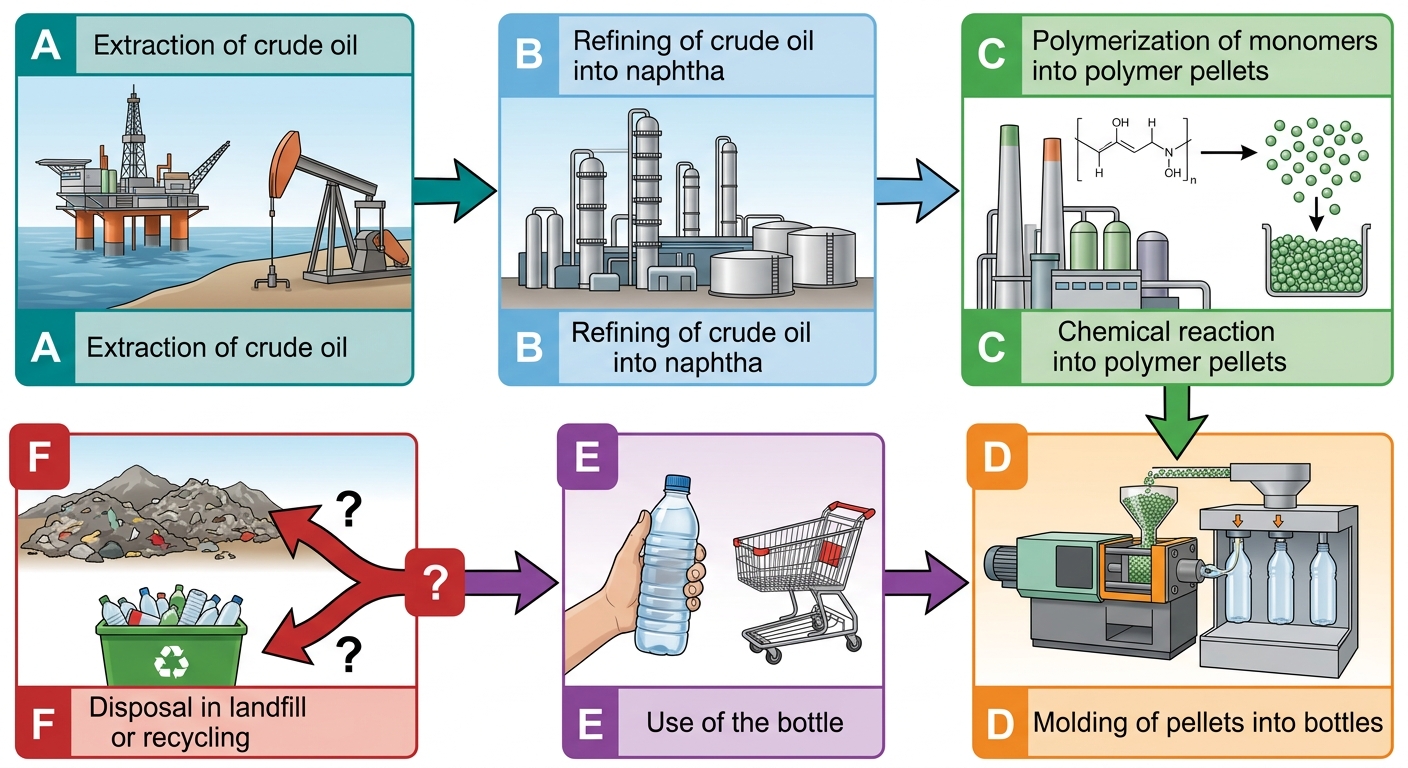
The diagram below shows the life cycle of a plastic bottle, with stages labelled A to F.
Stage A: Extraction of crude oil
Stage B: Refining of crude oil into naphtha
Stage C: Polymerisation of monomers into polymer pellets
Stage D: Moulding of pellets into bottles
Stage E: Use of the bottle
Stage F: Disposal in landfill or recycling
Stage A: Extraction of crude oil
Stage B: Refining of crude oil into naphtha
Stage C: Polymerisation of monomers into polymer pellets
Stage D: Moulding of pellets into bottles
Stage E: Use of the bottle
Stage F: Disposal in landfill or recycling
a
Identify the stage at which the material is first produced as a polymer. [1]
b
Explain why the material at Stage B cannot be classified as a polymer. [1]

Solutions
2QuestionLife cycle of materials (production → use → disposal)Assessment Practice
3 marks~5 minCriterion D
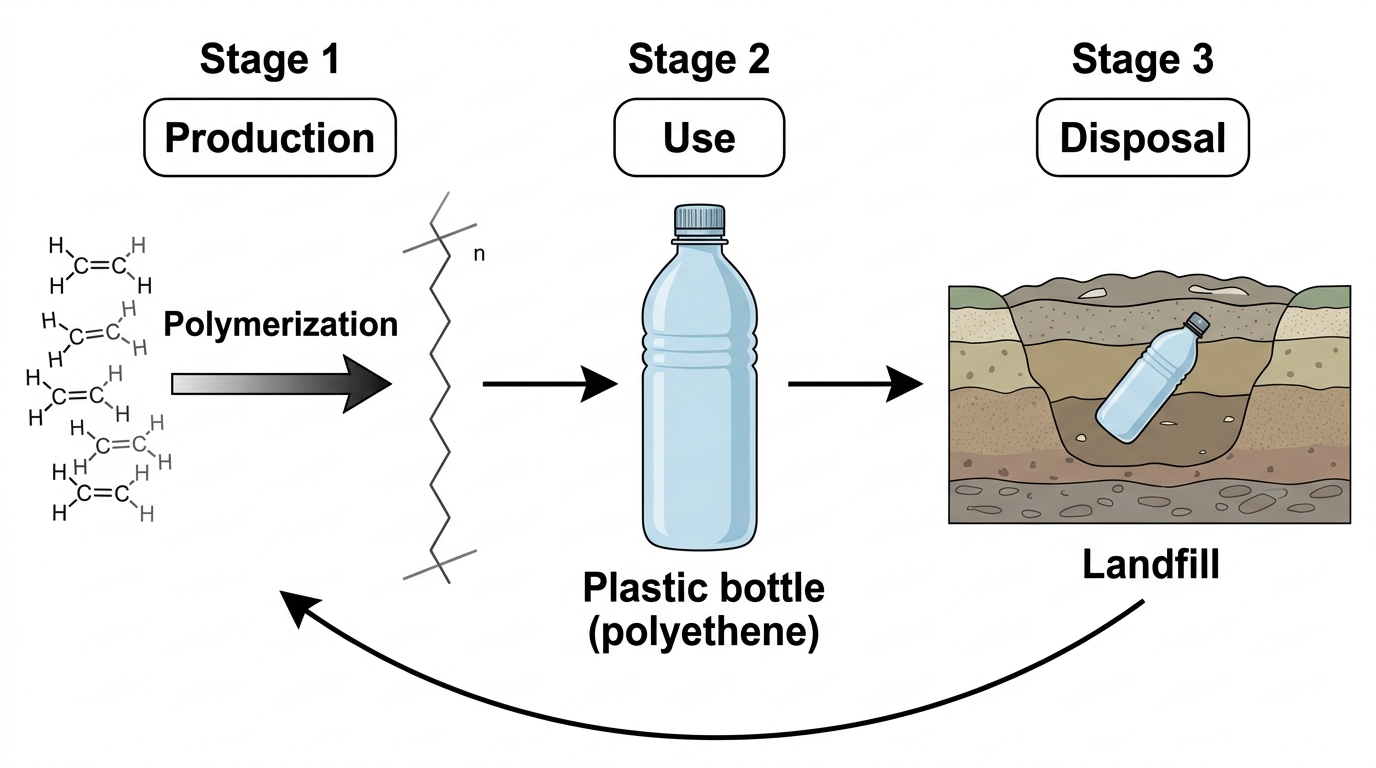
The diagram below shows the life cycle of a polyethene bottle: ethene monomers are polymerised, the bottle is used for packaging, and then disposed of in a landfill site.
a
Identify the type of bonding present in polyethene. [1]
b
Apply your knowledge of bonding to explain why polyethene is resistant to decomposition in the landfill. Refer to the bonds present in the polymer chain. [1]
c
Evaluate whether disposing of polyethene in a landfill is a sustainable end-of-life option. Use evidence from the life cycle shown in the diagram. [1]
Solutions
3QuestionTypes of recyclable materials (plastics, metals, glass)Assessment Practice
6 marks~9 minCriterion A
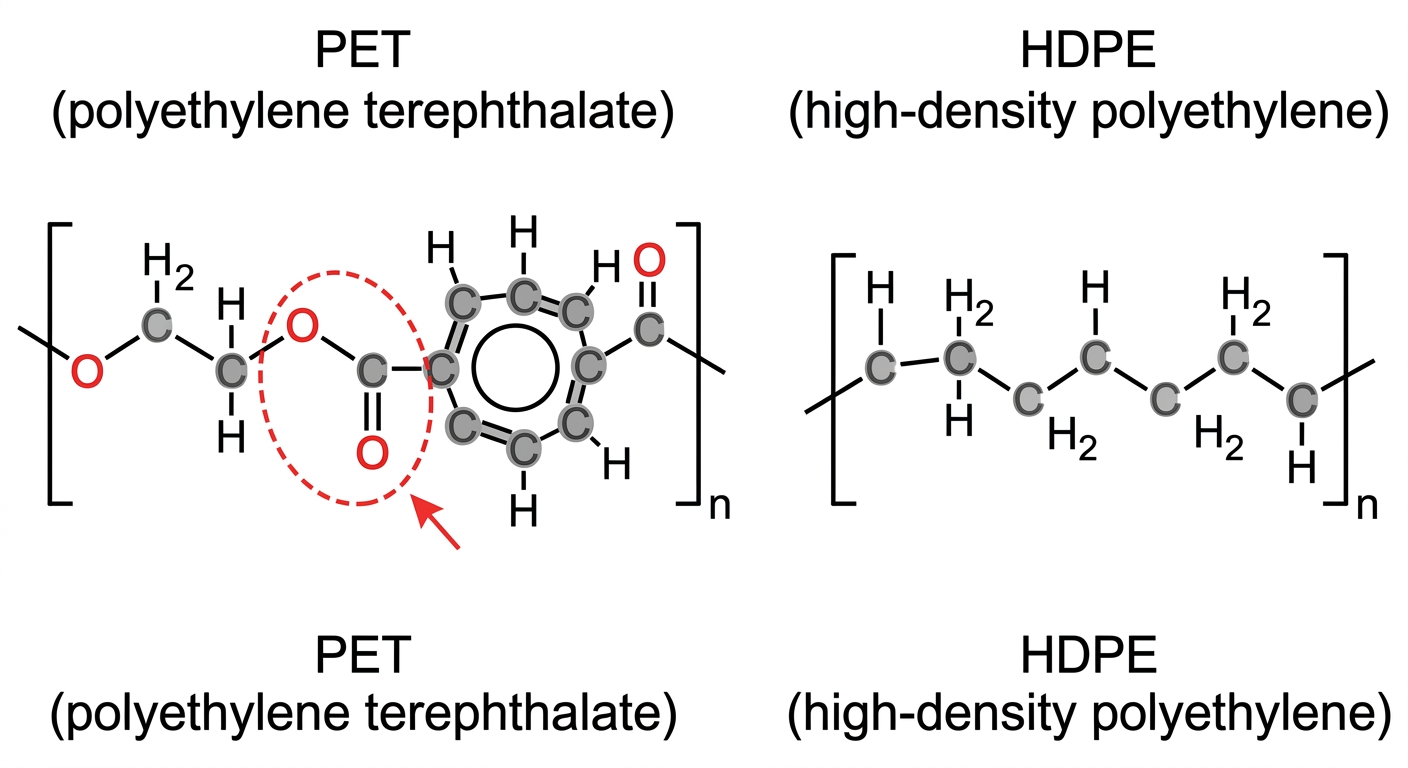
The diagram below shows the repeating units of two polymers used in plastic bottles.
PET (polyethylene terephthalate): linked by ester bonds .
HDPE (high-density polyethylene): linked by carbon–carbon single bonds.
PET (polyethylene terephthalate): linked by ester bonds .
HDPE (high-density polyethylene): linked by carbon–carbon single bonds.
a
Identify the type of bond that links monomers in each polymer. [2]
b
Explain why PET, but not HDPE, can be depolymerized by hydrolysis to recover its original monomers. [2]
c
Evaluate which polymer is more suitable for chemical recycling, referring to the products obtained and the conditions required for each breakdown process. [2]
Solutions
4QuestionLife cycle of materials (production → use → disposal)Assessment Practice
6 marks~9 minCriterion C
A hypothesis states: 'All bioplastics fully decompose within 90 days under industrial composting conditions.'
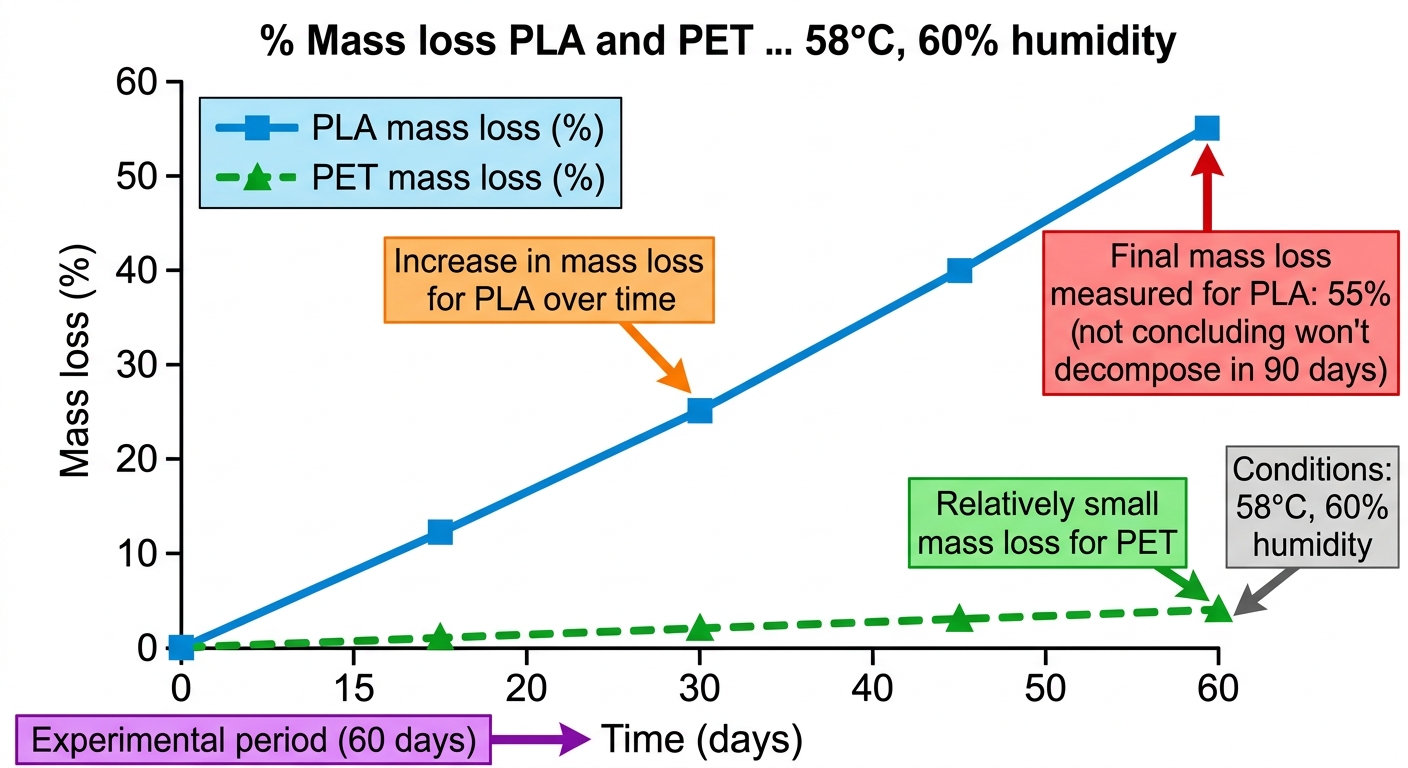
To test this, the mass loss of polylactic acid (PLA) and polyethylene terephthalate (PET) was measured over 60 days at 58 °C and 60% humidity.
To test this, the mass loss of polylactic acid (PLA) and polyethylene terephthalate (PET) was measured over 60 days at 58 °C and 60% humidity.
| Day | 0 | 15 | 30 | 45 | 60 |
|---|---|---|---|---|---|
| PLA mass loss (%) | 0 | 12 | 25 | 40 | 55 |
| PET mass loss (%) | 0 | 1 | 2 | 3 | 4 |
a
Calculate the average rate of mass loss for PLA over the 60-day period. Give your answer in % per day. [2]
b
Using your answer to (a) and specific data from the table, explain why the data does not fully support the hypothesis. [2]
c
Evaluate whether this experiment is sufficient to conclude that the hypothesis is false for all bioplastics. Justify your answer using evidence from the data and the experimental design. [2]
Solutions
That's every free question here — 4 of 80.
+76 more questions, plus Mock Papers & Worksheets, are waiting in Premium.