You're viewing free preview questions — 4 questions previewing here — subscribe to unlock 81 more, plus the Full Question Bank, Mock Papers & Worksheets.Upgrade
Water Purification and Treatment — Free MYP4 Chemistry Practice Questions

1QuestionStages of water treatment (filtration, sedimentation, chlorination)Concept Practice
2 marks~3 minCriterion A
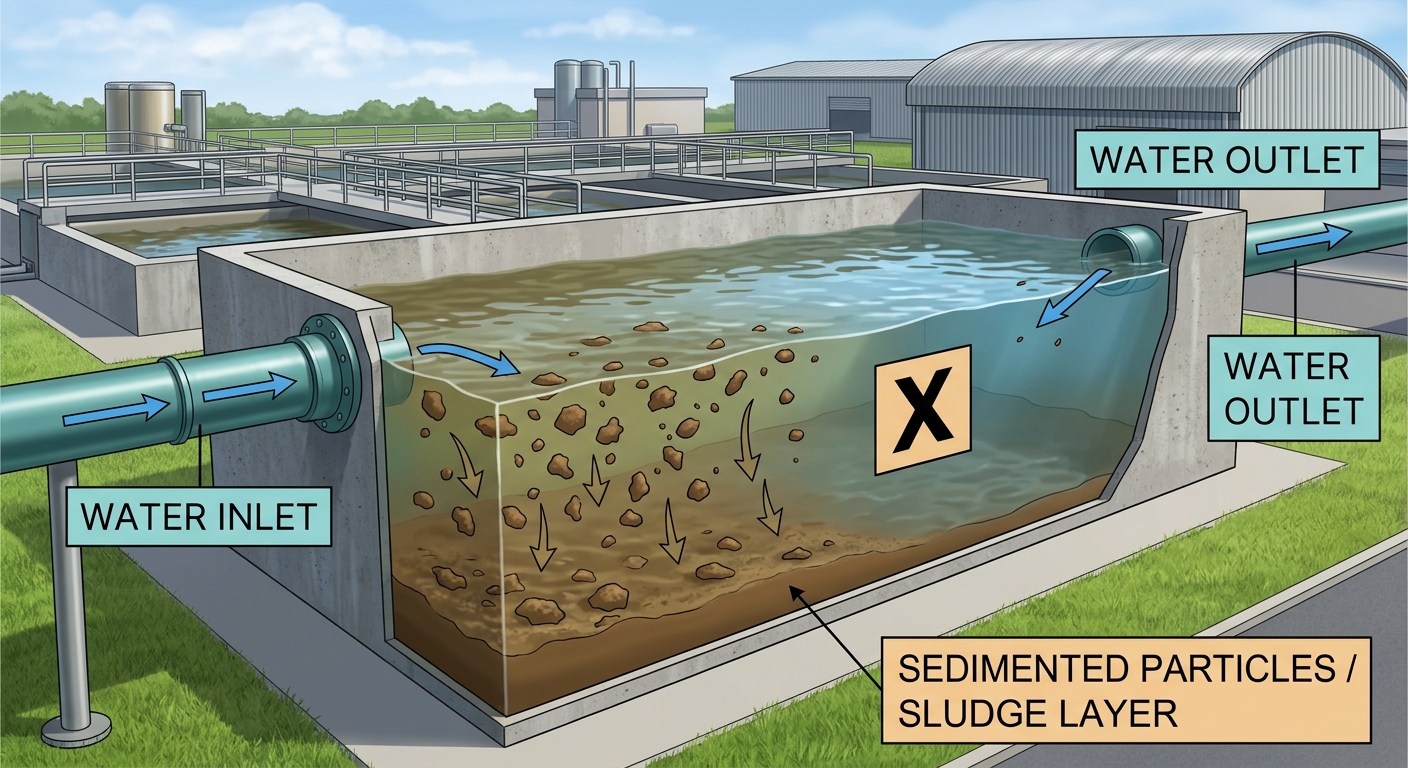
A water treatment plant receives river water containing suspended soil particles, algae, and fine sediment. The water first enters a large open tank, labelled X, where it is left undisturbed for several hours. Heavier particles gradually collect at the bottom, and clearer water is drawn off near the surface.
a
Identify tank X. [1]
b
Explain why leaving water undisturbed in tank X is more effective at removing particles when the particles are larger and denser. [1]

Solutions
2QuestionRole of chlorine and disinfection methodsAssessment Practice
5 marks~8 minCriterion C
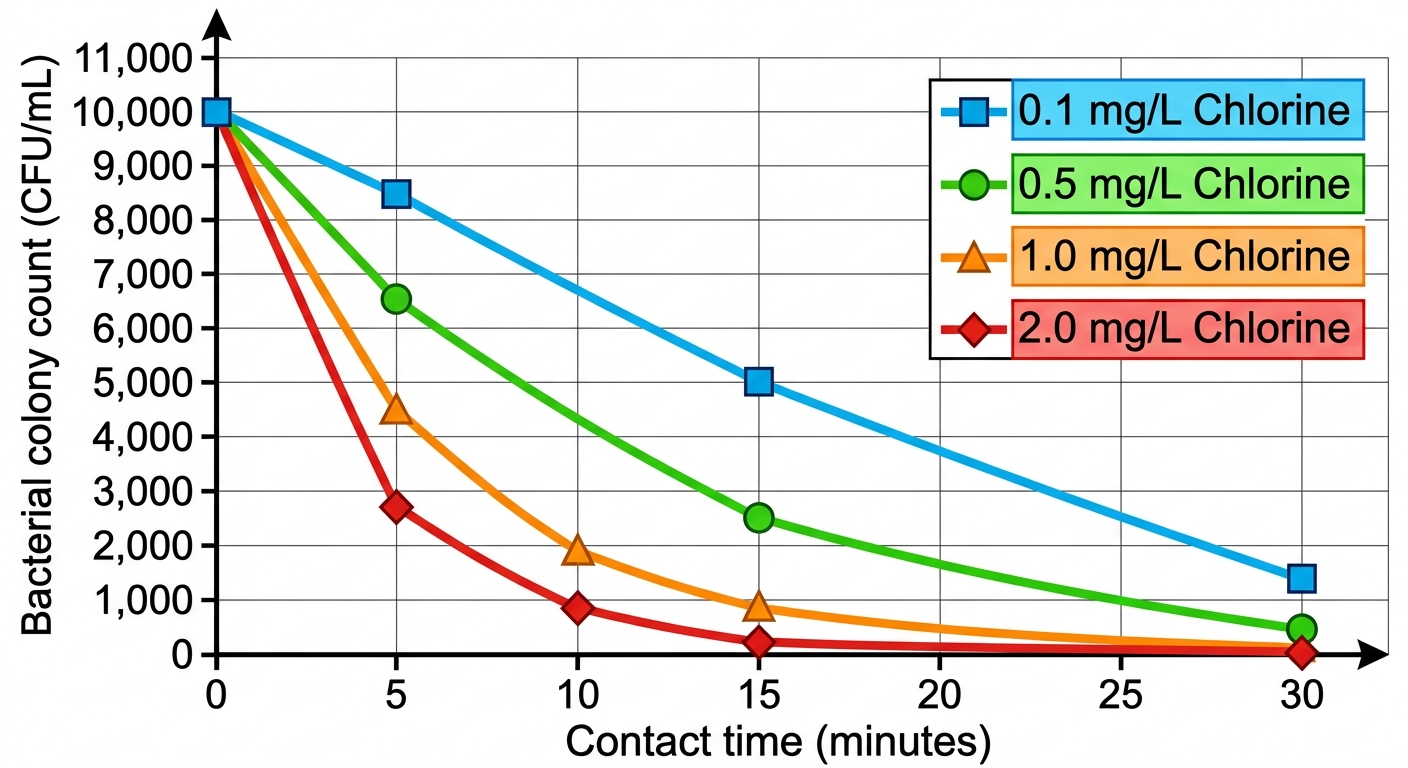
Students investigated chlorine disinfection by treating water samples contaminated with Escherichia coli at 10,000 CFU/mL. Each sample received one of four chlorine concentrations (0.1, 0.5, 1.0, or 2.0 mg/L), and bacterial counts were recorded after 5, 15, and 30 minutes. The graph below shows the results.
The hypothesis states: "Chlorine kills bacteria by disrupting cell membranes through oxidation."
The hypothesis states: "Chlorine kills bacteria by disrupting cell membranes through oxidation."
a
State two trends shown in the graph relating chlorine concentration or contact time to bacterial survival. [1]
b
Explain how chlorine forms an active disinfectant species in water and why this species is effective at damaging bacterial cells. [2]
c
Evaluate whether the experimental evidence supports the hypothesis. In your answer, refer to what the data can and cannot confirm about the proposed mechanism. [2]
Solutions
3QuestionRemoval of suspended vs dissolved impuritiesAssessment Practice
7 marks~11 minCriterion D
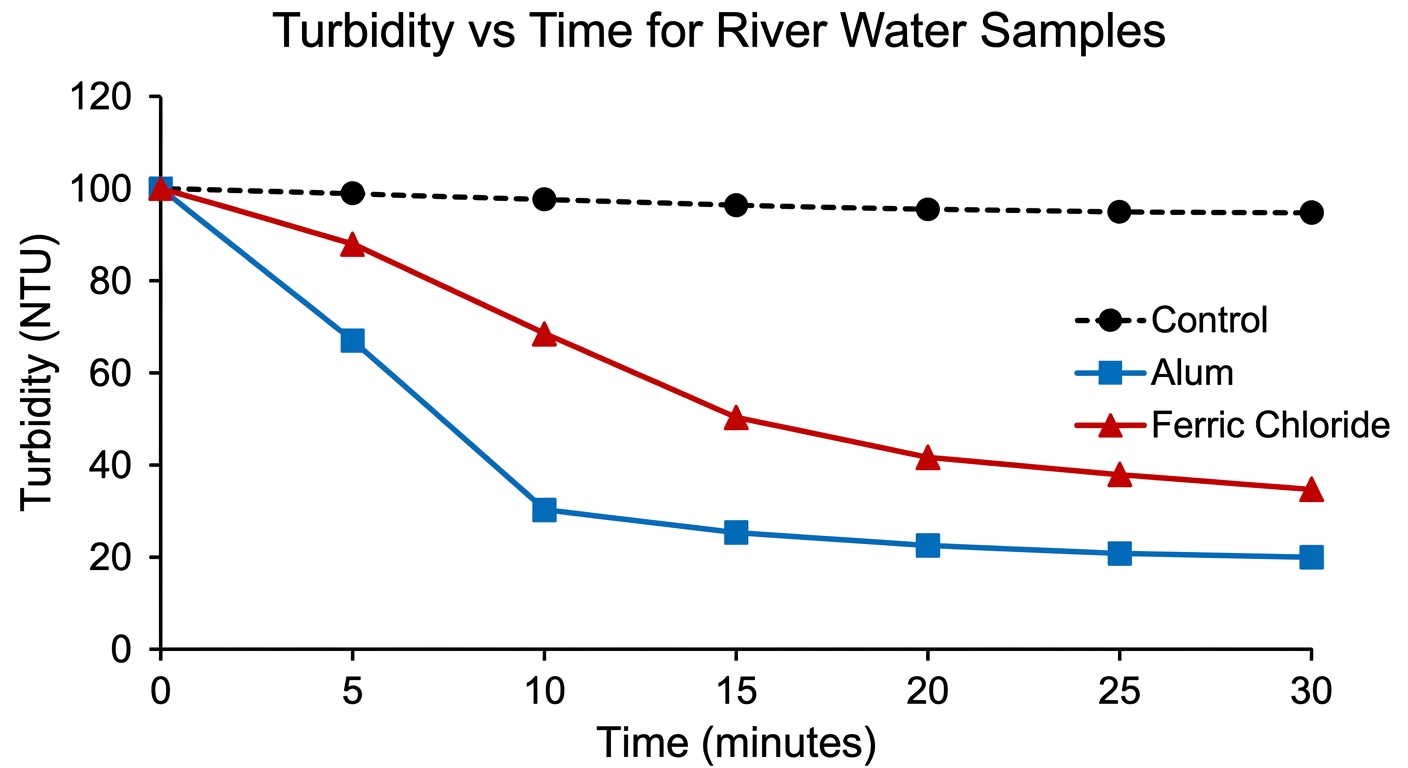
A student hypothesises that aluminium sulfate (alum) is more effective than ferric chloride at removing suspended clay particles from river water. Three 300 mL portions of river water (initial turbidity 100 NTU each) are treated: 0.5 g alum, 0.5 g ferric chloride, and no coagulant (control). Each portion is stirred for 2 minutes, then turbidity is recorded every 5 minutes for 30 minutes.
Turbidity readings (NTU):
Turbidity readings (NTU):
| Time (min) | 0 | 5 | 10 | 15 | 20 | 25 | 30 |
|---|---|---|---|---|---|---|---|
| Control | 100 | 95 | 95 | 95 | 95 | 95 | 95 |
| Alum | 100 | 30 | 20 | 20 | 20 | 20 | 20 |
| Ferric chloride | 100 | 50 | 35 | 35 | 35 | 35 | 35 |
a
Calculate the percentage reduction in turbidity for alum and for ferric chloride after 30 minutes. [2]
b
Analyse the rate of turbidity reduction for each coagulant between 0 and 10 minutes, using data from the table. [2]
c
Evaluate whether the experimental evidence supports the hypothesis. In your answer, identify one limitation of the experimental design and explain how it affects the validity of the conclusion. [3]
Solutions
4QuestionRole of chlorine and disinfection methodsAssessment Practice
2 marks~3 minCriterion B
A water treatment plant disinfects drinking water by adding chlorine to eliminate E. coli. The data below show the contact time required to kill 99.9% of E. coli at 20°C.
| Chlorine dose (mg/L) | 0.5 | 1.0 | 1.5 | 2.0 |
|---|---|---|---|---|
| Contact time (min) | 12 | 6 | 4 | 3 |
a
Deduce the mathematical relationship between chlorine dose and contact time, showing clearly how the data support your answer. [1]
b
A treatment plant operates at a chlorine dose of 2.5 mg/L but must achieve 99.9% kill of E. coli within 2 minutes. Evaluate whether this dose is sufficient, using your relationship from (a). [1]
Solutions
That's every free question here — 4 of 85.
+81 more questions, plus Mock Papers & Worksheets, are waiting in Premium.