You're viewing free preview questions — 4 questions previewing here — subscribe to unlock 107 more, plus the Full Question Bank, Mock Papers & Worksheets.Upgrade
Carboxylic Acids — Free MYP4 Chemistry Practice Questions

1QuestionPhysical properties:High boiling point and SolubilityConcept Practice
2 marks~3 minCriterion A
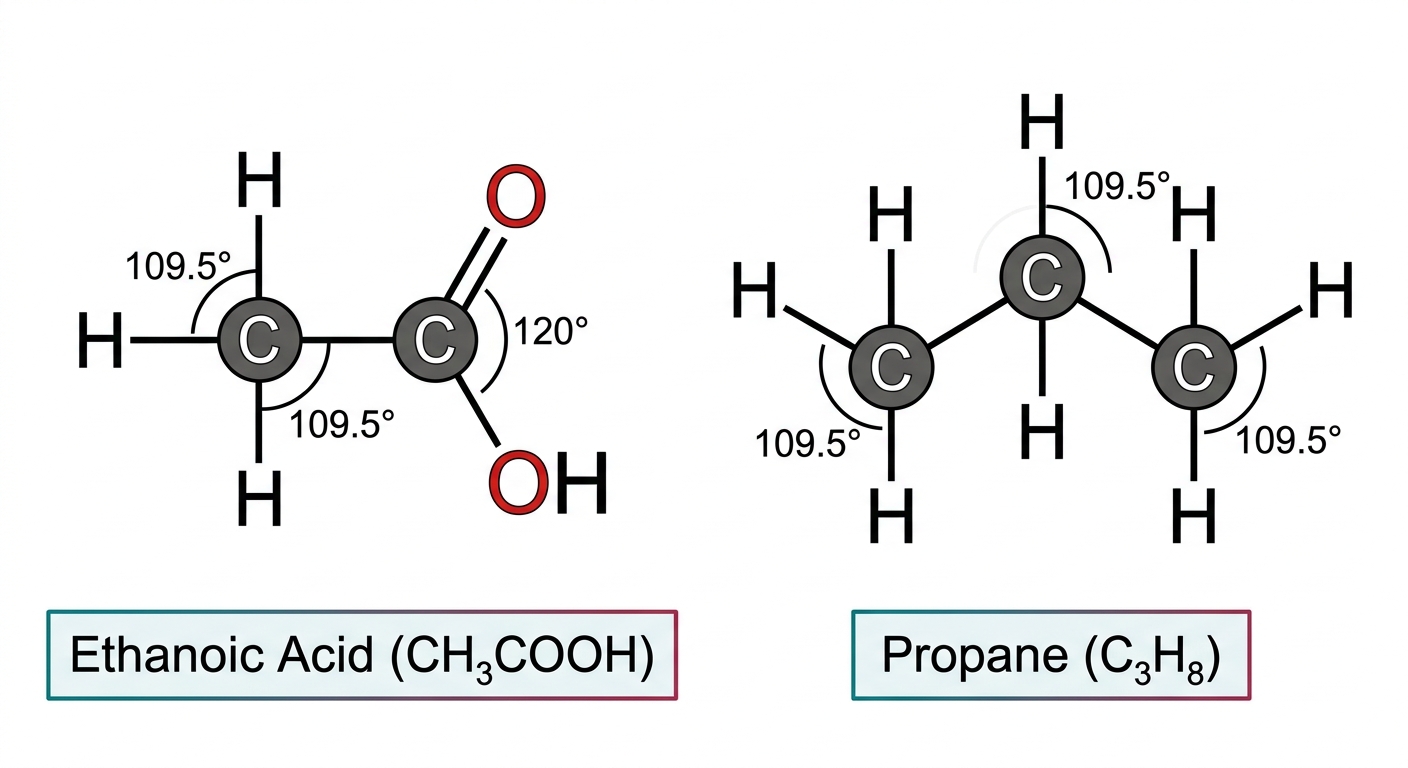
The table below shows data for two substances.
| Substance: ethanoic acid () | Boiling point: 118 °C | Functional group: carboxyl (–COOH) |
|---|---|---|
| Substance: propane () | Boiling point: –42 °C | Functional group: none |
a
State which substance has the higher boiling point. [1]
b
Explain why these two substances have significantly different boiling points, with reference to the intermolecular forces present in each. [1]

Solutions
2QuestionReactions:With metals and With bases (neutralization) and With carbonates (CO₂ production)Assessment Practice
5 marks~8 minCriterion C
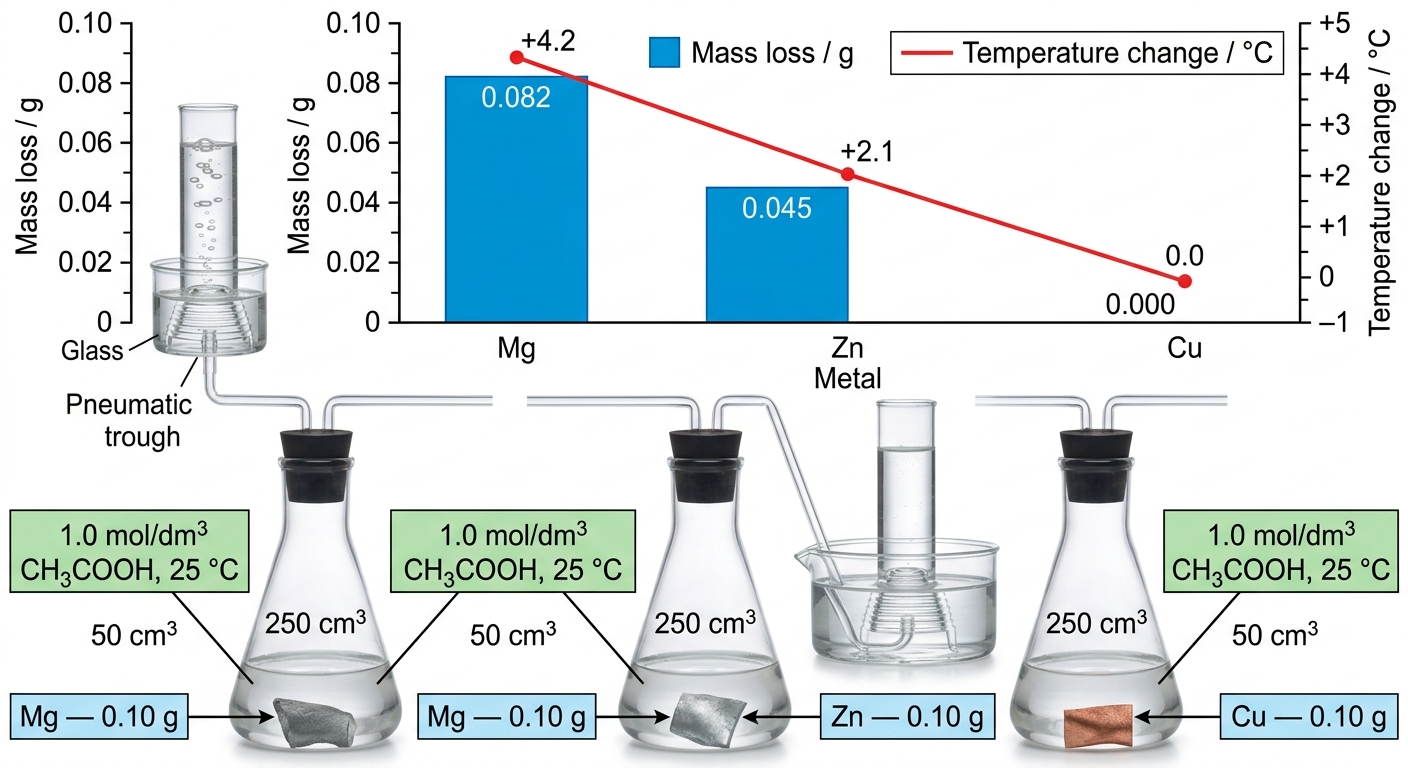
A student investigates the reaction of ethanoic acid () with magnesium (), zinc (), and copper (). Each metal (0.10 g) is placed in 50 cm³ of 1.0 mol dm ethanoic acid at 25 °C. Mass loss (due to gas escape) and temperature change are recorded after 5 minutes.
The student hypothesises: "All metals react with carboxylic acids to produce hydrogen gas."
| Metal | Mass loss (g) | Temperature change (°C) |
|---|---|---|
| Magnesium | 0.082 | +4.2 |
| Zinc | 0.045 | +2.1 |
| Copper | 0.000 | 0.0 |
The student hypothesises: "All metals react with carboxylic acids to produce hydrogen gas."
a
State the gas produced when magnesium reacts with ethanoic acid and write a balanced chemical equation for this reaction. [1]
b
Interpret the data for magnesium and zinc to compare the relative reactivity of these two metals with ethanoic acid. [2]
c
Evaluate whether the experimental evidence supports or refutes the hypothesis. In your answer, explain the copper result using the reactivity series. [2]
Solutions
3QuestionReactions:With metals and With bases (neutralization) and With carbonates (CO₂ production)Assessment Practice
6 marks~9 minCriterion D
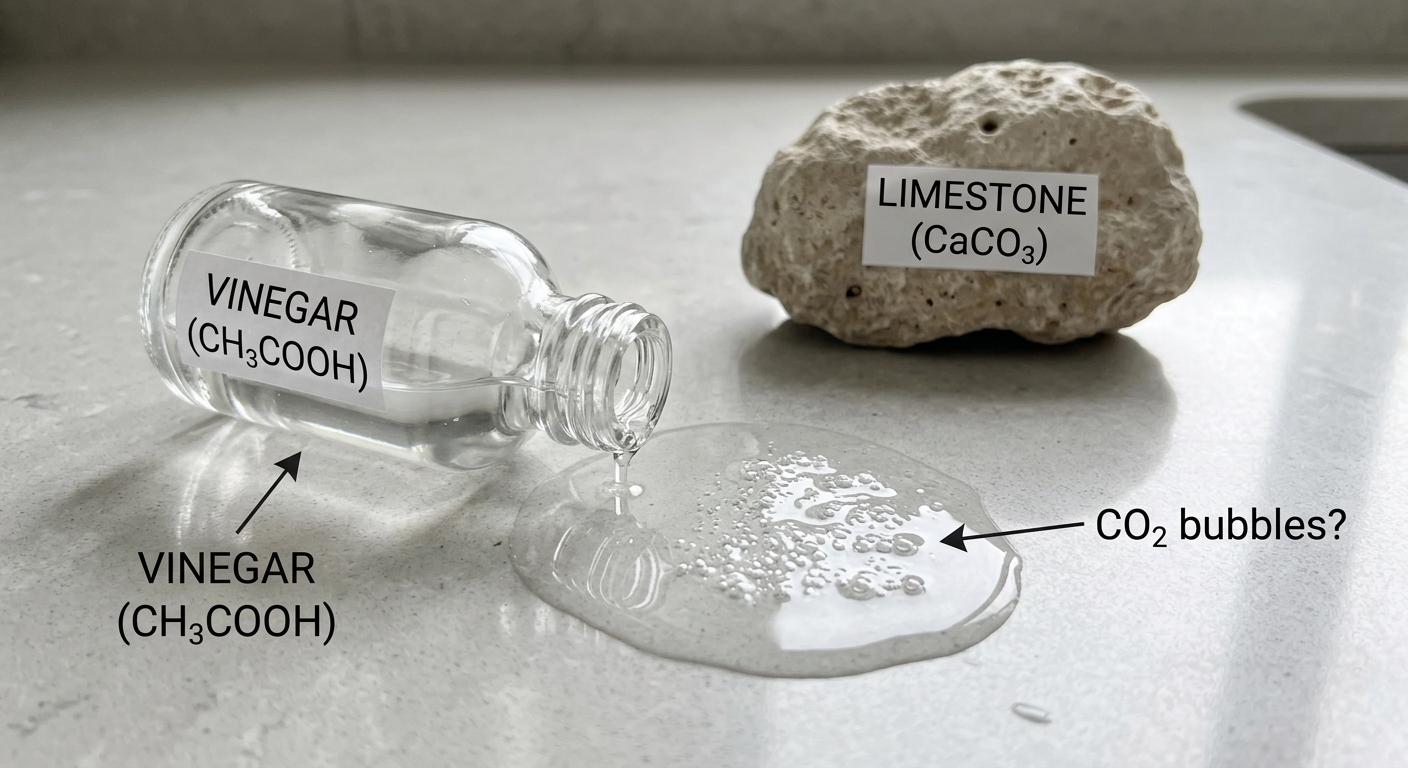
A student spills vinegar (a dilute solution of ethanoic acid, ) on a limestone () kitchen counter. Bubbles of form immediately.
a
Construct a balanced chemical equation, including state symbols, for the reaction between ethanoic acid and calcium carbonate. [2]
b
The student considers two clean-up options:
- Option 1: baking soda ()
- Option 2: sodium hydroxide ()
Construct a balanced equation, including state symbols, for the reaction of excess ethanoic acid with each option. [2]
- Option 1: baking soda ()
- Option 2: sodium hydroxide ()
Construct a balanced equation, including state symbols, for the reaction of excess ethanoic acid with each option. [2]
c
Evaluate which clean-up option poses a lower risk to aquatic life if the solution is washed down the drain. Refer to the products formed in each reaction. [2]
Solutions
4QuestionPhysical properties:High boiling point and SolubilityAssessment Practice
3 marks~5 minCriterion B
The table below shows the boiling points of four organic compounds.
| Compound | Boiling point (°C) |
|---|---|
| Methanoic acid | 101 |
| Ethanol | 78 |
| Propanoic acid | 141 |
| Propan-1-ol | 97 |
a
Identify the pattern in boiling points between the carboxylic acids and the alcohols shown in the table. [1]
b
Deduce the boiling point of butanoic acid, using the data in the table to support your reasoning. [1]
c
Analyse why carboxylic acids have higher boiling points than alcohols of comparable molar mass, referring to intermolecular forces and molecular structure. [1]
Solutions
That's every free question here — 4 of 111.
+107 more questions, plus Mock Papers & Worksheets, are waiting in Premium.