You're viewing free preview questions — 4 questions previewing here — subscribe to unlock 92 more, plus the Full Question Bank, Mock Papers & Worksheets.Upgrade
Fractional Distilation of crude oil — Free MYP4 Chemistry Practice Questions

1QuestionCrude oil as a mixture of hydrocarbonsConcept Practice
2 marks~3 minCriterion A
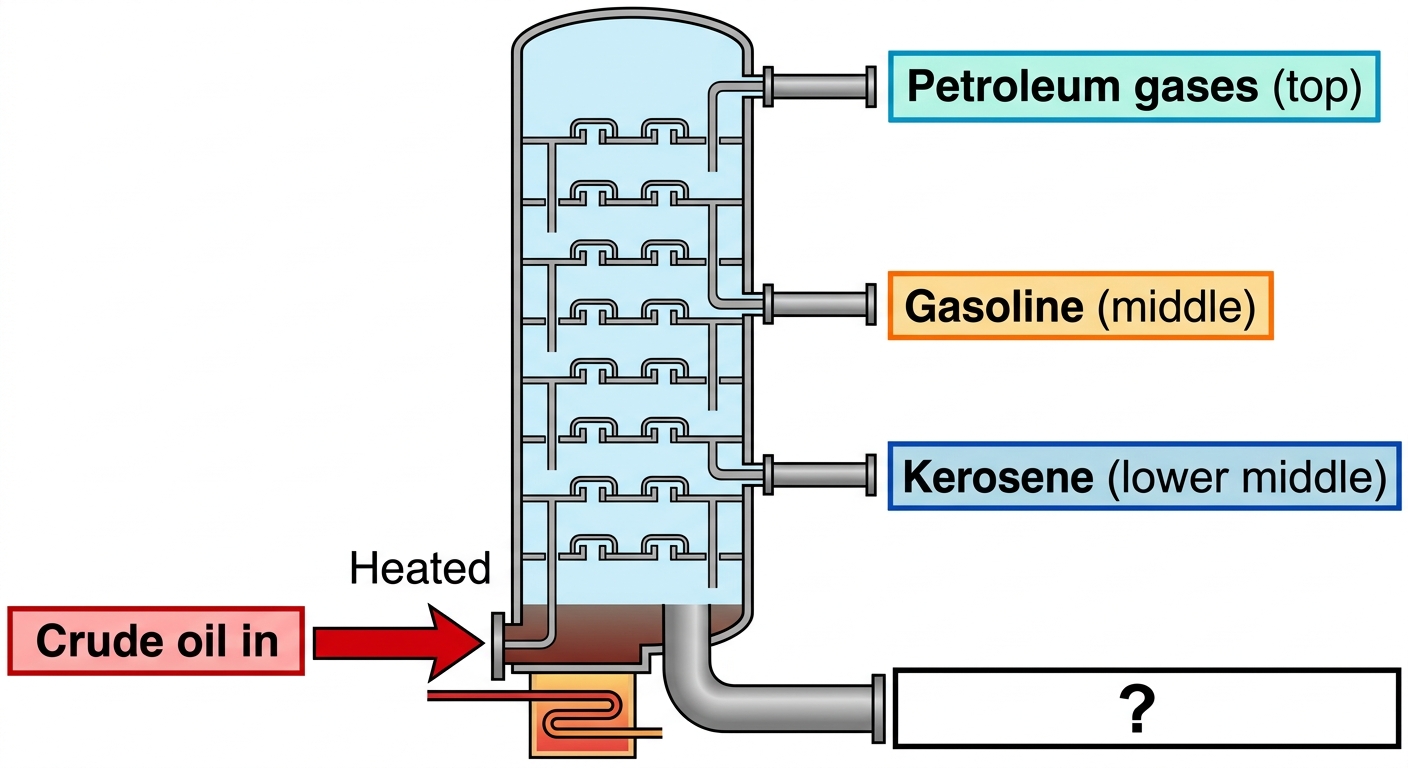
The diagram shows a fractional distillation column used to separate crude oil. Crude oil is fed into the column continuously as a hot vapour–liquid mixture.
a
Identify the substance fed into the bottom of the column. [1]
b
State one property of this substance that makes fractional distillation an effective method of separation. [1]

Solutions
2QuestionViscosity and flammability trendsAssessment Practice
4 marks~6 minCriterion C
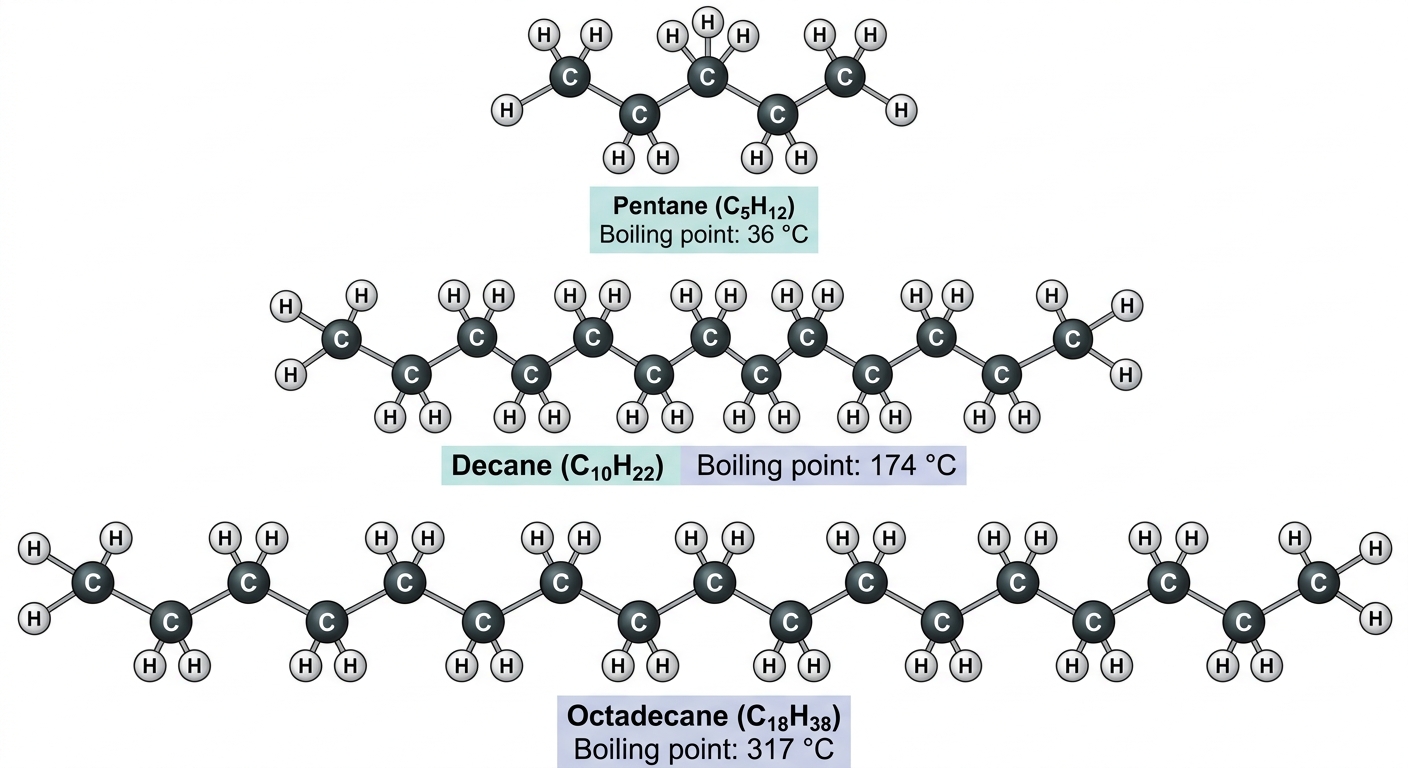
Three alkane molecules are compared: pentane (), decane (), and octadecane ().
Observed viscosities: pentane flows like water; decane flows like cooking oil; octadecane flows like honey.
Boiling points: pentane ; decane ; octadecane .
Observed viscosities: pentane flows like water; decane flows like cooking oil; octadecane flows like honey.
Boiling points: pentane ; decane ; octadecane .
a
State the trend in viscosity as hydrocarbon chain length increases. [1]
b
Explain how molecular structure influences the strength of London dispersion forces in these three molecules. [1]
c
Using the boiling point data, analyse how the intermolecular force strength accounts for both the boiling point trend and the viscosity trend across these three hydrocarbons. [2]
Solutions
3QuestionRefinery gasesAssessment Practice
6 marks~9 minCriterion D
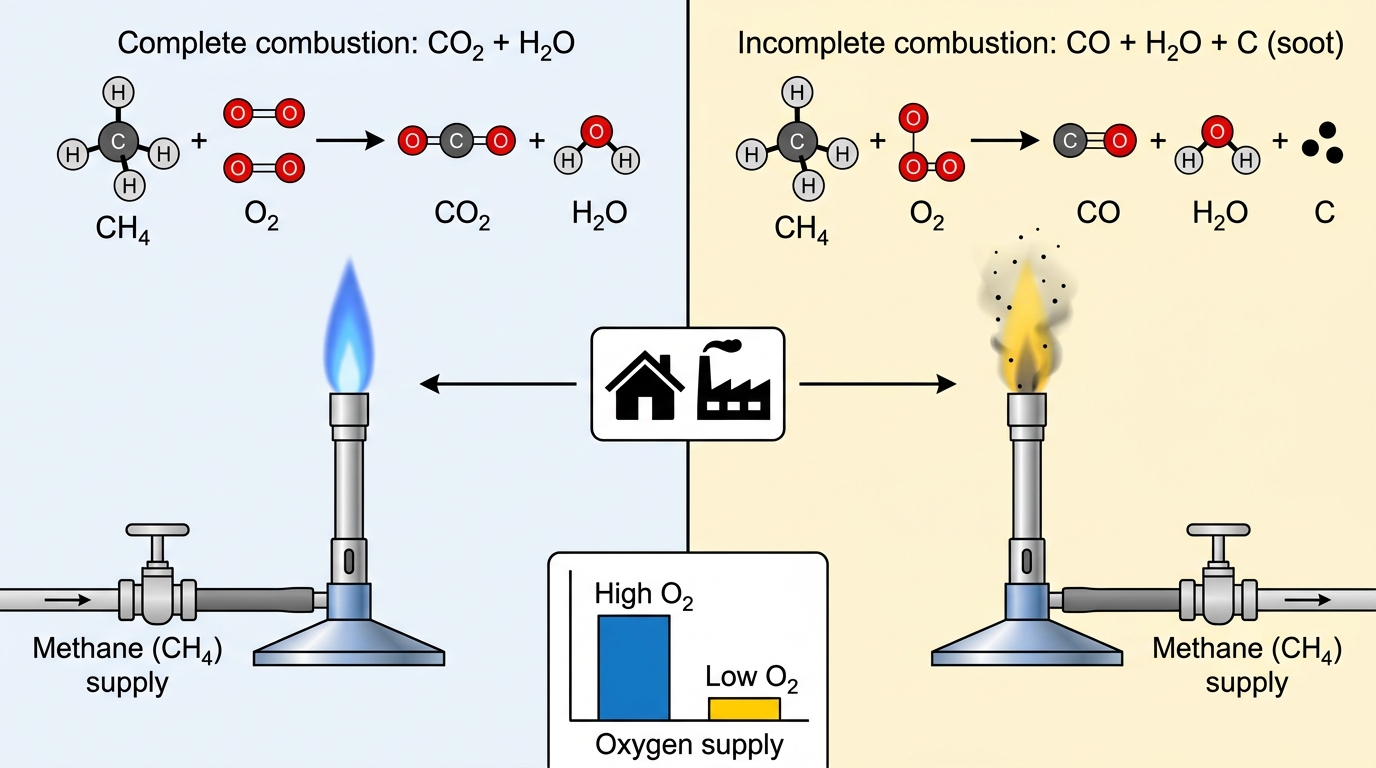
Refinery gases — methane (), ethane (), propane (), and butane () — are burned as fuel in homes and industry. When oxygen supply is limited, incomplete combustion occurs, producing carbon monoxide () and soot (carbon particles) alongside water, rather than the and predicted by complete combustion. Environmental models of urban air quality frequently assume combustion is 100% complete.
a
Construct balanced chemical equations for both the complete combustion and the incomplete combustion of methane (), clearly identifying the products in each case. [2]
b
Discuss two health or environmental implications arising specifically from the products of incomplete combustion of refinery gases. [2]
c
Evaluate the limitations of assuming 100% complete combustion when modelling air quality in urban areas. [2]
Solutions
4QuestionRefinery gasesAssessment Practice
6 marks~9 minCriterion B
Refinery gases from the fractional distillation of crude oil consist of methane (), ethane (), propane (), and butane ().
a
Construct balanced chemical equations, including state symbols, for the complete combustion of each of the four alkanes listed above. [4]
b
Using your equations from part (a), deduce how the molar ratio of produced to produced changes as the number of carbon atoms in the alkane increases. [1]
c
The general formula for alkanes is . Explain, using this formula, why the molar ratio approaches but never reaches as increases. [1]
Solutions
That's every free question here — 4 of 96.
+92 more questions, plus Mock Papers & Worksheets, are waiting in Premium.