You're viewing free preview questions — 4 questions previewing here — subscribe to unlock 117 more, plus the Full Question Bank, Mock Papers & Worksheets.Upgrade
Polymers — Free MYP4 Chemistry Practice Questions

1QuestionNatural vs synthetic polymersConcept Practice
2 marks~3 minCriterion A
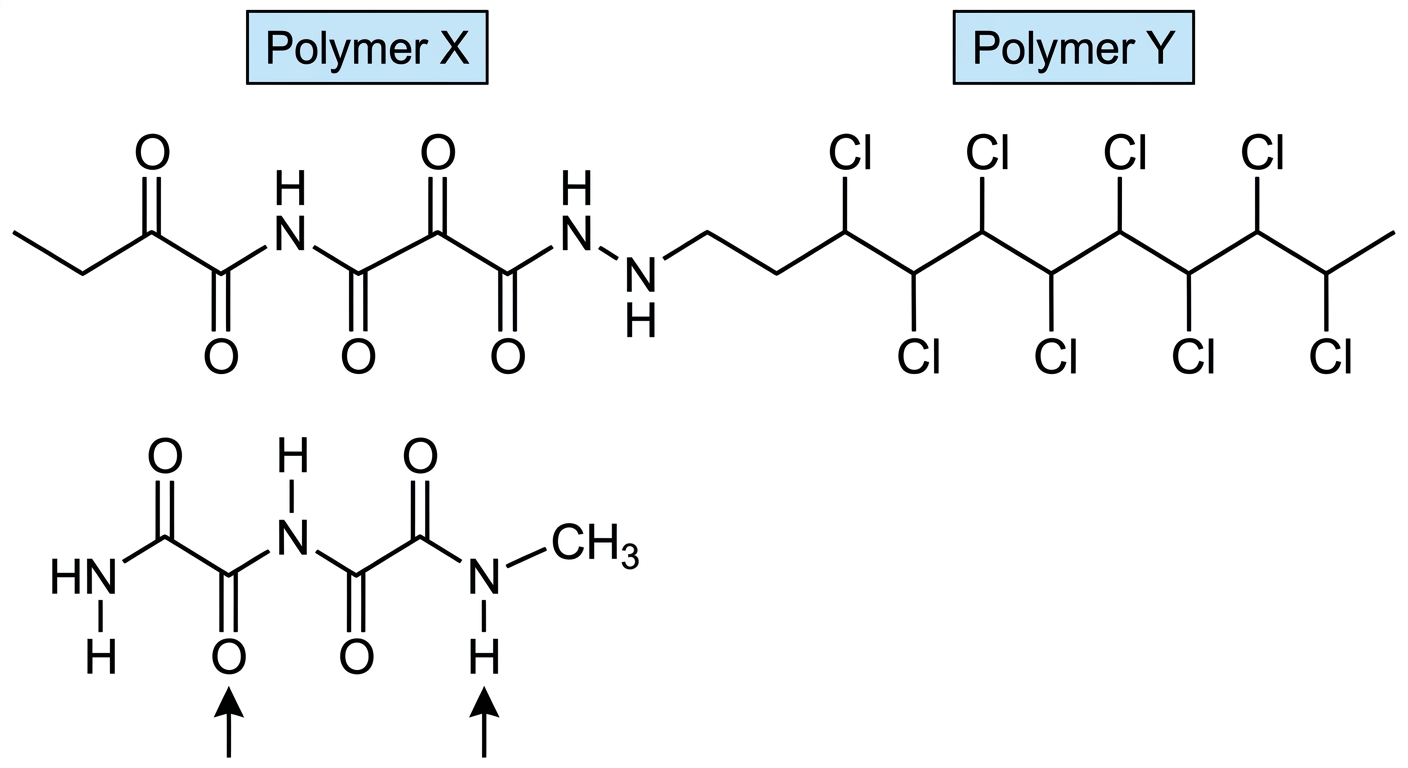
Two segments of polymer chains are shown in the diagram. Polymer X has a repeating unit containing a peptide bond () in its backbone. Polymer Y has a repeating carbon–carbon backbone with chlorine atoms attached to alternate carbon atoms.
a
Identify which polymer is natural and which is synthetic. [1]
b
Deduce one structural feature visible in the diagram that explains why Polymer X is classified as natural rather than synthetic. [1]

Solutions
2QuestionCondensation polymerization (basic)Assessment Practice
5 marks~8 minCriterion C
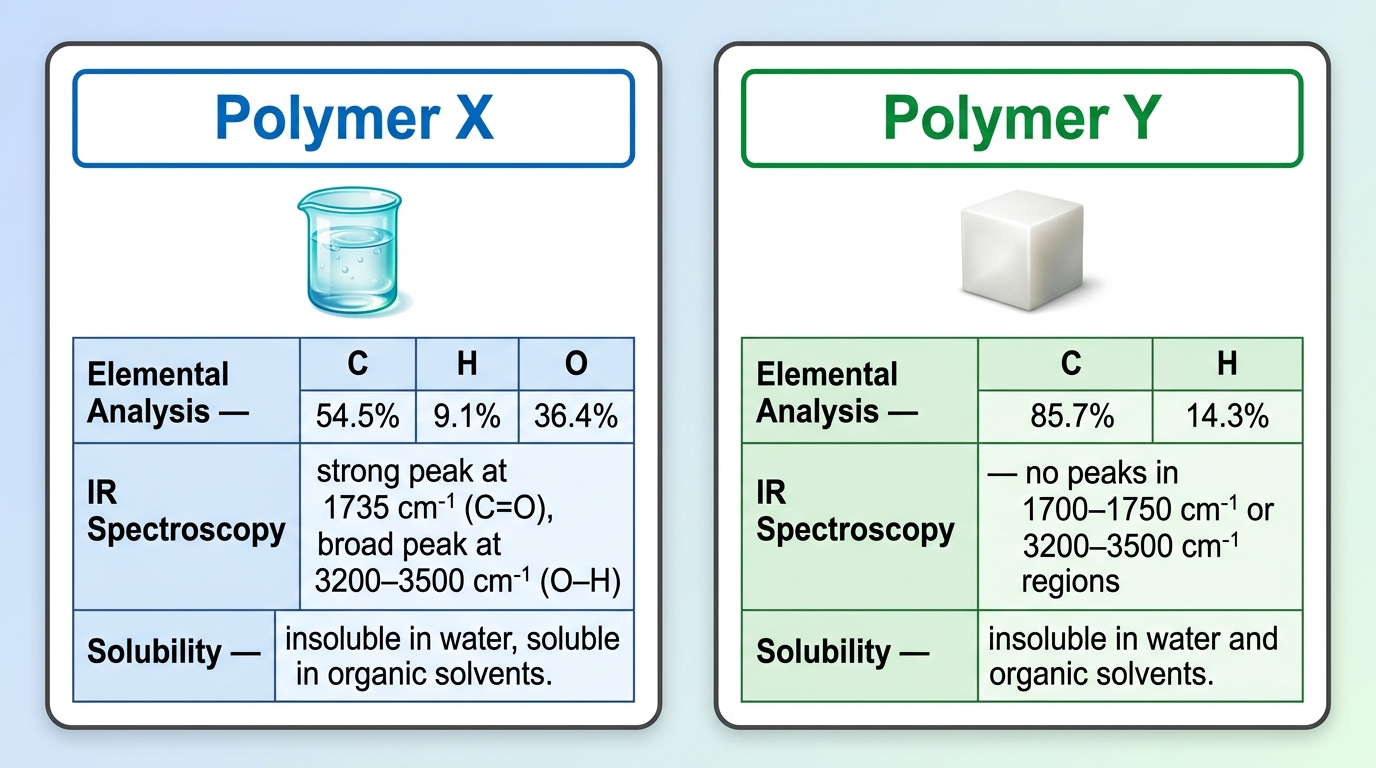
A student hypothesises that two unknown polymers, and , are both formed by condensation polymerisation. The following evidence was collected.
Elemental analysis (mass percent):
Polymer : C 54.5%, H 9.1%, O 36.4%
Polymer : C 85.7%, H 14.3%
IR spectroscopy:
Polymer : strong peak at ; broad peak at –
Polymer : no peaks in the – or – regions
Elemental analysis (mass percent):
Polymer : C 54.5%, H 9.1%, O 36.4%
Polymer : C 85.7%, H 14.3%
IR spectroscopy:
Polymer : strong peak at ; broad peak at –
Polymer : no peaks in the – or – regions
a
State two features that define a condensation polymer at the molecular level. [1]
b
Explain how the elemental analysis and IR data together support classifying polymer as a condensation polymer. [2]
c
Evaluate whether the full dataset supports the hypothesis that both and are condensation polymers, identifying which evidence is most decisive for polymer and justifying your conclusion. [2]
Solutions
3QuestionNatural vs synthetic polymersConcept Practice
2 marks~3 minCriterion B
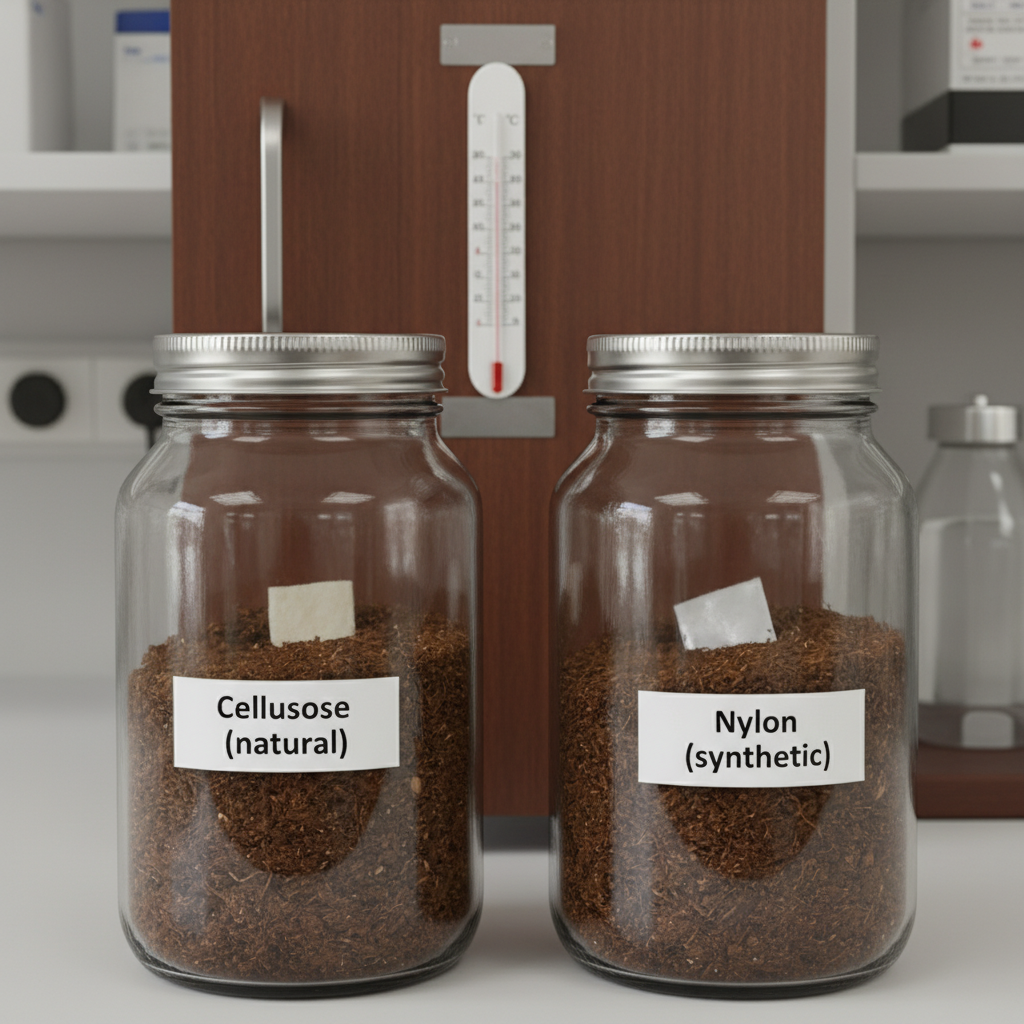
Outline the steps of a simple experiment to compare the biodegradability of natural and synthetic polymers, using the apparatus shown in the diagram. The diagram shows two identical glass jars, each half-filled with soil and a small piece of polymer (one labeled 'Cellulose (natural)', the other labeled 'Nylon (synthetic)'). Both jars are sealed with a lid and placed in a warm, dark cupboard.
Solutions
4QuestionEnvironmental issues like Non-biodegradability, MicroplasticsAssessment Practice
6 marks~9 minCriterion D
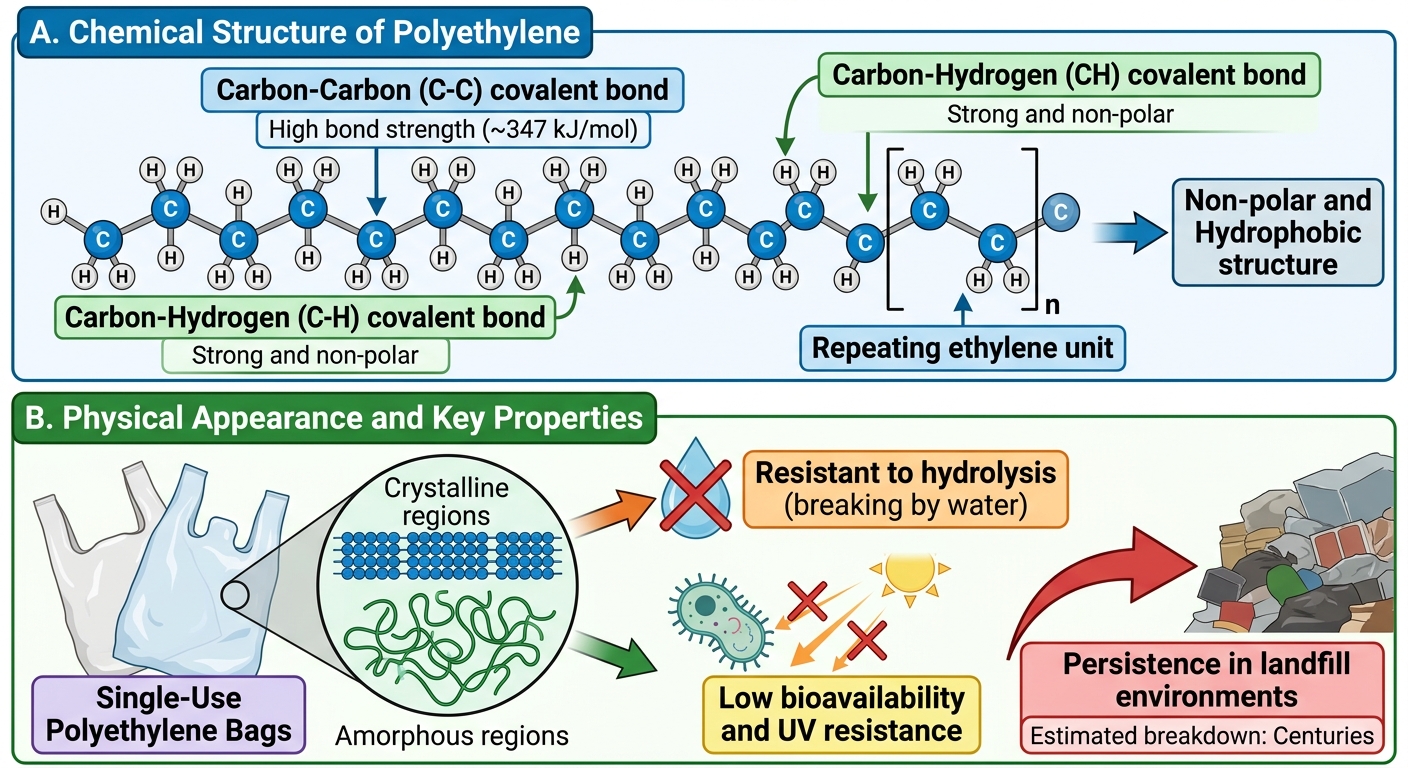
A city has banned single-use polyethylene shopping bags due to concerns about their persistence in landfills. Polyethylene is formed from repeating ethene () units, producing long chains held together by strong carbon–carbon () and carbon–hydrogen () covalent bonds. These bonds are resistant to hydrolysis. Studies suggest polyethylene bags may persist in landfills for 500–1000 years, though this estimate assumes uniform decomposition conditions across all sites.
a
Explain why polyethylene bags persist in landfills for centuries, referring to polymer bonding and landfill conditions. [2]
b
Discuss one limitation of assuming decomposition rates are uniform across all landfill environments. [2]
c
Evaluate one environmental or health implication of microplastics formed when polyethylene fragments into tiny particles over time. [2]
Solutions
That's every free question here — 4 of 121.
+117 more questions, plus Mock Papers & Worksheets, are waiting in Premium.