You're viewing free preview questions — 4 questions previewing here — subscribe to unlock 61 more, plus the Full Question Bank, Mock Papers & Worksheets.Upgrade
Concentration of Solutions — Free MYP4 Chemistry Practice Questions

1QuestionCalculating moles from concentration and volumeConcept Practice
3 marks~5 minCriterion A
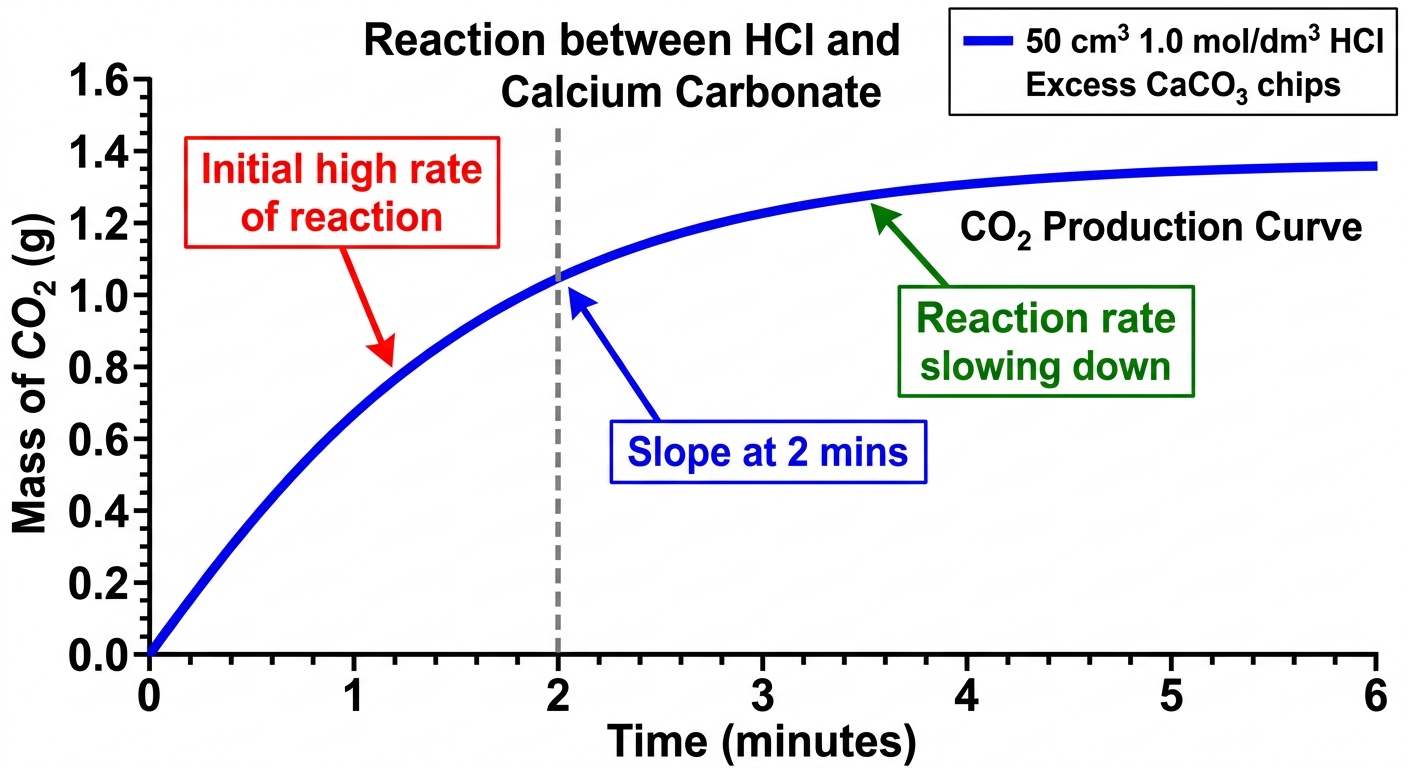
When 50 cm³ of 1.0 mol/dm³ hydrochloric acid reacts with excess calcium carbonate chips, the mass of CO₂ produced increases rapidly at first, then more slowly after 2 minutes.
a
Calculate the initial number of moles of HCl present. [1]
b
Explain how the number of moles of HCl changes during the reaction and what this means for the concentration of HCl in solution. [1]
c
Using collision theory, explain why the rate of reaction decreases as the reaction proceeds. [1]

Solutions
2QuestionCalculating moles from concentration and volumeAssessment Practice
6 marks~9 minCriterion C
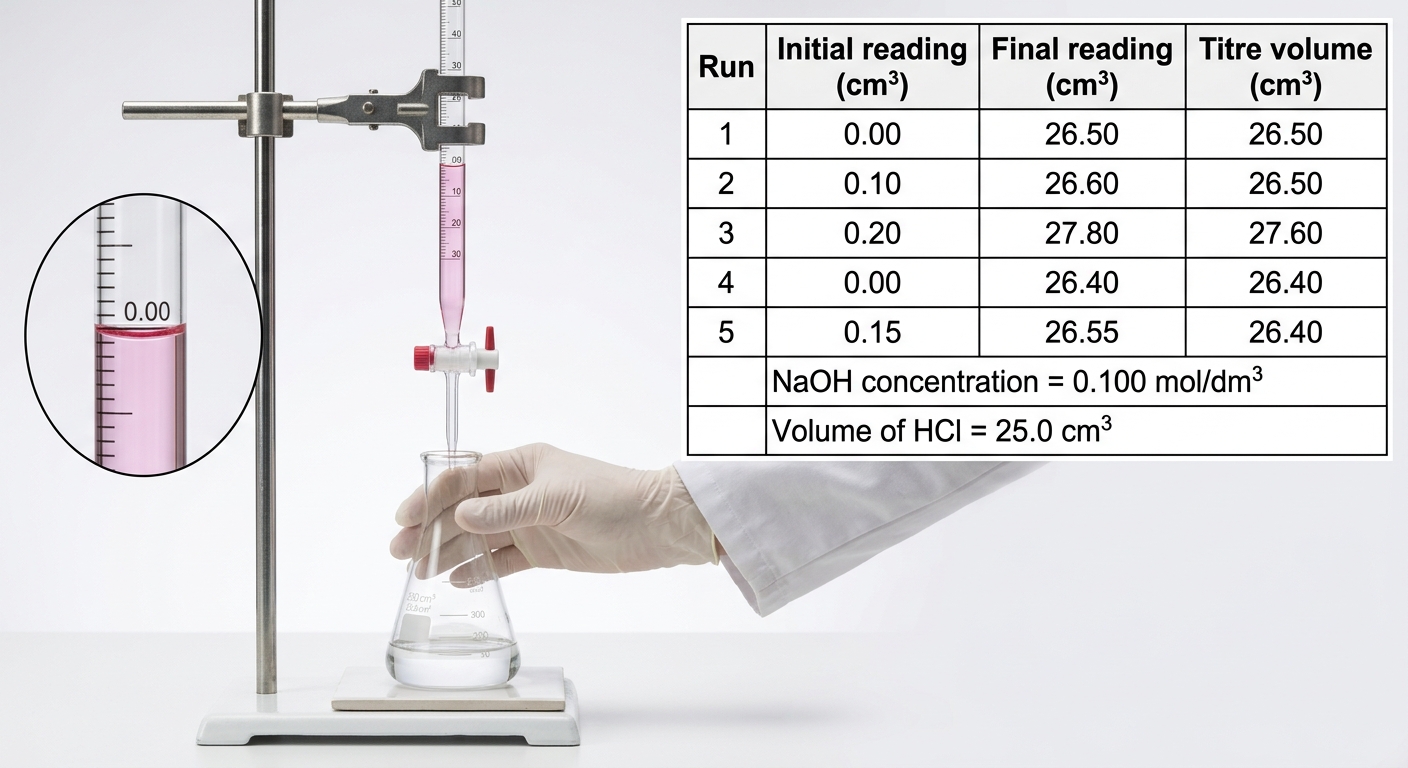
A student titrates of hydrochloric acid () against sodium hydroxide () solution, using phenolphthalein as the indicator. Five runs are recorded below.
| Run | 1 | 2 | 3 | 4 | 5 |
|---|---|---|---|---|---|
| Initial reading (cm³) | 0.00 | 0.10 | 0.20 | 0.00 | 0.15 |
| Final reading (cm³) | 26.50 | 26.60 | 27.80 | 26.40 | 26.55 |
| Titre volume (cm³) | 26.50 | 26.50 | 27.60 | 26.40 | 26.40 |
a
Identify the anomalous titre value and justify your choice. [1]
b
Calculate the mean titre volume in , excluding the anomalous value. Show your working. [2]
c
Using your mean titre volume, calculate the number of moles of that reacted. [2]
d
Deduce the number of moles of present in the sample, given that the neutralisation reaction is:
Justify your reasoning using the mole ratio. [1]
Justify your reasoning using the mole ratio. [1]
Solutions
3QuestionDilution concept and simple dilution calculationsAssessment Practice
8 marks~12 minCriterion D
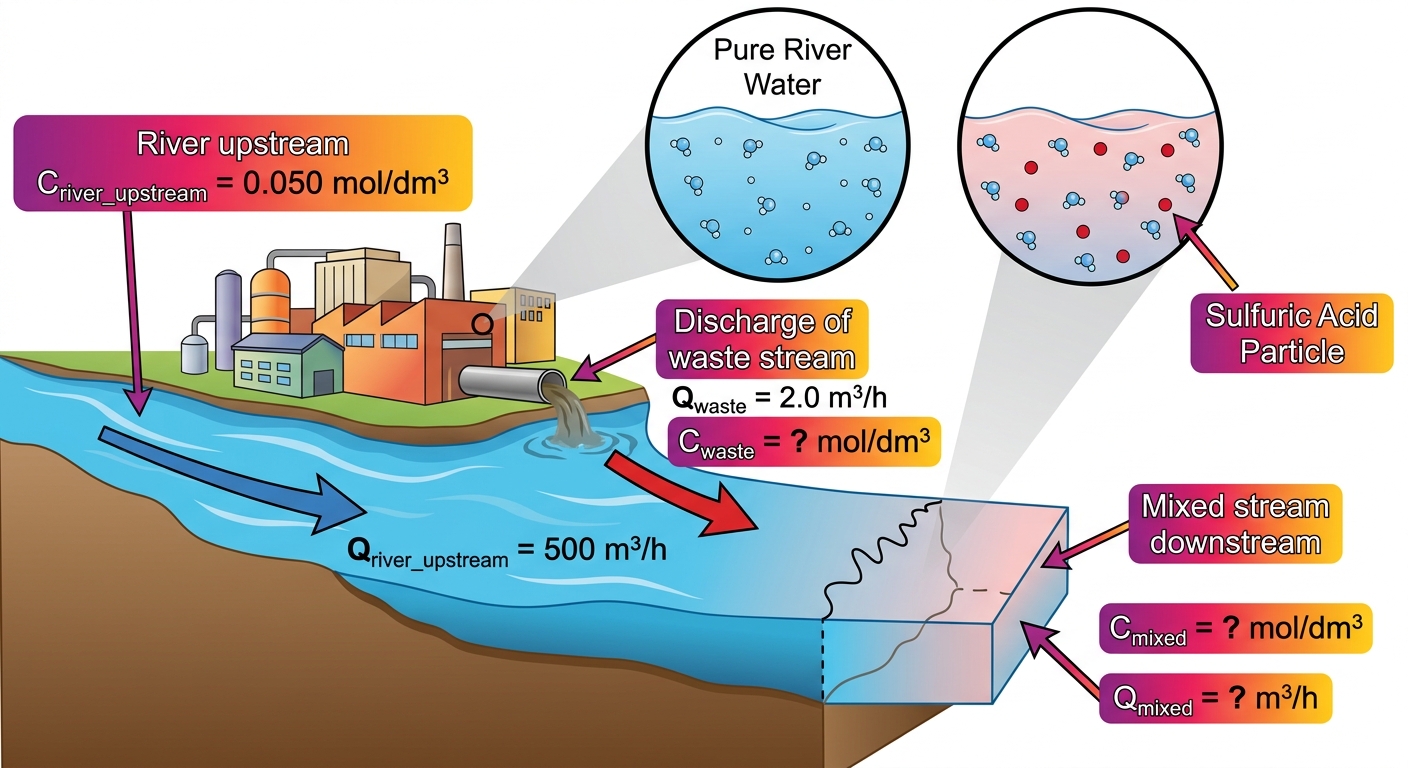
A chemical factory discharges sulfuric acid waste at a concentration of and a flow rate of into a river. The river's upstream flow rate is and initially contains no acid. Assume perfect mixing and no chemical reactions unless stated otherwise.
a
Calculate the concentration of sulfuric acid in the river downstream of the discharge point. [2]
b
Deduce whether the downstream concentration would be higher or lower than your calculated value during a period of heavy rainfall. Justify your answer with reference to the dilution formula. [2]
c
Evaluate the suitability of the model for predicting actual acid concentrations in this river, discussing the assumption of no chemical reactions and one further limitation. [4]
Solutions
4QuestionCalculating moles from concentration and volumeAssessment Practice
2 marks~3 minCriterion B
A student prepares four solutions by diluting a NaCl stock solution to a total volume of each time.
| Volume of stock solution () | 10 | 20 | 30 | 40 |
|---|---|---|---|---|
| Final concentration () | 0.20 | 0.40 | 0.60 | 0.80 |
a
Deduce the final concentration when of stock solution is used. [1]
b
Explain why this relationship between volume of stock solution and final concentration only holds when the total final volume remains constant. [1]
Solutions
That's every free question here — 4 of 65.
+61 more questions, plus Mock Papers & Worksheets, are waiting in Premium.