You're viewing free preview questions — 6 questions previewing here — subscribe to unlock 64 more, plus the Full Question Bank, Mock Papers & Worksheets.Upgrade
Back

Moles, mass and molar relationships — Free MYP4 Chemistry Practice Questions

Free questions

Open in full, with answers, mark scheme and examiner insights.

Question 1Criterion A · Band 1-4 · Easy · 4 marksrevisionprep.com

Using formula: moles = mass ÷ molar mass

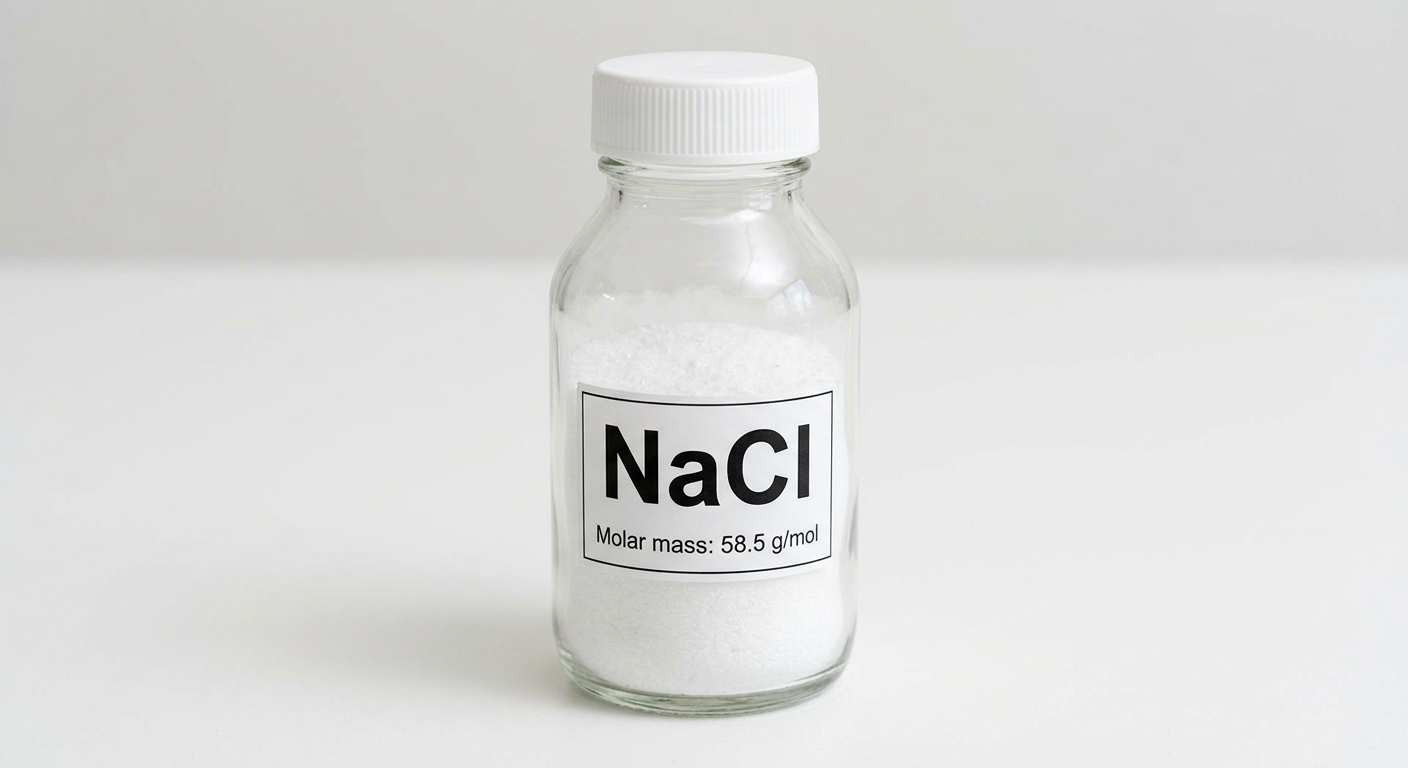
The photograph shows a bottle of sodium chloride, NaCl\mathrm{NaCl}, with its molar mass printed on the label. A student weighs out 11.7 g of the solid from this bottle.

Avogadro's constant, L=6.02×10²³ mol−1L = 6.02 \times 10^{23}\ \text{mol}^{-1}
Question diagram
(a)
Calculate the amount, in mol, of NaCl\mathrm{NaCl} in the 11.7 g sample. [1]Criterion A (ii) · Level 1-2
(b)
Calculate the number of NaCl\mathrm{NaCl} formula units in the sample. [1]Criterion A (ii) · Level 3-4
(c)
Deduce the total number of ions in the sample. Explain your reasoning. [2]Criterion A (i), A (ii) · Level 3-4

revisionprep.com

Summary Answer

Not available for this question.

Model Answer

Not available for this question.

Marking Scheme

Not available for this question.

Examiner Insights

Not available for this question.

Question 2Criterion A · Band 3-4 · Easy · 4 marksrevisionprep.com

Converting between mass and moles

Magnesium burns in oxygen:

2Mg(s)+O2(g)→2MgO(s)\mathrm{2Mg(s) + O_{2}(g) \rightarrow 2MgO(s)}

Molar masses: Mg = 24.3 g mol⁻¹, MgO = 40.3 g mol⁻¹
(a)
Calculate the mass of magnesium needed to make 60.0 g of magnesium oxide. [2]Criterion A (ii) · Level 3-4
(b)
A student says: 'Mg and MgO are in a 1 : 1 mole ratio, so the mass of Mg used equals the mass of MgO made.' Explain why this statement is incorrect. [2]Criterion A (iii) · Level 3-4

revisionprep.com

Summary Answer

Not available for this question.

Model Answer

Not available for this question.

Marking Scheme

Not available for this question.

Examiner Insights

Not available for this question.

Question 3Criterion A · Band 1-6 · Medium · 6 marksrevisionprep.com

Mole ratios from balanced chemical equations

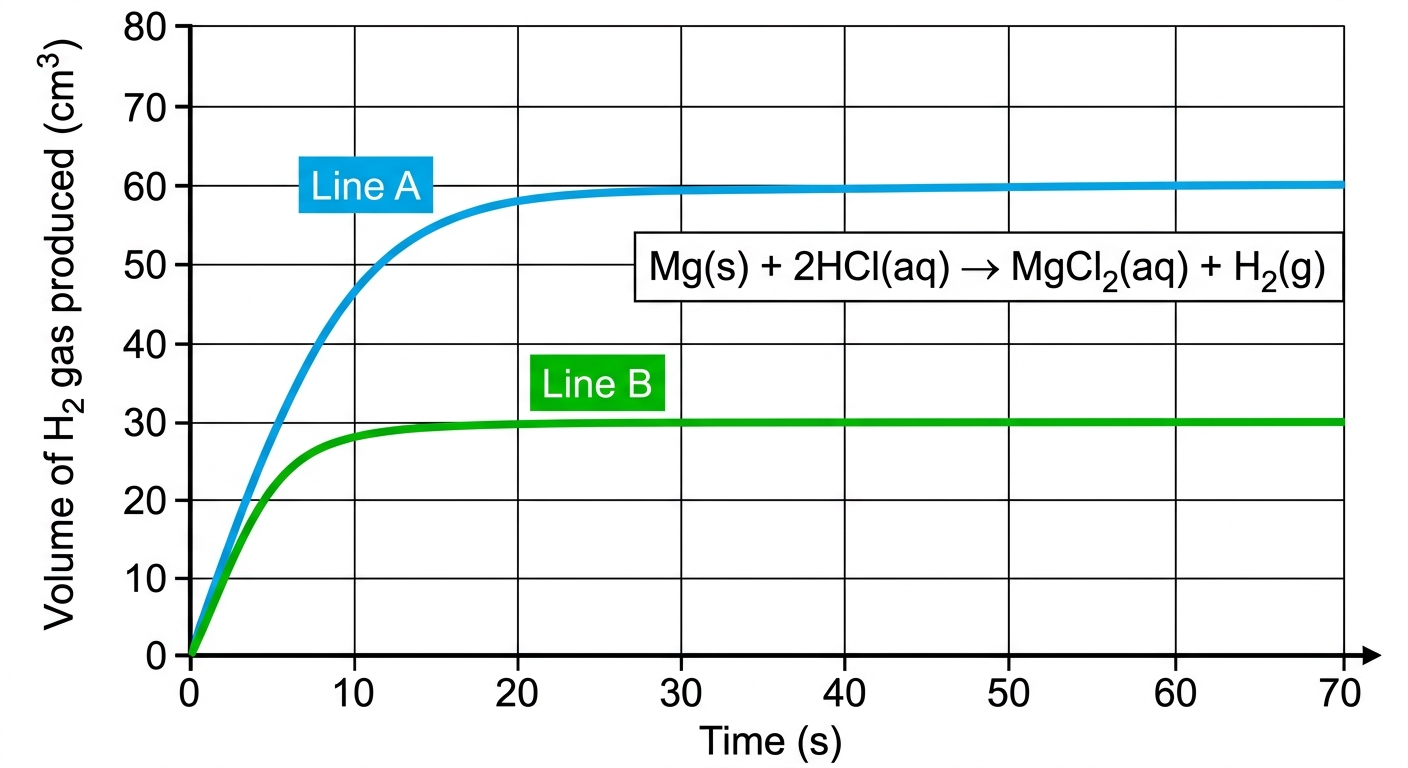
The graph shows the volume of hydrogen produced when two pieces of magnesium ribbon, A and B, each react with excess hydrochloric acid.

Mg(s)+2HCl(aq)→MgCl2(aq)+H2(g)\mathrm{Mg(s) + 2HCl(aq) \rightarrow MgCl_{2}(aq) + H_{2}(g)}

Molar mass of Mg = 24.31 g mol⁻¹. One mole of gas occupies 24.0 dm³ at RTP.
Question diagram
(a)
State the mole ratio of Mg to H2\mathrm{H_{2}}. [1]Criterion A (i) · Level 1-2
(b)
Use the graph to calculate the amount of hydrogen produced by ribbon A. [2]Criterion A (ii) · Level 3-4
(c)
Calculate the mass of ribbon A. [1]Criterion A (ii) · Level 3-4
(d)
Deduce the mass of ribbon B, explaining your reasoning. [2]Criterion A (iii) · Level 5-6

revisionprep.com

Summary Answer

Not available for this question.

Model Answer

Not available for this question.

Marking Scheme

Not available for this question.

Examiner Insights

Not available for this question.

Question 4Criterion D + A · Band 1-6 · Medium · 9 marksrevisionprep.com

Interpreting coefficients in chemical equations

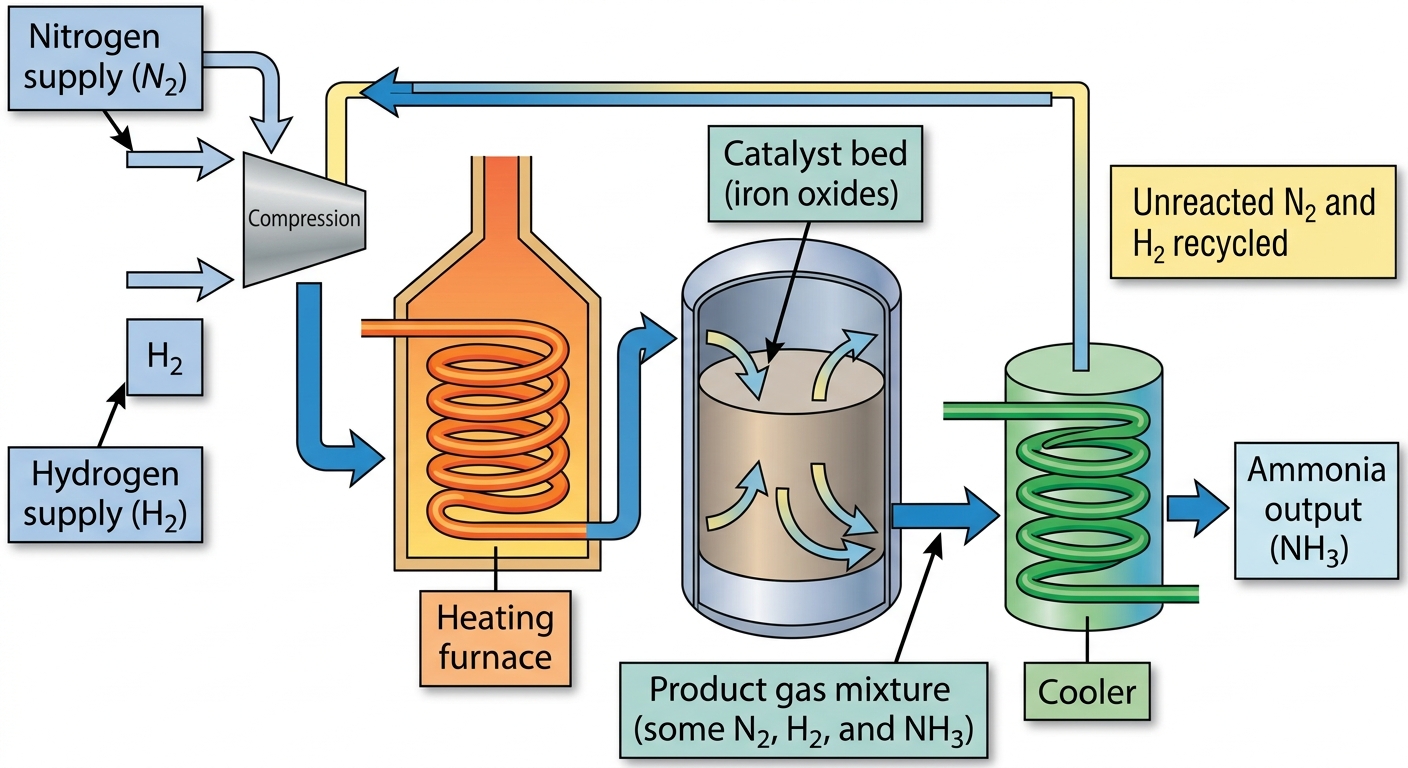
The flow diagram shows a Haber process plant.

N2(g)+3H2(g)⇌2NH3(g)\mathrm{N_{2}(g) + 3H_{2}(g) \rightleftharpoons 2NH_{3}(g)}

Only about 15 % of the nitrogen and hydrogen is converted to ammonia each time the gases pass over the catalyst.

Molar masses: H2\mathrm{H_{2}} = 2.0 g mol⁻¹, NH3\mathrm{NH_{3}} = 17.0 g mol⁻¹. 1 tonne = 10⁶ g
Question diagram
(a)
State the mole ratio in which nitrogen and hydrogen should be fed into the plant. [1]Criterion A (i) · Level 1-2
(b)
Use the diagram to explain how the plant converts almost all of the nitrogen and hydrogen into ammonia, even though each pass converts only 15 %. [2]Criterion D (i) · Level 5-6
(c)
Calculate the mass of hydrogen, in kg, used to make 1.00 tonne of ammonia. [2]Criterion A (ii) · Level 5-6
(d)
Explain one economic and one environmental benefit of recycling the unreacted gases. [4]Criterion D (ii) · Level 5-6

revisionprep.com

Summary Answer

Not available for this question.

Model Answer

Not available for this question.

Marking Scheme

Not available for this question.

Examiner Insights

Not available for this question.

Question 5Criterion C + A · Band 3-8 · Challenge · 7 marksrevisionprep.com

Multi-step mole–mass conversions in reactions

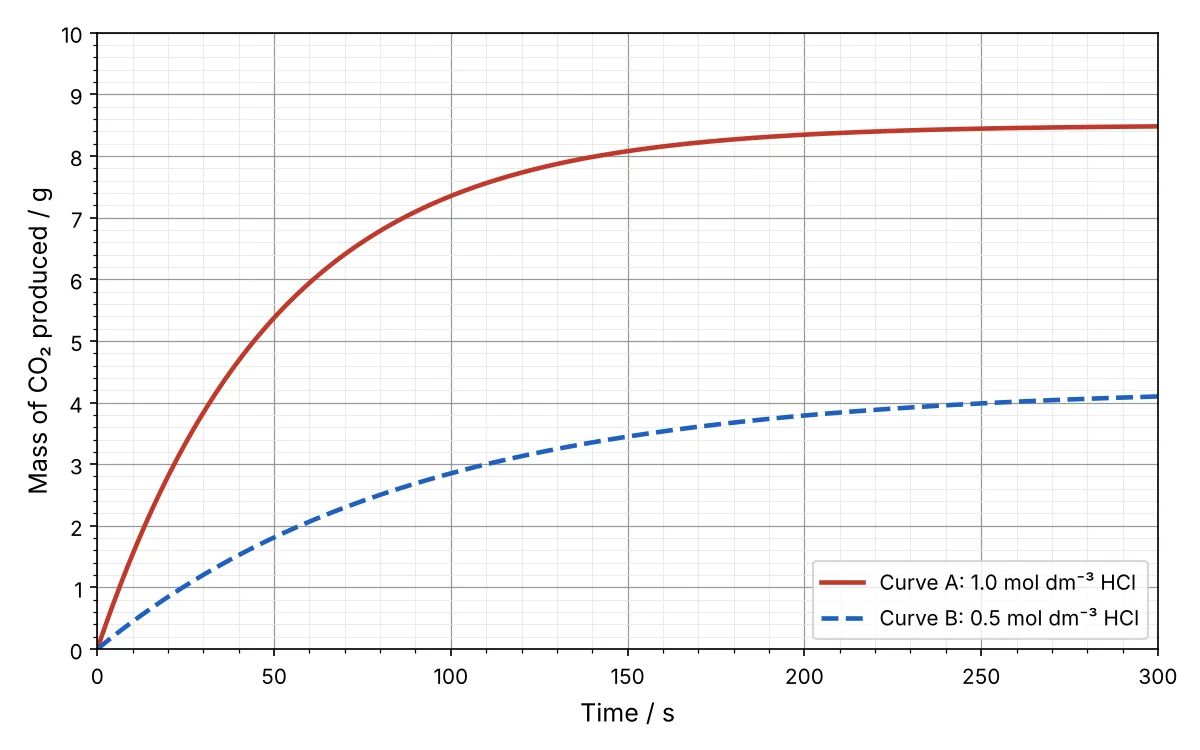
Excess calcium carbonate is added to two samples of hydrochloric acid of equal volume. Curve A uses 1.0 mol dm⁻³ acid and curve B uses 0.5 mol dm⁻³ acid. The graph shows the mass of carbon dioxide produced.

CaCO3(s)+2HCl(aq)→CaCl2(aq)+H2O(l)+CO2(g)\mathrm{CaCO_{3}(s) + 2HCl(aq) \rightarrow CaCl_{2}(aq) + H_{2}O(l) + CO_{2}(g)}

Molar mass of CO2\mathrm{CO_{2}} = 44.01 g mol⁻¹
Question diagram
(a)
Use the graph to state the final mass of CO2\mathrm{CO_{2}} for each curve. [1]Criterion C (ii) · Level 3-4
(b)
Calculate the amount of CO2\mathrm{CO_{2}} produced in experiment A and hence the amount of HCl that reacted. [2]Criterion A (ii) · Level 5-6
(c)
Explain why the final mass for curve B is half that for curve A. [2]Criterion C (ii) · Level 5-6
(d)
A student predicts that doubling the mass of calcium carbonate in experiment B would double its final mass of CO2\mathrm{CO_{2}}. Evaluate this prediction. [2]Criterion C (iii) · Level 7-8

revisionprep.com

Summary Answer

Not available for this question.

Model Answer

Not available for this question.

Marking Scheme

Not available for this question.

Examiner Insights

Not available for this question.

Question 6Criterion B · Band 5-8 · Challenge · 9 marksrevisionprep.com

Empirical and molecular formulae

A student plans an investigation to find the formula of magnesium oxide. A coil of magnesium ribbon is heated in a crucible with a lid until it has all reacted with oxygen from the air.

Molar masses: Mg = 24.31 g mol⁻¹, O = 16.00 g mol⁻¹

The diagram shows the apparatus.
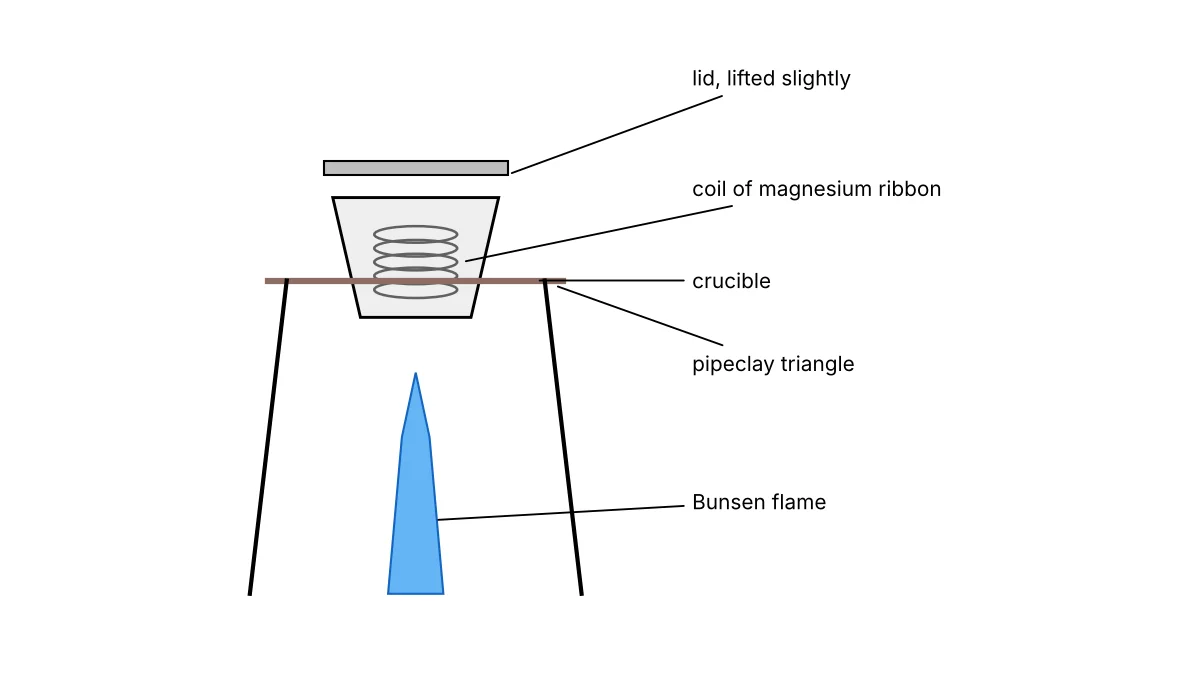
Question diagram
(a)
Formulate a hypothesis for the mole ratio of magnesium to oxygen in the product, and explain it using your knowledge of ions. [2]Criterion B (ii) · Level 5-6
(b)
Explain why the lid should be lifted slightly from time to time, but not removed. [2]Criterion B (iv) · Level 5-6
(c)
State the mass readings the student must record, and explain how they are used to find the amounts of magnesium and oxygen. [3]Criterion B (iii) · Level 5-6
(d)
Explain how the student can make sure that the data collected are sufficient and reliable. [2]Criterion B (iii) · Level 7-8

revisionprep.com

Summary Answer

Not available for this question.

Model Answer

Not available for this question.

Marking Scheme

Not available for this question.

Examiner Insights

Not available for this question.

That's every free question here — 6 of 70.

+64 more questions, plus Mock Papers & Worksheets, are waiting in Premium.

Upgrade