You're viewing free preview questions — 4 questions previewing here — subscribe to unlock 55 more, plus the Full Question Bank, Mock Papers & Worksheets.Upgrade
Reacting mass calculations and limiting reagents — Free MYP4 Chemistry Practice Questions

1QuestionUsing balanced equations for mass calculationsConcept Practice
4 marks~6 minCriterion A
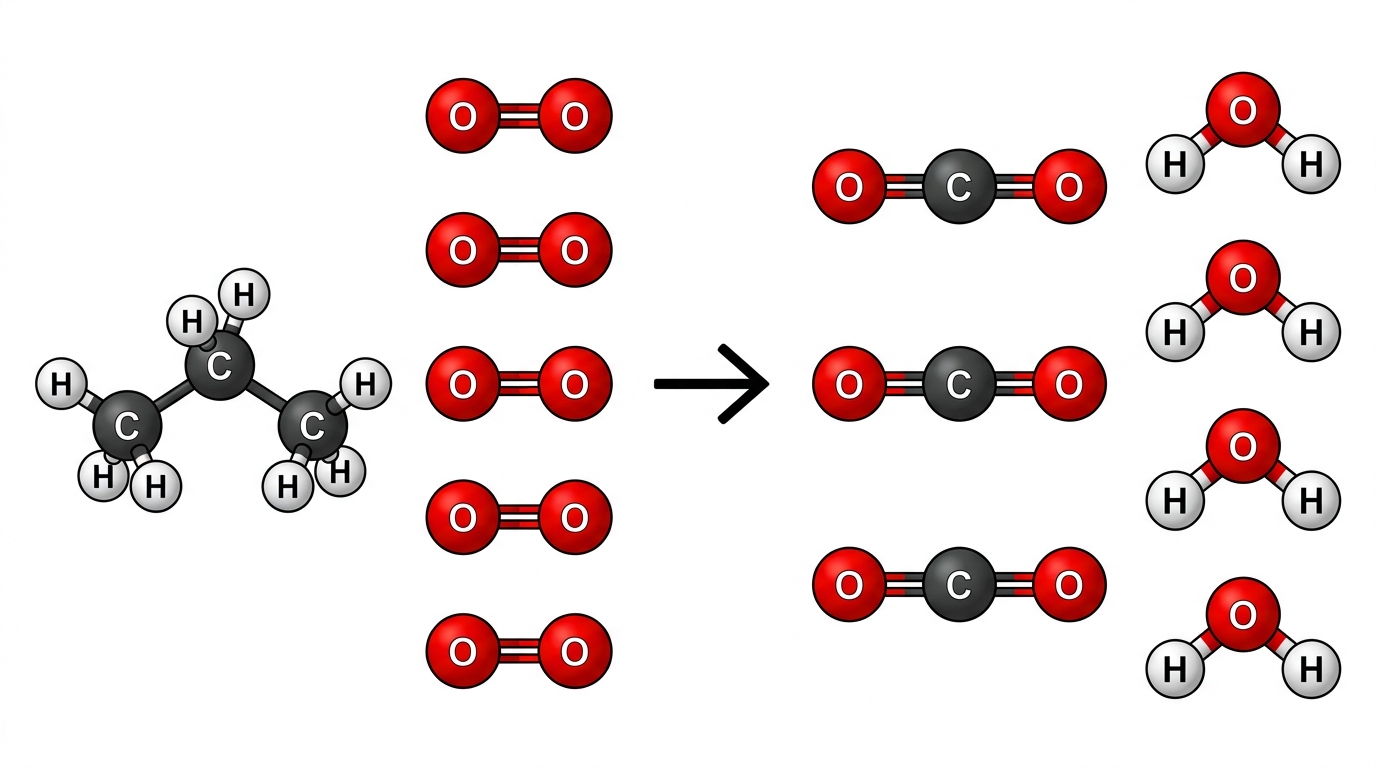
Natural gas appliances release carbon dioxide into the atmosphere. In one such appliance, propane undergoes complete combustion:
Atomic masses: C = 12.0 g/mol, H = 1.0 g/mol, O = 16.0 g/mol.
A gas canister contains 44.0 g of propane (), which is burned completely in excess oxygen.
Atomic masses: C = 12.0 g/mol, H = 1.0 g/mol, O = 16.0 g/mol.
A gas canister contains 44.0 g of propane (), which is burned completely in excess oxygen.
a
Calculate the molar mass of propane () and hence the number of moles present. [1]
b
Deduce the mass of carbon dioxide () produced. [2]
c
Evaluate whether doubling the mass of propane burned would double the mass of produced, assuming oxygen remains in excess. Justify your answer using the stoichiometry of the reaction. [1]

Solutions
2QuestionReal-life applications (industrial reactions, efficiency)Assessment Practice
2 marks~3 minCriterion D
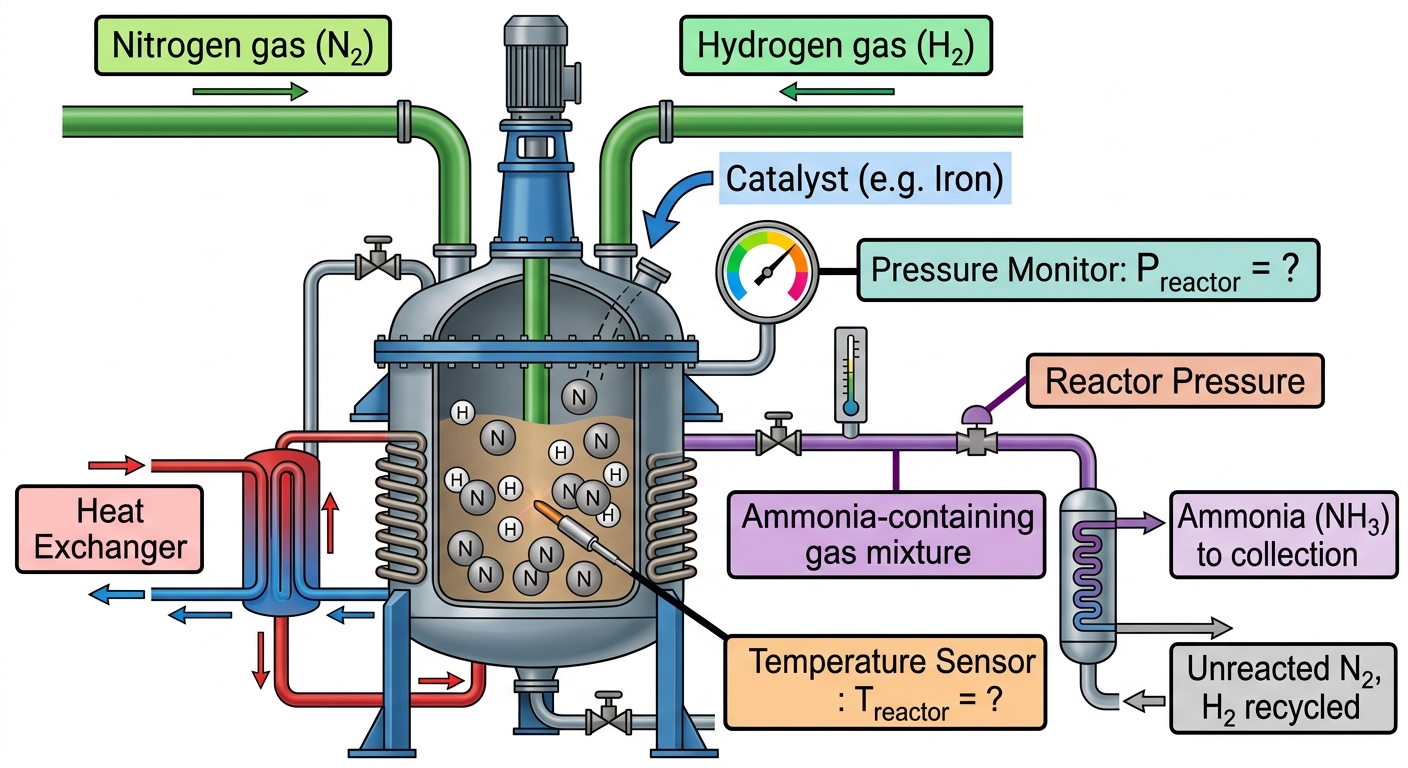
The Haber process synthesises ammonia () for use in fertilizers:
In an industrial reactor, 28 g of and 10 g of are combined. Stoichiometric calculations predict a theoretical yield of based on the limiting reagent.
Explain one real-world limitation of using the stoichiometric model to predict the actual yield of in this industrial process, and describe how it affects the yield. [2]
In an industrial reactor, 28 g of and 10 g of are combined. Stoichiometric calculations predict a theoretical yield of based on the limiting reagent.
Explain one real-world limitation of using the stoichiometric model to predict the actual yield of in this industrial process, and describe how it affects the yield. [2]
Solutions
3QuestionExcess reagent conceptAssessment Practice
3 marks~5 minCriterion C
In the Haber process, nitrogen gas reacts with hydrogen gas to produce ammonia:
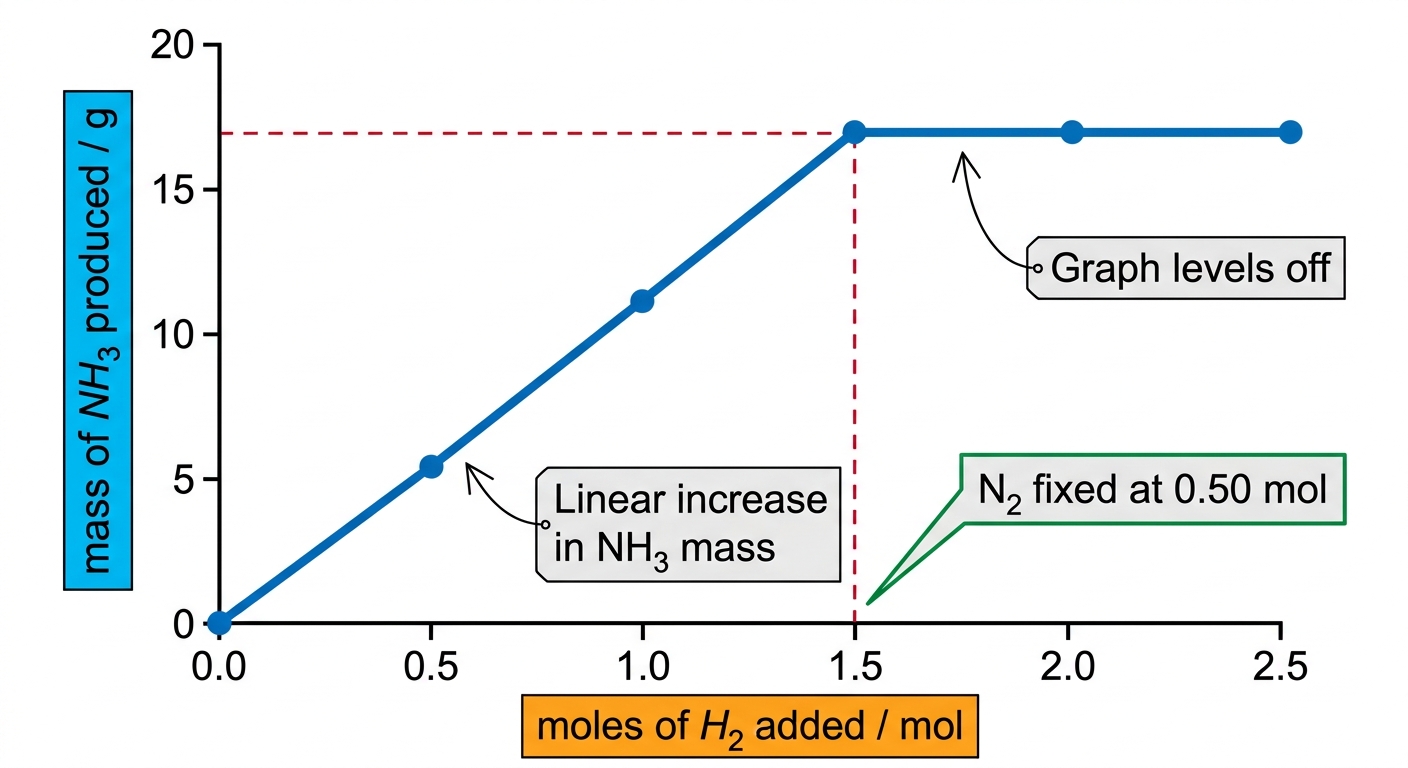
A student fixes the amount of at 0.50 mol and varies the amount of added. The mass of produced is recorded below.
A student fixes the amount of at 0.50 mol and varies the amount of added. The mass of produced is recorded below.
| added (mol) | 0 | 0.50 | 1.0 | 1.5 | 2.0 |
|---|---|---|---|---|---|
| Mass of produced (g) | 0 | 5.7 | 11.3 | 17.0 | 17.0 |
a
Calculate the moles of produced when 1.5 mol of is added. [1]
b
Explain why no additional is produced when the amount of added exceeds 1.5 mol. [1]
c
A second student suggests that adding more beyond 1.5 mol could increase the yield of if the temperature is lowered simultaneously. Evaluate this claim using your understanding of limiting reagents and stoichiometry. [1]
Solutions
4QuestionStep-by-step stoichiometric calculations (mass → moles → ratio → mass)Assessment Practice
3 marks~5 minCriterion B
Four experiments record the masses of magnesium and oxygen that react completely to form magnesium oxide (MgO).
| Experiment | 1 | 2 | 3 | 4 |
|---|---|---|---|---|
| Mass of Mg (g) | 3.0 | 6.0 | 9.0 | 12.0 |
| Mass of O (g) | 2.0 | 4.0 | 6.0 | 8.0 |
| Mass of MgO (g) | 5.0 | 10.0 | 15.0 | 20.0 |
a
Calculate the mass ratio of Mg to O for each experiment. [1]
b
Describe the pattern shown by the four mass ratios. [1]
c
Explain why the mass ratio of Mg to O remains constant regardless of the quantity of MgO formed. [1]
Solutions
That's every free question here — 4 of 59.
+55 more questions, plus Mock Papers & Worksheets, are waiting in Premium.