You're viewing free preview questions — 6 questions previewing here — subscribe to unlock 85 more, plus the Full Question Bank, Mock Papers & Worksheets.Upgrade
Back

The mole concept and Avogadro's constant — Free MYP4 Chemistry Practice Questions

Free questions

Open in full, with answers, mark scheme and examiner insights.

Question 1Criterion A + C · Band 1-4 · Easy · 4 marksrevisionprep.com

Relationship between molar mass and one mole of substance
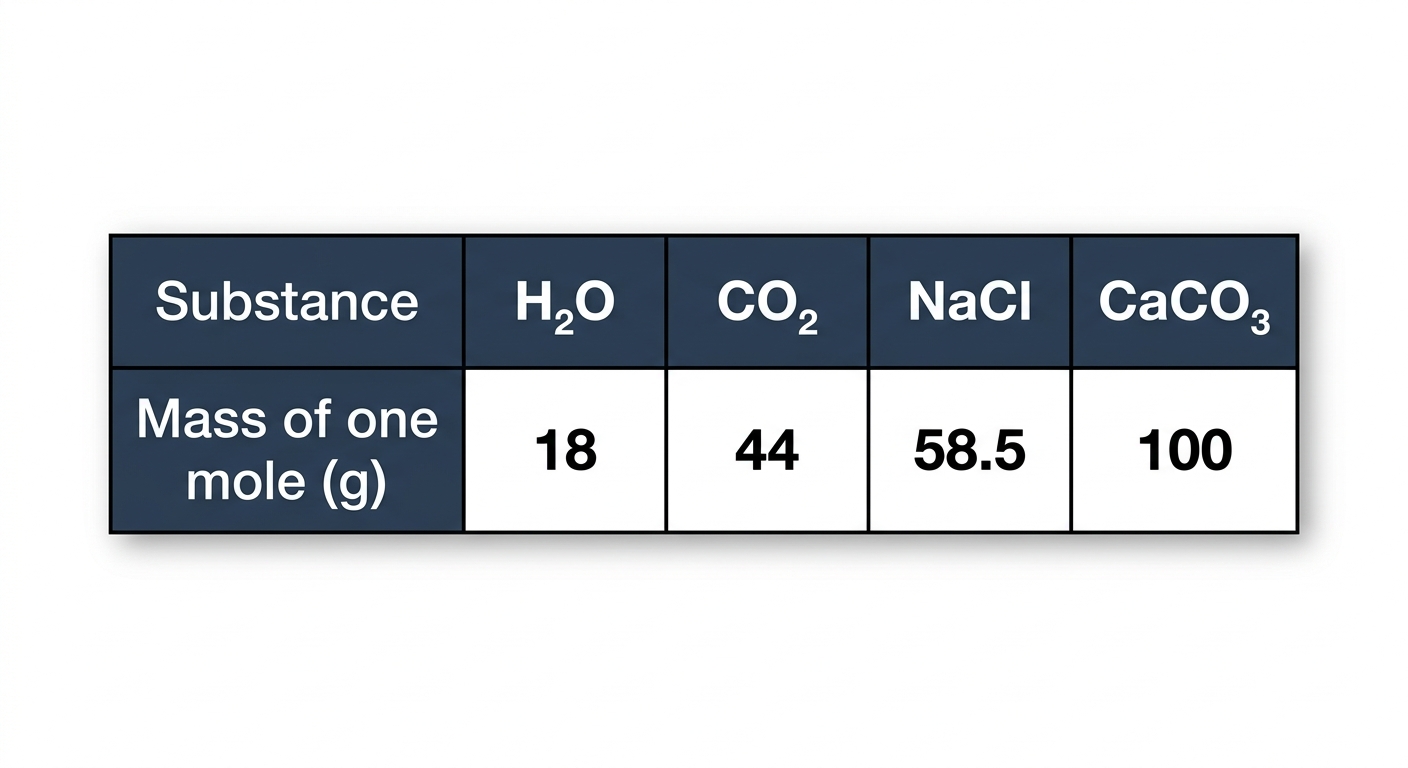
The table shown gives the mass of one mole of four substances.
Question diagram
(a)
Calculate the mass of 0.250 mol of calcium carbonate. [1]Criterion C (i) · Level 1-2
(b)
Calculate the amount of carbon dioxide in 11.0 g. [1]Criterion C (i) · Level 1-2
(c)
Deduce whether 9.0 g of water or 29.25 g of sodium chloride contains more particles. Show your working. [2]Criterion A (ii) · Level 3-4

revisionprep.com

Summary Answer

Not available for this question.

Model Answer

Not available for this question.

Marking Scheme

Not available for this question.

Examiner Insights

Not available for this question.

Question 2Criterion A + C · Band 1-4 · Easy · 5 marksrevisionprep.com

Counting particles in compounds vs elements
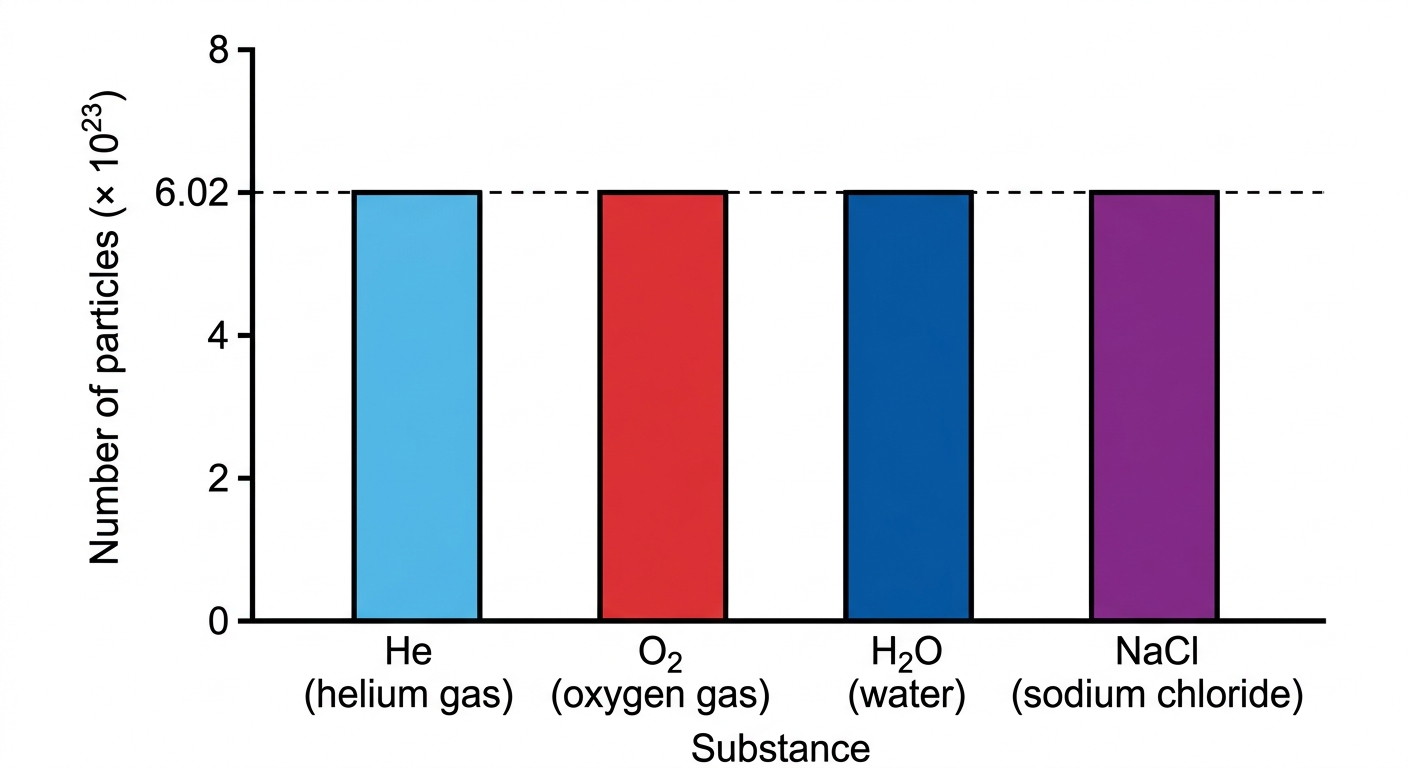
The bar chart shows the number of particles in one mole of helium, oxygen, water and sodium chloride.
Question diagram
(a)
State the name and value of the constant shown by the height of every bar. [1]Criterion A (i) · Level 1-2
(b)
Identify the type of particle counted for each substance. [2]Criterion A (i) · Level 3-4
(c)
A student redraws the chart to show the total number of atoms or ions in one mole of each substance. State the new height of each bar. [2]Criterion C (i) · Level 3-4

revisionprep.com

Summary Answer

Not available for this question.

Model Answer

Not available for this question.

Marking Scheme

Not available for this question.

Examiner Insights

Not available for this question.

Question 3Criterion C + B · Band 1-6 · Medium · 9 marksrevisionprep.com

Definition of a mole and amount of substance

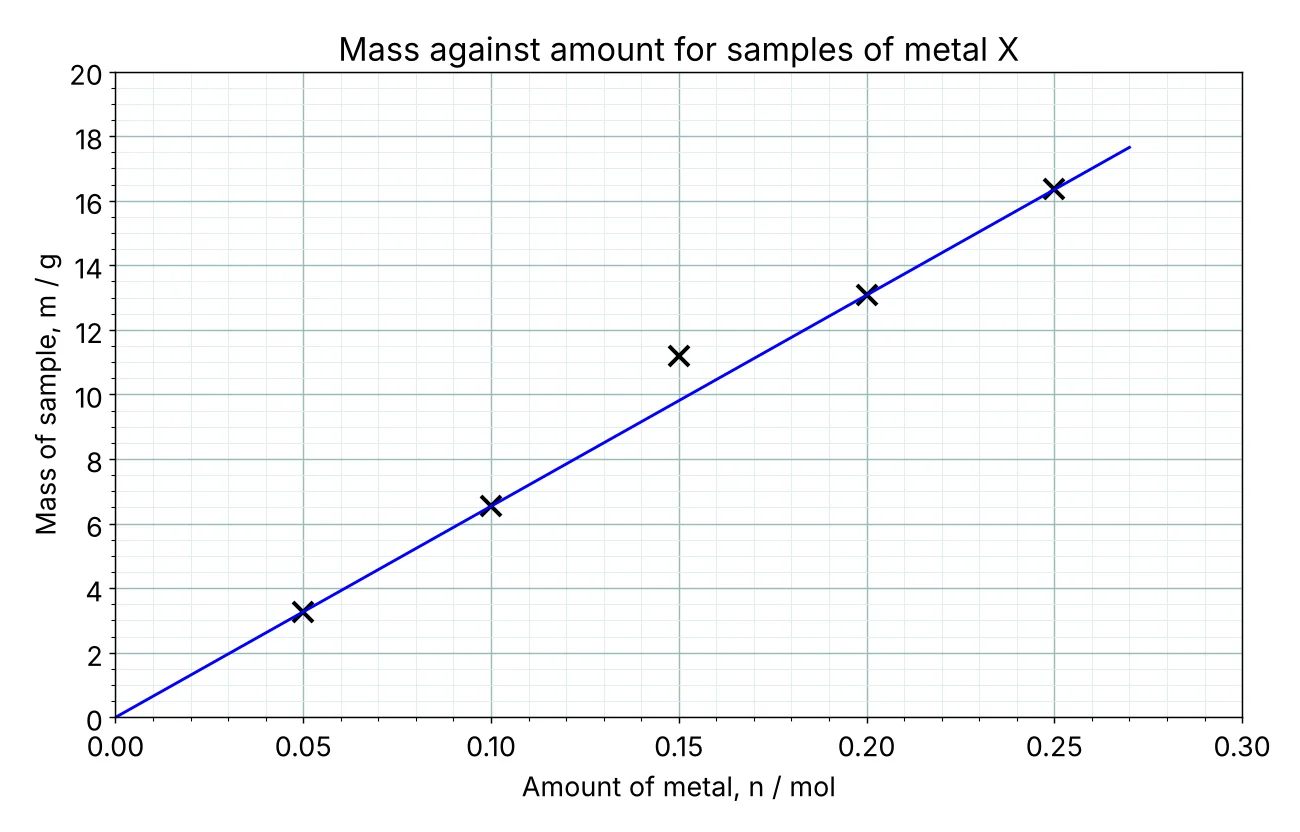
A student measured the mass of five samples of a pure metal X, each containing a known amount of X. The graph shows the results and a line of best fit drawn through the origin.

Molar masses: copper 63.55 g mol−1\text{g mol}^{-1}, zinc 65.38 g mol−1\text{g mol}^{-1}, gallium 69.72 g mol−1\text{g mol}^{-1}.
Question diagram
(a)
Determine the gradient of the line of best fit. Give its unit. [2]Criterion C (ii) · Level 3-4
(b)
State what the gradient represents. [1]Criterion C (ii) · Level 1-2
(c)
Identify metal X. Justify your answer. [1]Criterion C (ii) · Level 3-4
(d)
Identify the anomalous result. Suggest one cause, explaining whether it would make the measured mass too high or too low. [2]

(e) Explain why the line of best fit must pass through the origin. [1]

(f) Each sample was weighed only once. Explain how the student could collect sufficient data to make the gradient more reliable. [2]
Criterion C (iv) · Level 5-6

revisionprep.com

Summary Answer

Not available for this question.

Model Answer

Not available for this question.

Marking Scheme

Not available for this question.

Examiner Insights

Not available for this question.

Question 4Criterion B + A · Band 3-6 · Medium · 11 marksrevisionprep.com

Converting between moles and number of particles (atoms, molecules, ions)

A student wants to investigate how temperature affects the number of water molecules that evaporate per hour from an open dish. A balance reading to 0.01 g is available. Molar mass of water = 18.02 g mol−1\text{g mol}^{-1}; NA=6.02×10²³ mol−1N_A = 6.02 \times 10^{23}\ \text{mol}^{-1}.
(a)
Formulate a research question for this investigation. [2]Criterion B (i) · Level 3-4
(b)
Formulate a testable hypothesis and explain it using particle theory. [3]Criterion B (ii) · Level 5-6
(c)
Explain how the independent variable will be changed, how the dependent variable will be measured, and identify two control variables. [4]Criterion B (iii) · Level 5-6
(d)
At 40 °C, the dish lost 0.36 g of water in one hour. Calculate the number of water molecules that evaporated. [2]Criterion A (ii) · Level 3-4

revisionprep.com

Summary Answer

Not available for this question.

Model Answer

Not available for this question.

Marking Scheme

Not available for this question.

Examiner Insights

Not available for this question.

Question 5Criterion D + A · Band 3-8 · Challenge · 8 marksrevisionprep.com

Definition of a mole and amount of substance

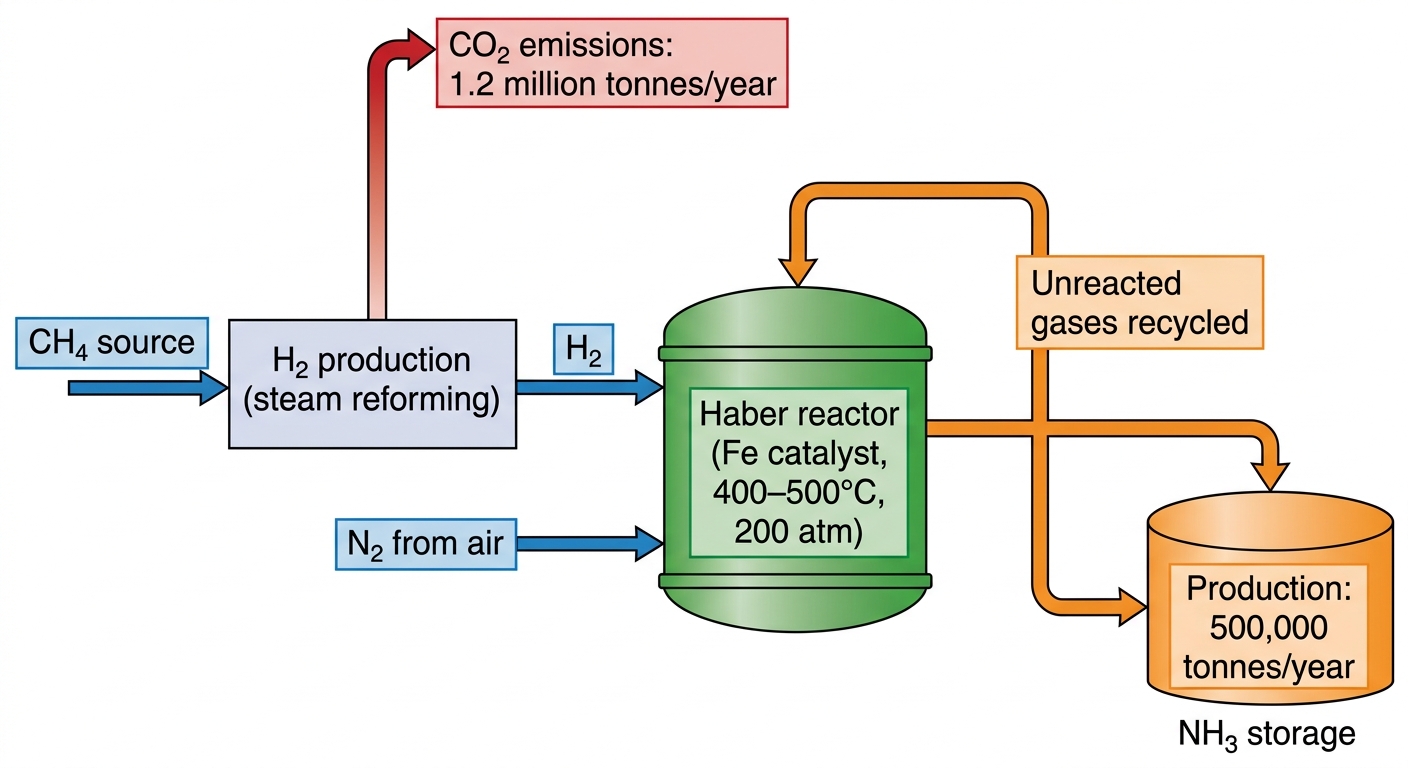
The diagram shows a proposed ammonia plant. Hydrogen is made from methane (natural gas), which releases carbon dioxide. Use the production and emission figures shown in the diagram (1 tonne = 10⁶ g).

Molar masses: NH3\mathrm{NH_{3}} = 17.03 g mol−1\text{g mol}^{-1}, CO2\mathrm{CO_{2}} = 44.01 g mol−1\text{g mol}^{-1}.
Question diagram
(a)
Calculate the amount of ammonia, in mol, produced per year. [2]Criterion A (ii) · Level 3-4
(b)
Calculate the amount of carbon dioxide, in mol, emitted per year. [1]Criterion A (ii) · Level 3-4
(c)
Deduce the number of CO2\mathrm{CO_{2}} molecules released for every NH3\mathrm{NH_{3}} molecule produced. [1]Criterion D (i) · Level 5-6
(d)
The company proposes making hydrogen by electrolysis of water using electricity from wind farms instead of from methane. Discuss the implications of this change. [4]Criterion D (ii) · Level 7-8

revisionprep.com

Summary Answer

Not available for this question.

Model Answer

Not available for this question.

Marking Scheme

Not available for this question.

Examiner Insights

Not available for this question.

Question 6Criterion A + D · Band 1-8 · Challenge · 8 marksrevisionprep.com

Avogadro's constant and its significance
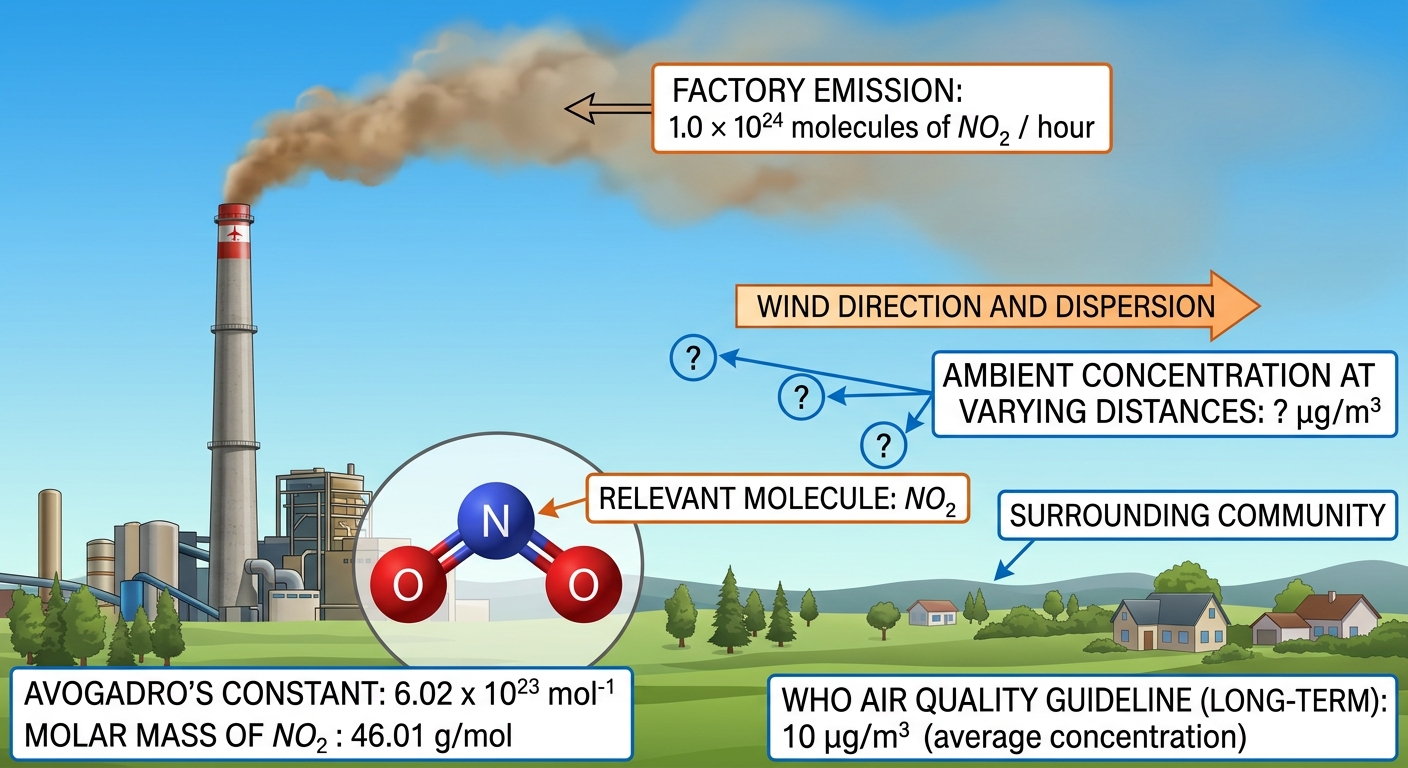
The diagram shows a factory that releases 1.0×10241.0 \times 10^{24} molecules of nitrogen dioxide, NO2\mathrm{NO_{2}}, per hour. Molar mass of NO2\mathrm{NO_{2}} = 46.01 g mol−1\text{g mol}^{-1}; NA=6.02×10²³ mol−1N_A = 6.02 \times 10^{23}\ \text{mol}^{-1}. The World Health Organization (WHO) guideline for long-term exposure is an average of 10 µg of NO2\mathrm{NO_{2}} per cubic metre of air.
Question diagram
(a)
Calculate the amount of NO2\mathrm{NO_{2}} released per hour. [1]Criterion A (ii) · Level 1-2
(b)
Calculate the mass of NO2\mathrm{NO_{2}} released per hour. [2]Criterion A (ii) · Level 3-4
(c)
Calculate the volume of air in which one hour's emission would give exactly the WHO guideline concentration. [2]Criterion A (ii) · Level 5-6
(d)
Explain why the emission rate alone cannot show whether people living near the factory are exposed to more than the WHO guideline. [3]Criterion D (ii) · Level 7-8

revisionprep.com

Summary Answer

Not available for this question.

Model Answer

Not available for this question.

Marking Scheme

Not available for this question.

Examiner Insights

Not available for this question.

That's every free question here — 6 of 91.

+85 more questions, plus Mock Papers & Worksheets, are waiting in Premium.

Upgrade