You're viewing free preview questions — 4 questions previewing here — subscribe to unlock 55 more, plus the Full Question Bank, Mock Papers & Worksheets.Upgrade
Real-Life Problem Solving with Equations — Free MYP4 Mathematics (Extended) Practice Questions

1QuestionMulti-Step Problems with VariablesConcept Practice
2 marks~3 minCriterion B
A community centre arranges daily volunteer shifts. The shift lengths (in hours) follow a pattern of consecutive integers:
Day 1: hours
Day 2: hours
Day 3: hours
Day 4: hours
On Day 5, shifts run for 6 consecutive integers starting at 5.
Day 1: hours
Day 2: hours
Day 3: hours
Day 4: hours
On Day 5, shifts run for 6 consecutive integers starting at 5.
a
Deduce the pattern connecting the sum of each set to its terms. [1]
b
A volunteer coordinator claims Day 5 totals exactly 45 hours of coverage. Justify whether this claim is correct. [1]
Solutions

2QuestionAge Distance and Geometry-Based ProblemsAssessment Practice
2 marks~3 minCriterion A
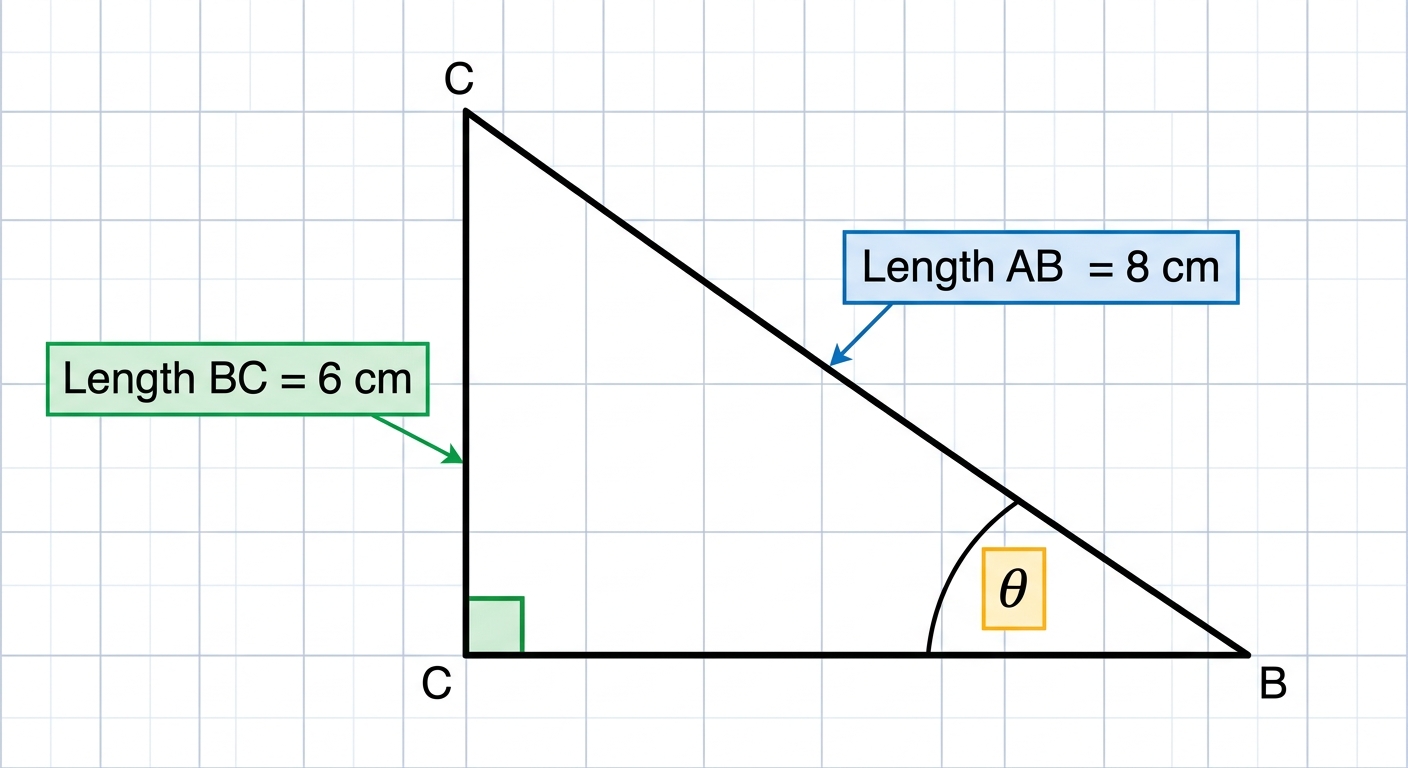
A ladder leans against a vertical wall. The ladder is 8 m long and its base rests on horizontal ground 6 m from the wall. The angle is formed between the ladder and the wall at the top.
Deduce the size of angle , giving your answer in degrees to one decimal place. [2]
Deduce the size of angle , giving your answer in degrees to one decimal place. [2]
Solutions
3QuestionChoosing Appropriate MethodsAssessment Practice
4 marks~6 minCriterion D
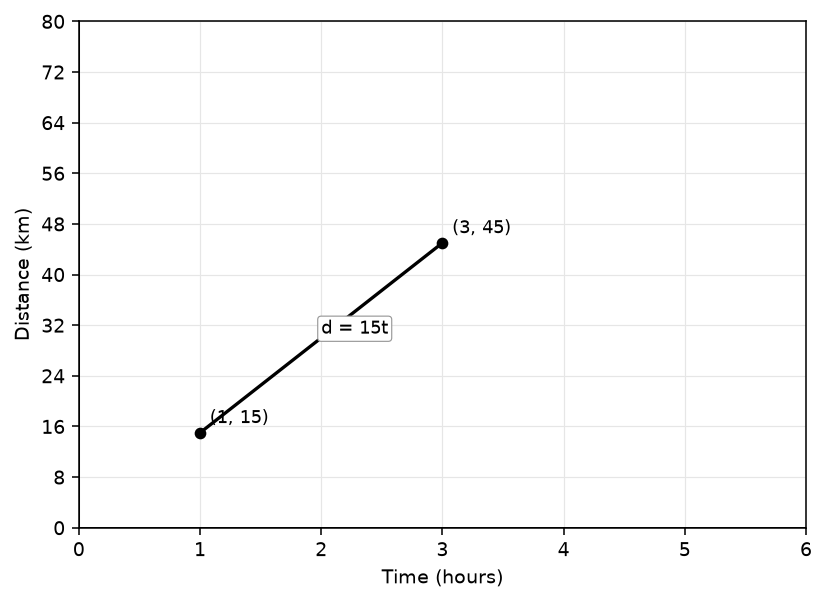
A cyclist's journey is modelled by a straight-line graph of distance (km) against time (hours). The line passes through the points and .
a
Calculate the cyclist's speed. [1]
b
Deduce the equation of the line in the form , where is distance in km and is time in hours. [1]
c
The cyclist's destination is 70 km away. Using your equation, advise whether the cyclist should plan to complete the journey within a 5-hour window. Justify your answer. [2]
Solutions
4QuestionChoosing Appropriate MethodsAssessment Practice
3 marks~5 minCriterion C
A car's distance from its starting point is recorded below.
| Time (hours) | 0 | 1 | 2 | 3 | 4 |
|---|---|---|---|---|---|
| Distance (km) | 0 | 40 | 90 | 120 | 200 |
a
Calculate the average speed of the car during the interval hours to hours, using
Show your working and give your answer in km/h. [1]
Show your working and give your answer in km/h. [1]
b
The car travels the same total distance of 200 km in 4 hours on a second journey, but at a constant speed throughout. Calculate this constant speed. [1]
c
The road used for the first journey has a speed limit of 60 km/h. Justify whether your answer from part (a) alone is sufficient evidence to conclude that the speed limit was exceeded during the interval to hours. [1]
Solutions
That's every free question here — 4 of 59.
+55 more questions, plus Mock Papers & Worksheets, are waiting in Premium.