You're viewing free preview questions — 4 questions previewing here — subscribe to unlock 91 more, plus the Full Question Bank, Mock Papers & Worksheets.Upgrade
Simultaneous Linear Equations — Free MYP4 Mathematics (Extended) Practice Questions

1QuestionChecking Solutions for Both EquationsConcept Practice
2 marks~3 minCriterion A
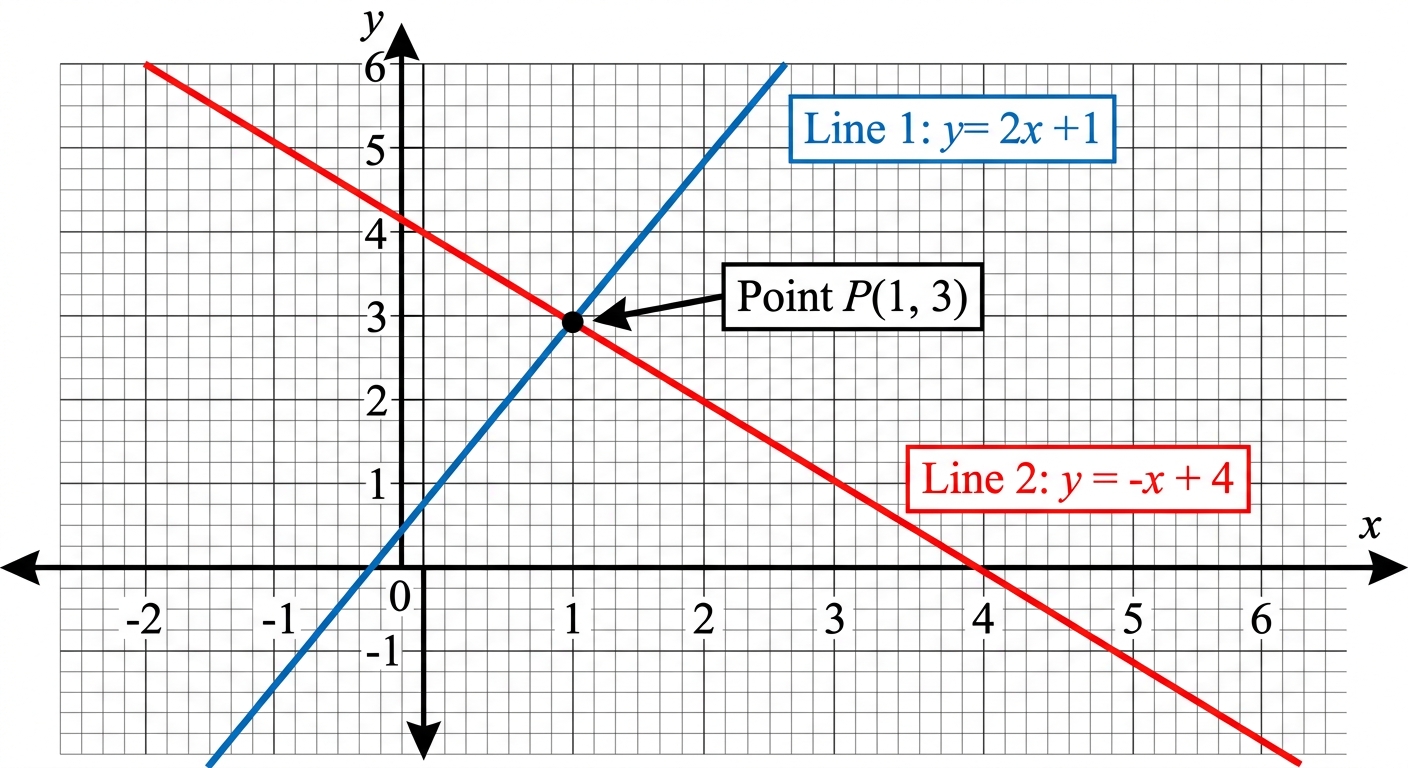
A city planner models two proposed road alignments on a coordinate grid. Road 1 follows and Road 2 follows . A junction is planned at point .
Justify that is the junction point of the two roads by verifying it satisfies both equations. [2]
Justify that is the junction point of the two roads by verifying it satisfies both equations. [2]

Solutions
2QuestionSolving GraphicallyAssessment Practice
4 marks~6 minCriterion C
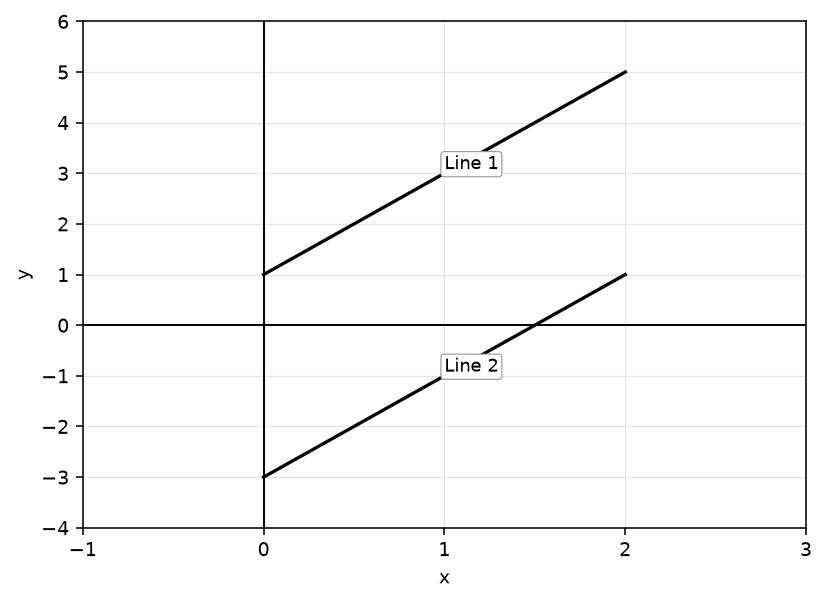
A city planner models two proposed road alignments as straight lines on a coordinate grid. The graph shows both lines.
Line 1 passes through and .
Line 2 passes through and .
Line 1 passes through and .
Line 2 passes through and .
a
Deduce the gradient of each line from the graph. [1]
b
Explain why the two roads will never intersect, using the properties of both lines. [2]
c
Advise the city planner whether a single crossing point between the two roads can ever be achieved by extending them indefinitely, and justify your advice. [1]
Solutions
3QuestionChecking Solutions for Both EquationsAssessment Practice
4 marks~6 minCriterion D
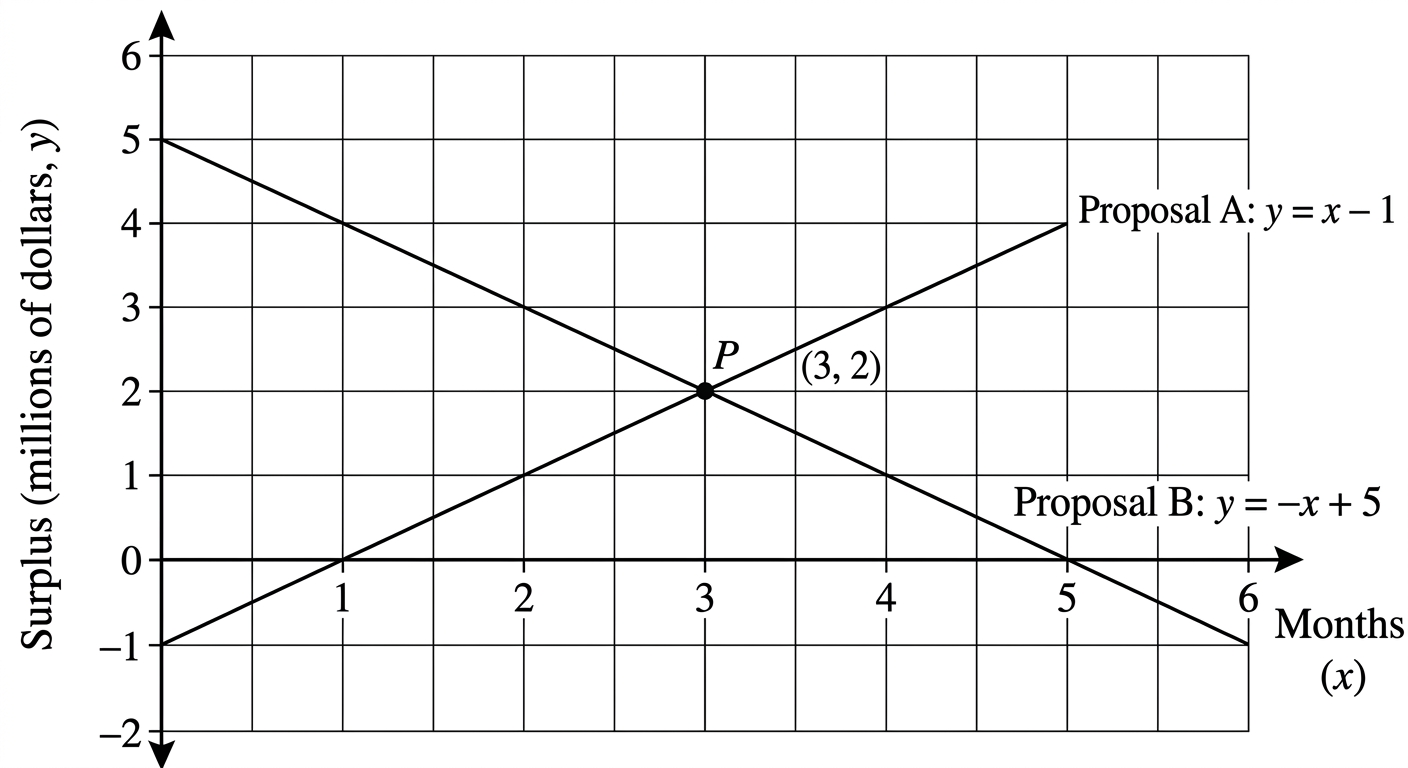
A city planner models two road-widening proposals. Proposal A follows the cost equation and Proposal B follows , where is the number of months into the project and is the projected budget surplus (in millions of dollars). The graph shows both lines intersecting at point .
a
State the coordinates of from the graph. [1]
b
Show that satisfies both equations simultaneously. [2]
c
Interpret what the coordinates of mean in this context, and advise the city planner whether should be used as the basis for deciding when both proposals are financially equivalent. [1]
Solutions
4QuestionSolving by Substitution MethodAssessment Practice
4 marks~6 minCriterion B
A logistics company tracks two delivery routes. Each day, the total distance covered by both routes is km, and the difference between the longer and shorter route is km. The distances (longer) and (shorter), in km, satisfy:
a
Deduce the values of and for each system. [1]
System 1: System 2:
System 3: System 4:
System 1: System 2:
System 3: System 4:
b
Deduce general formulas for and in terms of and . [1]
c
Prove that your formulas satisfy both original equations. [1]
d
The company requires the shorter route to be at least 30% of the total daily distance. For and , advise the company whether this scheduling requirement is met, justifying your answer using your formulas. [1]
Solutions
That's every free question here — 4 of 95.
+91 more questions, plus Mock Papers & Worksheets, are waiting in Premium.