You're viewing free preview questions — 4 questions previewing here — subscribe to unlock 41 more, plus the Full Question Bank, Mock Papers & Worksheets.Upgrade
Solving Quadratic Equations — Free MYP4 Mathematics (Extended) Practice Questions

1QuestionSolving Using the Quadratic FormulaAssessment Practice
5 marks~8 minCriterion A
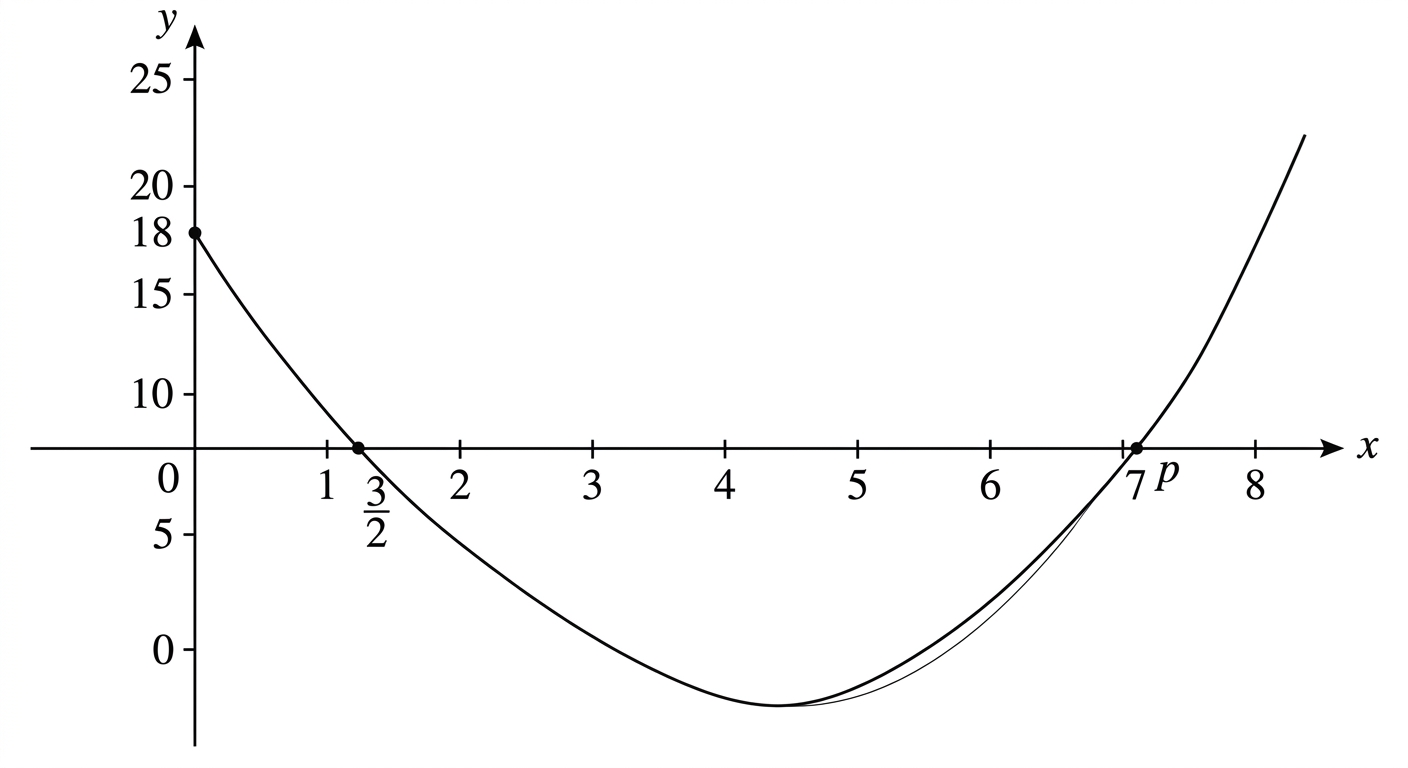
A quadratic function is defined by , where is a constant.
The diagram shows the parabola crossing the -axis at and at a second point labelled .
The diagram shows the parabola crossing the -axis at and at a second point labelled .
a
Write down the -intercept of . [1]
b
Given that is a root of , calculate the value of and hence the value of . [3]
c
The equation has exactly one solution. Justify why exactly one value of produces this result and state that value of . [1]

Solutions
2QuestionSolving Using the Quadratic FormulaAssessment Practice
6 marks~9 minCriterion C
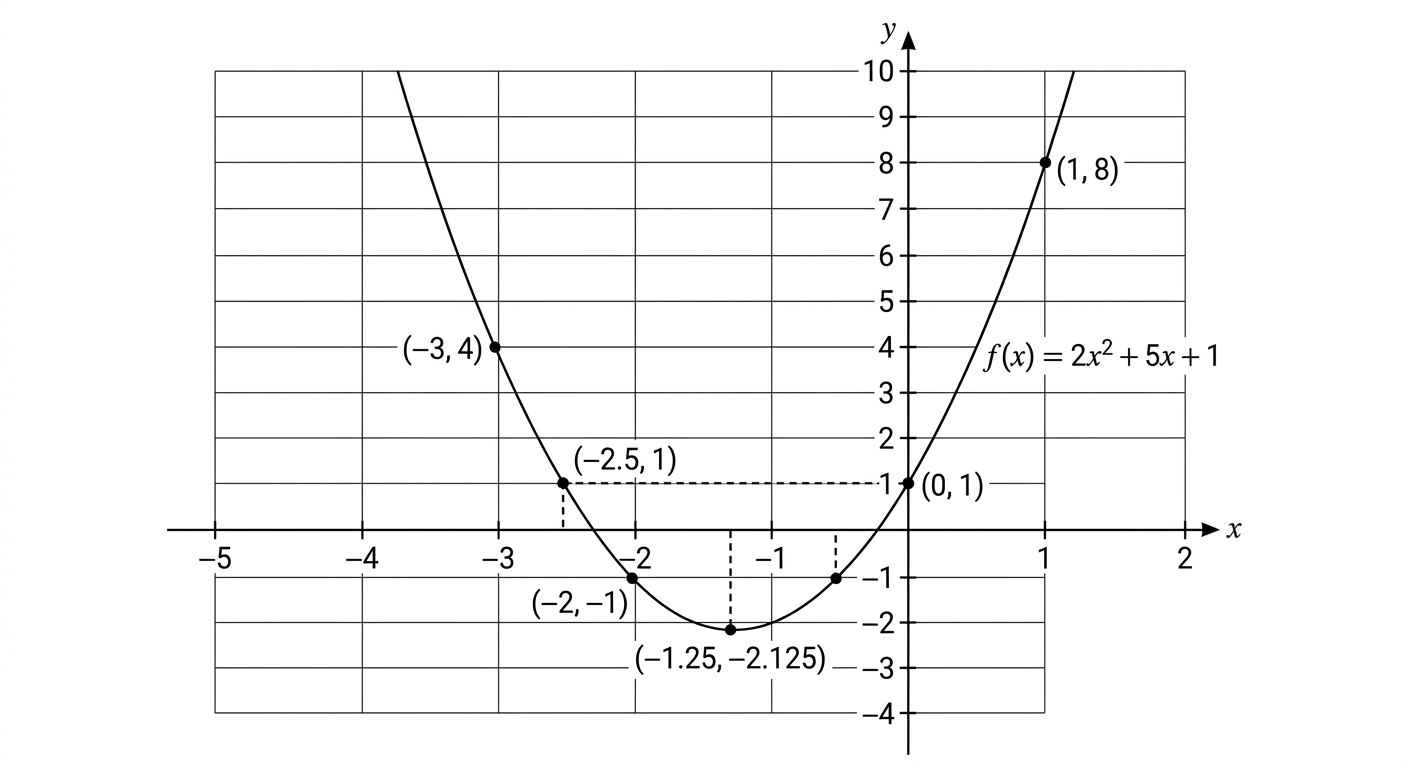
A quadratic function is given by , where is a constant.
a
Given that , show that . [1]
b
Find the other solution of . Give your answer as an exact value. [2]
c
A engineer states that the equation has no real solutions for . Justify whether the engineer's claim is correct. [3]
Solutions
3QuestionSolving Using the Quadratic FormulaAssessment Practice
7 marks~11 minCriterion B
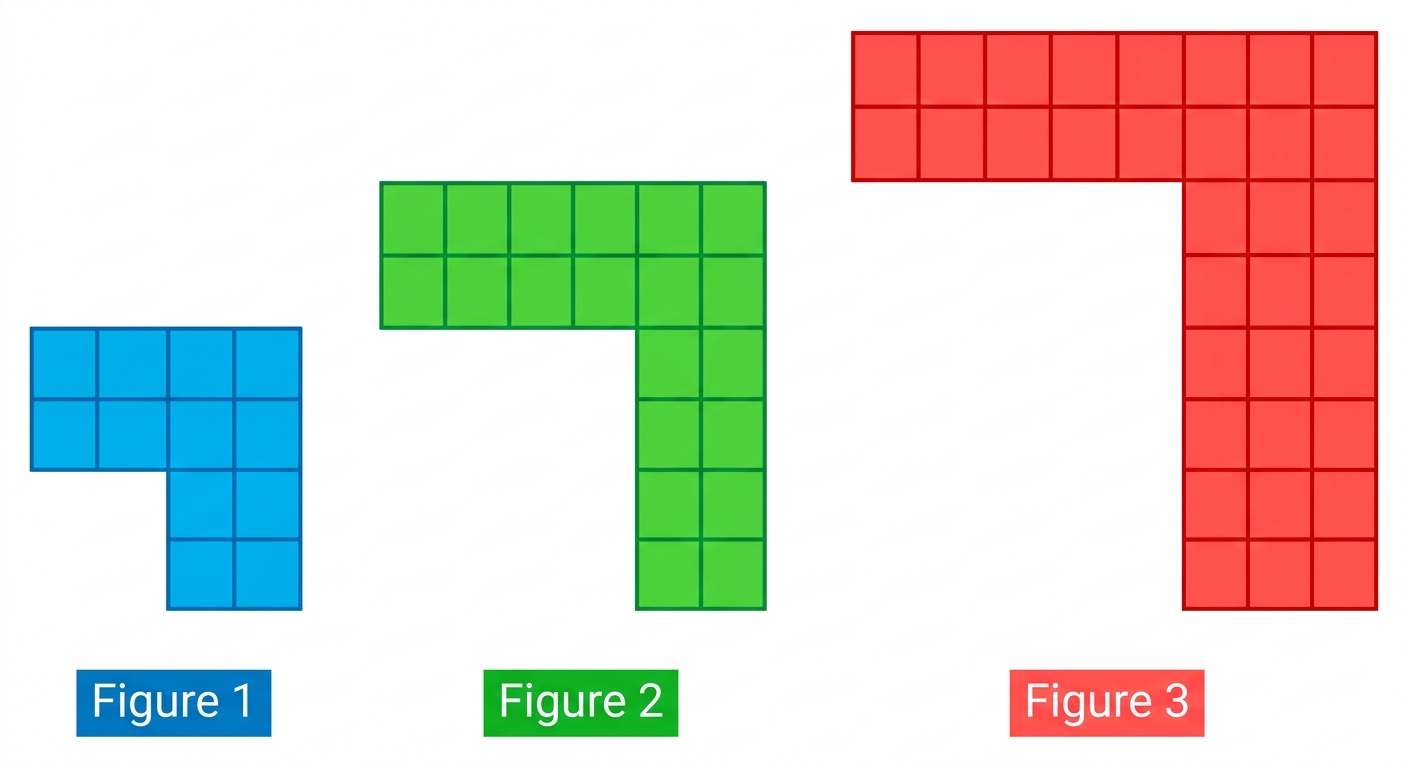
A pattern of growing L-shaped figures is made from unit squares. The first three figures are shown in the diagram.
| Figure number () | 1 | 2 | 3 |
|---|---|---|---|
| Number of squares () | 3 | 7 | 13 |
a
Write down the number of unit squares in Figure 4. [1]
b
Find a rule for the total number of unit squares in Figure . Give your rule in the form , where , and are integers. Show your method clearly. [3]
c
A student claims that every figure in the pattern contains an odd number of unit squares. Justify whether this claim is correct for all positive integer values of . [3]
Solutions
4QuestionNature of Roots Using DiscriminantAssessment Practice
10 marks~15 minCriterion D
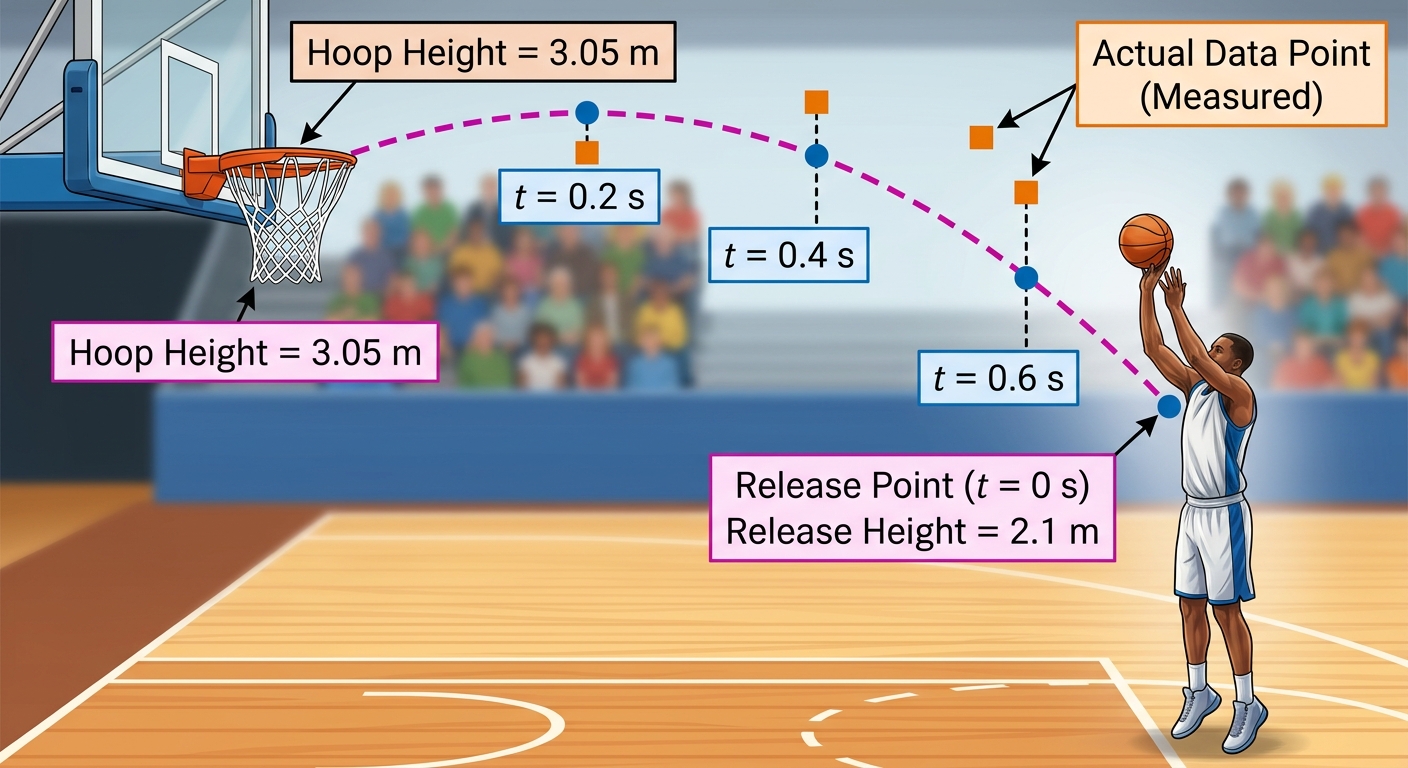
A basketball player shoots a free throw. The height (in metres) of the ball seconds after release is modelled by
The hoop is at a height of m. The table below shows the height predicted by the model and the actual measured height of the ball at three moments during a real shot.
Time (s): , ,
Predicted (m): , ,
Actual (m): , ,
The hoop is at a height of m. The table below shows the height predicted by the model and the actual measured height of the ball at three moments during a real shot.
Time (s): , ,
Predicted (m): , ,
Actual (m): , ,
a
Show that can be written as
and hence calculate the discriminant of this equation. [2]
and hence calculate the discriminant of this equation. [2]
b
The player adjusts their release so that the new model is
Find the minimum value of for which the ball can just reach the hoop height of m. Give your answer to 3 significant figures. [3]
Find the minimum value of for which the ball can just reach the hoop height of m. Give your answer to 3 significant figures. [3]
c
Percentage error is defined as
Calculate the percentage error at each of , , and . Give each answer to 1 decimal place. [3]
Calculate the percentage error at each of , , and . Give each answer to 1 decimal place. [3]
d
Using your percentage errors from part (c), justify whether this quadratic model is suitable for predicting the height of the ball throughout the shot. [2]
Solutions
That's every free question here — 4 of 45.
+41 more questions, plus Mock Papers & Worksheets, are waiting in Premium.