You're viewing free preview questions — 4 questions previewing here — subscribe to unlock 43 more, plus the Full Question Bank, Mock Papers & Worksheets.Upgrade
Applications of Functions — Free MYP4 Mathematics (Extended) Practice Questions

1QuestionInterpret contextConcept Practice
2 marks~3 minCriterion A
A bicycle rental company charges a fixed registration fee plus an hourly rate. The total cost (in dollars) for renting a bicycle for hours is recorded below.
| Hours () | 1 | 2 | 3 | 4 |
|---|---|---|---|---|
| Total cost ( in dollars) | 8 | 11 | 14 | 17 |
a
Deduce the equation for in terms of . [1]
b
Interpret what the fixed registration fee and the hourly rate represent in this context, and identify which variable is dependent and which is independent. [1]

Solutions
2QuestionPredictionAssessment Practice
2 marks~3 minCriterion D
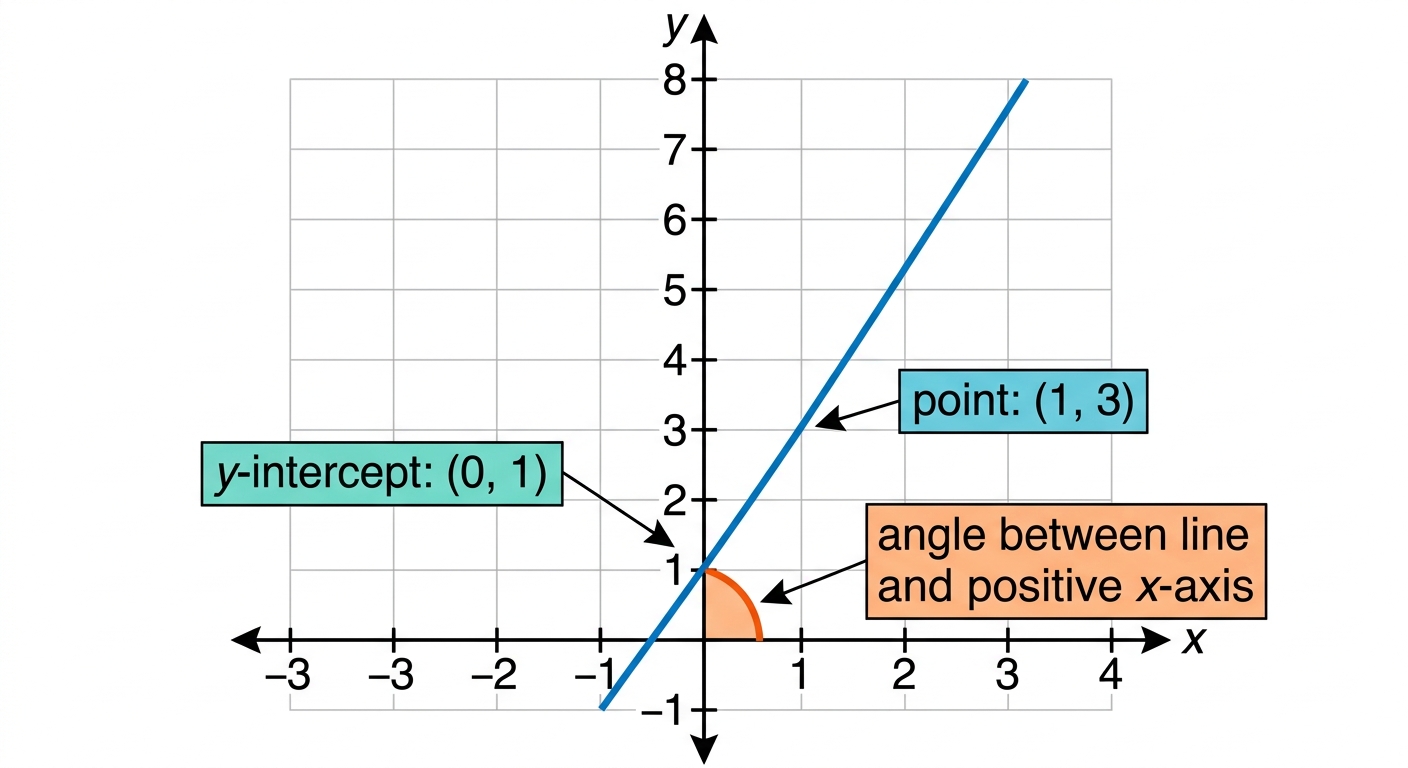
A ski slope is modelled by the line , where is the horizontal distance (m) and is the vertical height (m).
Safety regulations state that a ski slope must make an angle of less than 60° with the horizontal to be classified as a beginner slope.
Justify whether this slope qualifies as a beginner slope. [2]
Safety regulations state that a ski slope must make an angle of less than 60° with the horizontal to be classified as a beginner slope.
Justify whether this slope qualifies as a beginner slope. [2]
Solutions
3QuestionReal-life modelsAssessment Practice
4 marks~6 minCriterion B
A student compares two savings plans. The total saved (in dollars) at the end of each week is recorded below.
Week (): 1, 2, 3, 4, 5
Plan A (): 50, 100, 150, 200, 250
Plan B (): 50, 105, 170, 245, 330
Week (): 1, 2, 3, 4, 5
Plan A (): 50, 100, 150, 200, 250
Plan B (): 50, 105, 170, 245, 330
a
Deduce the type of pattern (linear or quadratic) for each plan and derive a formula for total savings after weeks. [2]
b
Construct a prediction for the total savings under each plan after 10 weeks. [1]
c
Advise the student which savings plan to follow over a 52-week year, supporting your recommendation with calculated evidence. [1]
Solutions
4QuestionPredictionAssessment Practice
6 marks~9 minCriterion D
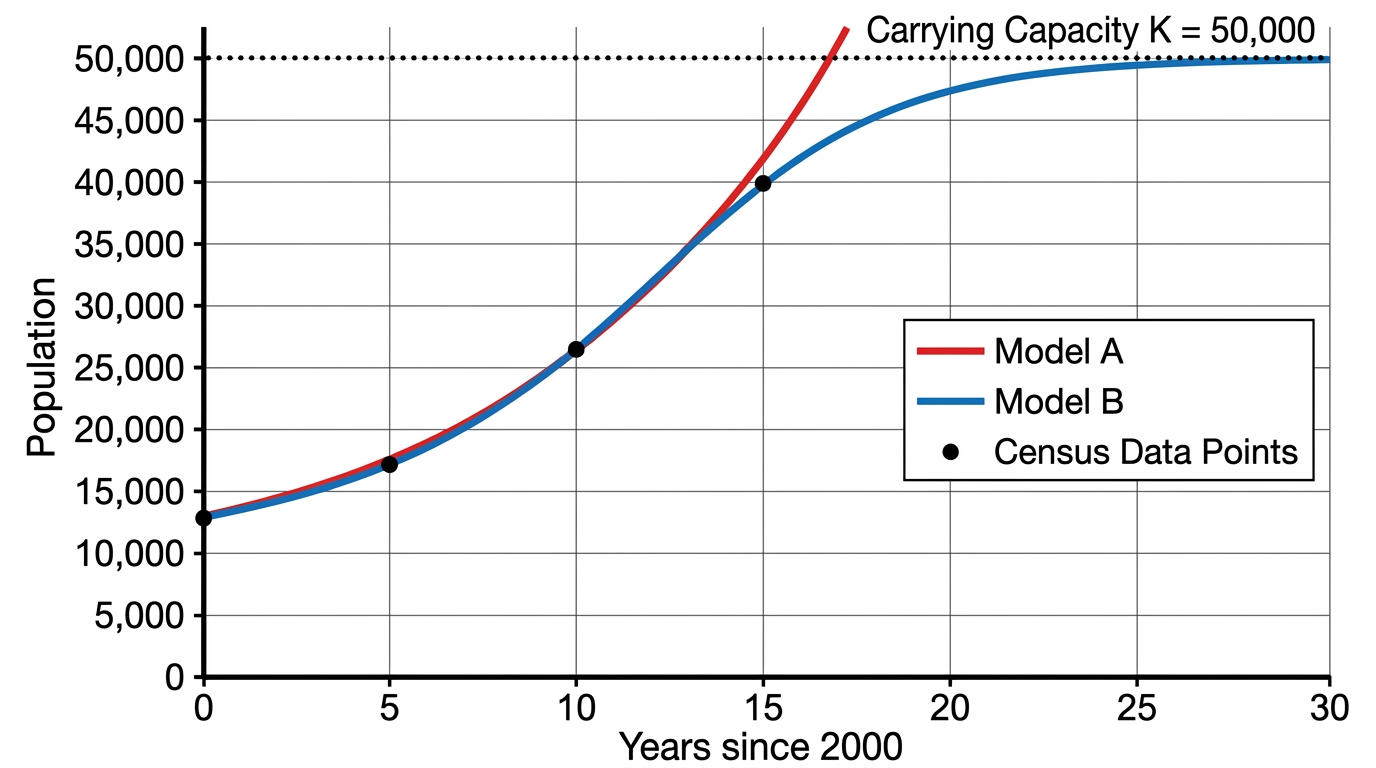
A city planner is modelling the population growth of a town. Census data shows the population was 10 000 in 2000, 12 000 in 2005, 14 400 in 2010, and 17 280 in 2015. Two models are proposed, where is years since 2000:
Model A (exponential):
Model B (logistic):
Model A (exponential):
Model B (logistic):
a
Calculate the predicted population in 2030 using both models. Show all working. [2]
b
Justify which model is more appropriate for long-term population prediction, referring to the structure of each model. [2]
c
The city planner must decide whether to commission a new water treatment plant with capacity for 30 000 residents. Advise the city planner whether either model provides sufficient justification to commission the plant for 2030, identifying one assumption of each model that could affect the reliability of this advice. [2]
Solutions
That's every free question here — 4 of 47.
+43 more questions, plus Mock Papers & Worksheets, are waiting in Premium.