You're viewing free preview questions — 4 questions previewing here — subscribe to unlock 47 more, plus the Full Question Bank, Mock Papers & Worksheets.Upgrade
Transformations — Free MYP4 Mathematics (Extended) Practice Questions

1QuestionStretch/compressionConcept Practice
4 marks~6 minCriterion A
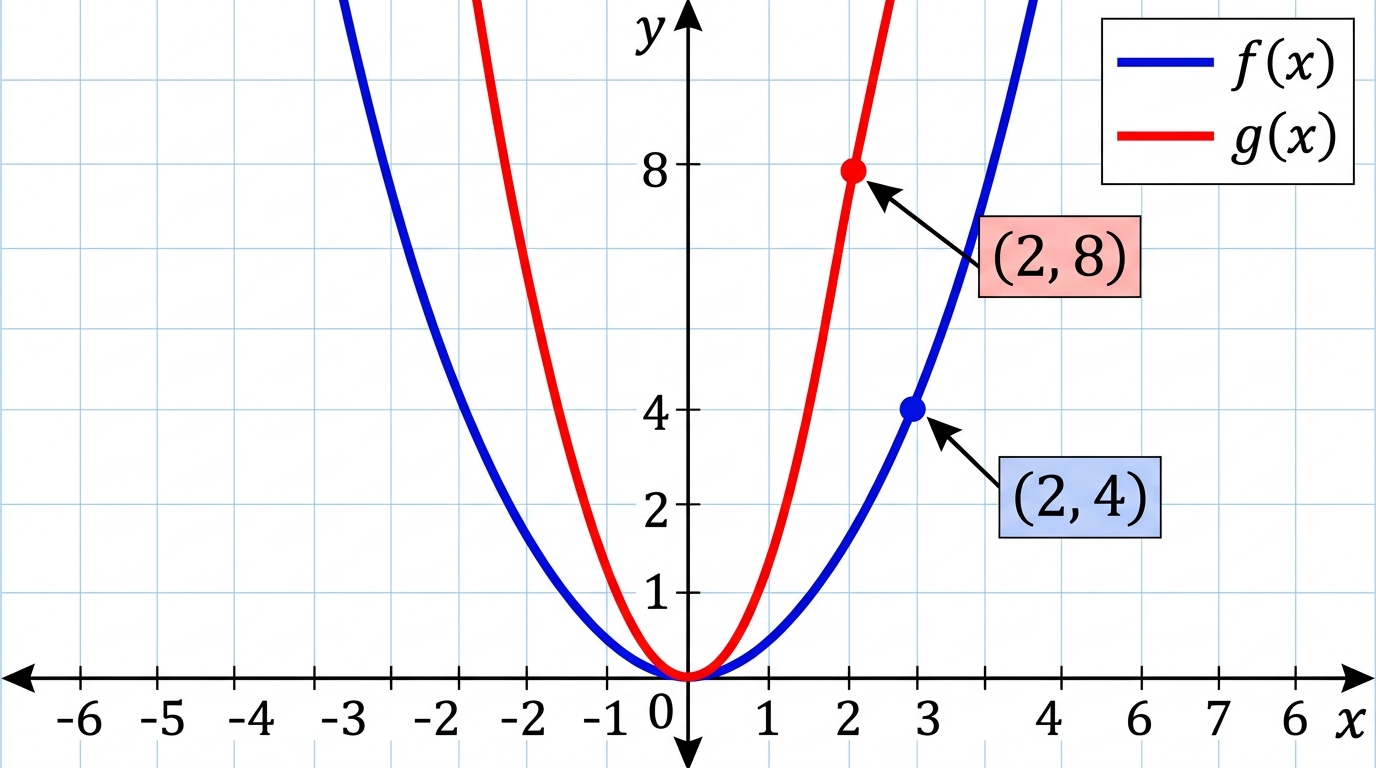
A photographer uses editing software to adjust image brightness. The software models the original brightness of a pixel as , where is the input light value. The adjusted brightness is .
The point lies on and the point lies on .
The point lies on and the point lies on .
a
Deduce the value of . [1]
b
Explain what the vertical stretch by factor means for how the software changes pixel brightness. [1]
c
A pixel has input value . The software requires adjusted brightness to exceed 60 to display correctly. Justify whether this pixel displays correctly after the transformation. [2]

Solutions
2QuestionStretch/compressionAssessment Practice
6 marks~9 minCriterion C
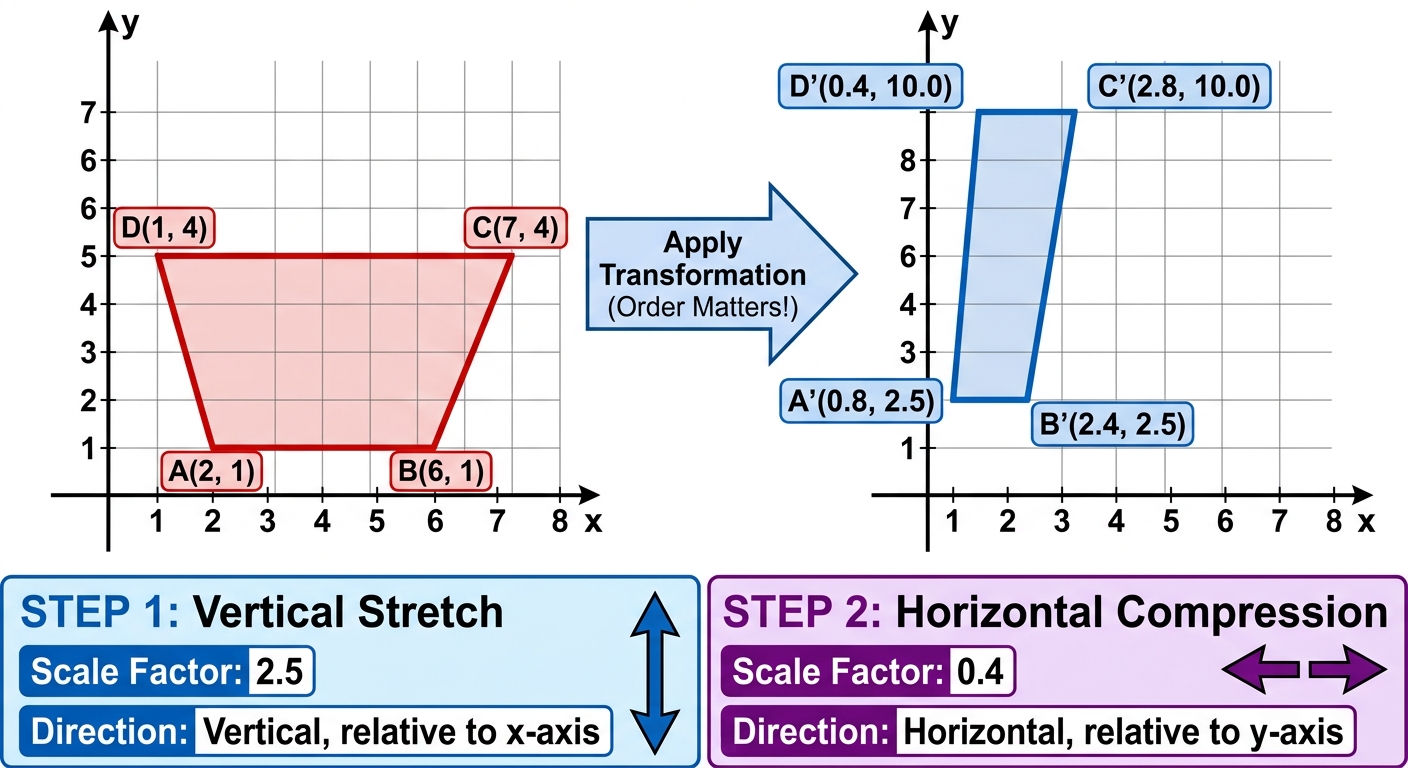
A graphic designer is resizing a logo for a billboard and a business card. The logo's outline is defined by vertices , , , and . The designer applies a vertical stretch by factor , followed by a horizontal compression by factor .
a
Determine the coordinates of the transformed vertices , , , and after both transformations are applied in the given order. [2]
b
Calculate the area of the original logo and the area of the transformed logo. Show that the two areas are equal, and explain why this result occurs. [2]
c
Advise the designer whether this transformation is suitable for both media, justifying your answer with reference to the effect of non-uniform scaling on the logo's proportions and the significance of the equal-area result. [2]
Solutions
3QuestionReflectionsConcept Practice
2 marks~3 minCriterion B
A graphic designer uses coordinate geometry to create a reflected logo. The original logo contains the point . The designer reflects the entire logo across the -axis, as shown by the pattern below.
Deduce the general rule for reflecting any point across the -axis. [1]
State the image of after reflection across the -axis. [1]
Deduce the general rule for reflecting any point across the -axis. [1]
State the image of after reflection across the -axis. [1]
Solutions
4QuestionHorizontal shiftsAssessment Practice
6 marks~9 minCriterion D
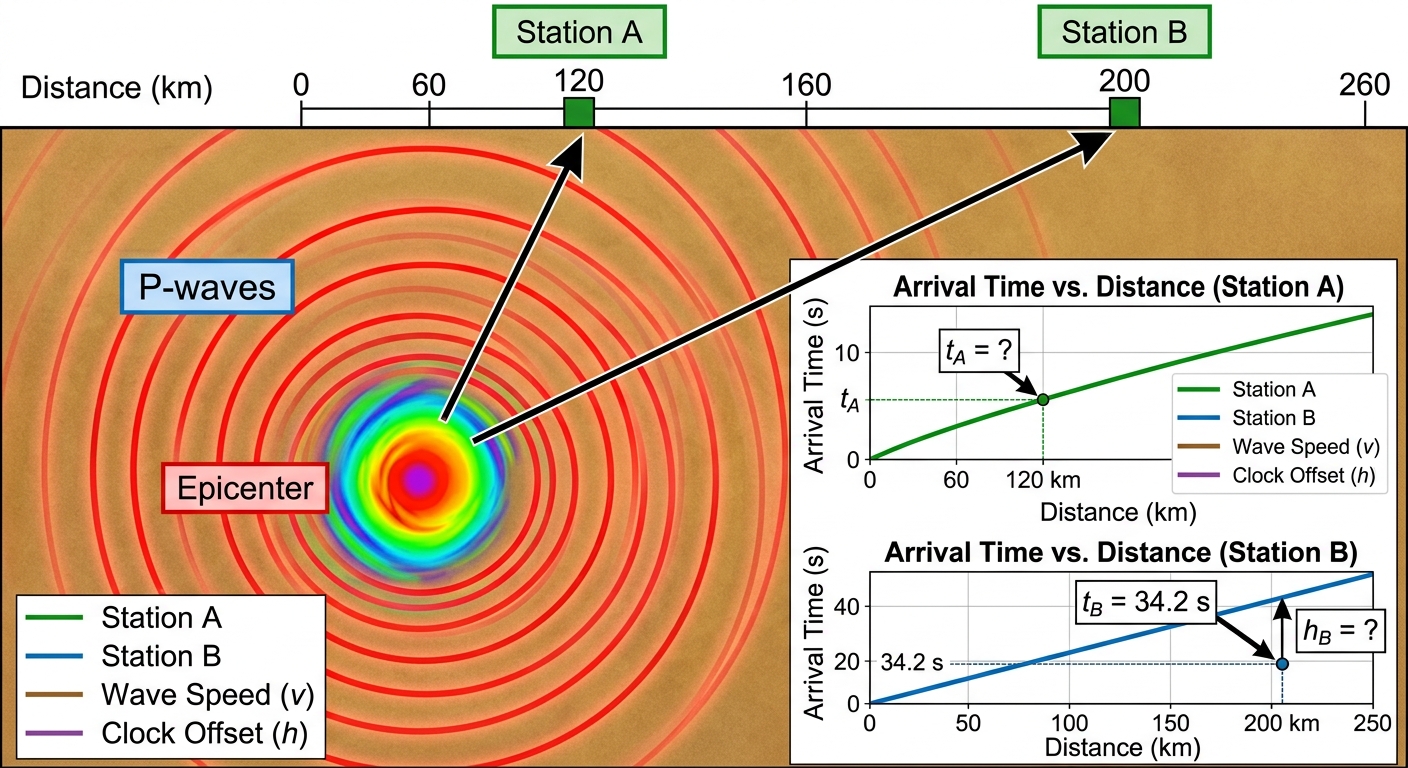
Seismologists model the P-wave arrival time (seconds) at a recording station using
where is the distance (km) from the epicentre, is the wave speed (km/s), and is the station's clock offset (seconds).
Station A is 120 km from an epicentre. The wave speed is km/s and the clock offset is s.
Station B is 200 km from the same epicentre, with km/s. Its recorded arrival time is s and its clock offset is unknown.
where is the distance (km) from the epicentre, is the wave speed (km/s), and is the station's clock offset (seconds).
Station A is 120 km from an epicentre. The wave speed is km/s and the clock offset is s.
Station B is 200 km from the same epicentre, with km/s. Its recorded arrival time is s and its clock offset is unknown.
a
Calculate the predicted arrival time at Station A. [2]
b
Determine the clock offset at Station B. [2]
c
Clock offsets carry a s uncertainty and wave speed is assumed constant across all rock layers. Advise a seismologist whether this model is sufficiently reliable to locate the epicentre for emergency response purposes. [2]
Solutions
That's every free question here — 4 of 51.
+47 more questions, plus Mock Papers & Worksheets, are waiting in Premium.