You're viewing free preview questions — 4 questions previewing here — subscribe to unlock 63 more, plus the Full Question Bank, Mock Papers & Worksheets.Upgrade
Transformations of Graphs — Free MYP4 Mathematics (Extended) Practice Questions

1QuestionStretching and Compressing GraphsConcept Practice
4 marks~6 minCriterion A
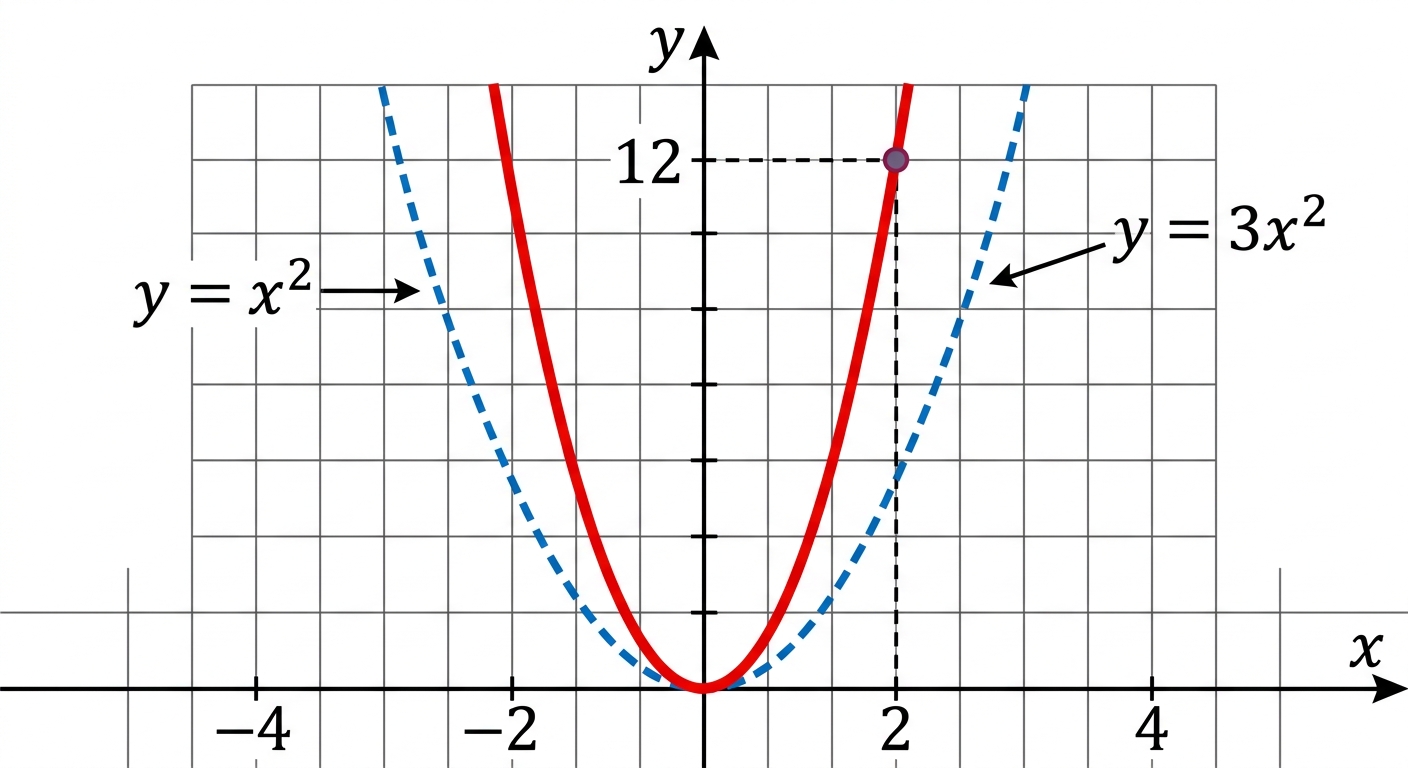
A solar panel manufacturer models the power output (in watts) of a panel using the function , where is the number of hours after sunrise. A premium panel has greater output, modelled by .
The premium panel produces 48 watts exactly 4 hours after sunrise.
The premium panel produces 48 watts exactly 4 hours after sunrise.
a
Deduce the value of . [2]
b
Explain what the value of means for the power output of the premium panel compared to the standard panel at every hour of the day. [2]

Solutions
2QuestionCombining Multiple TransformationsAssessment Practice
4 marks~6 minCriterion D
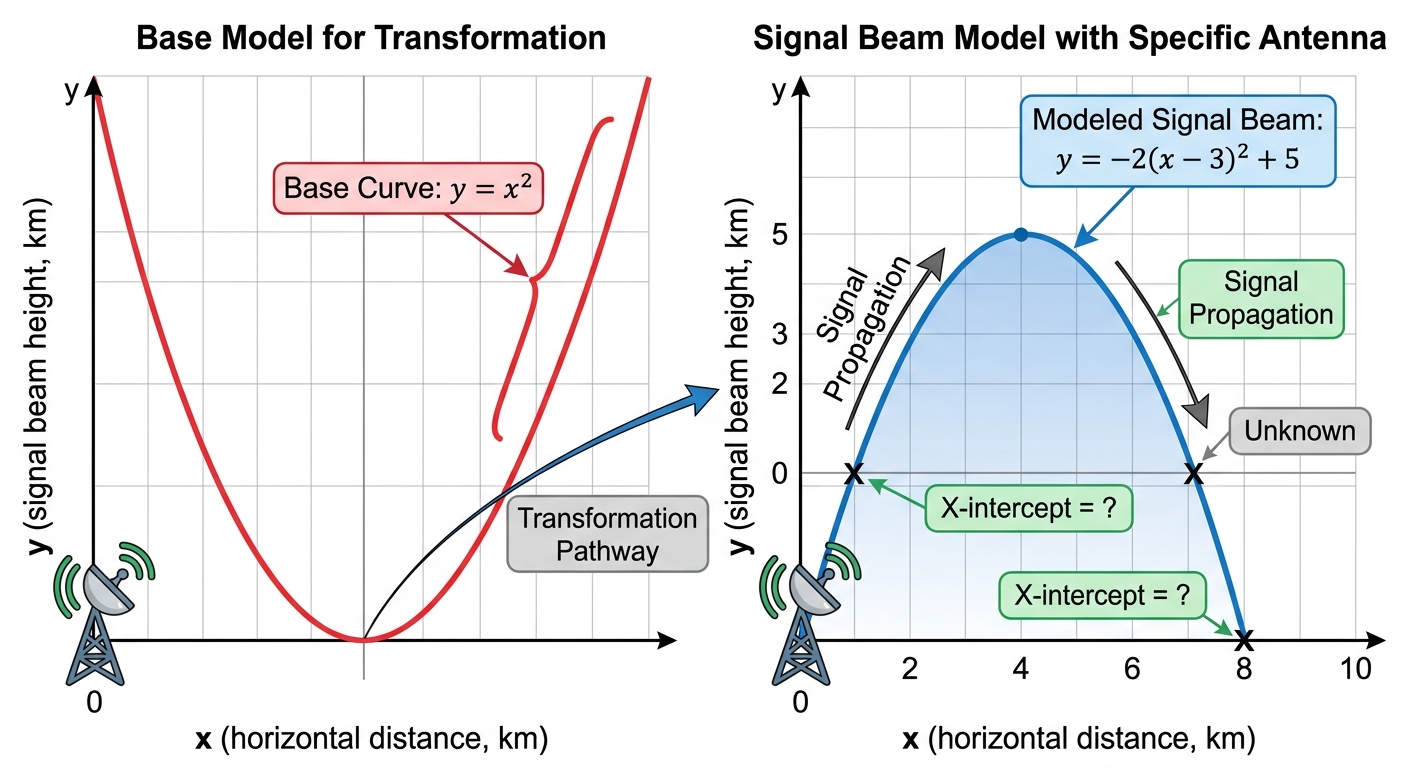
A telecommunications company models the height (in km) of a satellite dish's signal beam using
where is the horizontal distance in kilometres from the dish. The parent function is .
where is the horizontal distance in kilometres from the dish. The parent function is .
a
Describe the sequence of transformations applied to to obtain . [2]
b
Explain one mathematical advantage of using this form of the equation to identify the optimal signal coverage position. [1]
c
The company claims the model is reliable for all distances . Advise the company whether this claim should be accepted, supporting your answer with both a mathematical and a physical reason. [1]
Solutions
3QuestionDescribing Graph Changes AlgebraicallyAssessment Practice
7 marks~11 minCriterion C
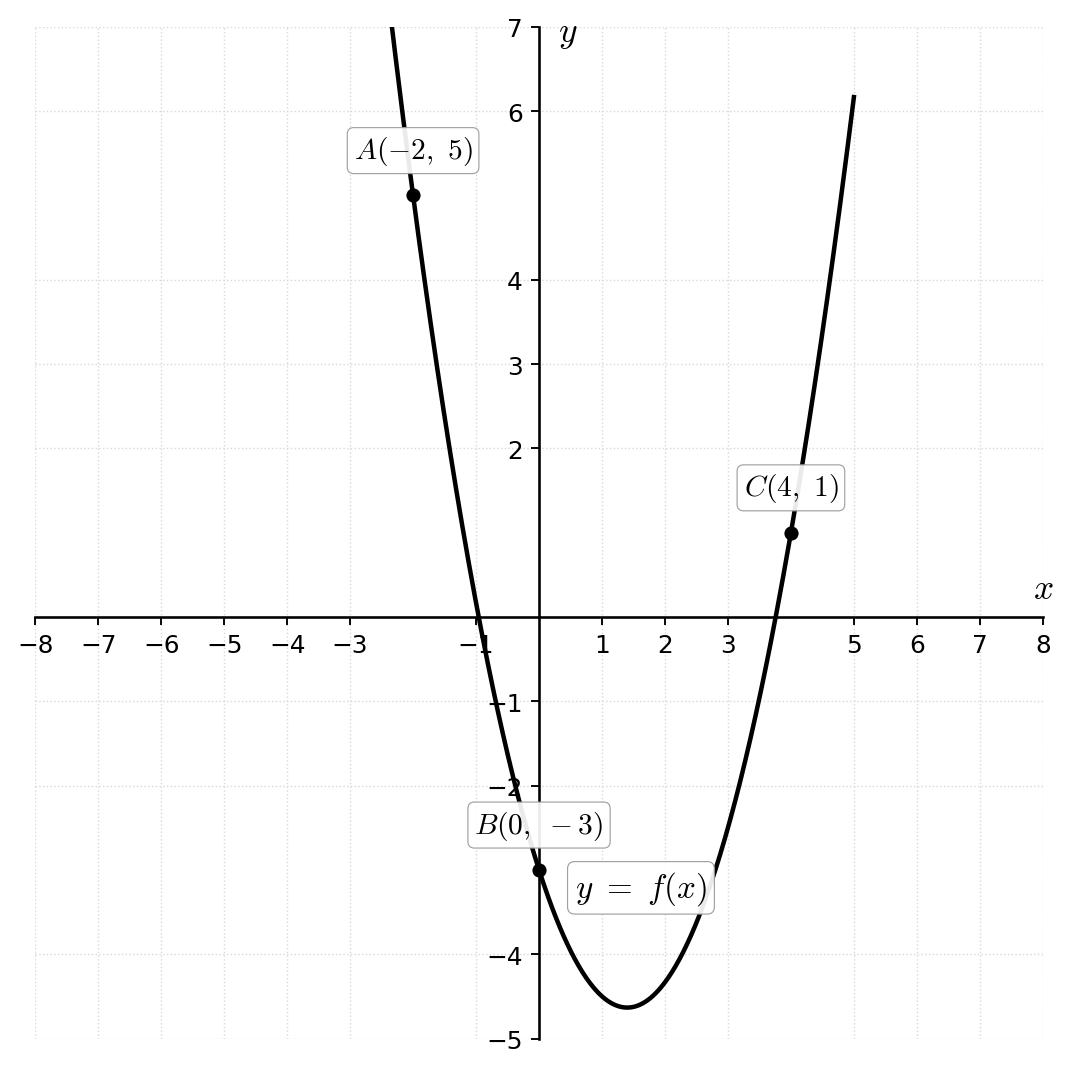
The diagram shows part of the graph of , which passes through the points , , and .
The table below shows the coordinates of , , and their images under three transformations.
Original on : \quad \quad
Image on : \quad \quad
Image on : \quad \quad
Image on : \quad \quad
The table below shows the coordinates of , , and their images under three transformations.
Original on : \quad \quad
Image on : \quad \quad
Image on : \quad \quad
Image on : \quad \quad
a
State the change in the -coordinate of each point when is transformed to , and state the direction of the resulting shift. [1]
b
A student claims that the combined transformation is equivalent to a single horizontal shift of . Find the image of under this combined transformation, and hence determine the single equivalent transformation, giving its equation in the form . [3]
c
Using the pattern in the table, write a general rule for the horizontal shift produced by for any real constant . Hence justify why shifts the graph of exactly units to the right, referring explicitly to at least two rows of the table to support your reasoning. [3]
Solutions
4QuestionStretching and Compressing GraphsAssessment Practice
2 marks~3 minCriterion B
A camera lens models image distortion using . Two adjusted lens settings produce and .
Selected coordinate pairs giving equal output values:
: values ; values
: values ; values
: values ; values
Deduce the general rule for the horizontal transformation of when written as , where , by identifying the pattern in the -coordinates across all three functions. [2]
Selected coordinate pairs giving equal output values:
: values ; values
: values ; values
: values ; values
Deduce the general rule for the horizontal transformation of when written as , where , by identifying the pattern in the -coordinates across all three functions. [2]
Solutions
That's every free question here — 4 of 67.
+63 more questions, plus Mock Papers & Worksheets, are waiting in Premium.