You're viewing free preview questions — 4 questions previewing here — subscribe to unlock 111 more, plus the Full Question Bank, Mock Papers & Worksheets.Upgrade
Change of Base Formula — Free MYP4 Mathematics (Extended) Practice Questions

1QuestionUnderstanding base conversionAssessment Practice
7 marks~11 minCriterion B
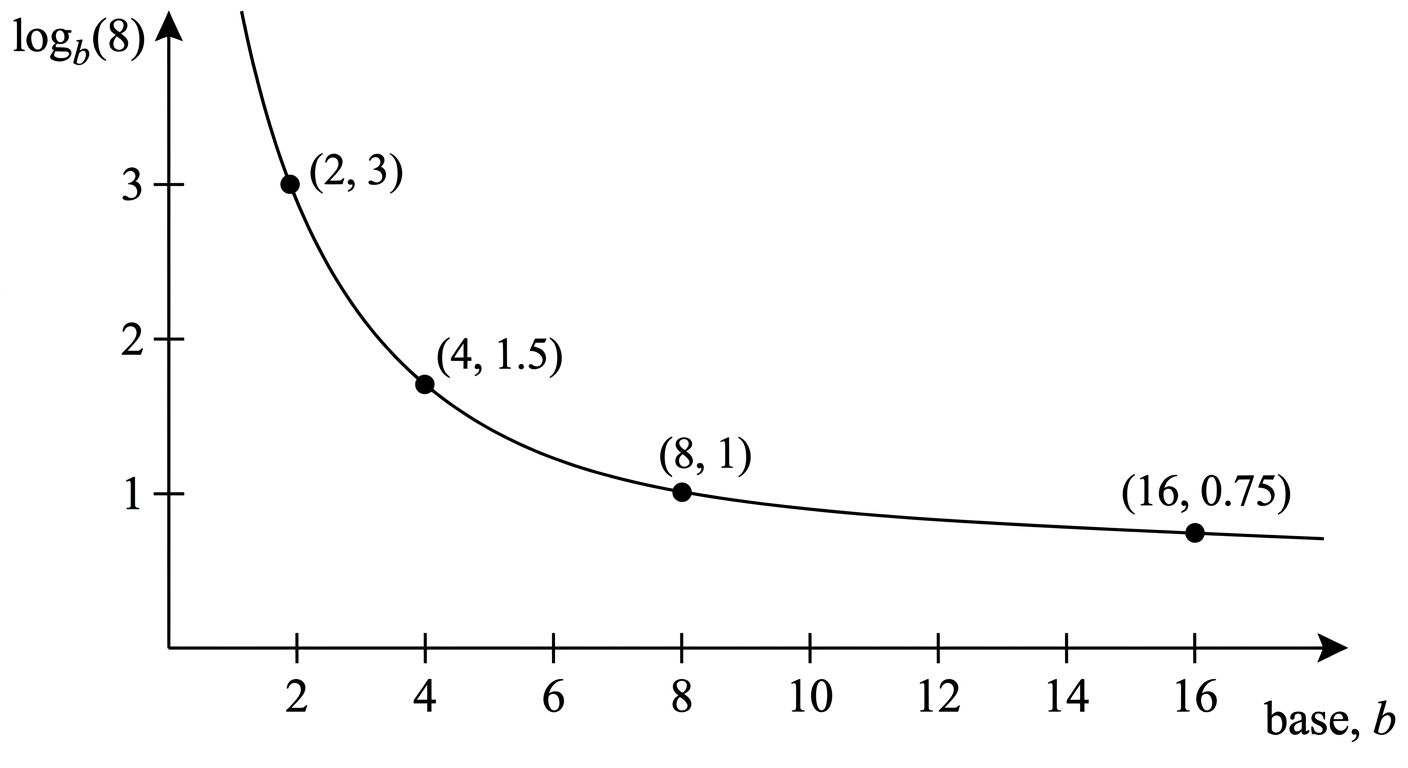
The table below shows values of for four different bases .
| 2 | 4 | 8 | 16 | |
| 3 | 1.5 | 1 | 0.75 |
a
Describe the pattern in the table, including how changes as increases, and write down the value of . [2]
b
The change-of-base formula states
Using this formula, find an expression for in terms of , using base 2. Hence verify your answer from part (a) for . [3]
Using this formula, find an expression for in terms of , using base 2. Hence verify your answer from part (a) for . [3]
c
A student claims: "Doubling the base always halves the value of ."
Using your expression from part (b), justify whether this claim is correct. [2]
Using your expression from part (b), justify whether this claim is correct. [2]

Solutions
2QuestionConverting between basesAssessment Practice
12 marks~18 minCriterion C
A seismologist models the energy released by earthquakes using the relationship
where is the Richter magnitude and is a positive constant. Two earthquakes are recorded: one of magnitude and one of magnitude .
where is the Richter magnitude and is a positive constant. Two earthquakes are recorded: one of magnitude and one of magnitude .
a
Show that the ratio of energies equals , and evaluate this ratio correct to 3 significant figures. [3]
b
A news report claims the magnitude-7.2 earthquake released "about 20 times more energy" than the magnitude-5.8 earthquake. Complete the table below, then determine whether the news report is accurate.
Claim (times more energy): 20
Calculated ratio (3 s.f.): ?
Percentage error (1 d.p.): ?
Use
[4]
Claim (times more energy): 20
Calculated ratio (3 s.f.): ?
Percentage error (1 d.p.): ?
Use
[4]
c
A second seismologist argues: "Because the Richter scale is logarithmic, every increase of 1 in magnitude multiplies the energy by the same fixed factor." Verify this claim by finding the exact energy multiplication factor for a magnitude increase of 1, and evaluate it correct to 3 significant figures. Advise a science journalist, with reference to your results from parts (a) and (b), whether the Richter scale is suitable for communicating earthquake energy differences to a general public audience. [5]
Solutions
3QuestionApplying change of base formulaAssessment Practice
12 marks~18 minCriterion A
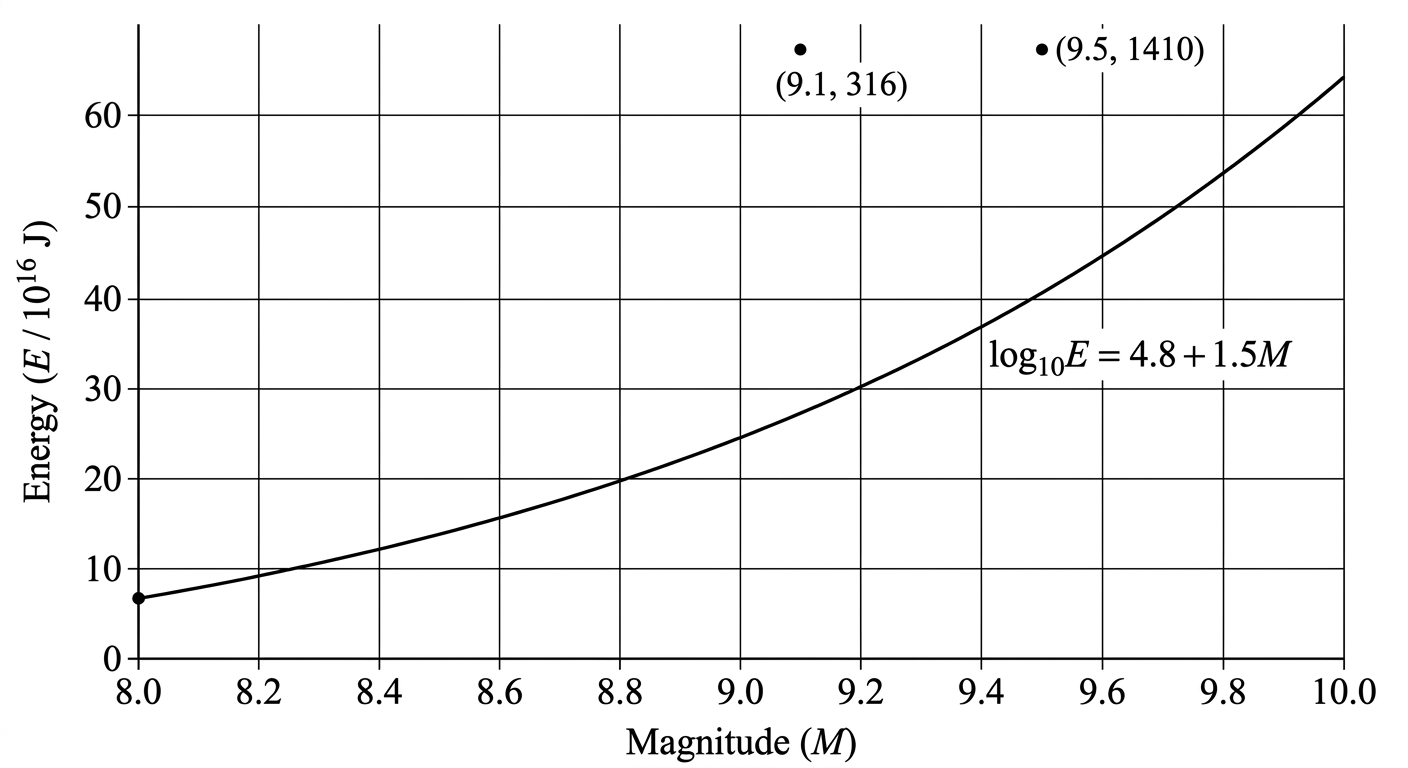
A seismologist compares two historical earthquakes using the formula where is the energy released in joules and is the Richter magnitude. The 1960 Valdivia earthquake had magnitude 9.5, and the 2011 Tohoku earthquake had magnitude 9.1.
a
Calculate the energy released by each earthquake, giving your answers in scientific notation with 3 significant figures. [4 marks]
b
Using the change of base formula, find the ratio of the energy of the Valdivia earthquake to that of the Tohoku earthquake. Show your working. [3 marks]
c
The Richter scale is logarithmic. Comment on how this can lead the public to underestimate the relative danger of a slightly higher magnitude earthquake. [3 marks]
Solutions
4QuestionConverting between basesAssessment Practice
13 marks~20 minCriterion D
An acoustic engineer tests two sound sources using the formula
where W/m² is the standard reference intensity, is the sound intensity in W/m², and is the sound level in decibels (dB). The jet engine measures dB and the laboratory fan measures dB.
where W/m² is the standard reference intensity, is the sound intensity in W/m², and is the sound level in decibels (dB). The jet engine measures dB and the laboratory fan measures dB.
a
Find the intensities and in W/m². Give your answers in exact form. [3]
b
The engineer proposes a rescaled model using a new reference intensity W/m², so that a barely audible whisper in the lab registers 0 dB. Show that on this rescaled model the jet engine registers exactly 100 dB and the fan registers exactly 22 dB. [3]
c
The table below compares the rescaled model levels with readings from an independent calibrated meter for three sound sources.
Sound source: Jet engine | Fan | Door slam
Rescaled model (dB): 100 | 22 | 65
Meter reading (dB): 98 | 25 | 61
Using the percentage error formula
calculate the percentage error for each of the three sound sources, giving your answers to 1 decimal place. [3]
Sound source: Jet engine | Fan | Door slam
Rescaled model (dB): 100 | 22 | 65
Meter reading (dB): 98 | 25 | 61
Using the percentage error formula
calculate the percentage error for each of the three sound sources, giving your answers to 1 decimal place. [3]
d
Using your results from part (c), advise the engineer whether the rescaled model should be adopted as a reliable measurement tool across different types of sound source, and identify one limitation of using a fixed reference intensity as the basis of the rescaled model. [4]
Solutions
That's every free question here — 4 of 115.
+111 more questions, plus Mock Papers & Worksheets, are waiting in Premium.