You're viewing free preview questions — 4 questions previewing here — subscribe to unlock 111 more, plus the Full Question Bank, Mock Papers & Worksheets.Upgrade
Exponential–Logarithmic Relationships — Free MYP4 Mathematics (Extended) Practice Questions

1QuestionConverting logarithmic equations to exponential formAssessment Practice
5 marks~8 minCriterion C
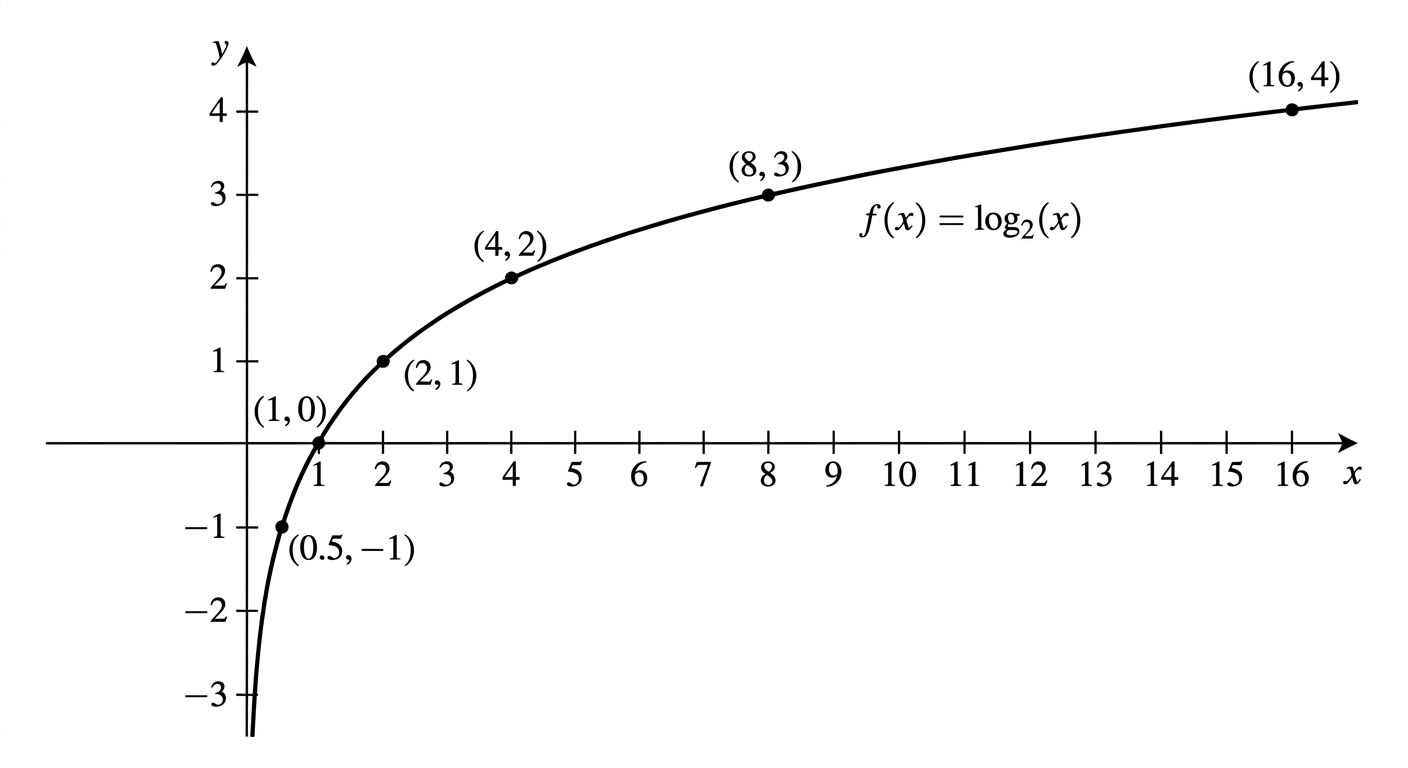
The graph of is shown in the diagram for .
a
Write down the value of . [1]
b
Find the value of for which , giving your answer as a fraction. [2]
c
A second function is defined as . Justify whether a student who claims the vertical asymptote of is and the domain is is correct. [2]

Solutions
2QuestionConverting exponential equations to logarithmic formAssessment Practice
6 marks~9 minCriterion D
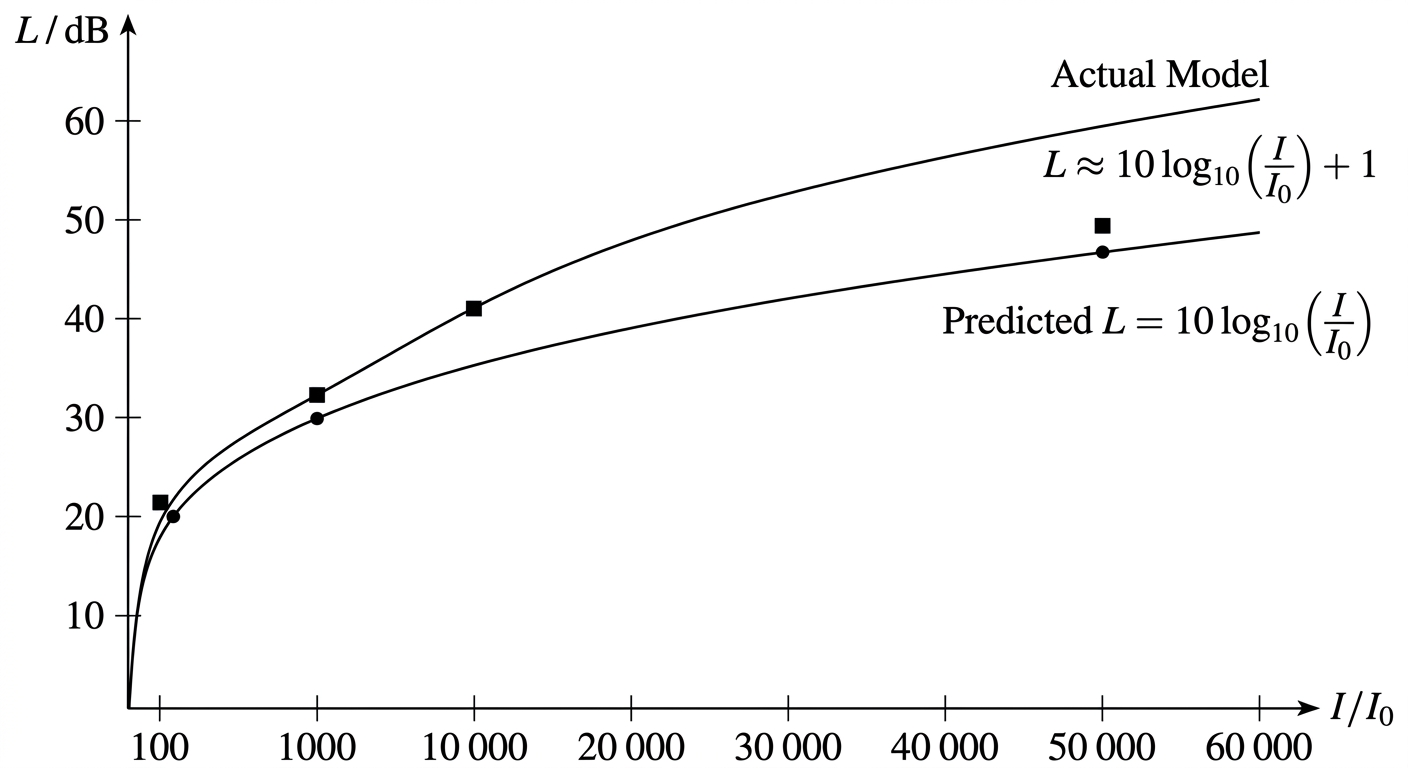
A sound engineer uses the formula to model the loudness (in decibels, dB) of a sound, where is the sound intensity and is the reference intensity.
The engineer measures three sounds and records the following data.
Intensity ratio : 100 | 1000 | 50 000
Predicted (dB): (i) | (ii) | (iii)
Actual (dB): 21 | 32 | 49
The engineer measures three sounds and records the following data.
Intensity ratio : 100 | 1000 | 50 000
Predicted (dB): (i) | (ii) | (iii)
Actual (dB): 21 | 32 | 49
a
Calculate the three predicted values of . Give each answer to the nearest whole number. [2]
b
Find the percentage error for each sound using Give each answer to 1 decimal place. [2]
c
The engineer claims the model is reliable across all three sounds. Justify whether this claim is supported by your results from parts (a) and (b), and identify one limitation of applying this model at very high intensity ratios. [2]
Solutions
3QuestionConverting exponential equations to logarithmic formAssessment Practice
7 marks~11 minCriterion A
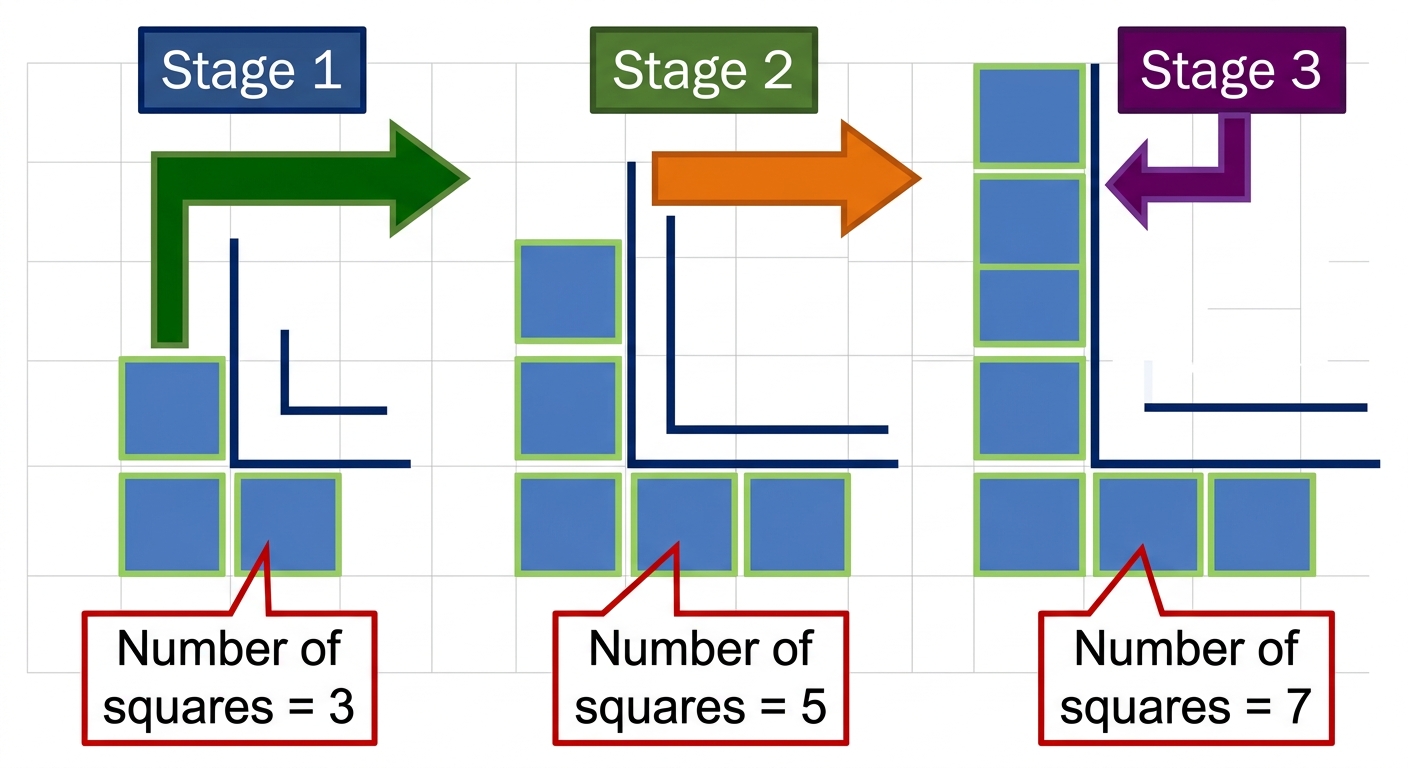
The diagram shows three stages of a pattern made from small squares arranged in an L-shape.
Stage 1 has 3 squares, Stage 2 has 5 squares, and Stage 3 has 7 squares.
Stage 1 has 3 squares, Stage 2 has 5 squares, and Stage 3 has 7 squares.
a
Write down the number of squares in Stage 4 and Stage 5. [2]
b
Find a formula for , the number of squares in Stage , where is a positive integer. Show your working clearly. [2]
c
A student claims that no stage of this pattern can contain a perfect square number of squares. Justify whether this claim is correct. [3]
Solutions
4QuestionConverting exponential equations to logarithmic formAssessment Practice
7 marks~11 minCriterion B
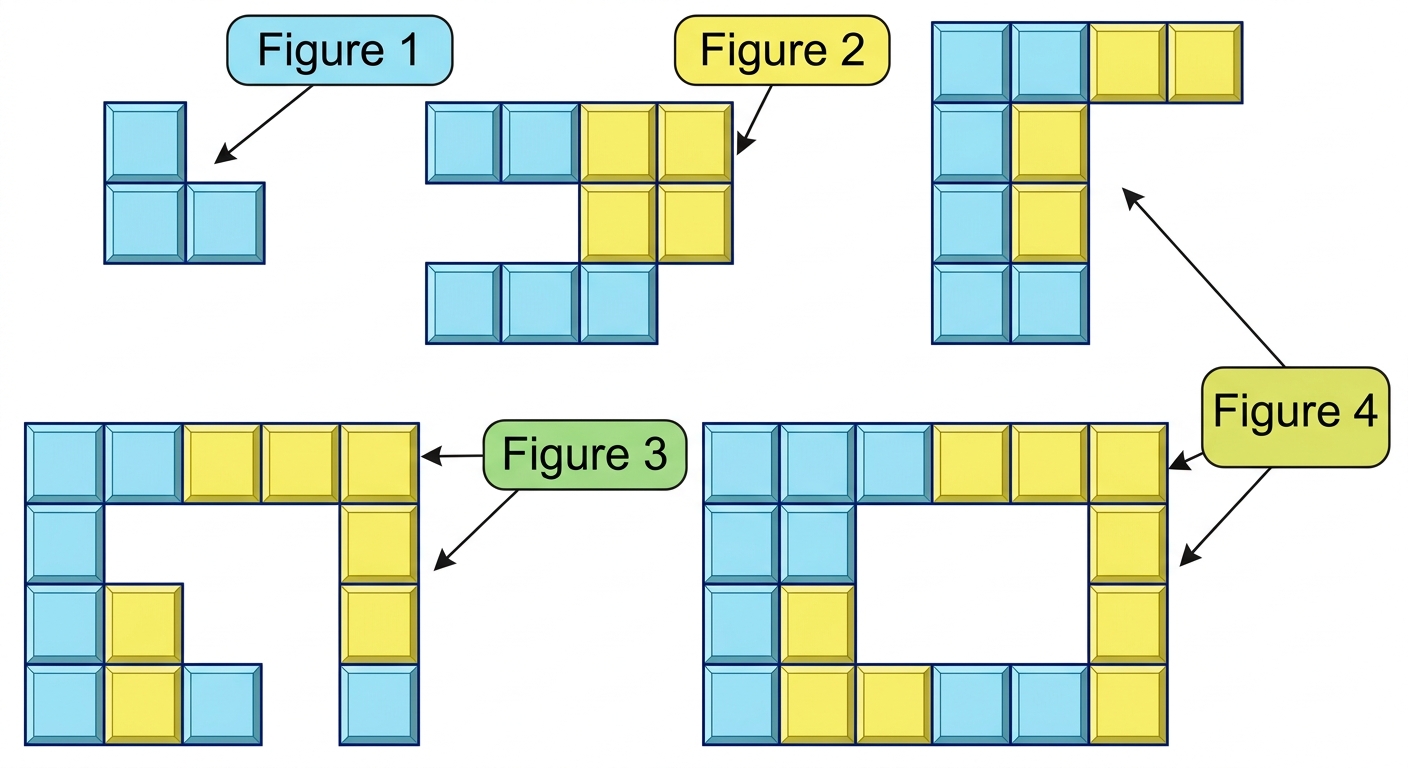
The diagrams below show Figures 1, 2, 3, and 4 of a pattern built from unit squares arranged in an L-shape.
The number of unit squares in each figure is recorded below.
The number of unit squares in each figure is recorded below.
| Figure number () | 1 | 2 | 3 | 4 |
|---|---|---|---|---|
| Number of squares () | 3 | 7 | 13 | 21 |
a
Write down the number of unit squares in Figure 5. [1]
b
Find a quadratic rule for in terms of , giving your rule in the form
Show all working. [3]
Show all working. [3]
c
A student claims that Figure 50 contains more than 2600 unit squares. Justify whether this claim is correct. [3]
Solutions
That's every free question here — 4 of 115.
+111 more questions, plus Mock Papers & Worksheets, are waiting in Premium.