You're viewing free preview questions — 4 questions previewing here — subscribe to unlock 166 more, plus the Full Question Bank, Mock Papers & Worksheets.Upgrade
Introduction to Logarithms — Free MYP4 Mathematics (Extended) Practice Questions

1QuestionEvaluating simple logarithmsAssessment Practice
7 marks~11 minCriterion B
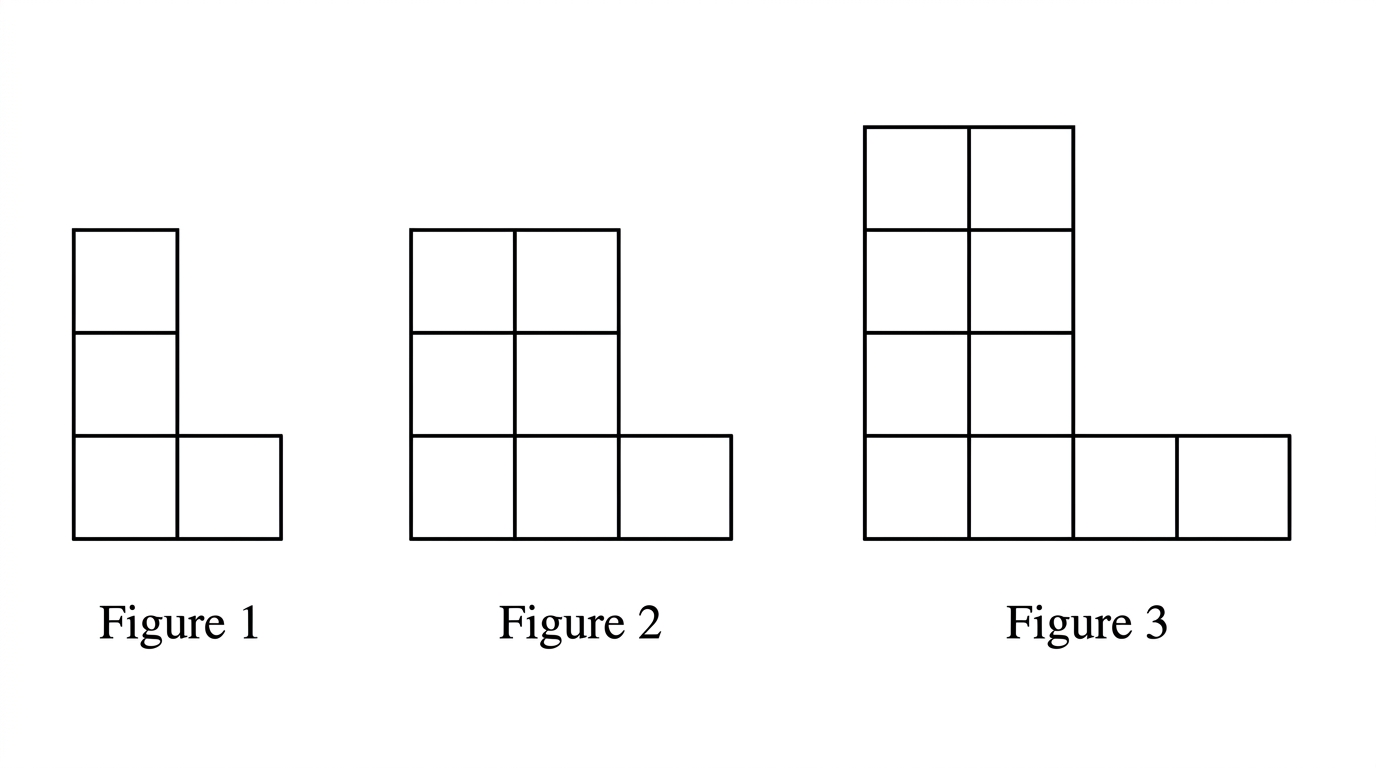
The diagram shows the first three figures of a pattern made from small squares arranged in an L-shape.
Figure 1 has 3 squares, Figure 2 has 8 squares, and Figure 3 has 15 squares.
Figure 1 has 3 squares, Figure 2 has 8 squares, and Figure 3 has 15 squares.
a
Write down the number of squares in Figure 4. [1]
b
Find a rule for the total number of squares in Figure , giving your answer in the form , where and are integers to be found. [3]
c
A student claims that Figure always contains an odd number of squares. Justify whether this claim is correct for all positive integers , referring to the structure of your rule. [3]

Solutions
2QuestionEvaluating simple logarithmsAssessment Practice
10 marks~15 minCriterion A
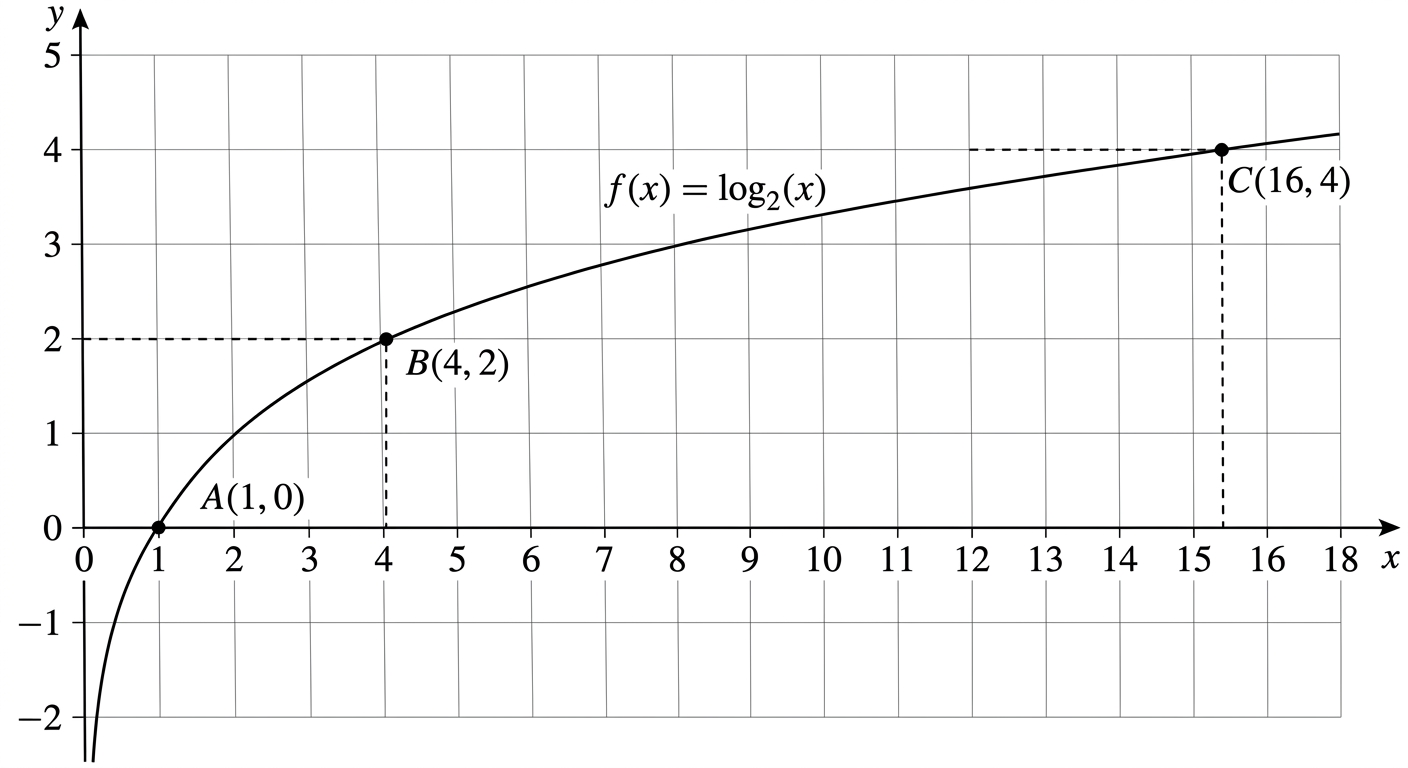
The diagram shows the graph of for , with three points , , and marked on the curve at , , and respectively.
a
Find the coordinates of points , , and , giving exact values. [3]
b
A student claims that the point lies on the graph of . Find the value of , showing all steps of your reasoning. [3]
c
The equation has exactly one valid solution. Solve the equation and justify why the other algebraic solution must be rejected. [4]
Solutions
3QuestionEvaluating simple logarithmsAssessment Practice
12 marks~18 minCriterion C
Two major earthquakes are compared using the Richter scale formula
where is the magnitude, is the intensity of the earthquake, and is a fixed reference intensity.
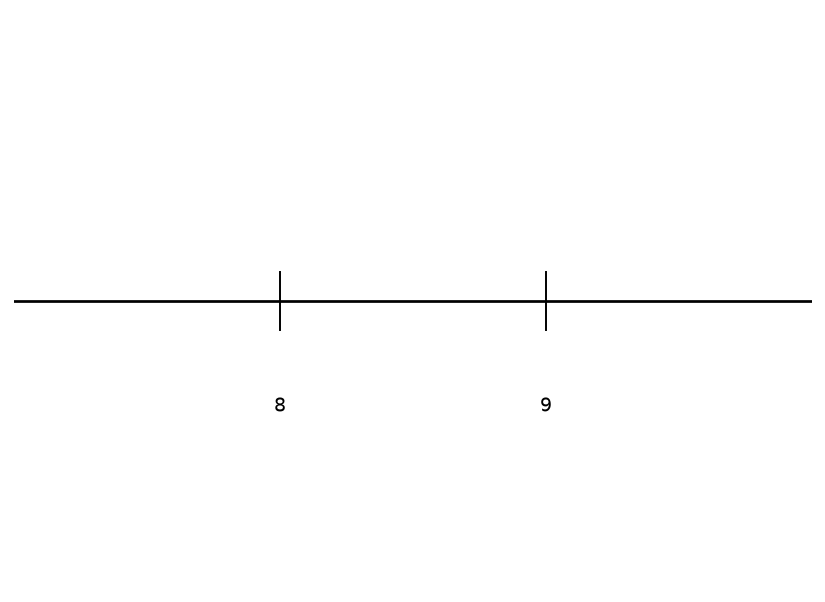
The 1906 San Francisco earthquake had magnitude , the 2011 Tohoku earthquake had magnitude , and the 1960 Valdivia earthquake had magnitude .
The diagram shows the three magnitudes plotted on a number line.
where is the magnitude, is the intensity of the earthquake, and is a fixed reference intensity.
The 1906 San Francisco earthquake had magnitude , the 2011 Tohoku earthquake had magnitude , and the 1960 Valdivia earthquake had magnitude .
The diagram shows the three magnitudes plotted on a number line.
a
Calculate how many times more intense the Tohoku earthquake was compared to the San Francisco earthquake. Give your answer to 3 significant figures. [3]
b
A seismologist claims that the Valdivia earthquake released approximately 8 times more energy than the San Francisco earthquake, using the empirical relationship
where is the energy released in joules. Show that this claim is incorrect by calculating the ratio of energies, and find the correct ratio to 3 significant figures. [4]
where is the energy released in joules. Show that this claim is incorrect by calculating the ratio of energies, and find the correct ratio to 3 significant figures. [4]
c
The table below shows the Richter magnitude and the energy ratio relative to the San Francisco earthquake () for three earthquakes.
Earthquake — Magnitude — Energy ratio (relative to San Francisco)
Using your results from parts (a) and (b), or otherwise, assess whether the Richter magnitude scale gives an accurate impression of the relative destructive potential of these earthquakes. Justify your assessment by referring to both the intensity ratios and the energy ratios in your answer. [5]
Earthquake — Magnitude — Energy ratio (relative to San Francisco)
| San Francisco | 7.8 | 1.00 |
|---|---|---|
| Valdivia | 8.6 | |
| Tohoku | 9.1 |
Using your results from parts (a) and (b), or otherwise, assess whether the Richter magnitude scale gives an accurate impression of the relative destructive potential of these earthquakes. Justify your assessment by referring to both the intensity ratios and the energy ratios in your answer. [5]
Solutions
4QuestionNatural logarithms (base e)Assessment Practice
14 marks~21 minCriterion D
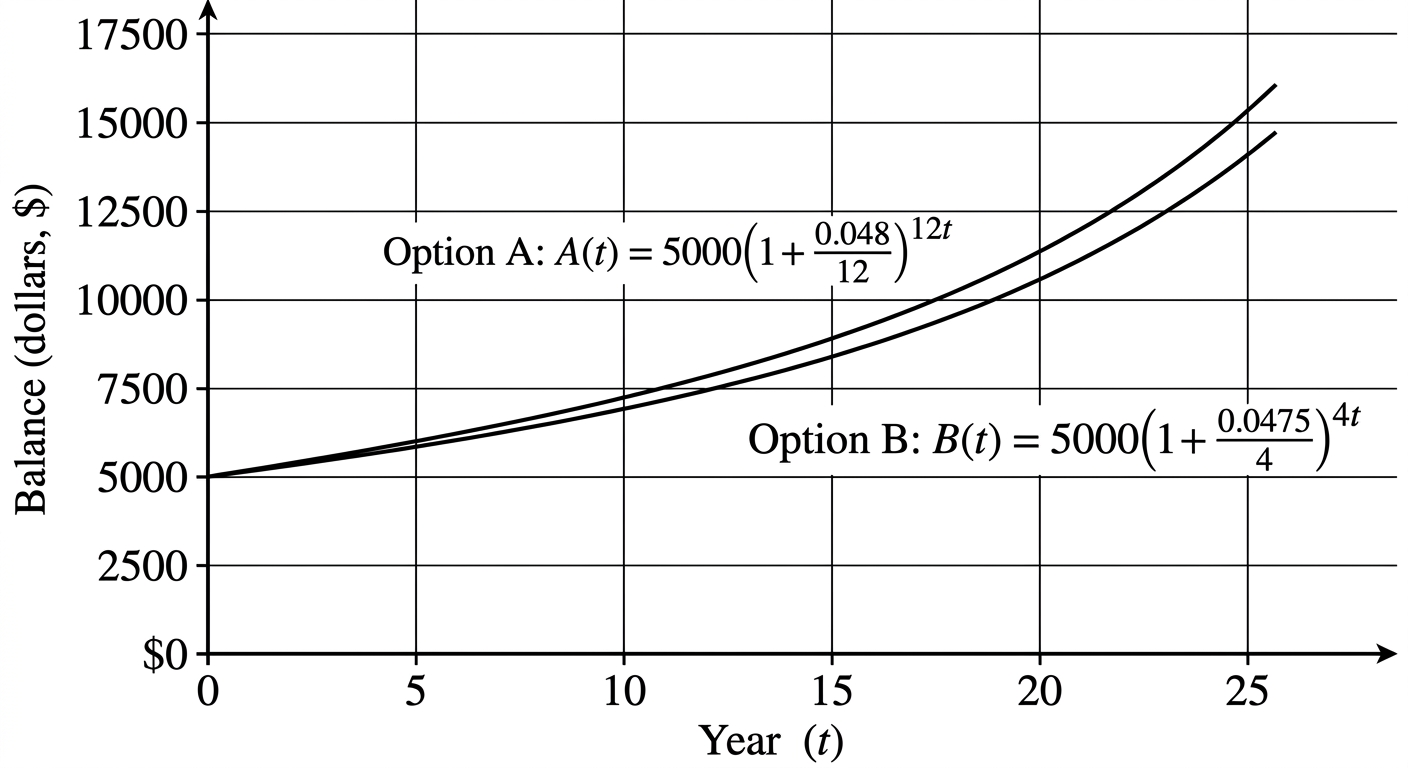
An investor places 5000 dollars into a savings account. The bank offers two options:
Option A: 4.8% annual interest compounded monthly.
Option B: 4.75% annual interest compounded quarterly.
The balance after years under Option A is modelled by
and under Option B by
The table below shows the actual recorded balances at selected years.
Option A: 4.8% annual interest compounded monthly.
Option B: 4.75% annual interest compounded quarterly.
The balance after years under Option A is modelled by
and under Option B by
The table below shows the actual recorded balances at selected years.
| Year () | 5 | 10 | 20 |
|---|---|---|---|
| Actual balance (dollars) | 6283 | 7891 | 12530 |
a
Calculate the balance predicted by Option A at , , and . Give each answer to the nearest dollar. [3]
b
The investor states: "Option A always gives a higher balance than Option B." Using your results from part (a) and calculations for Option B at , , and , determine whether this statement is correct. Give all balances to the nearest dollar. [4]
c
The percentage error of a model prediction is given by
Using Option A predictions from part (a) and the actual balances in the table, calculate the percentage error at each of , , and . Give each answer to 2 decimal places. [3]
Using Option A predictions from part (a) and the actual balances in the table, calculate the percentage error at each of , , and . Give each answer to 2 decimal places. [3]
d
The investor is deciding whether to use Option A as a long-term financial plan. Using the percentage errors found in part (c), advise the investor on whether Option A is a reliable model for their actual balance over time, and suggest one reason why the model may not reflect the actual balance in the long term. [4]
Solutions
That's every free question here — 4 of 170.
+166 more questions, plus Mock Papers & Worksheets, are waiting in Premium.