You're viewing free preview questions — 4 questions previewing here — subscribe to unlock 230 more, plus the Full Question Bank, Mock Papers & Worksheets.Upgrade
Laws of Logarithms — Free MYP4 Mathematics (Extended) Practice Questions

1QuestionQuotient ruleAssessment Practice
6 marks~9 minCriterion B
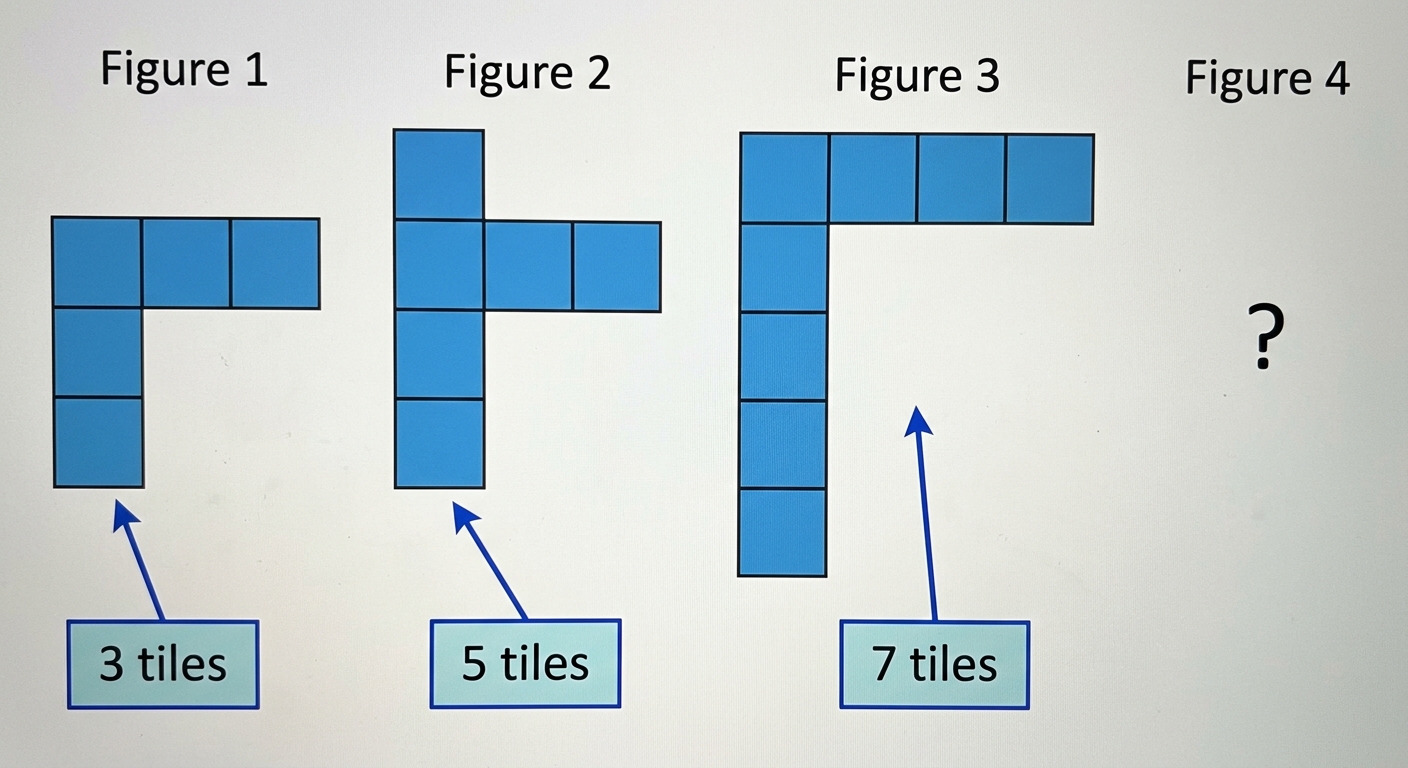
The diagram shows a growing pattern of tiles arranged in L-shaped figures. Figure 1 has 3 tiles, Figure 2 has 5 tiles, and Figure 3 has 7 tiles.
a
Write down the number of tiles in Figure 4. [1]
b
Find a rule for the number of tiles in Figure , giving your answer in the form , where and are integers. [2]
c
The total number of tiles used to build Figures 1 through is given by . Verify this formula for , then justify whether this formula confirms that the cumulative total grows faster than the per-figure tile count as increases. [3]

Solutions
2QuestionQuotient ruleAssessment Practice
10 marks~15 minCriterion A
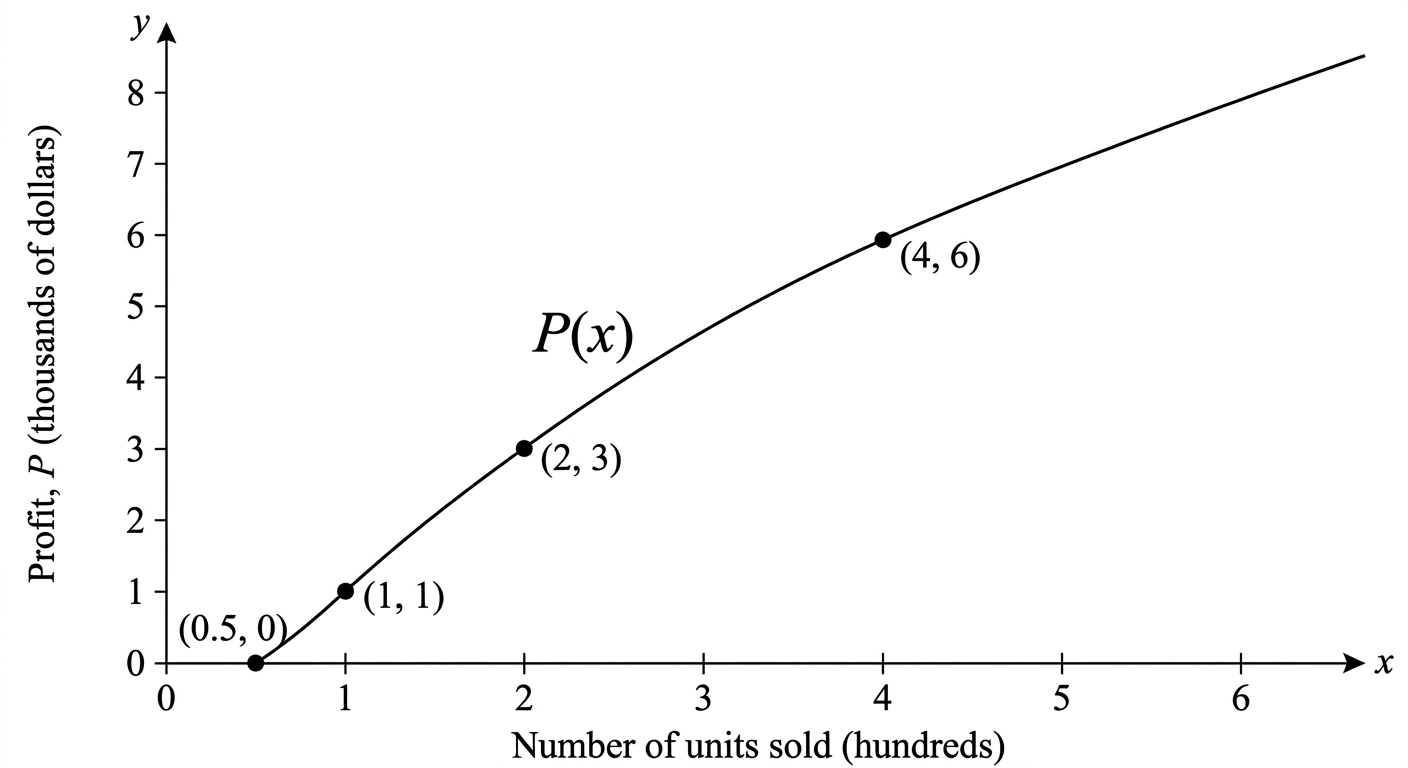
A company models its monthly profit (in thousands of dollars) using the function
where is the number of units sold (in hundreds) and .
where is the number of units sold (in hundreds) and .
a
Show that can be written in the form , where is an integer to be found. [3]
b
The table below shows the model's predicted profit alongside observed data at three production levels.
(hundreds of units): 1, 2, 4
Predicted (thousands of dollars): 1, 3, 5
Actual (thousands of dollars): 0.8, 2.6, 5.3
Calculate the percentage error for each value of , giving your answers to 2 decimal places, using
and hence determine at which production level the model is least reliable. [4]
(hundreds of units): 1, 2, 4
Predicted (thousands of dollars): 1, 3, 5
Actual (thousands of dollars): 0.8, 2.6, 5.3
Calculate the percentage error for each value of , giving your answers to 2 decimal places, using
and hence determine at which production level the model is least reliable. [4]
c
The company sets a profit target of . Using your result from part (a), solve for the exact value of . Justify whether the company should rely on this model to meet the target, given that the maximum production capacity is 400 units per month and the model's reliability varies across production levels. [3]
Solutions
3QuestionQuotient ruleAssessment Practice
12 marks~18 minCriterion D
An environmental scientist monitors seismic activity in a region prone to earthquakes. The Richter scale assigns a magnitude to each earthquake, where the intensity of an earthquake of magnitude is given by
and is a fixed reference intensity. The magnitude difference between two earthquakes satisfies
The scientist records four earthquakes. The predicted intensity ratio is measured relative to a reference earthquake of magnitude 4.0.
Earthquake A — Magnitude: 4.0 — Predicted ratio: 1.00
Earthquake B — Magnitude: 4.5 — Predicted ratio: ?
Earthquake C — Magnitude: 5.2 — Predicted ratio: ? — Observed ratio: 158
Earthquake D — Magnitude: 6.1 — Predicted ratio: ?
and is a fixed reference intensity. The magnitude difference between two earthquakes satisfies
The scientist records four earthquakes. The predicted intensity ratio is measured relative to a reference earthquake of magnitude 4.0.
Earthquake A — Magnitude: 4.0 — Predicted ratio: 1.00
Earthquake B — Magnitude: 4.5 — Predicted ratio: ?
Earthquake C — Magnitude: 5.2 — Predicted ratio: ? — Observed ratio: 158
Earthquake D — Magnitude: 6.1 — Predicted ratio: ?
a
Calculate the predicted intensity ratio for earthquakes B, C, and D, giving each answer to 3 significant figures. [3]
b
Using the formula
calculate the percentage error for earthquake C. Give your answer to 1 decimal place. [2]
calculate the percentage error for earthquake C. Give your answer to 1 decimal place. [2]
c
A building code requires that any earthquake whose intensity is at least 200 times the reference intensity must trigger an automatic structural inspection. Deduce the minimum magnitude that triggers an inspection, giving your answer to 2 decimal places. [3]
d
The scientist claims that the Richter scale is a reliable model for communicating earthquake severity to the public because equal magnitude differences always correspond to equal intensity ratios. Assess this claim, and justify whether the Richter scale is an appropriate communication tool for non-specialist audiences. [4]
Solutions
4QuestionExpanding logarithmic expressionsAssessment Practice
12 marks~18 minCriterion C
A seismologist models earthquake intensity using the Richter scale, where the magnitude of an earthquake is defined by
where is the intensity of the earthquake and is a fixed reference intensity.
Two earthquakes are recorded at the same monitoring station. Earthquake A has intensity and Earthquake B has intensity . The energy released by an earthquake satisfies .
Give all numerical answers to 3 significant figures where appropriate.
where is the intensity of the earthquake and is a fixed reference intensity.
Two earthquakes are recorded at the same monitoring station. Earthquake A has intensity and Earthquake B has intensity . The energy released by an earthquake satisfies .
Give all numerical answers to 3 significant figures where appropriate.
a
Find the Richter magnitude of each earthquake, showing your use of the formula. [2]
b
Show that , and hence deduce the ratio . [3]
c
Calculate how many times more energy Earthquake B releases compared to Earthquake A, giving your answer in the form where is an exact fraction. [3]
d
A journalist reports that Earthquake B is "three times more destructive" than Earthquake A because its magnitude is 3 units higher. Critique this claim, justifying your answer with reference to both the intensity ratio and the energy ratio found in parts (b) and (c). [4]
Solutions
That's every free question here — 4 of 234.
+230 more questions, plus Mock Papers & Worksheets, are waiting in Premium.