You're viewing free preview questions — 4 questions previewing here — subscribe to unlock 109 more, plus the Full Question Bank, Mock Papers & Worksheets.Upgrade
Solving Exponential Equations using Logarithms — Free MYP4 Mathematics (Extended) Practice Questions

1QuestionApplying logarithms to both sidesAssessment Practice
7 marks~11 minCriterion B
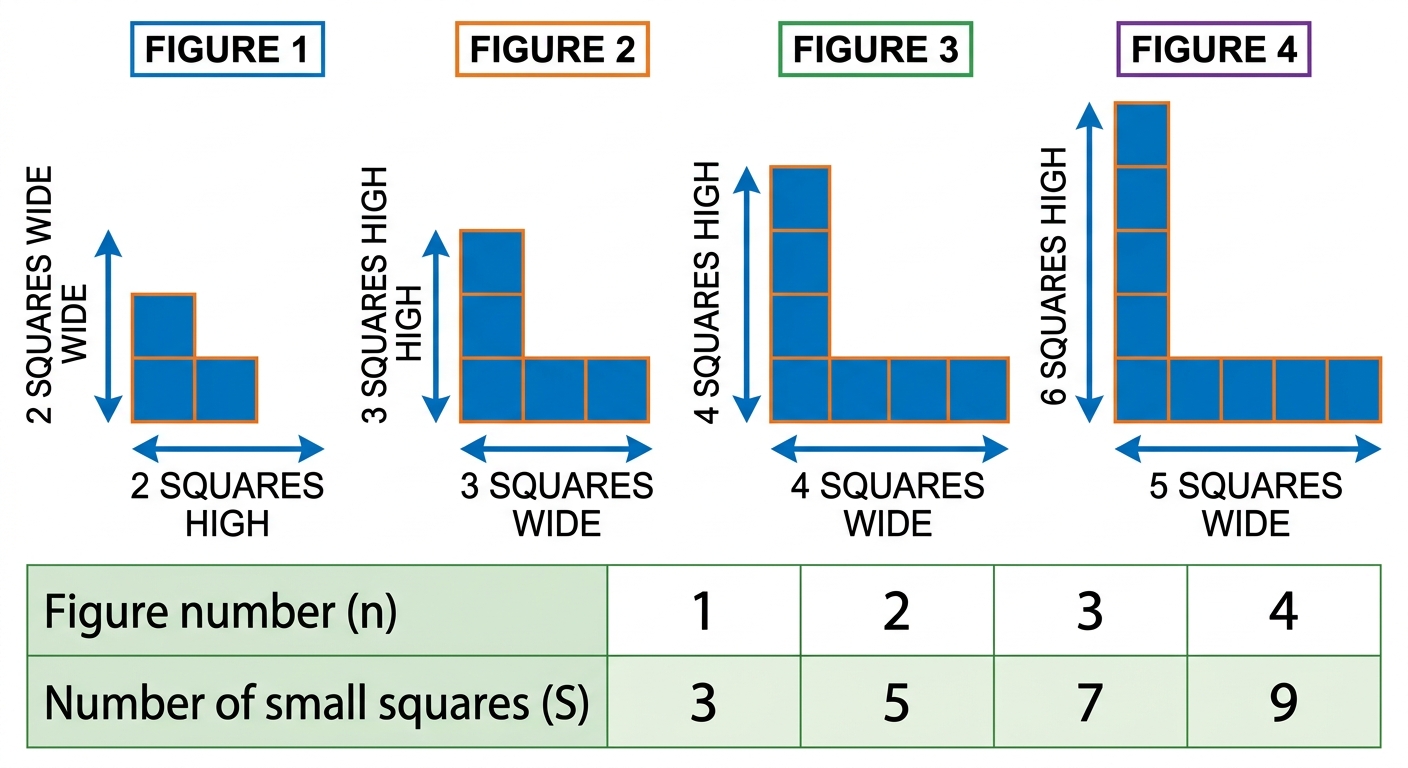
The diagram shows the first four figures of a pattern made from small squares arranged in an L-shape.
The table below shows the number of small squares in each figure.
The table below shows the number of small squares in each figure.
| Figure number () | 1 | 2 | 3 | 4 |
|---|---|---|---|---|
| Number of squares () | 3 | 5 | 7 | 9 |
a
Write down the number of small squares in Figure 5. [1]
b
Find a rule for the number of small squares in Figure , giving your answer in the form
where and are integers to be determined. [2]
where and are integers to be determined. [2]
c
A large version of this pattern is built using exactly 47 small squares. Determine which figure number this is, showing your working. [1]
d
Justify why the rule can never produce a value of that is an even number, for any positive integer . [3]

Solutions
2QuestionApplying logarithms to both sidesAssessment Practice
10 marks~15 minCriterion D
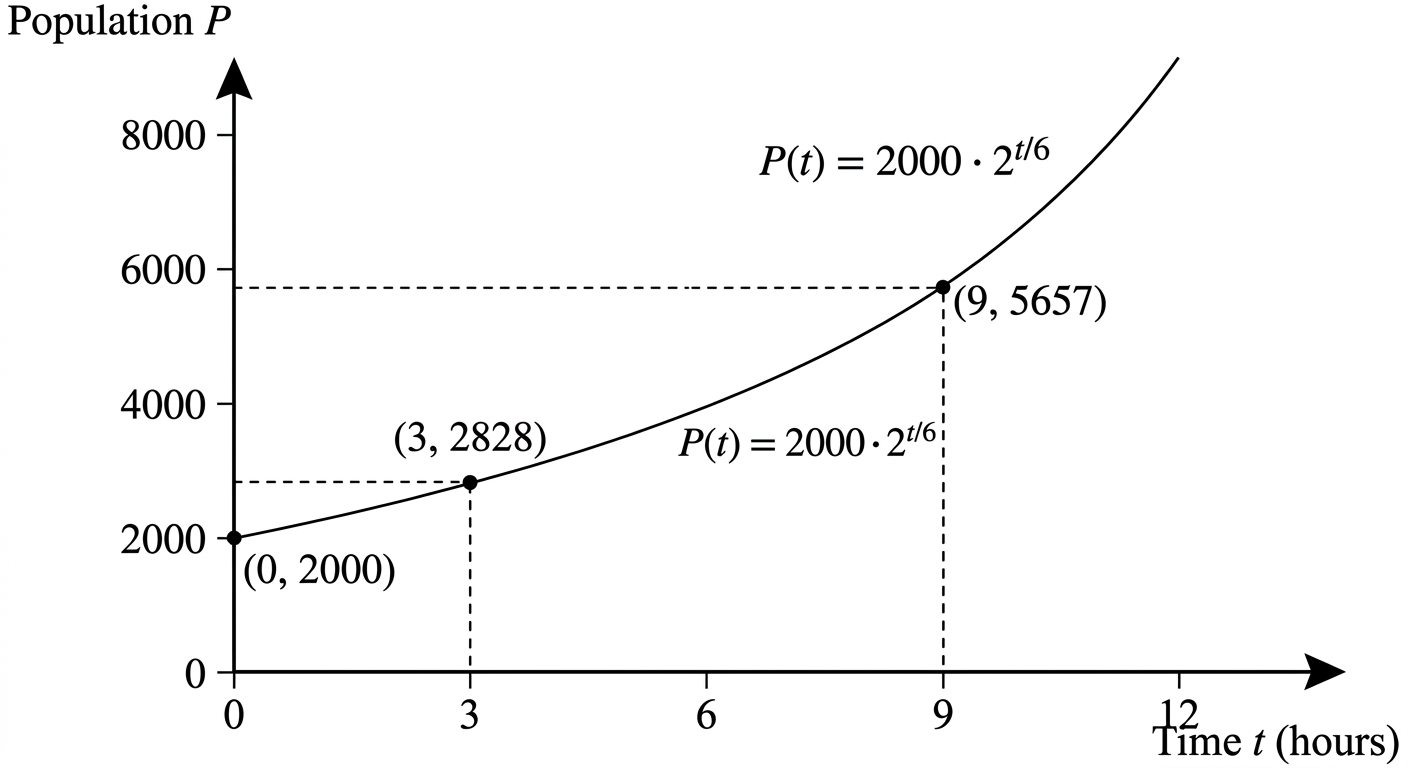
A colony of bacteria grows so that its population at time hours satisfies
where is the initial population and is a positive constant.
A scientist records the following data.
The scientist uses the model to predict future population values.
where is the initial population and is a positive constant.
A scientist records the following data.
| Time (hours) | 0 | 3 | 9 |
|---|---|---|---|
| Population | 2000 | 2828 | 5657 |
The scientist uses the model to predict future population values.
a
Show that is consistent with the data point at , giving your answer to 4 significant figures. [3]
b
The scientist claims the colony will reach a population of at some time , where satisfies
Solve this equation for , giving your answer in exact form and as a decimal to 3 significant figures. [4]
Solve this equation for , giving your answer in exact form and as a decimal to 3 significant figures. [4]
c
A second scientist argues that the model will eventually overestimate the true population because real bacterial colonies face resource constraints. Assess the validity of this argument by stating one assumption of the model and one limitation that arises from it. [3]
Solutions
3QuestionSolving equations with unknown exponentsAssessment Practice
10 marks~15 minCriterion C
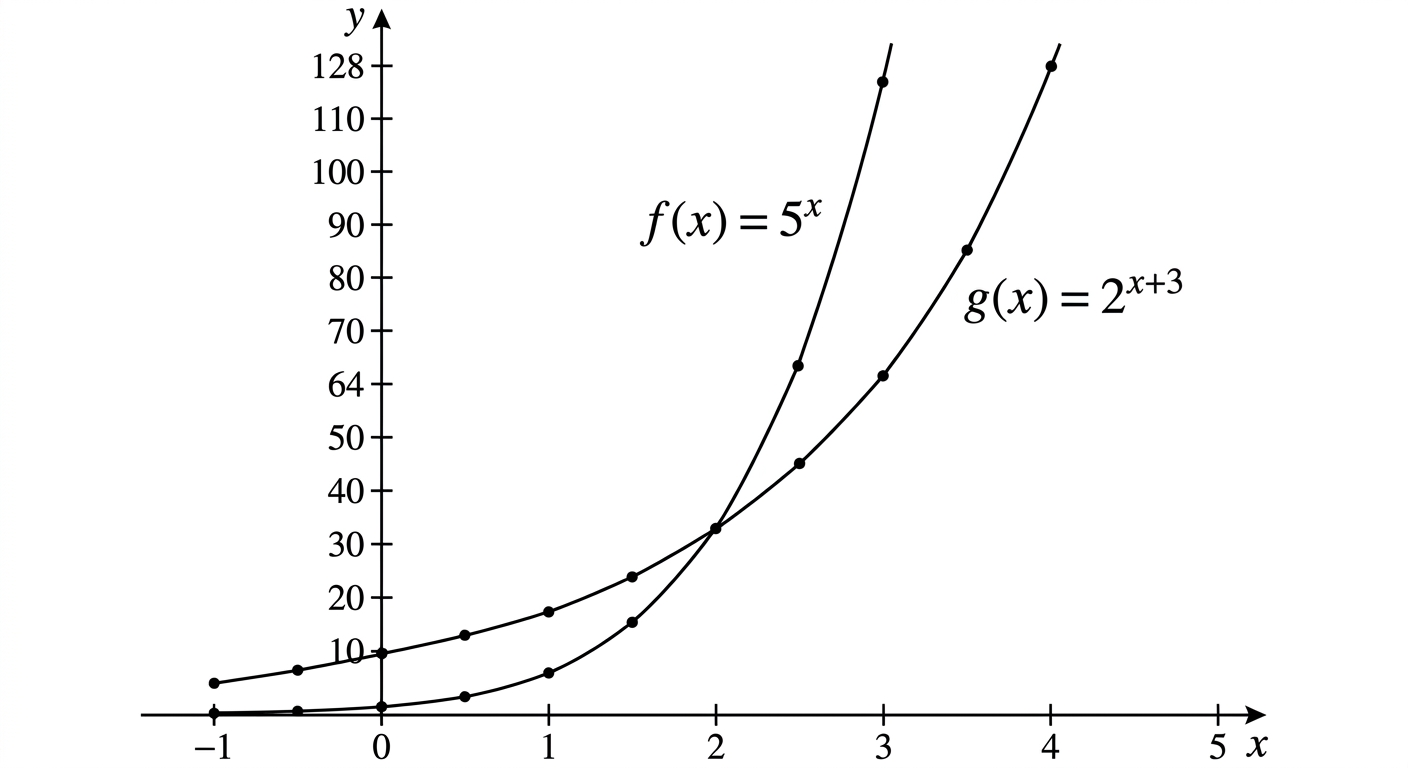
The diagram shows the graphs of and for .
a
Show that the equation can be written as
[3]
[3]
b
Hence find the coordinates of the point of intersection of the two graphs, giving the -value in exact form and the -value to 3 significant figures. [3]
c
A student claims that for any positive constant , the equation always has exactly one solution. Justify whether this claim is correct, giving the solution in exact form in terms of and , and state what happens to as . [4]
Solutions
4QuestionSolving equations with unknown exponentsAssessment Practice
11 marks~17 minCriterion A
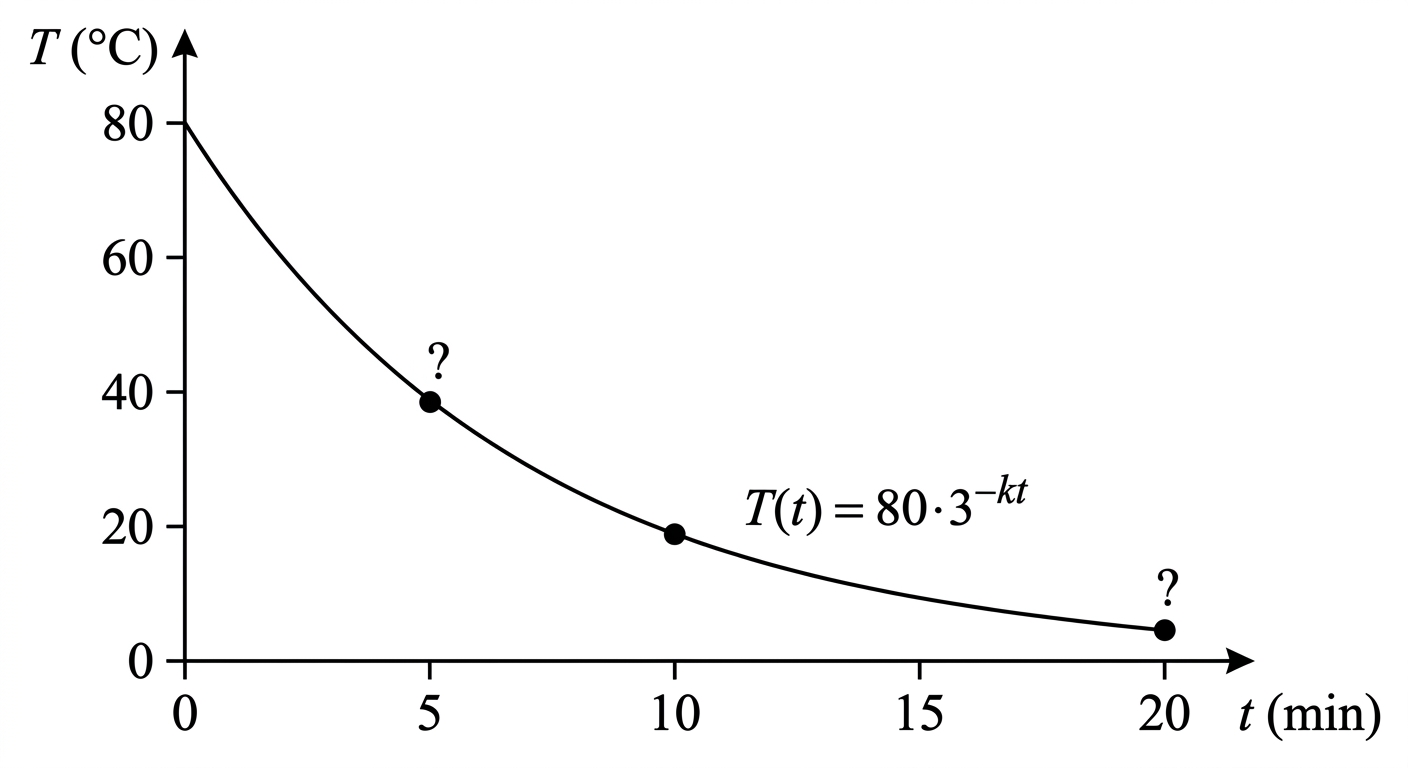
A scientist models the temperature (in °C) of a cooling liquid at time minutes using the equation
where is a positive constant.
Observed and predicted temperatures at three values of are shown below.
The value is determined using the observed temperature at minutes.
where is a positive constant.
Observed and predicted temperatures at three values of are shown below.
| (min) | 5 | 10 | 20 |
|---|---|---|---|
| Observed (°C) | 38.0 | 18.5 | 4.3 |
| Predicted (°C) | ? | 18.5 | ? |
The value is determined using the observed temperature at minutes.
a
Using when , show that
and hence find the value of correct to 3 significant figures. [4]
and hence find the value of correct to 3 significant figures. [4]
b
Using your value of from part (a), find the model's predicted temperatures at and , each correct to 1 decimal place. Hence calculate the percentage error for each prediction using
giving each percentage error correct to 1 decimal place. [4]
giving each percentage error correct to 1 decimal place. [4]
c
The scientist claims the model is reliable for . Justify this claim, or reject it, by referring to the percentage errors found in part (b), and state one limitation of using this exponential model to predict the temperature for large values of . [3]
Solutions
That's every free question here — 4 of 113.
+109 more questions, plus Mock Papers & Worksheets, are waiting in Premium.