You're viewing free preview questions — 4 questions previewing here — subscribe to unlock 178 more, plus the Full Question Bank, Mock Papers & Worksheets.Upgrade
Solving Logarithmic Equations — Free MYP4 Mathematics (Extended) Practice Questions

1QuestionSolving equations using log lawsAssessment Practice
7 marks~11 minCriterion B
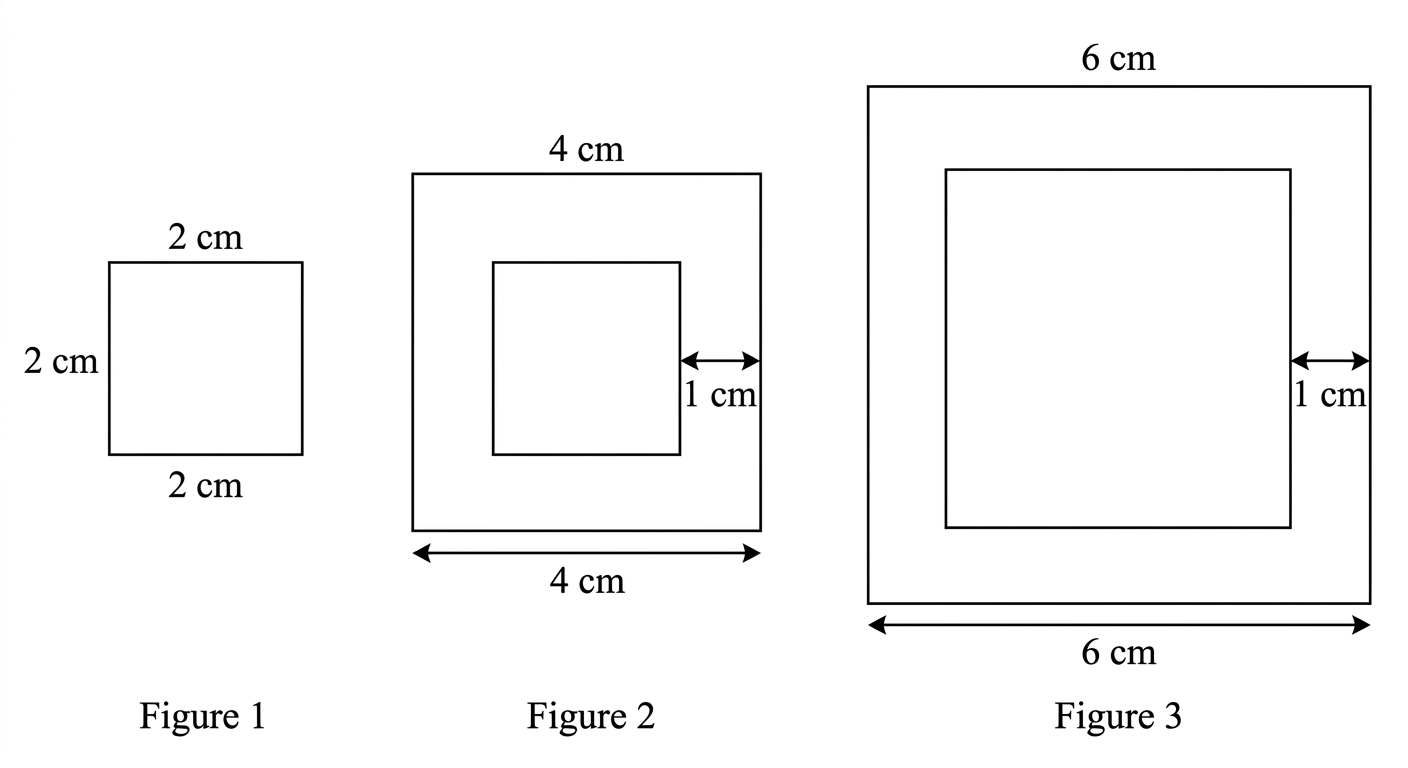
The diagram shows the first three figures of a pattern of nested squares.
Figure 1 is a single square with side length cm.
Figure 2 is formed by placing a square of side length cm around Figure 1, leaving a border of width cm on each side.
Figure 3 is formed by placing a square of side length cm around Figure 2, leaving a border of width cm on each side.
The area (in cm²) of the outermost square ring added at Figure follows the pattern:
Figure 1 is a single square with side length cm.
Figure 2 is formed by placing a square of side length cm around Figure 1, leaving a border of width cm on each side.
Figure 3 is formed by placing a square of side length cm around Figure 2, leaving a border of width cm on each side.
The area (in cm²) of the outermost square ring added at Figure follows the pattern:
a
Write down , the area of the outermost ring added in Figure 4. [1]
b
Find a rule for in the form , where and are integers. [3]
c
Justify why must be a linear function of by referring to the structure of the squares in the pattern. [3]

Solutions
2QuestionSolving equations with different basesAssessment Practice
9 marks~14 minCriterion A
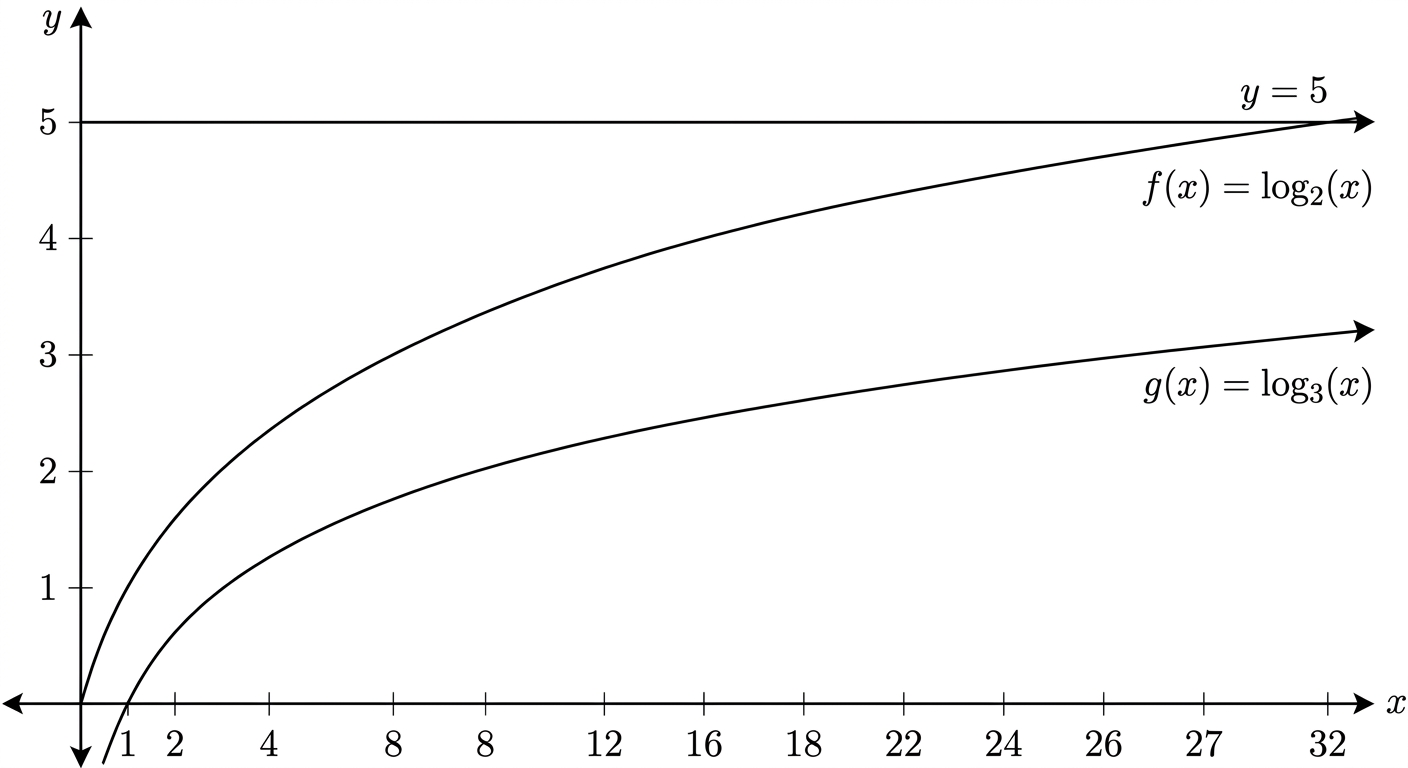
The diagram shows the graphs of and for , together with the horizontal line .
a
Using the change-of-base formula, show that the equation can be written as
[3]
[3]
b
Hence find the value of that satisfies . Give your answer correct to 3 significant figures. [2]
c
A student claims that the equation has a solution for every real number . Justify whether this claim is correct, and determine the value of for which the solution is , giving in exact form using logarithms. [4]
Solutions
3QuestionChecking for extraneous solutionsAssessment Practice
10 marks~15 minCriterion D
A seismologist uses the Gutenberg–Richter energy model
where is the energy released in joules and is the Richter magnitude of an earthquake.
Three earthquakes were recorded in a seismically active region.
where is the energy released in joules and is the Richter magnitude of an earthquake.
Three earthquakes were recorded in a seismically active region.
| Earthquake | A | B | C |
|---|---|---|---|
| Magnitude | 5.0 | 7.0 | 9.0 |
| Predicted (J) | ? | ? | ? |
| Measured (J) |
a
Calculate the predicted energy (in joules, to 3 significant figures) for each earthquake and complete the table. [3]
b
Calculate the percentage error between the predicted and measured energy for earthquake , giving your answer to 1 decimal place. Use
[2]
[2]
c
A new earthquake releases a measured energy of J. Using the model, determine the magnitude predicted for this earthquake, giving your answer to 2 decimal places. [2]
d
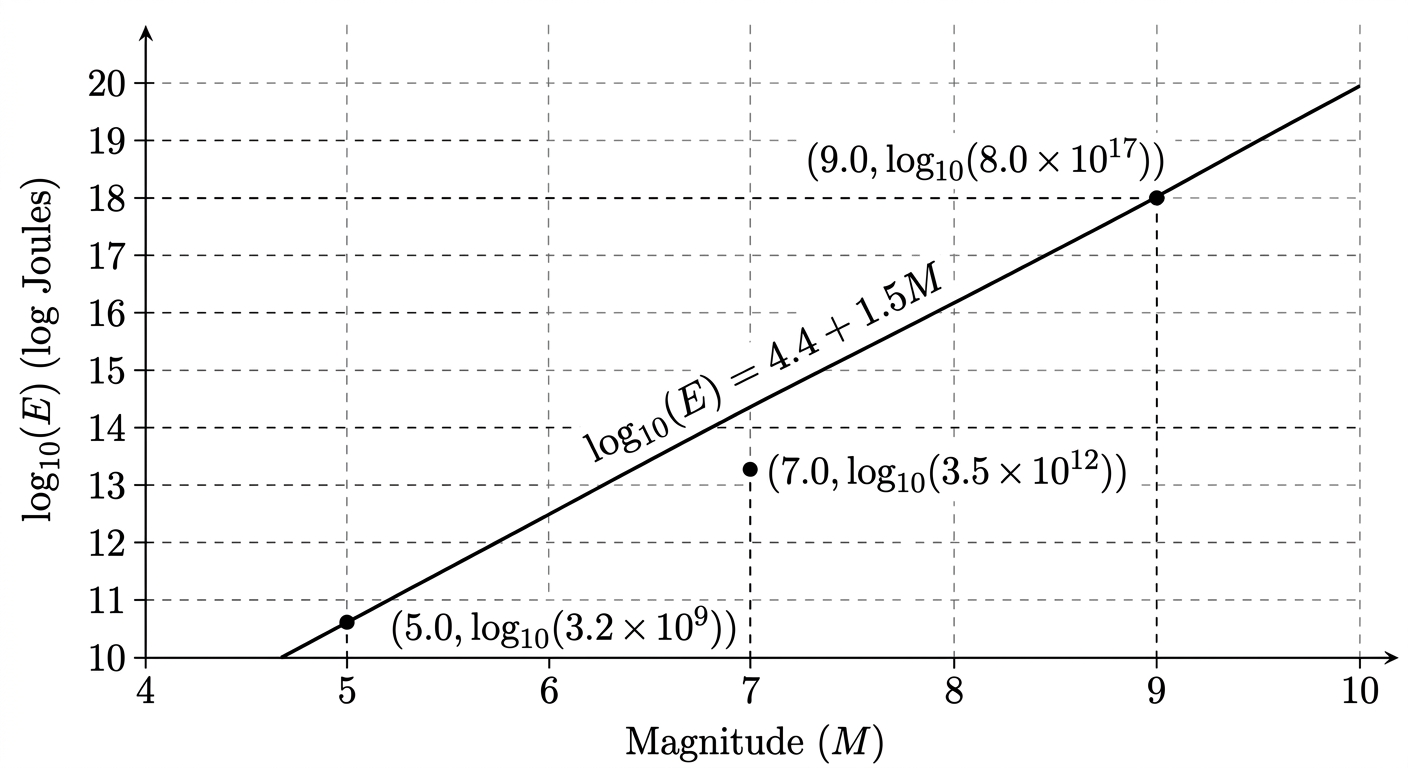
The diagram shows the model curve together with the three measured data points from the table. Using your results from parts (a) and (b), assess whether the seismologist should rely on this model to predict earthquake energy across all three magnitude levels, and identify one limitation that affects its reliability. [3]
Solutions
4QuestionSolving equations using log lawsAssessment Practice
11 marks~17 minCriterion C
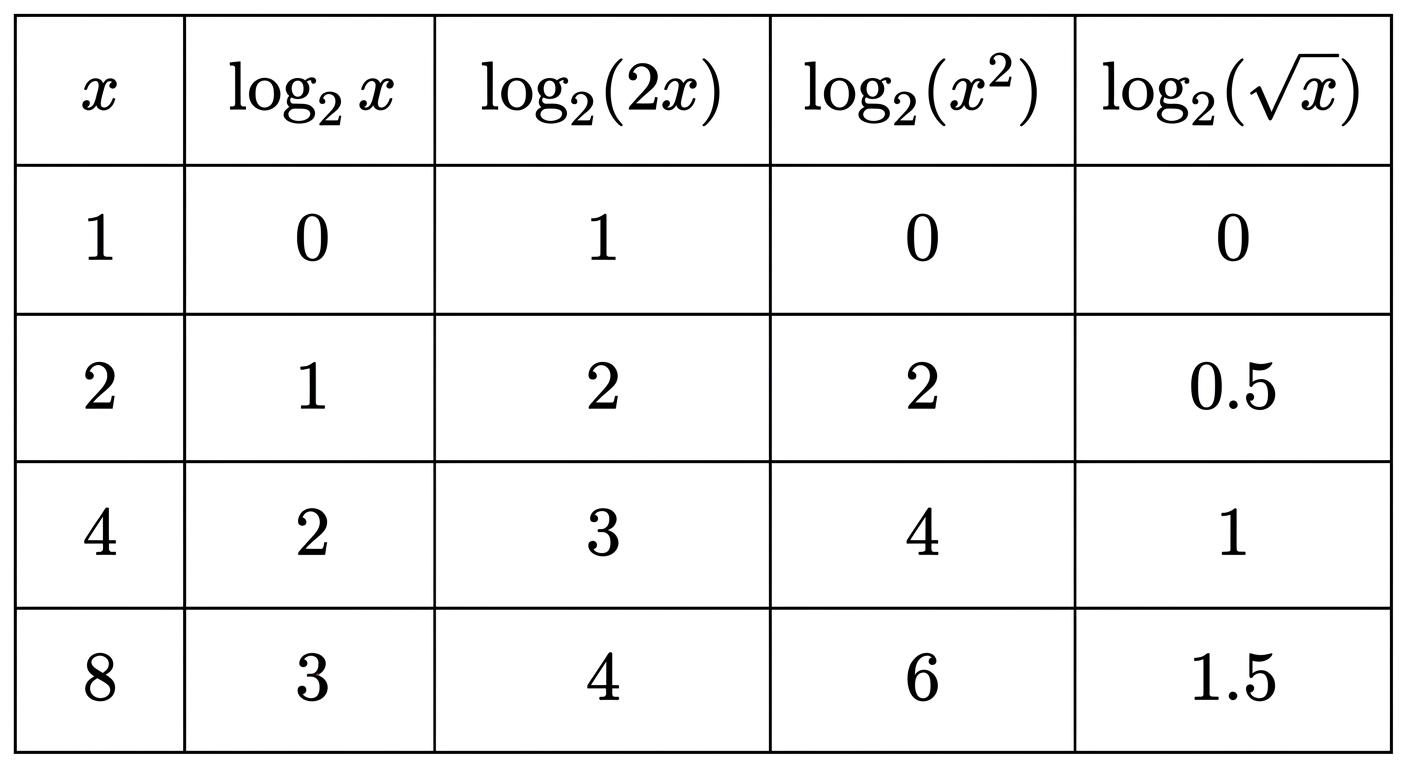
The table below shows values of four logarithmic expressions for .
| 1 | 2 | 4 | 8 | |
| 0 | 1 | 2 | 3 | |
| 1 | 2 | 3 | 4 | |
| 0 | 2 | 4 | 6 | |
| 0 | 0.5 | 1 | 1.5 |
a
Using the table, find the values of , , and such that, for all ,
For each value, show how the table supports your answer. [3]
For each value, show how the table supports your answer. [3]
b
A student claims that whenever . Using your rules from part (a), find all positive values of for which , and verify your answer by substituting back into both expressions. [4]
c
The student conjectures that all three rules from part (a) follow from the single law . Justify whether this conjecture is correct by deriving each rule directly from that law, without using the table. [4]
Solutions
That's every free question here — 4 of 182.
+178 more questions, plus Mock Papers & Worksheets, are waiting in Premium.