You're viewing free preview questions — 4 questions previewing here — subscribe to unlock 62 more, plus the Full Question Bank, Mock Papers & Worksheets.Upgrade
Estimation Rounding and Significant Figures — Free MYP4 Mathematics (Extended) Practice Questions

1QuestionApproximations in Scientific and Everyday ContextsConcept Practice
2 marks~3 minCriterion A
State the formula for percentage error, where is the approximate value and is the exact value. [2]
Solutions

2QuestionUse of Estimation in Checking ResultsAssessment Practice
2 marks~3 minCriterion C
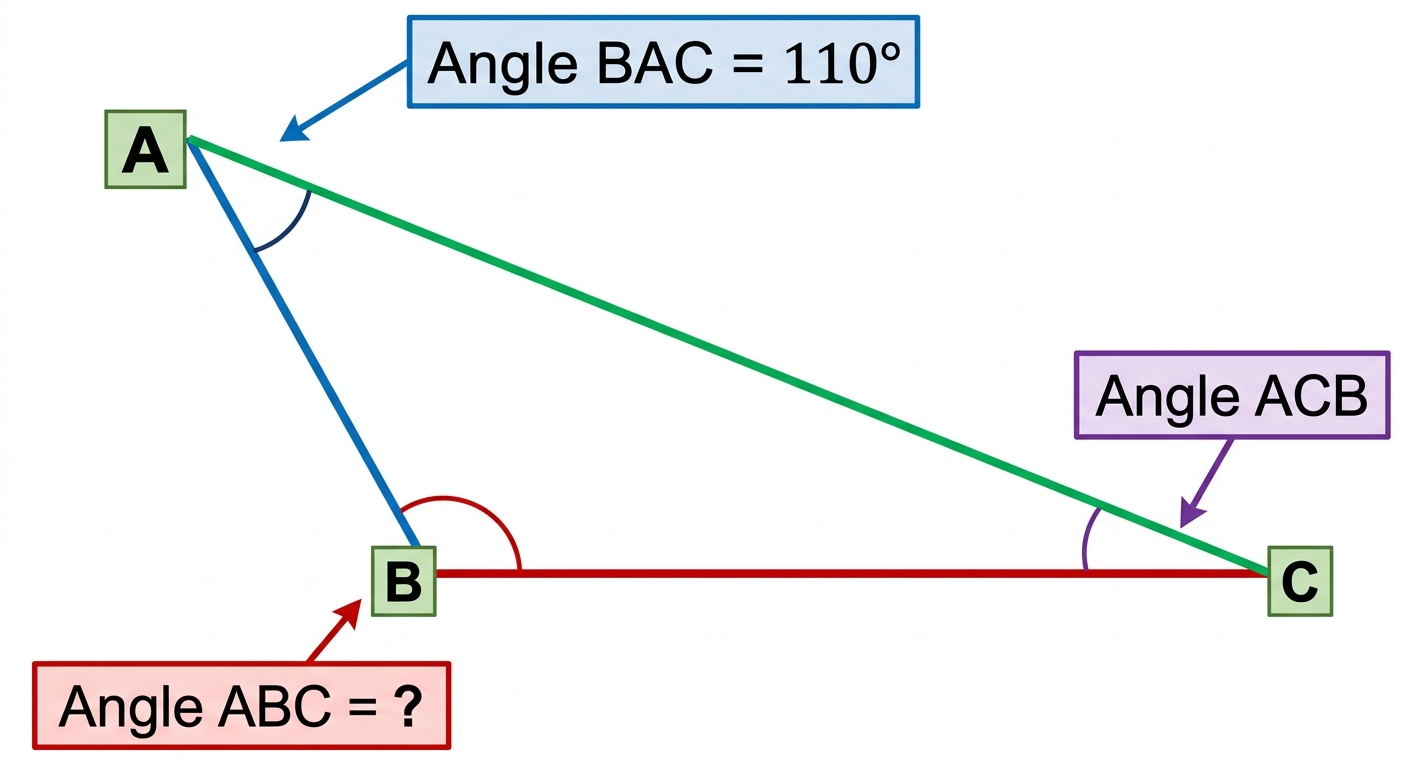
A surveyor is mapping a triangular plot of land, triangle . The angle at vertex measures . The diagram shows that is visibly smaller than .
a
Deduce the combined size of and , showing your working. [1]
b
Estimate the size of , justifying your answer using the diagram and your result from part (a). [1]
Solutions
3QuestionRounding Large and Small NumbersAssessment Practice
6 marks~9 minCriterion D
A city's population is currently estimated at 2.36 million. Planners use the exponential growth model
where is the population after years, is the initial population, is the annual growth rate, and is time in years. The city's annual growth rate is 3.8\%.
where is the population after years, is the initial population, is the annual growth rate, and is time in years. The city's annual growth rate is 3.8\%.
a
Calculate the projected population after 50 years. Round your answer to three significant figures. [2]
b
Explain how rounding to the nearest million and to the nearest whole percent each affect the 50-year projection, and describe one consequence for resource planning. [2]
c
The city council must decide whether to begin construction of three new hospitals now, each designed to serve 1.5 million people. Using your projection and the limitations of the model, advise the council whether to proceed with all three, fewer, or more hospitals. [2]

Solutions
4QuestionApproximations in Scientific and Everyday ContextsAssessment Practice
2 marks~3 minCriterion B
A student rounds each grocery item to the nearest dollar before totalling the bill.
Analyse the data to identify the relationship between the magnitude of the rounding error and the percentage error, and explain why this relationship exists using the percentage error formula. [2]
| Estimated price (dollars) | 25 | 32 | 41 | 18 |
|---|---|---|---|---|
| Actual price (dollars) | 25.45 | 31.50 | 39.80 | 17.75 |
| Rounding error (dollars) | −0.45 | 0.50 | 1.20 | 0.25 |
| Percentage error | −1.8% | 1.6% | 3.0% | 1.4% |
Analyse the data to identify the relationship between the magnitude of the rounding error and the percentage error, and explain why this relationship exists using the percentage error formula. [2]
Solutions
That's every free question here — 4 of 66.
+62 more questions, plus Mock Papers & Worksheets, are waiting in Premium.