You're viewing free preview questions — 4 questions previewing here — subscribe to unlock 62 more, plus the Full Question Bank, Mock Papers & Worksheets.Upgrade
Exponents Powers and Roots — Free MYP4 Mathematics (Extended) Practice Questions

1QuestionLaws of Exponents for Integer PowersAssessment Practice
3 marks~5 minCriterion D
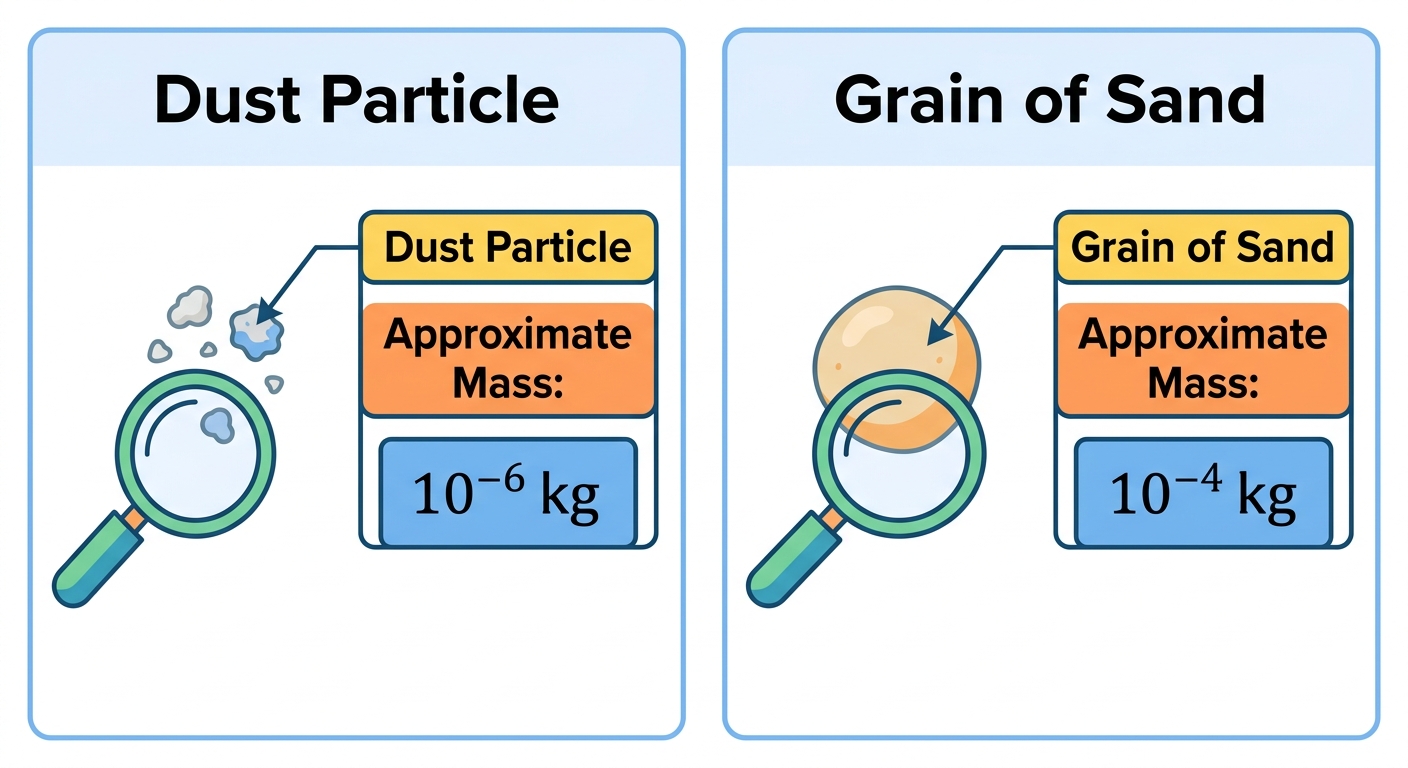
In atmospheric science, particle masses are often expressed as powers of ten. The mass of a dust particle is approximately kg and the mass of a grain of sand is approximately kg.
a
Deduce how many times heavier a grain of sand is than a dust particle. Apply the quotient law of exponents and show all steps. [1]
b
A scientist collects dust particles and grains of sand. Deduce the total combined mass of both samples, showing your working. [1]
c
The scientist claims these power-of-ten values give a sufficiently accurate model for comparing particle masses. Critique this claim, giving one specific mathematical reason. [1]

Solutions
2QuestionLaws of Exponents for Integer PowersAssessment Practice
3 marks~5 minCriterion B
The intensity of light decreases as it travels from a source. A photographer measures the relative intensity of a lamp at several distances.
Distance (m):
Relative intensity:
Distance (m):
Relative intensity:
a
Express each relative intensity as a power of 2. [1]
b
Express each distance as a power of 2, then deduce the relationship between the exponent of the distance and the exponent of the relative intensity. [1]
c
A subject is positioned 32 m from the lamp. The photographer requires a relative intensity of at least for a usable photograph. Using laws of exponents, calculate the relative intensity at 32 m and advise the photographer whether the subject should be moved closer. [1]
Solutions
3QuestionLaws of Exponents for Integer PowersAssessment Practice
4 marks~6 minCriterion C
A biologist models two bacterial populations. Population A grows according to , where is the population size (thousands) and is time in hours. Population B decays and is modelled by .
a
Show that , stating the law of exponents used. [1]
b
Describe the geometric transformation that maps the graph of onto the graph of , explaining how the change in exponent produces this transformation. [2]
c
At hours, Population A has reached 8 thousand. Calculate the size of Population B at the same time, then justify whether this value is a realistic prediction for a decaying bacterial culture. [1]
Solutions
4QuestionSimplifying Expressions with ExponentsAssessment Practice
6 marks~9 minCriterion A
A materials scientist models the thermal conductivity of a composite alloy using the expression
where , , , represent measurable physical parameters, all positive and non-zero.
where , , , represent measurable physical parameters, all positive and non-zero.
a
Show that the expression simplifies to , stating each law of exponents you apply. [4]
b
The scientist states: "Because the outer exponent is negative, the simplified expression must always be less than 1." Critique this claim, justifying your reasoning with a specific numerical counterexample. [2]
Solutions
That's every free question here — 4 of 66.
+62 more questions, plus Mock Papers & Worksheets, are waiting in Premium.