You're viewing free preview questions — 25 questions previewing here — subscribe to unlock 54 more, plus the Full Question Bank, Mock Papers & Worksheets.Upgrade
Back

Real Number System and Classifications — Free MYP4 Mathematics (Extended) Practice Questions

Free questions

Open in full, with answers, mark scheme and examiner insights.

Easy4 questions
Question 1Criterion A · Band 1-4 · Easy · 4 marksrevisionprep.com

Classifying Rational and Irrational Numbers

A CNC router must move its cutting head exactly π\pi metres along a curved track. The control software only accepts numbers written as terminating or recurring decimals, so the operator enters 3.14 m.
(a)
Express 3.14 as a fraction in its simplest form. [2]Criterion A (ii) · Level 1-2
(b)
Hence explain why no value the operator types into this software can be exactly π\pi m. [2]Criterion A (iii) · Level 3-4

revisionprep.com

Summary Answer

Not available for this question.

Model Answer

Not available for this question.

Marking Scheme

Not available for this question.

Examiner Insights

Not available for this question.

Question 2Criterion A + C · Band 1-4 · Easy · 7 marksrevisionprep.com

Understanding Integers Fractions and Decimals
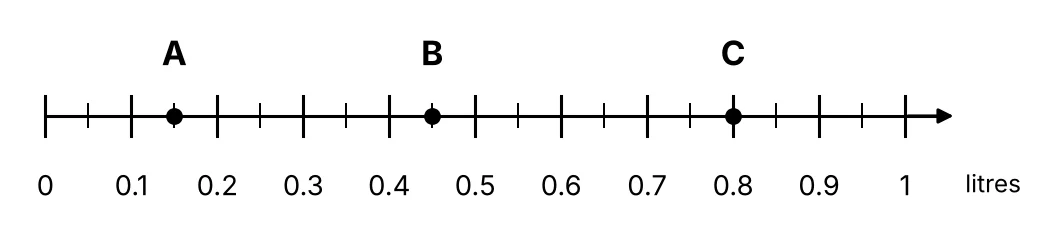
A pharmacist marks three fill levels, A, B and C, on a 1-litre bottle. The number line shows the levels in litres.
Question diagram
(a)
Write the levels A, B and C as fractions in their simplest form. [2]Criterion A (i) · Level 1-2
(b)
The pharmacist also needs a level of 310\dfrac{3}{10} litre. Show that this level lies exactly halfway between A and B. [2]Criterion A (ii) · Level 3-4
(c)
State between which two neighbouring marks on the number line a level of 13\dfrac{1}{3} litre lies. [1]Criterion A (iii) · Level 3-4
(d)
Explain why 13\dfrac{1}{3} litre can never lie exactly on one of the marks of this number line. [2]Criterion C (iv) · Level 3-4

revisionprep.com

Summary Answer

Not available for this question.

Model Answer

Not available for this question.

Marking Scheme

Not available for this question.

Examiner Insights

Not available for this question.

Question 3Criterion A · Band 1-4 · Easy · 4 marksrevisionprep.com

Set Notation and Venn Diagrams for Number Sets
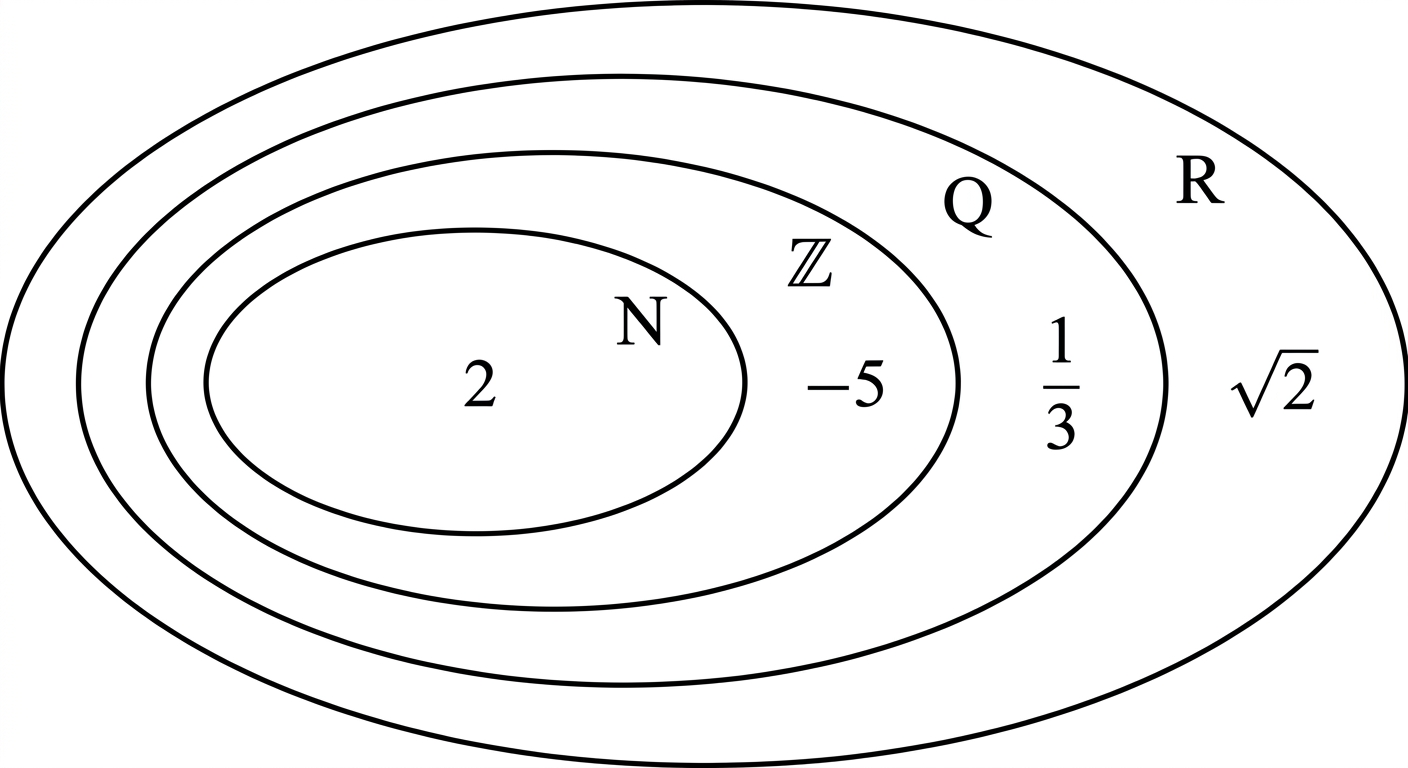
The diagram shows the sets N⊂Z⊂Q⊂R\mathbb{N} \subset \mathbb{Z} \subset \mathbb{Q} \subset \mathbb{R}, with the numbers 22, −5-5, 13\dfrac{1}{3} and 2\sqrt{2} placed in their regions.
Question diagram
(a)
Write down, in set notation, the elements shown that belong to Z\mathbb{Z} but not to N\mathbb{N}. [1]Criterion A (i) · Level 1-2
(b)
Write down the elements shown that belong to R∖Q\mathbb{R} \setminus \mathbb{Q}. [1]Criterion A (i) · Level 1-2
(c)
State the region of the diagram in which each of −0.25-0.25 and 9\sqrt{9} should be placed. Give a reason for each. [2]Criterion A (ii) · Level 3-4

revisionprep.com

Summary Answer

Not available for this question.

Model Answer

Not available for this question.

Marking Scheme

Not available for this question.

Examiner Insights

Not available for this question.

Question 4Criterion A + C · Band 1-4 · Easy · 6 marksrevisionprep.com

Set Notation and Venn Diagrams for Number Sets
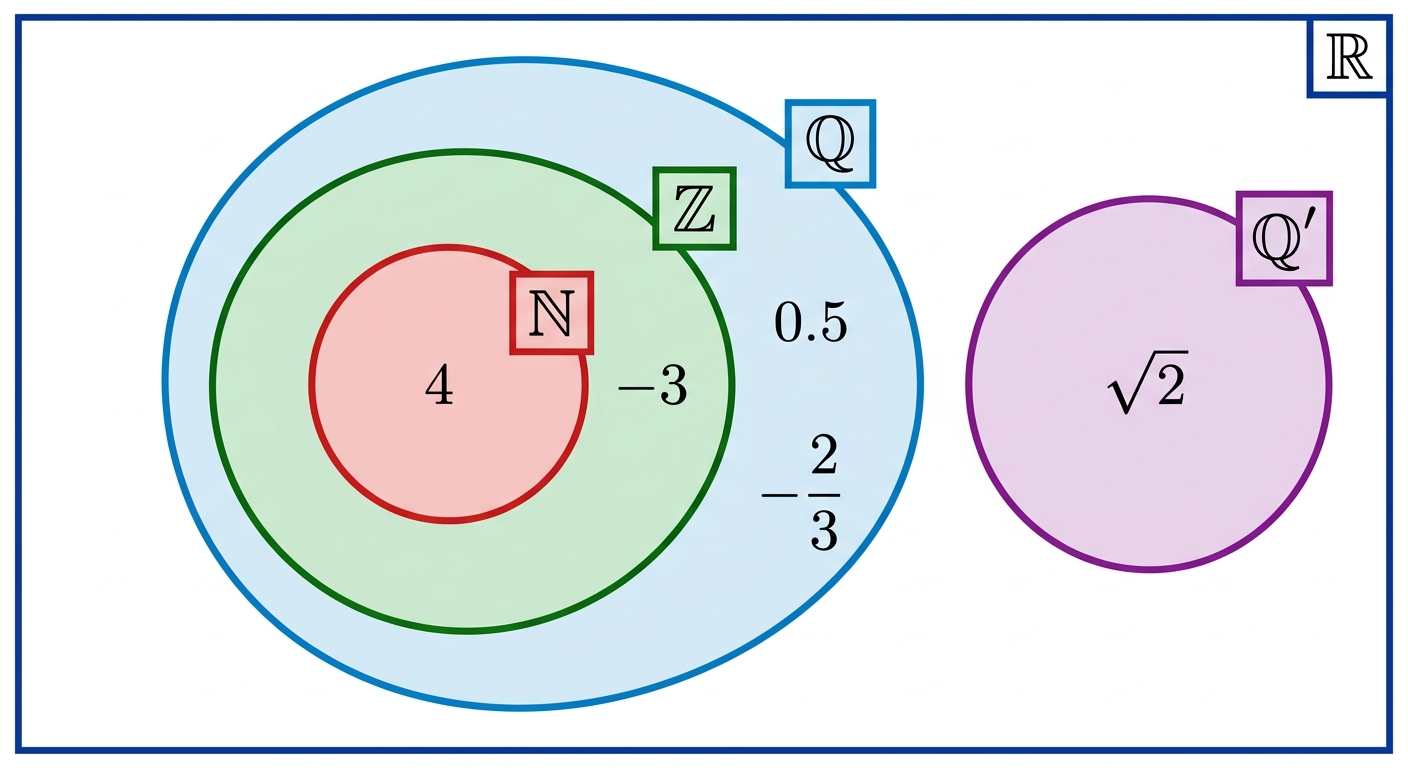
The Venn diagram shows the universal set R\mathbb{R}, the nested sets N⊂Z⊂Q\mathbb{N} \subset \mathbb{Z} \subset \mathbb{Q}, and the set Q′\mathbb{Q}'. The numbers −3-3, 0.50.5, 2\sqrt{2}, 44 and −23-\dfrac{2}{3} are placed in their regions.
Question diagram
(a)
Describe in words the set {x∈Z∣x<0}\{x \in \mathbb{Z} \mid x < 0\}, and list the numbers from the diagram that belong to it. [2]Criterion A (i) · Level 1-2
(b)
Write down, in set notation, the numbers from the diagram that belong to Q\mathbb{Q} but not to Z\mathbb{Z}. [1]Criterion A (ii) · Level 1-2
(c)
State what the set Q′\mathbb{Q}' contains, and explain why the circles for Q\mathbb{Q} and Q′\mathbb{Q}' do not overlap. [2]Criterion C (i), C (iv) · Level 3-4
(d)
Write down the set Q∪Q′\mathbb{Q} \cup \mathbb{Q}'. [1]Criterion C (i) · Level 3-4

revisionprep.com

Summary Answer

Not available for this question.

Model Answer

Not available for this question.

Marking Scheme

Not available for this question.

Examiner Insights

Not available for this question.

Medium13 questions
Question 5Criterion A · Band 1-6 · Medium · 6 marksrevisionprep.com

Classifying Rational and Irrational Numbers
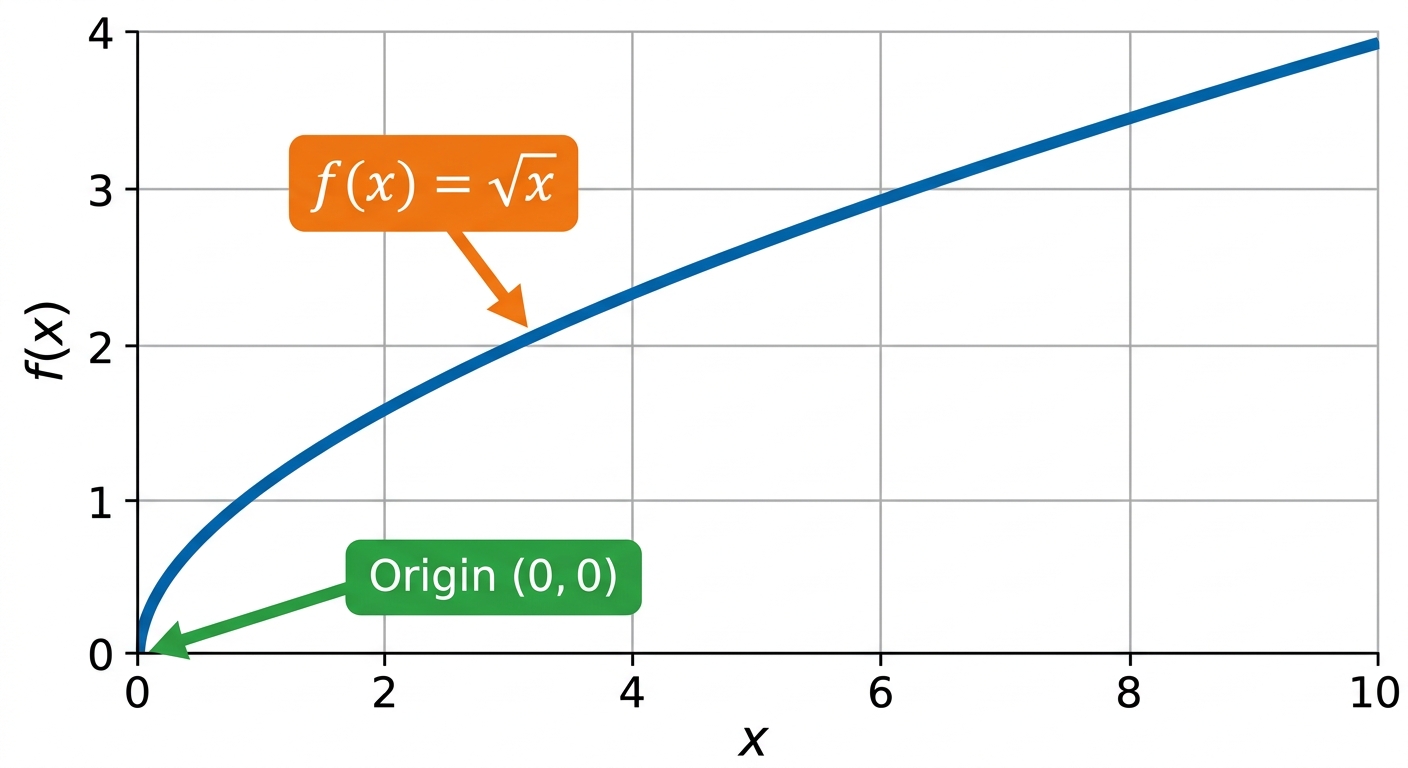
The graph shows f(x)=xf(x) = \sqrt{x} for 0≤x≤100 \le x \le 10.
Question diagram
(a)
Use the graph to write down f(4)f(4) and f(9)f(9). [1]Criterion A (i) · Level 1-2
(b)
List all the integers xx, with 0≤x≤100 \le x \le 10, for which f(x)f(x) is rational. [2]Criterion A (ii) · Level 3-4
(c)
Yuki reads f(2)≈1.4f(2) \approx 1.4 from the graph and writes 2=75\sqrt{2} = \dfrac{7}{5}, so 2\sqrt{2} is rational. Explain why Yuki is wrong. [2]Criterion A (iii) · Level 5-6
(d)
Write down a value of xx with 0<x<100 < x < 10 that is not an integer, for which f(x)f(x) is rational. [1]Criterion A (iii) · Level 5-6

revisionprep.com

Summary Answer

Not available for this question.

Model Answer

Not available for this question.

Marking Scheme

Not available for this question.

Examiner Insights

Not available for this question.

Question 6Criterion C · Band 1-6 · Medium · 7 marksrevisionprep.com

Classifying Rational and Irrational Numbers
Mei uses 2≈1.41421\sqrt{2} \approx 1.41421 and works out 1.41421+13=5242633000001.41421 + \dfrac{1}{3} = \dfrac{524263}{300000}. She writes: "The answer is a fraction, so 2+13\sqrt{2} + \dfrac{1}{3} is rational."
(a)
Show that 1.41421+13=5242633000001.41421 + \dfrac{1}{3} = \dfrac{524263}{300000}. [2]Criterion C (i) · Level 3-4
(b)
State whether 1.41421 is rational or irrational, giving a reason. [1]Criterion C (i) · Level 1-2
(c)
Given that 2\sqrt{2} is irrational, explain why 2+13\sqrt{2} + \dfrac{1}{3} is irrational. [2]Criterion C (iv) · Level 5-6
(d)
Explain the error in Mei's argument. [2]Criterion C (iv), C (v) · Level 5-6

revisionprep.com

Summary Answer

Not available for this question.

Model Answer

Not available for this question.

Marking Scheme

Not available for this question.

Examiner Insights

Not available for this question.

Question 7Criterion D + A · Band 3-6 · Medium · 8 marksrevisionprep.com

Classifying Rational and Irrational Numbers

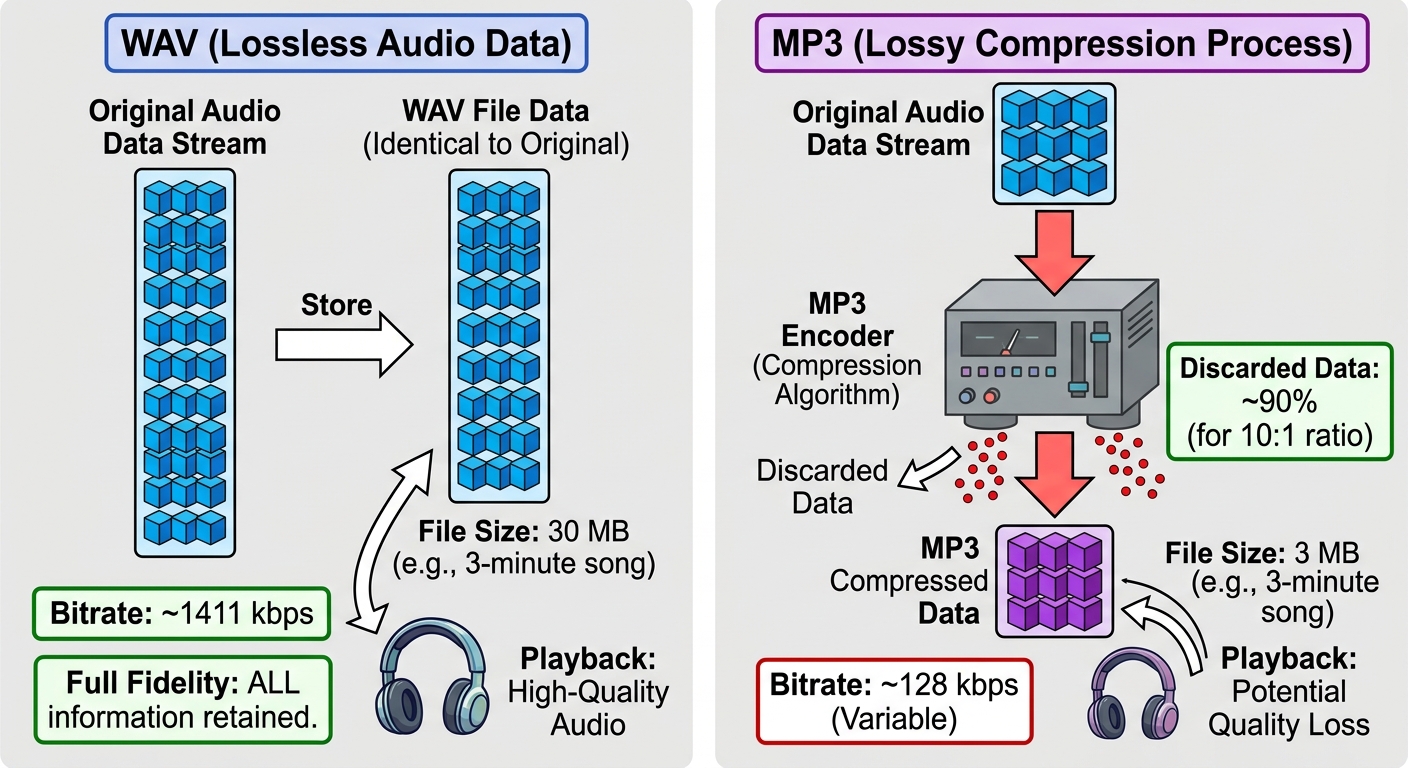
The diagram compares a WAV file and an MP3 file of the same 3-minute song.
Question diagram
(a)
Use the diagram to express the MP3 bitrate as a fraction of the WAV bitrate, in its simplest form. [2]Criterion D (i) · Level 3-4
(b)
Without dividing, determine whether your fraction has a terminating or a recurring decimal. Justify your answer. [2]Criterion A (iii) · Level 5-6
(c)
Calculate the percentage of the WAV bitrate that is kept in the MP3. Give your answer to 3 significant figures. [2]Criterion D (iii) · Level 3-4
(d)
The diagram states that about 90% of the data is discarded. Use your answer to (c) and the file sizes shown to justify whether this statement is reasonable. [2]Criterion D (v) · Level 5-6

revisionprep.com

Summary Answer

Not available for this question.

Model Answer

Not available for this question.

Marking Scheme

Not available for this question.

Examiner Insights

Not available for this question.

Question 8Criterion D · Band 1-6 · Medium · 7 marksrevisionprep.com

Understanding Integers Fractions and Decimals
A bottling plant accepts a bottle labelled 330 ml if the volume vv ml in the bottle satisfies ∣v−330∣≤1.5\lvert v - 330 \rvert \le 1.5.
(a)
Find ∣v−330∣\lvert v - 330 \rvert for v=328.7v = 328.7 and for v=332v = 332, and state which bottle is accepted. [2]Criterion D (iii) · Level 1-2
(b)
Solve ∣v−330∣≤1.5\lvert v - 330 \rvert \le 1.5 and write the set of accepted volumes in interval notation. [2]Criterion D (ii), D (iii) · Level 3-4
(c)
A second line makes 500 ml bottles and accepts a volume vv if ∣v−500∣<2.5\lvert v - 500 \rvert < 2.5. Write the accepted volumes in interval notation. [1]Criterion D (iii) · Level 3-4
(d)
Find each line's tolerance as a percentage of its label volume. Justify which line is stricter. [2]Criterion D (iv), D (v) · Level 5-6

revisionprep.com

Summary Answer

Not available for this question.

Model Answer

Not available for this question.

Marking Scheme

Not available for this question.

Examiner Insights

Not available for this question.

Question 9Criterion A + D · Band 1-6 · Medium · 8 marksrevisionprep.com

Understanding Integers Fractions and Decimals

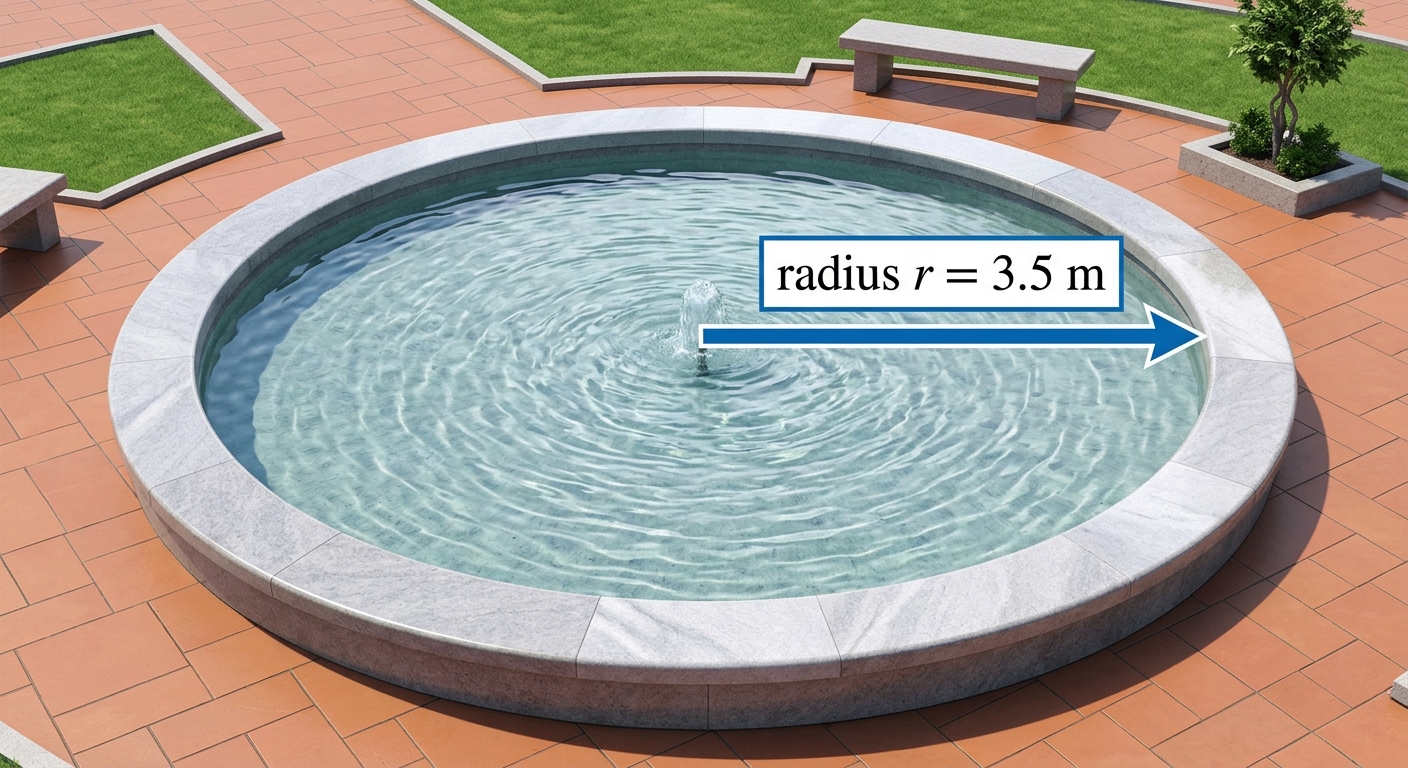
The fountain in the diagram has a radius of 3.5 m. Stone edging blocks, each 0.5 m long, are laid around its circumference. A builder uses π≈227\pi \approx \dfrac{22}{7}.
Question diagram
(a)
Write down the exact circumference in terms of π\pi, and state whether it is rational or irrational. [2]Criterion A (i) · Level 1-2
(b)
Show that the builder's value for the circumference is 22 m. [2]Criterion D (iii) · Level 1-2
(c)
Write 227\dfrac{22}{7} as a recurring decimal, and state whether the builder's circumference is larger or smaller than the exact value. [2]Criterion A (ii) · Level 3-4
(d)
Justify whether using 227\dfrac{22}{7} changes the number of edging blocks the builder must order. [2]Criterion D (iv), D (v) · Level 5-6

revisionprep.com

Summary Answer

Not available for this question.

Model Answer

Not available for this question.

Marking Scheme

Not available for this question.

Examiner Insights

Not available for this question.

Question 10Criterion D · Band 3-6 · Medium · 9 marksrevisionprep.com

Understanding Integers Fractions and Decimals

A vet uses the model B=70 m3/4B = 70\,m^{3/4} to estimate the daily energy need BB kilocalories of a healthy mammal of mass mm kg.
(a)
A fox has a mass of 16 kg. Without a calculator, find BB. [2]Criterion D (iii) · Level 3-4
(b)
A wolf has a mass of 81 kg. Without a calculator, find BB. [1]Criterion D (iii) · Level 3-4
(c)
A mammal needs 8750 kilocalories a day. Find its mass. [2]Criterion D (ii), D (iii) · Level 5-6
(d)
Without a calculator, show that doubling an animal's mass multiplies its energy need by less than 2. [2]

(e) Find the energy need per kilogram of the fox and of the wolf, and explain what this shows about large animals. [2]
Criterion D (iv), D (v) · Level 5-6

revisionprep.com

Summary Answer

Not available for this question.

Model Answer

Not available for this question.

Marking Scheme

Not available for this question.

Examiner Insights

Not available for this question.

Question 11Criterion C · Band 1-6 · Medium · 7 marksrevisionprep.com

Comparing and Ordering Real Numbers

Consider the four numbers
−10,−π,−3.15,−227-\sqrt{10}, \quad -\pi, \quad -3.15, \quad -\dfrac{22}{7}
(a)
Write 227\dfrac{22}{7} as a recurring decimal, and compare it with 3.15 and with π\pi. [2]Criterion C (i), C (iii) · Level 1-2
(b)
Without a calculator, show that 10>3.15\sqrt{10} > 3.15. [2]Criterion C (iv) · Level 3-4
(c)
Hence write the four numbers in ascending order, explaining how the negative signs affect the order. [2]Criterion C (iv), C (v) · Level 5-6
(d)
Tomas places −π-\pi to the left of −227-\dfrac{22}{7} on a number line, because π<227\pi < \dfrac{22}{7}. State his error. [1]Criterion C (iv) · Level 5-6

revisionprep.com

Summary Answer

Not available for this question.

Model Answer

Not available for this question.

Marking Scheme

Not available for this question.

Examiner Insights

Not available for this question.

Question 12Criterion A · Band 1-6 · Medium · 7 marksrevisionprep.com

Comparing and Ordering Real Numbers

A mixing desk works best when a gain setting gg satisfies 0.5<g<10.5 < g < 1. Five gain settings are
35,0.72,π−2,58,2−1\dfrac{3}{5}, \quad 0.72, \quad \pi - 2, \quad \dfrac{5}{8}, \quad \sqrt{2} - 1
The number line in the diagram is marked from 0 to 1.2.
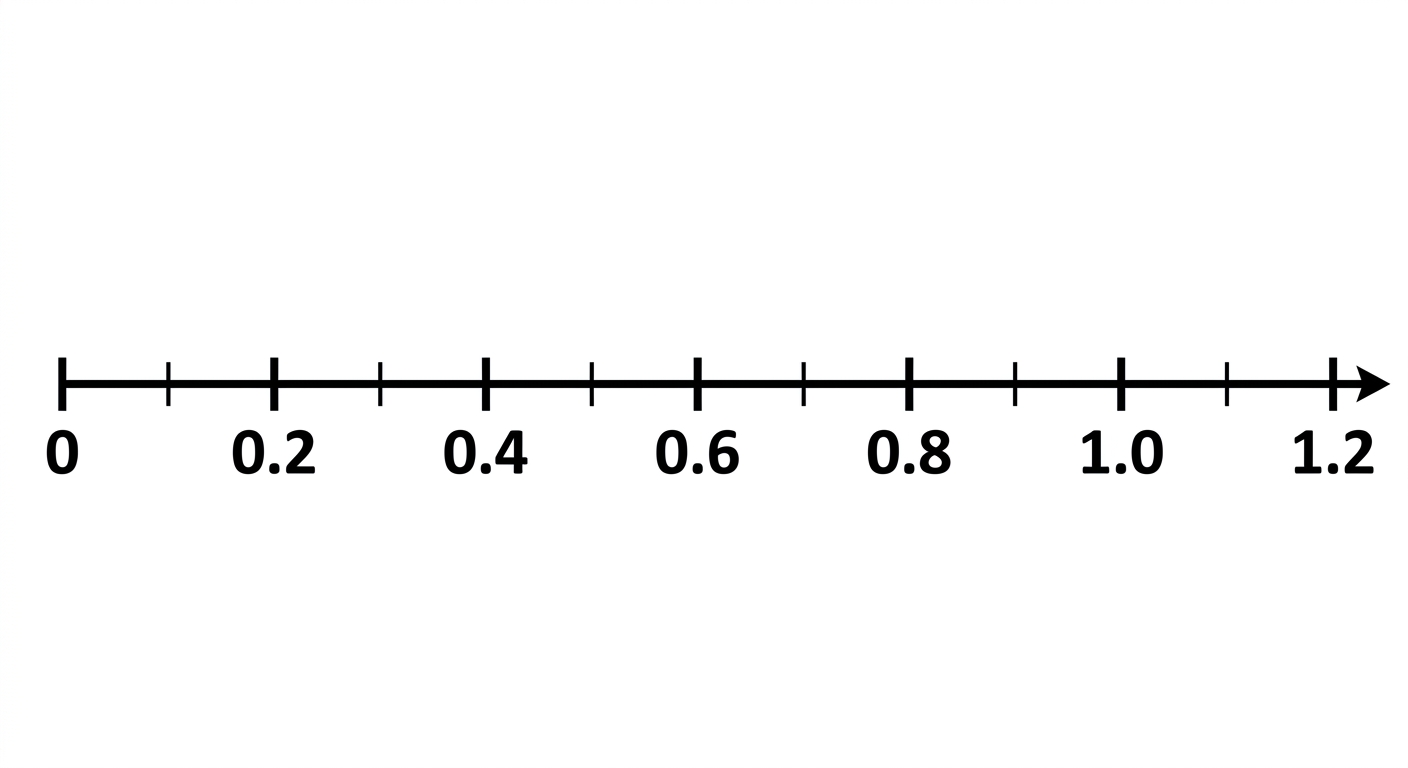
Question diagram
(a)
Write each setting as a decimal, correct to 3 decimal places where necessary. [2]Criterion A (ii) · Level 1-2
(b)
Plot the five settings on a copy of the number line. [2]Criterion A (ii) · Level 3-4
(c)
Write down the settings that do not satisfy 0.5<g<10.5 < g < 1. [1]Criterion A (i) · Level 1-2
(d)
Show that the condition 0.5<g<10.5 < g < 1 can be written as ∣g−0.75∣<0.25\lvert g - 0.75 \rvert < 0.25, and write the set of working gain settings in interval notation. [2]Criterion A (iii) · Level 5-6

revisionprep.com

Summary Answer

Not available for this question.

Model Answer

Not available for this question.

Marking Scheme

Not available for this question.

Examiner Insights

Not available for this question.

Question 13Criterion A · Band 1-6 · Medium · 8 marksrevisionprep.com

Comparing and Ordering Real Numbers

Consider the numbers M=5−1M = \sqrt{5} - 1 and N=75N = \dfrac{7}{5}.
(a)
State whether each of MM and NN is rational or irrational. [1]Criterion A (i) · Level 1-2
(b)
Without using a calculator, determine which of MM and NN is larger. Show your reasoning. [3]Criterion A (ii), A (iii) · Level 5-6
(c)
Show that 1M=5+14\dfrac{1}{M} = \dfrac{\sqrt{5} + 1}{4}. [2]Criterion A (ii) · Level 5-6
(d)
Hence, without a calculator, determine whether 1M\dfrac{1}{M} is greater than 34\dfrac{3}{4}. [2]Criterion A (iii) · Level 5-6

revisionprep.com

Summary Answer

Not available for this question.

Model Answer

Not available for this question.

Marking Scheme

Not available for this question.

Examiner Insights

Not available for this question.

Question 14Criterion A + C · Band 1-6 · Medium · 6 marksrevisionprep.com

Set Notation and Venn Diagrams for Number Sets
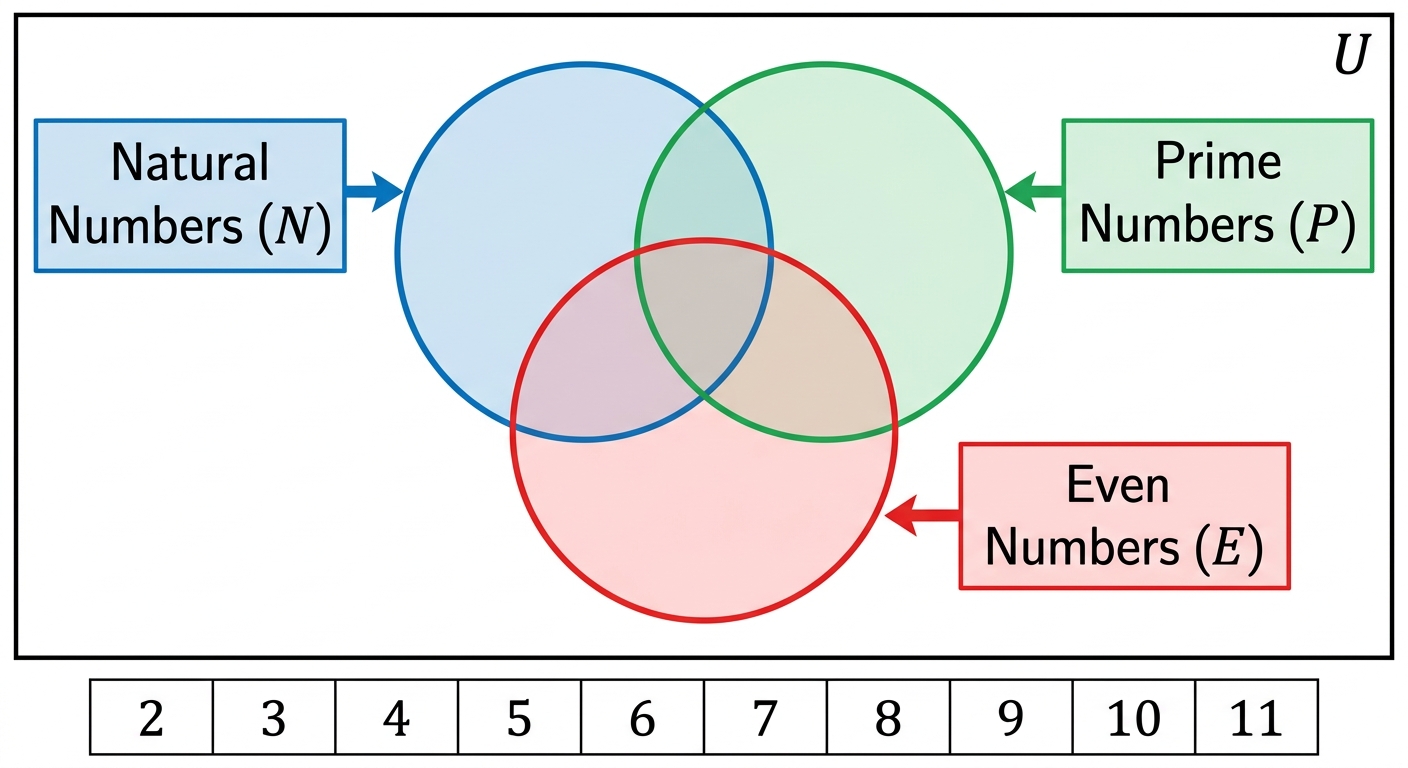
A coordinator sorts the jersey numbers {2,3,4,5,6,7,8,9,10,11}\{2, 3, 4, 5, 6, 7, 8, 9, 10, 11\} using the Venn diagram shown, with circles for natural numbers NN, prime numbers PP and even numbers EE.
Question diagram
(a)
List the elements of PP, EE and P∩EP \cap E. [3]Criterion A (i), A (ii) · Level 1-2
(b)
Explain why the circle for NN makes this diagram misleading. [2]Criterion C (ii), C (iv) · Level 5-6
(c)
State how the diagram should be redrawn. [1]Criterion C (ii) · Level 3-4

revisionprep.com

Summary Answer

Not available for this question.

Model Answer

Not available for this question.

Marking Scheme

Not available for this question.

Examiner Insights

Not available for this question.

Question 15Criterion C · Band 3-6 · Medium · 8 marksrevisionprep.com

Set Notation and Venn Diagrams for Number Sets

Three sets of real numbers are defined by
A=[−3,2[,B={x∈R∣x≥1},C={x∈R∣∣x∣<2}A = [-3, 2[, \qquad B = \{x \in \mathbb{R} \mid x \ge 1\}, \qquad C = \{x \in \mathbb{R} \mid \lvert x \rvert < 2\}
(a)
Write AA in set-builder notation using inequalities, and write CC in interval notation. [2]Criterion C (i), C (iii) · Level 3-4
(b)
Find A∩BA \cap B and A∪BA \cup B, giving each in interval notation. [2]Criterion C (iii) · Level 3-4
(c)
Find A∩CA \cap C in interval notation and list the integers in it. [2]Criterion C (i), C (iv) · Level 5-6
(d)
Without a calculator, determine whether 3∈A∩B\sqrt{3} \in A \cap B. Justify your answer. [2]Criterion C (iv) · Level 5-6

revisionprep.com

Summary Answer

Not available for this question.

Model Answer

Not available for this question.

Marking Scheme

Not available for this question.

Examiner Insights

Not available for this question.

Question 16Criterion C · Band 1-6 · Medium · 8 marksrevisionprep.com

Number Line Representation of Real Numbers
A={x∈R∣−2≤x<3}A = \{x \in \mathbb{R} \mid -2 \le x < 3\} and B={x∈R∣x>2}B = \{x \in \mathbb{R} \mid x > \sqrt{2}\}.
(a)
Describe how AA and BB are shown on a number line, stating which end points are included. [2]Criterion C (ii) · Level 1-2
(b)
Write A∩BA \cap B as a double inequality and in interval notation. [2]Criterion C (i), C (iii) · Level 3-4
(c)
Write A∪BA \cup B and A∖BA \setminus B in interval notation. [2]Criterion C (i), C (iii) · Level 5-6
(d)
Zainab says: "A∩BA \cap B contains exactly one rational number." Explain why she is wrong. [2]Criterion C (iv) · Level 5-6

revisionprep.com

Summary Answer

Not available for this question.

Model Answer

Not available for this question.

Marking Scheme

Not available for this question.

Examiner Insights

Not available for this question.

Question 17Criterion A + C · Band 1-6 · Medium · 9 marksrevisionprep.com

Number Line Representation of Real Numbers

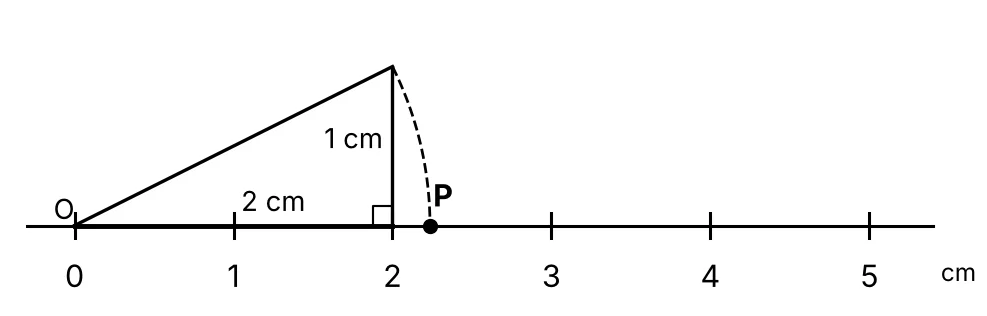
A carpenter draws a right-angled triangle with sides of 2 cm and 1 cm on a number line, as shown. She uses a compass centred at O to swing the hypotenuse down onto the line, and marks the point P.
Question diagram
(a)
Show that the hypotenuse is 5\sqrt{5} cm long. [2]Criterion A (ii) · Level 1-2
(b)
Without a calculator, show that 2<5<2.52 < \sqrt{5} < 2.5. [2]Criterion A (iii) · Level 3-4
(c)
Ravi copies the construction but marks P at 2.75, "about three quarters of the way from 2 to 3". Use your answer to (b) to justify that Ravi's point is in the wrong place. [1]Criterion C (iv) · Level 3-4
(d)
Explain how this construction can locate 5\sqrt{5} exactly, even though its decimal expansion never ends. [2]

(e) Show that 20=25\sqrt{20} = 2\sqrt{5}, and explain how to mark 20\sqrt{20} exactly on the number line using the same compass setting. [2]
Criterion C (iv) · Level 5-6

revisionprep.com

Summary Answer

Not available for this question.

Model Answer

Not available for this question.

Marking Scheme

Not available for this question.

Examiner Insights

Not available for this question.

Challenge8 questions
Question 18Criterion B · Band 1-8 · Challenge · 9 marksrevisionprep.com

Classifying Rational and Irrational Numbers

This task investigates which unit fractions 1d\dfrac{1}{d} have terminating decimals.
(a)
Find 1d\dfrac{1}{d} as a decimal for each integer dd from 2 to 12, and state whether each decimal terminates or recurs. [3]Criterion B (i) · Level 1-2
(b)
Write each value of dd as a product of prime factors. Describe the rule that tells you whether 1d\dfrac{1}{d} terminates. [2]Criterion B (ii) · Level 3-4
(c)
Without dividing, use your rule to predict whether 116\dfrac{1}{16}, 124\dfrac{1}{24} and 140\dfrac{1}{40} terminate. Then verify your predictions by division. [2]Criterion B (iii) · Level 5-6
(d)
Justify your rule for any fraction 12m×5n\dfrac{1}{2^m \times 5^n}, where mm and nn are non-negative integers. [2]Criterion B (iii) · Level 7-8

revisionprep.com

Summary Answer

Not available for this question.

Model Answer

Not available for this question.

Marking Scheme

Not available for this question.

Examiner Insights

Not available for this question.

Question 19Criterion B · Band 1-8 · Challenge · 9 marksrevisionprep.com

Classifying Rational and Irrational Numbers

This task investigates how a recurring decimal can be written as a fraction.
(a)
Write down 19\dfrac{1}{9}, 49\dfrac{4}{9}, 79\dfrac{7}{9}, 599\dfrac{5}{99}, 2399\dfrac{23}{99} and 6199\dfrac{61}{99} as recurring decimals. [2]Criterion B (i) · Level 1-2
(b)
Describe the pattern, and write a general rule for 0.d‾0.\overline{d} and for 0.ab‾0.\overline{ab}, where dd, aa and bb are digits. [2]Criterion B (ii) · Level 3-4
(c)
Verify your rule for 0.36‾0.\overline{36} by letting x=0.363636…x = 0.363636\ldots, multiplying by 100 and subtracting. Give the fraction in its simplest form. [3]Criterion B (iii) · Level 5-6
(d)
Justify why subtracting xx from 100x100x always removes the recurring part when the repeating block has two digits, and predict the rule for 0.abc‾0.\overline{abc}. [2]Criterion B (iii) · Level 7-8

revisionprep.com

Summary Answer

Not available for this question.

Model Answer

Not available for this question.

Marking Scheme

Not available for this question.

Examiner Insights

Not available for this question.

Question 20Criterion C · Band 1-8 · Challenge · 9 marksrevisionprep.com

Classifying Rational and Irrational Numbers

In a puzzle, a counter sits at p=0.27‾p = 0.\overline{27} on a number line and a gate sits at q=0.1q = \sqrt{0.1}.
(a)
Find pp as a fraction in its simplest form. [2]Criterion C (i) · Level 1-2
(b)
Write qq in the form 10k\dfrac{\sqrt{10}}{k} by rationalising the denominator. Given that 10\sqrt{10} is irrational, explain why qq is irrational. [3]Criterion C (iv) · Level 5-6
(c)
Without a calculator, determine whether the counter is to the left or to the right of the gate. [2]Criterion C (iii), C (iv) · Level 5-6
(d)
Mia says: "No rational number lies between the counter and the gate, because they are so close." Find a rational number between them, and explain why such a number must always exist. [2]Criterion C (iv), C (v) · Level 7-8

revisionprep.com

Summary Answer

Not available for this question.

Model Answer

Not available for this question.

Marking Scheme

Not available for this question.

Examiner Insights

Not available for this question.

Question 21Criterion B · Band 1-8 · Challenge · 8 marksrevisionprep.com

Understanding Integers Fractions and Decimals

Some decimals start with digits that do not repeat, then recur, for example 16=0.16‾\dfrac{1}{6} = 0.1\overline{6}, which has 1 non-repeating digit.
(a)
Write 112\dfrac{1}{12}, 115\dfrac{1}{15}, 118\dfrac{1}{18}, 124\dfrac{1}{24} and 175\dfrac{1}{75} as recurring decimals, and state the number of non-repeating digits in each. [2]Criterion B (i) · Level 1-2
(b)
Write each denominator as a product of prime factors. Describe the rule that gives the number of non-repeating digits. [2]Criterion B (ii) · Level 3-4
(c)
Predict the number of non-repeating digits in 148\dfrac{1}{48} and 1150\dfrac{1}{150}. Verify your predictions. [2]Criterion B (iii) · Level 5-6
(d)
Justify your rule by considering what happens when the decimal is multiplied by a suitable power of 10. [2]Criterion B (iii) · Level 7-8

revisionprep.com

Summary Answer

Not available for this question.

Model Answer

Not available for this question.

Marking Scheme

Not available for this question.

Examiner Insights

Not available for this question.

Question 22Criterion B · Band 1-8 · Challenge · 9 marksrevisionprep.com

Understanding Integers Fractions and Decimals

A phone screen shows numbers to at most 6 decimal places. Kai uses it to display 15\dfrac{1}{5}, 125\dfrac{1}{25}, 1125\dfrac{1}{125}, and so on.
(a)
Write 15n\dfrac{1}{5^n} as an exact decimal for n=1,2,3,4,5n = 1, 2, 3, 4, 5. [2]Criterion B (i) · Level 1-2
(b)
Describe the pattern in the digits and in the number of decimal places, and write 15n\dfrac{1}{5^n} as a fraction with a power of 10 as its denominator. [2]Criterion B (ii) · Level 3-4
(c)
Use your rule to predict the exact decimal for 157\dfrac{1}{5^7}, then verify it. [2]Criterion B (iii) · Level 5-6
(d)
Justify your rule for every positive integer nn. [2]

(e) Write down the largest value of nn for which the screen shows 15n\dfrac{1}{5^n} exactly. [1]
Criterion B (iii) · Level 7-8

revisionprep.com

Summary Answer

Not available for this question.

Model Answer

Not available for this question.

Marking Scheme

Not available for this question.

Examiner Insights

Not available for this question.

Question 23Criterion D + A · Band 1-8 · Challenge · 10 marksrevisionprep.com

Comparing and Ordering Real Numbers

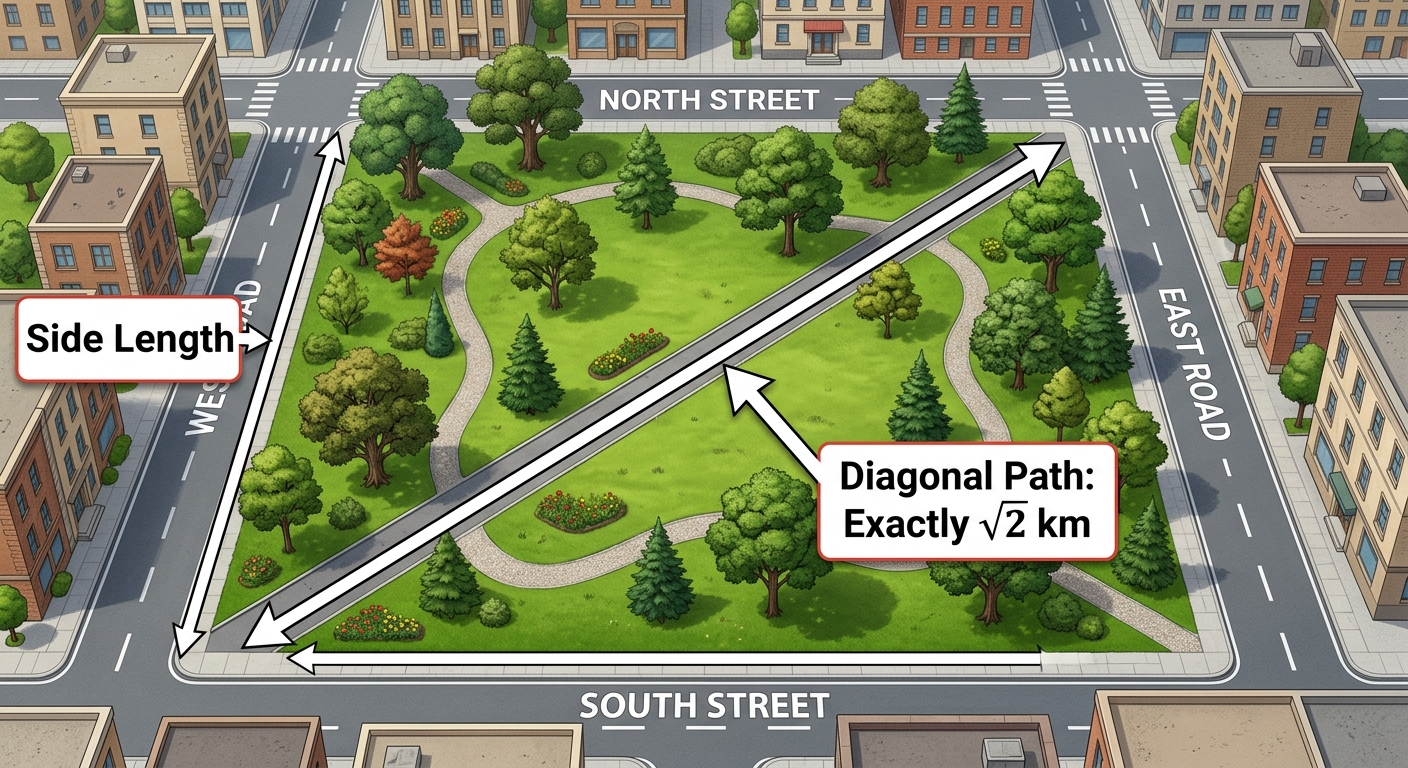
The diagram shows a square park. The diagonal path across the park is exactly 2\sqrt{2} km long.
Question diagram
(a)
Show that each side of the park is 1 km long. [2]Criterion D (iii) · Level 3-4
(b)
State whether the side length and the diagonal length are rational or irrational. [1]Criterion A (i) · Level 1-2
(c)
Show that the diagonal path is (2−2)(2 - \sqrt{2}) km shorter than walking along two sides, and find this saving in metres, correct to the nearest metre. [2]Criterion D (iii) · Level 3-4
(d)
A sign at the corner will tell walkers how far the diagonal path saves. Justify a sensible degree of accuracy for the number on the sign. [2]

(e) Another square park has side length ss km. Prove that the diagonal path saves the same fraction of the two-side route, whatever the value of ss, and find this fraction in the form 1−2k1 - \dfrac{\sqrt{2}}{k}. [3]
Criterion D (iv), D (v) · Level 5-6

revisionprep.com

Summary Answer

Not available for this question.

Model Answer

Not available for this question.

Marking Scheme

Not available for this question.

Examiner Insights

Not available for this question.

Question 24Criterion B · Band 1-8 · Challenge · 8 marksrevisionprep.com

Set Notation and Venn Diagrams for Number Sets

U={x∈Z∣1≤x≤30}U = \{x \in \mathbb{Z} \mid 1 \le x \le 30\}. For a positive integer kk, MkM_k is the set of multiples of kk in UU.
(a)
List M2∩M3M_2 \cap M_3, M4∩M6M_4 \cap M_6 and M3∩M5M_3 \cap M_5, and write down the number of elements in each. [2]Criterion B (i) · Level 1-2
(b)
Describe the pattern, and write a rule for Ma∩MbM_a \cap M_b. [2]Criterion B (ii) · Level 3-4
(c)
Use your rule to predict n(M6∩M10)n(M_6 \cap M_{10}) and n(M9∩M12)n(M_9 \cap M_{12}), then verify by listing. [2]Criterion B (iii) · Level 5-6
(d)
Justify your rule, and explain why M4∩M6M_4 \cap M_6 is not the same as M24M_{24}. [2]Criterion B (iii) · Level 7-8

revisionprep.com

Summary Answer

Not available for this question.

Model Answer

Not available for this question.

Marking Scheme

Not available for this question.

Examiner Insights

Not available for this question.

Question 25Criterion B · Band 1-8 · Challenge · 8 marksrevisionprep.com

Number Line Representation of Real Numbers

Points are placed on a number line. P1=0P_1 = 0 and P2=1P_2 = 1, and each new point is the midpoint of the previous two, so P3=12P_3 = \dfrac{1}{2}.
(a)
Find P4P_4, P5P_5, P6P_6 and P7P_7 as fractions and as decimals. [2]Criterion B (i) · Level 1-2
(b)
The points appear to approach 23\dfrac{2}{3}. Find the distance from each of P1P_1 to P6P_6 to 23\dfrac{2}{3}, and describe the pattern. [2]Criterion B (i), B (ii) · Level 3-4
(c)
Use your pattern to predict the distance from P8P_8 to 23\dfrac{2}{3}, then verify it. [2]Criterion B (iii) · Level 5-6
(d)
Justify why no point PnP_n is ever exactly equal to 23\dfrac{2}{3}. [2]Criterion B (iii) · Level 7-8

revisionprep.com

Summary Answer

Not available for this question.

Model Answer

Not available for this question.

Marking Scheme

Not available for this question.

Examiner Insights

Not available for this question.

That's every free question here — 25 of 79.

+54 more questions, plus Mock Papers & Worksheets, are waiting in Premium.

Upgrade