You're viewing free preview questions — 6 questions previewing here — subscribe to unlock 83 more, plus the Full Question Bank, Mock Papers & Worksheets.Upgrade
Back

Geometric Sequences and Series — Free MYP4 Mathematics (Extended) Practice Questions

Free questions

Open in full, with answers, mark scheme and examiner insights.

Question 1Criterion D · Band 3-6 · Medium · 8 marksrevisionprep.com

Recognising Geometric Sequences

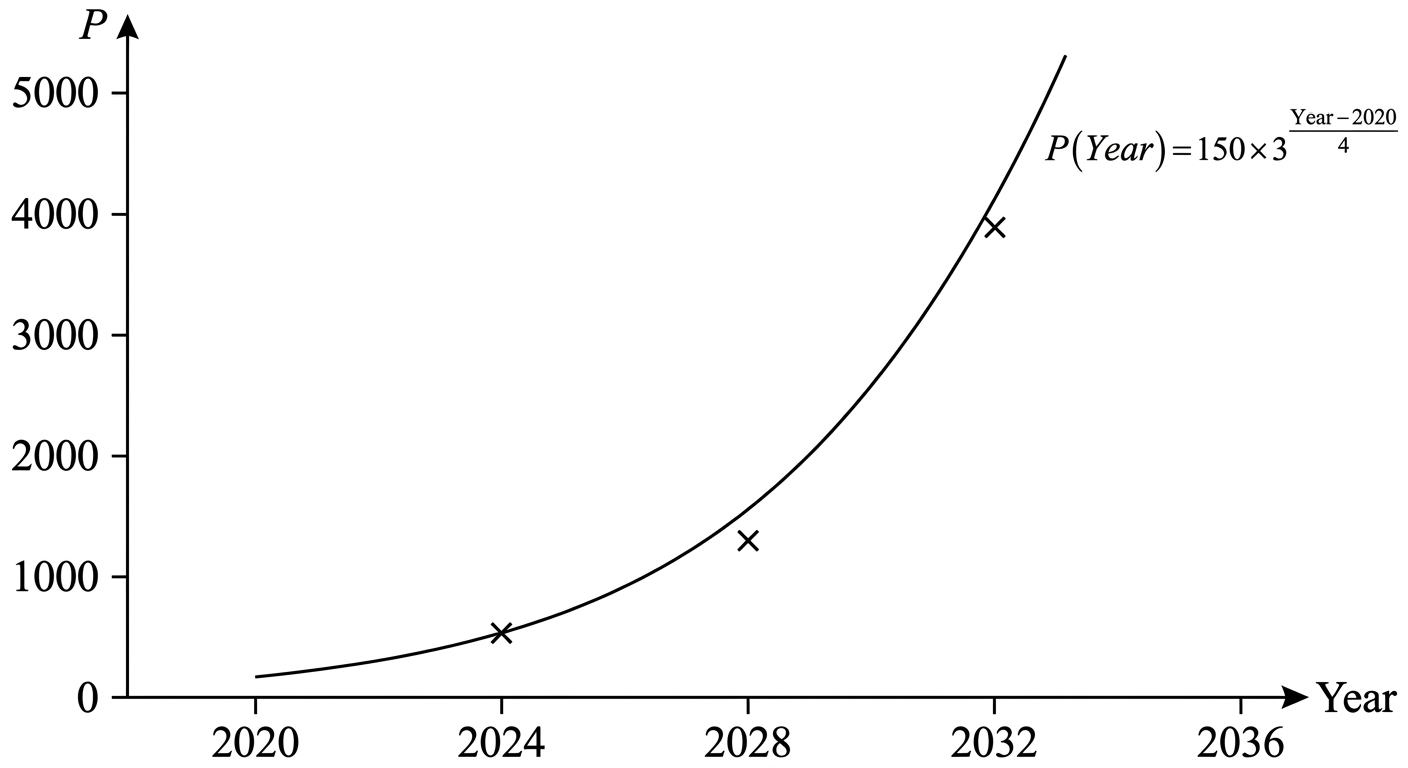
A conservation agency monitors an endangered bird species. The population was 150 in 2020 and is modelled as tripling every 4 years. The geometric model gives the population PP after nn complete 4-year periods from 2020 as
P(n)=150×3n.P(n) = 150 \times 3^{n}.
The table below shows predicted and actual populations at three checkpoints.

Year202420282032
Actual count52012803900
Predicted P(n)P(n)???
Question diagram
(a)
Calculate the predicted population for each of the years 2024, 2028, and 2032. Give each answer as an integer. [2]Criterion D (iii) · Level 3-4
(b)
Find the percentage error between the model's prediction and the actual count for each year, using percentage error=∣ predicted−actual ∣actual×100%.\text{percentage error} = \frac{|\,\text{predicted} - \text{actual}\,|}{\text{actual}} \times 100\%. Give each answer to 1 decimal place. Hence state the year in which the model performs best. [3]Criterion D (iv) · Level 5-6
(c)
The agency proposes using the model to predict the population in 2044. Advise the agency whether this prediction should be used to inform conservation decisions, referring to the percentage errors found in part (b) and one assumption of the geometric model. [3]Criterion D (v) · Level 5-6

revisionprep.com

Summary Answer

Not available for this question.

Model Answer

Not available for this question.

Marking Scheme

Not available for this question.

Examiner Insights

Not available for this question.

Question 2Criterion A · Band 3-6 · Medium · 6 marksrevisionprep.com

Finding the Common Ratio

A geometric sequence has first term u1=4u_1 = 4 and common ratio r=3r = 3.
(a)
Write down the value of the 5th term. [1]Criterion A (ii) · Level 3-4
(b)
Find the value of nn such that un=972u_n = 972. [2]Criterion A (ii) · Level 3-4
(c)
A second geometric sequence has first term 44 and its 5th term equals the sum of the 4th and 5th terms of the first sequence. Justify whether the common ratio of the second sequence is greater than or less than 33, giving your answer in exact simplified form. [3]Criterion A (iii) · Level 5-6

revisionprep.com

Summary Answer

Not available for this question.

Model Answer

Not available for this question.

Marking Scheme

Not available for this question.

Examiner Insights

Not available for this question.

Question 3Criterion A + D · Band 3-6 · Medium · 12 marksrevisionprep.com

General Term of a Geometric Sequence

A conservation agency monitors an endangered bird population on a protected island. The population was recorded at the end of 2020, 2021 and 2022 as 5050, 7272 and 112112 birds respectively. The agency models the population using a geometric sequence, where n=0n = 0 corresponds to the end of 2020.

The diagram shows the model curve together with the three observed data points.
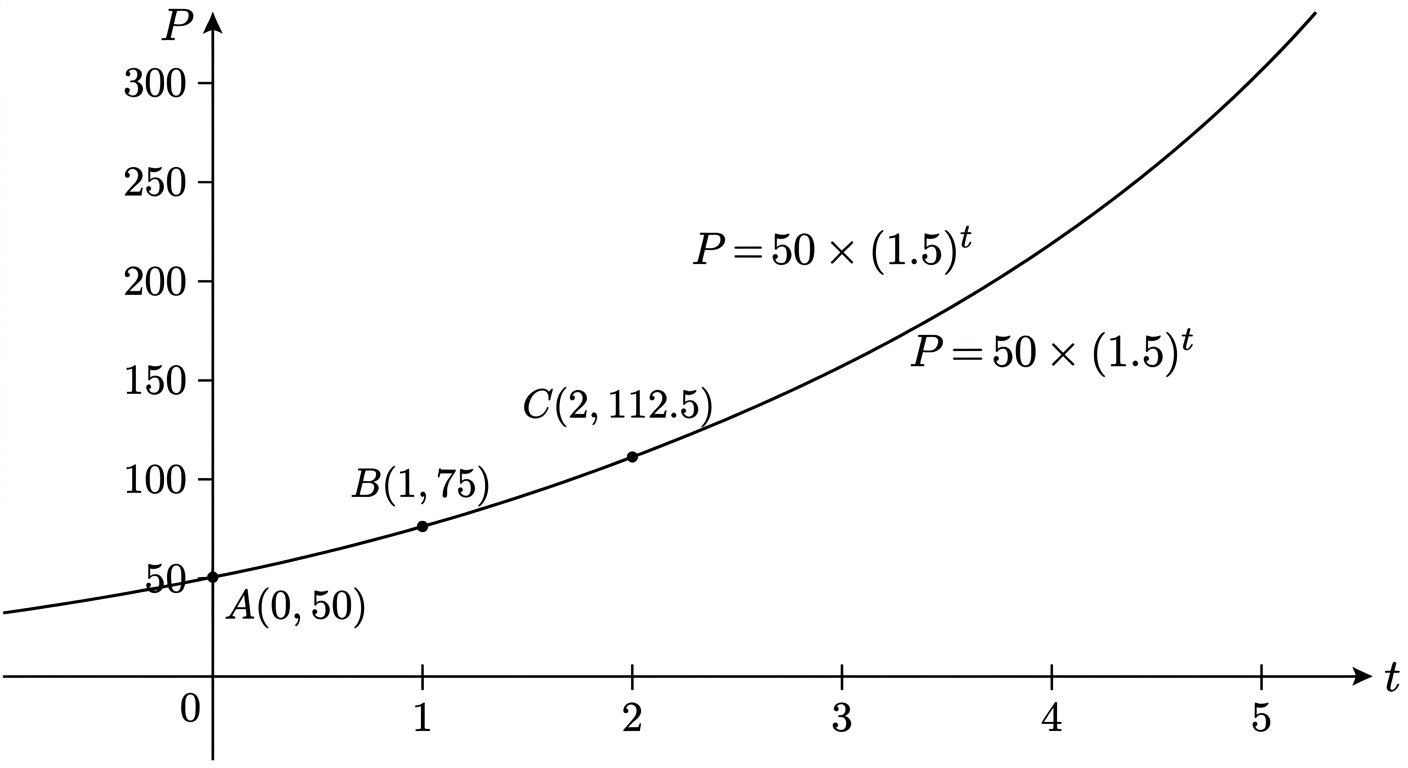
Question diagram
(a)
Show that the constant annual growth factor that takes 5050 birds in 2020 to 112112 birds in 2022 is 1.501.50, correct to 33 significant figures. Hence write down the general term un=50×(1.5)nu_{n} = 50 \times (1.5)^{n}. [2]Criterion A (ii) · Level 3-4
(b)
Complete the percentage error column of the table, using ∣predicted−actual∣actual×100%\dfrac{\left\lvert \text{predicted} - \text{actual} \right\rvert}{\text{actual}} \times 100\%, to one decimal place. [3]Criterion D (iii) · Level 3-4
(c)
The agency claims: 'By the end of 2027 the population will exceed 500500 birds.' Determine whether this claim is correct, giving your answer to the nearest whole number of birds. [2]Criterion D (v) · Level 5-6
(d)
The percentage errors in (b) are all below 5%5\%. A colleague argues that this means the model is reliable for predicting the population in 2027. Explain whether the argument is valid, referring to the errors, the nature of the prediction and one assumption of the model. [3]

(e) Use logarithms to find the end of which year the model first predicts a population above 50005000. [2]
Criterion D (v) · Level 5-6

revisionprep.com

Summary Answer

Not available for this question.

Model Answer

Not available for this question.

Marking Scheme

Not available for this question.

Examiner Insights

Not available for this question.

Question 4Criterion A + C · Band 3-6 · Medium · 8 marksrevisionprep.com

Solving Word Problems with Geometric Sequences

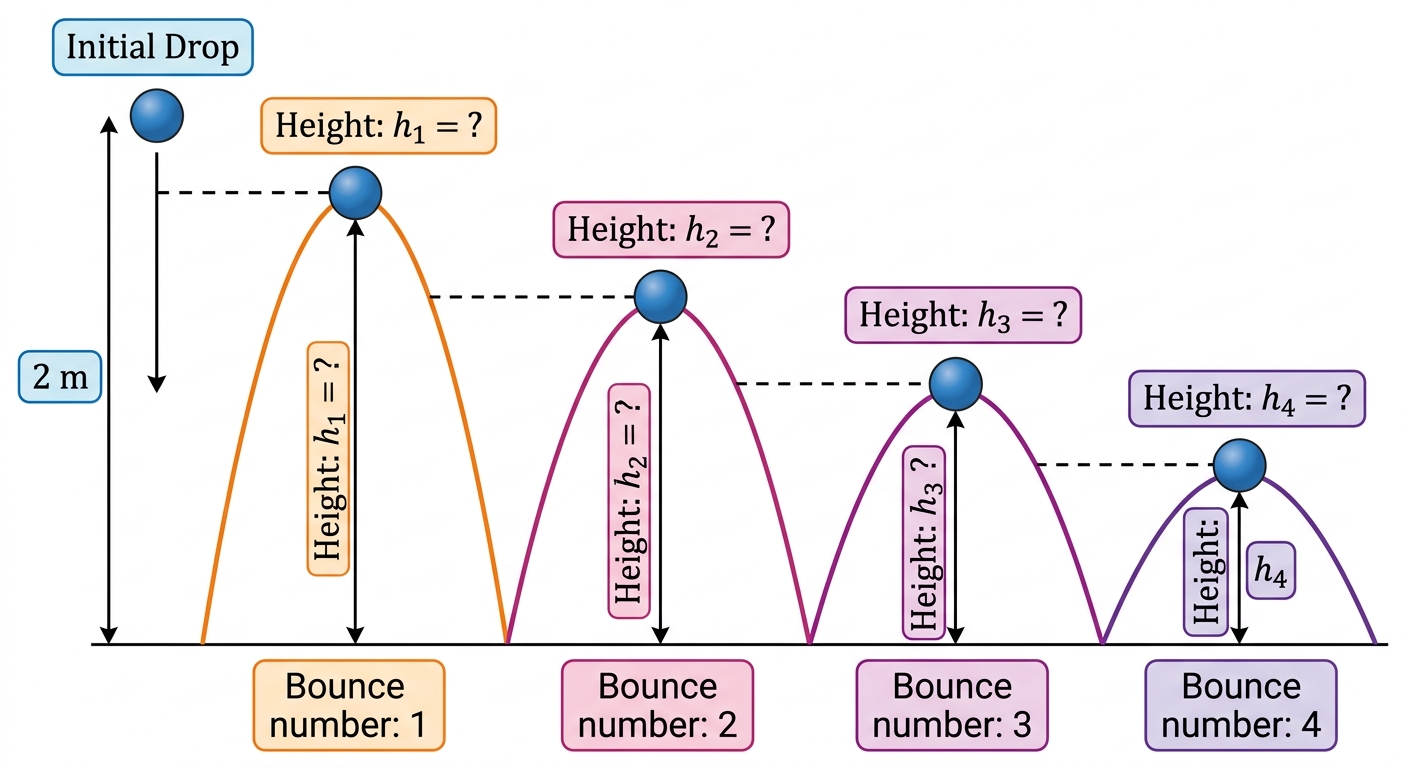
A ball is dropped from a height of 2 m. After each bounce, it reaches 60% of its previous height. The heights of the first four bounces are shown below.

Bounce number1234
Height (m)1.20.720.4320.2592
Question diagram
(a)
Write down the common ratio of the bounce heights and describe how the heights change from one bounce to the next. [1]Criterion A (ii) · Level 3-4
(b)
Find the height of the 10th bounce. Give your answer in metres, correct to 3 significant figures. [2]Criterion A (ii) · Level 3-4
(c)
Write down a general formula for the height hnh_n, in metres, after the nnth bounce. Hence determine the smallest value of nn for which hn<0.01h_n < 0.01 m. Give your answer as an integer. [3]Criterion A (iii) · Level 5-6
(d)
A student claims that the total of all bounce heights will eventually exceed 5 m. Assess whether this claim is correct, justifying your answer by finding the sum of all bounce heights. [2]Criterion C (iii) · Level 5-6

revisionprep.com

Summary Answer

Not available for this question.

Model Answer

Not available for this question.

Marking Scheme

Not available for this question.

Examiner Insights

Not available for this question.

Question 5Criterion B · Band 3-8 · Challenge · 5 marksrevisionprep.com

Recognising Geometric Sequences

A geometric sequence has first term a=3a = 3 and common ratio r=2r = 2, so its nnth term is
un=3×2n−1.u_{n} = 3 \times 2^{n-1}.

A student claims: "Because the terms keep doubling, the sum of the first nn terms is always equal to un+1−3u_{n+1} - 3."
(a)
Verify this claim for n=4n = 4. [1]Criterion B (ii) · Level 3-4
(b)
Justify algebraically why the claim holds for any positive integer nn. [1]Criterion B (iii) · Level 5-6
(c)
A geometric sequence has first term a≠0a \neq 0 and common ratio r≠1r \neq 1. Prove that Sn=un+1−aS_{n} = u_{n+1} - a for every positive integer nn if and only if r=2r = 2. [3]Criterion B (iii) · Level 7-8

revisionprep.com

Summary Answer

Not available for this question.

Model Answer

Not available for this question.

Marking Scheme

Not available for this question.

Examiner Insights

Not available for this question.

Question 6Criterion C + B · Band 3-8 · Challenge · 9 marksrevisionprep.com

Finding the Common Ratio

The numbers of small triangles in Figures 1, 2, 3 and 4 of a pattern are 1,4,91, 4, 9 and 1616. The pattern continues so that Figure nn contains Tn=n2T_{n} = n^{2} small triangles.
(a)
Explain why the sequence 1,4,9,16,…1, 4, 9, 16, \ldots is neither arithmetic nor geometric. [2]Criterion C (iv) · Level 3-4
(b)
Show that the number of triangles added when going from Figure n−1n - 1 to Figure nn is 2n−12n - 1. [2]Criterion B (iii) · Level 5-6
(c)
Using sigma notation and the sum of an arithmetic series, prove that ∑k=1n(2k−1)=n2\sum_{k=1}^{n} (2k - 1) = n^{2} for every positive integer nn. [3]Criterion B (iii) · Level 7-8
(d)
Find the value of ∑k=1130(2k−1)\sum_{k=11}^{30} (2k - 1). [2]Criterion A (iii) · Level 5-6

revisionprep.com

Summary Answer

Not available for this question.

Model Answer

Not available for this question.

Marking Scheme

Not available for this question.

Examiner Insights

Not available for this question.

That's every free question here — 6 of 89.

+83 more questions, plus Mock Papers & Worksheets, are waiting in Premium.

Upgrade