You're viewing free preview questions — 4 questions previewing here — subscribe to unlock 71 more, plus the Full Question Bank, Mock Papers & Worksheets.Upgrade
Number Patterns and Arithmetic Sequences — Free MYP4 Mathematics (Extended) Practice Questions

1QuestionRecognizing and Continuing Arithmetic SequencesConcept Practice
4 marks~6 minCriterion A
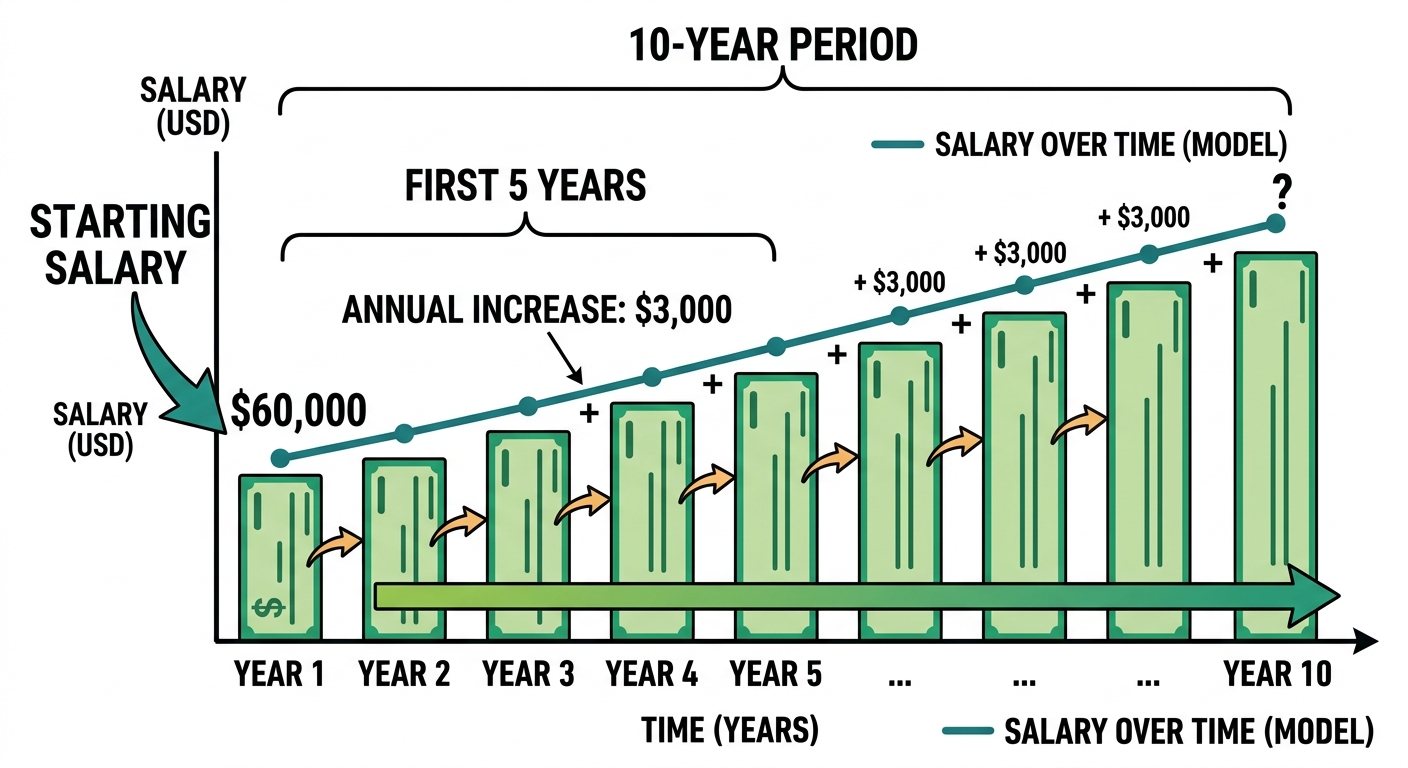
A recent university graduate accepts a job with a starting salary of USD 60000 per year. The job offer includes an annual salary increase of USD 3000 for the next 10 years.
a
Write an arithmetic sequence that models the graduate's salary for the first 5 years.
b
Using the arithmetic sequence formula, calculate the graduate's salary in the 10th year. Show your working. The formula for the nth term of an arithmetic sequence is given by , where is the nth term, is the first term, is the term number, and is the common difference.
c
Calculate the total amount of money the graduate will earn over the 10-year period. The formula for the sum of an arithmetic series is given by , where is the sum of the first n terms, is the first term, and is the nth term.
d
Discuss the strengths and limitations of using this arithmetic sequence as a model to predict the graduate's future earnings, considering factors such as inflation and potential promotions.

Solutions
2QuestionFinding the Common DifferenceAssessment Practice
2 marks~3 minCriterion D
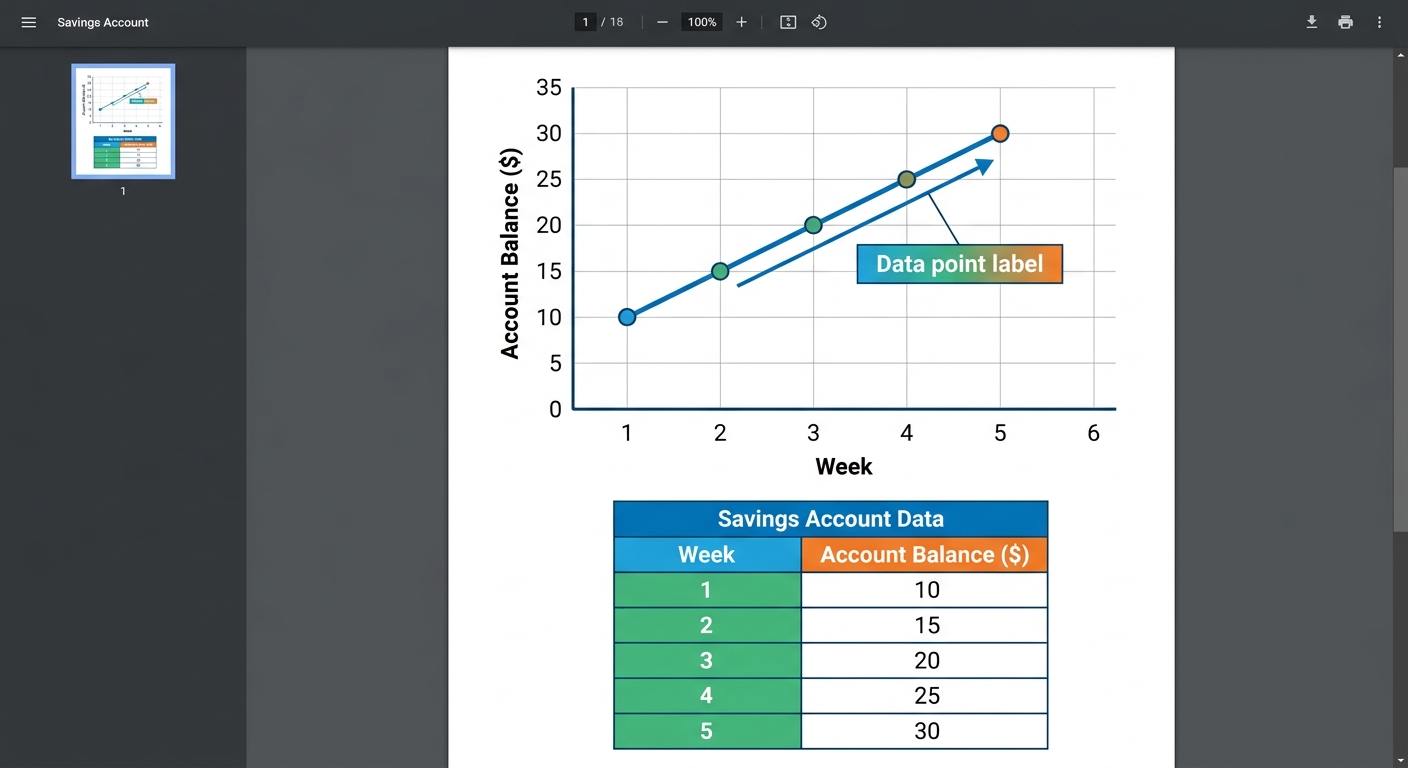
A student deposits money into a savings account each week. The account balance at the start of each week is recorded below.
| Week | 1 | 2 | 3 | 4 | 5 |
|---|---|---|---|---|---|
| Balance (dollars) | 10 | 15 | 20 | 25 | 30 |
a
Calculate the common difference in the account balance and explain what it represents in this savings context. [1]
b
The student wants to reach a balance of 60 dollars. State one assumption this arithmetic model makes, and justify whether the model is reliable for predicting when the target balance will be reached. [1]
Solutions
3QuestionSolving Problems Using Arithmetic SequencesAssessment Practice
16 marks~24 minCriterion B
Communication: Arithmetic Series and Staircase Patterns
A staircase is being built using identical blocks. The number of blocks required for each step forms an arithmetic sequence.
The pattern begins as follows:
Step number: 1, 2, 3, 4, …
Blocks in step: 3, 5, 7, 9, …
Let represent the total number of blocks needed to build a staircase with steps.
Question
A staircase is being built using identical blocks. The number of blocks required for each step forms an arithmetic sequence.
The pattern begins as follows:
Step number: 1, 2, 3, 4, …
Blocks in step: 3, 5, 7, 9, …
Let represent the total number of blocks needed to build a staircase with steps.
Question
a
Calculate , , , and . Show clearly how each total is formed from the blocks in each step. [4 marks]
b
Predict a general formula for in terms of . Your answer should:
- Identify the pattern in the totals,
- Express the relationship using algebra,
- Clearly define what and represent. [4 marks]
- Identify the pattern in the totals,
- Express the relationship using algebra,
- Clearly define what and represent. [4 marks]
c
Justify your formula by showing that can be written as the sum of the first terms of an arithmetic series. In your response:
- Identify the first term ,
- Identify the common difference ,
- Write the th term of the sequence,
- Use the arithmetic series sum formula,
- Simplify your expression to match your formula from part (b). [6 marks]
- Identify the first term ,
- Identify the common difference ,
- Write the th term of the sequence,
- Use the arithmetic series sum formula,
- Simplify your expression to match your formula from part (b). [6 marks]
d
Derive the standard formula for the sum of an arithmetic series: . Use clear mathematical communication and explain each step of your derivation. [4 marks]
(e) Explain why clear notation is important when solving this problem, especially the difference between:
- Blocks in the th step,
- Total blocks in steps. [2 marks]
(e) Explain why clear notation is important when solving this problem, especially the difference between:
- Blocks in the th step,
- Total blocks in steps. [2 marks]
Solutions
4QuestionDeriving the nth Term of an Arithmetic SequenceAssessment Practice
6 marks~9 minCriterion C
A student records weekly savings (in dollars) over four weeks:
Week 1: 15 — Week 2: 22 — Week 3: 29 — Week 4: 36
A friend claims the th term of this arithmetic sequence is .
Week 1: 15 — Week 2: 22 — Week 3: 29 — Week 4: 36
A friend claims the th term of this arithmetic sequence is .
a
Calculate the values predicted by for Weeks 1 to 4. [2]
b
Deduce, with supporting calculations, whether the formula correctly models the student's savings. [2]
c
The student has a savings goal of 100 dollars in a single week. Using the correct th term formula, justify whether this goal will ever be reached exactly under the same saving pattern. [2]
Solutions
That's every free question here — 4 of 75.
+71 more questions, plus Mock Papers & Worksheets, are waiting in Premium.