You're viewing free preview questions — 6 questions previewing here — subscribe to unlock 76 more, plus the Full Question Bank, Mock Papers & Worksheets.Upgrade
Back

Experimental vs Theoretical Probability — Free MYP4 Mathematics (Extended) Practice Questions

Free questions

Open in full, with answers, mark scheme and examiner insights.

Question 1Criterion C + A · Band 1-4 · Easy · 5 marksrevisionprep.com

Conducting Experiments and Simulations

A spinner has five equal sectors: two red (R), two blue (B) and one green (G). Ines spins it 20 times and writes down the colours.

R, B, G, R, R, B, B, R, G, B, R, B, B, R, B, G, B, R, R, B
(a)
Organise these results into a frequency table. [2]Criterion C (ii), C (v) · Level 3-4
(b)
Find the experimental probability of blue. [1]Criterion A (ii) · Level 1-2
(c)
Write down the theoretical probability of green and compare it with the experimental probability of green. [2]Criterion A (i), A (iii) · Level 3-4

revisionprep.com

Summary Answer

Not available for this question.

Model Answer

Not available for this question.

Marking Scheme

Not available for this question.

Examiner Insights

Not available for this question.

Question 2Criterion A · Band 1-4 · Easy · 5 marksrevisionprep.com

Relative Frequency and Long-Term Trends
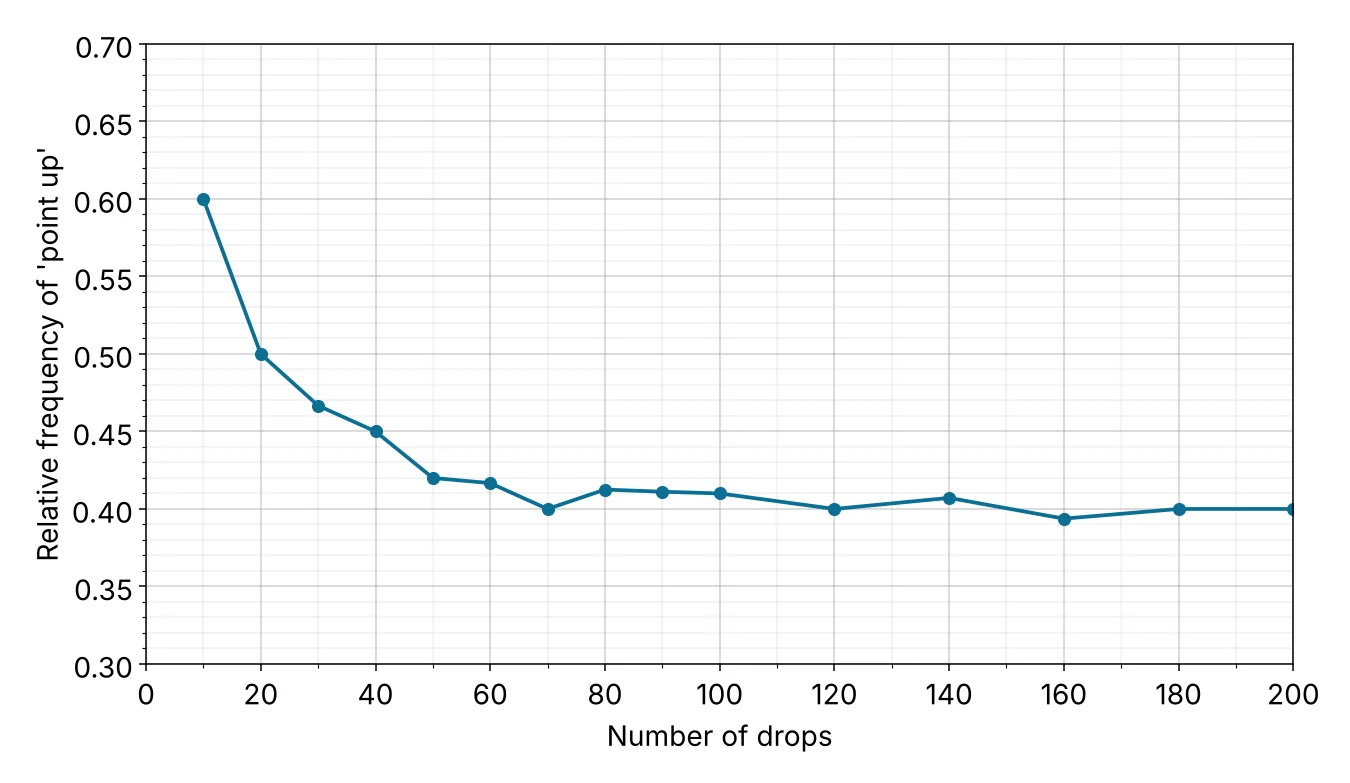
Priya drops a drawing pin 200 times and records whether it lands point up. The graph shows the relative frequency of point up after every 10 drops (then every 20 drops).
Question diagram
(a)
Write down the relative frequency of point up after 20 drops. [1]Criterion A (iii) · Level 1-2
(b)
Use the graph to estimate the probability that the pin lands point up. Give a reason for your answer. [2]Criterion A (i), A (iii) · Level 3-4
(c)
Use the graph to find how many times the pin landed point up in the first 40 drops. [2]Criterion A (ii), A (iii) · Level 3-4

revisionprep.com

Summary Answer

Not available for this question.

Model Answer

Not available for this question.

Marking Scheme

Not available for this question.

Examiner Insights

Not available for this question.

Question 3Criterion D + A · Band 1-6 · Medium · 12 marksrevisionprep.com

Conducting Experiments and Simulations

Each box of a cereal contains one of three collectable cards, A, B or C, each equally likely. Malik uses a fair die to simulate buying boxes until he has all three cards: a roll of 1 or 2 means card A, 3 or 4 means card B, and 5 or 6 means card C. He stops each trial as soon as he has all three cards.

TrialDie rolls12, 5, 1, 6, 324, 3, 6, 5, 131, 2, 6, 5, 2, 443, 6, 255, 6, 5, 1, 2, 6, 6, 362, 4, 676, 1, 1, 5, 384, 4, 2, 3, 1, 6\begin{array}{|l|l|}\hline \text{Trial} & \text{Die rolls} \\ \hline 1 & 2,\ 5,\ 1,\ 6,\ 3 \\ \hline 2 & 4,\ 3,\ 6,\ 5,\ 1 \\ \hline 3 & 1,\ 2,\ 6,\ 5,\ 2,\ 4 \\ \hline 4 & 3,\ 6,\ 2 \\ \hline 5 & 5,\ 6,\ 5,\ 1,\ 2,\ 6,\ 6,\ 3 \\ \hline 6 & 2,\ 4,\ 6 \\ \hline 7 & 6,\ 1,\ 1,\ 5,\ 3 \\ \hline 8 & 4,\ 4,\ 2,\ 3,\ 1,\ 6 \\ \hline\end{array}
(a)
Explain why this use of the die is a suitable model for buying one box. [1]Criterion D (ii) · Level 3-4
(b)
Write down the number of boxes bought in each trial. [1]Criterion A (iii) · Level 1-2
(c)
Estimate the probability that a complete set is collected by buying 5 boxes or fewer. [2]Criterion A (ii), A (iii) · Level 3-4
(d)
Calculate the mean number of boxes needed to collect a complete set in these trials. [2]

(e) A family buys 5 boxes. Use your results to comment on whether they are likely to complete the set, and state how Malik could make his estimates more reliable. [2]

(f) Let AA be the event that the first two boxes show different cards and BB the event that the third box shows the card still missing. Use conditional probability to show that the theoretical probability of collecting a complete set in exactly 33 boxes is 29\dfrac{2}{9}, and compare it with the simulation. [4]
Criterion D (iii) · Level 3-4

revisionprep.com

Summary Answer

Not available for this question.

Model Answer

Not available for this question.

Marking Scheme

Not available for this question.

Examiner Insights

Not available for this question.

Question 4Criterion A + C · Band 1-6 · Medium · 5 marksrevisionprep.com

Comparing Experimental and Expected Results
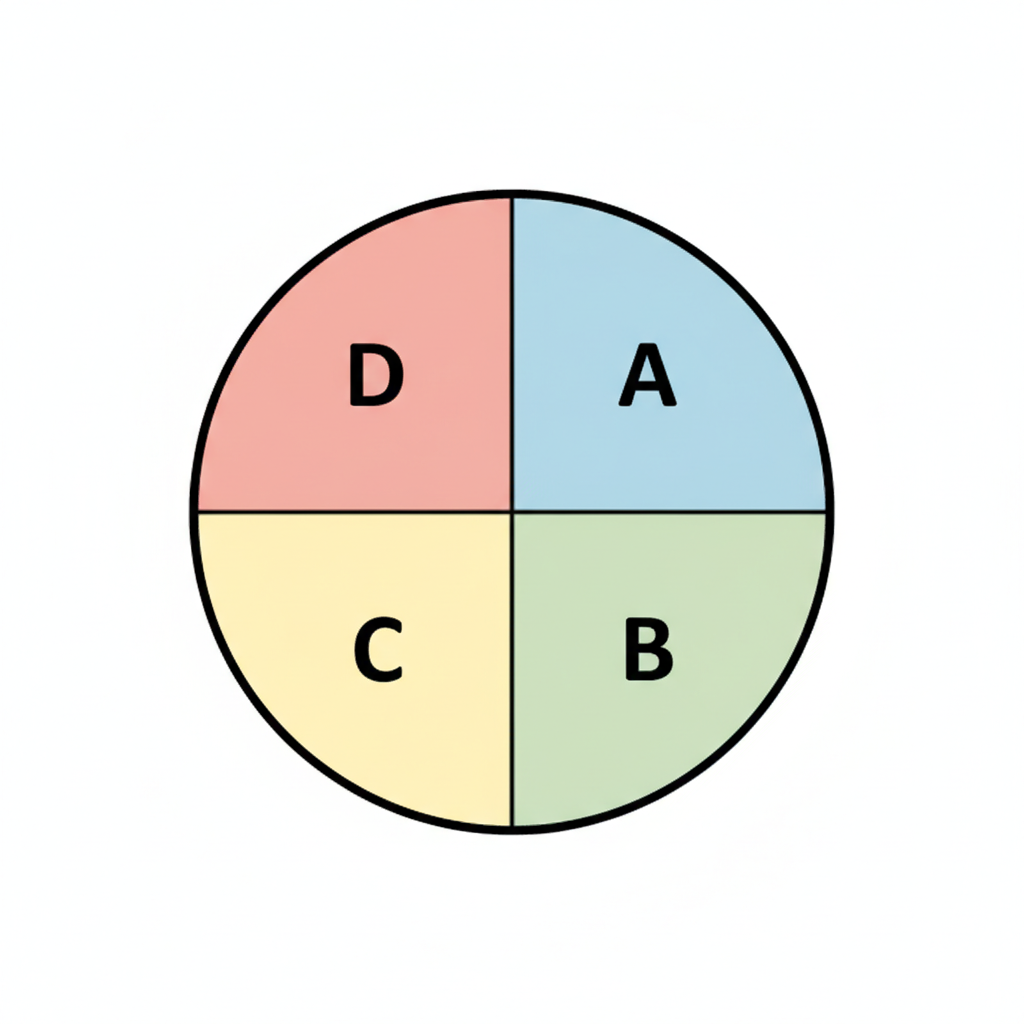
The spinner shown has four equal sectors, A, B, C and D. Yuki spins it 20 times and gets A 8 times, B 5 times, C 4 times and D 3 times.
Question diagram
(a)
Write down the theoretical probability of landing on A. [1]Criterion A (i) · Level 1-2
(b)
Find the expected number of times each letter would occur in 20 spins. [1]Criterion A (ii) · Level 1-2
(c)
Find the experimental probability of landing on A. [1]Criterion A (ii) · Level 1-2
(d)
Yuki says the spinner is biased towards A. Comment on her claim. [2]Criterion C (iv) · Level 5-6

revisionprep.com

Summary Answer

Not available for this question.

Model Answer

Not available for this question.

Marking Scheme

Not available for this question.

Examiner Insights

Not available for this question.

Question 5Criterion B + A · Band 3-8 · Challenge · 13 marksrevisionprep.com

Fairness Bias and Randomness

Two fair nn-sided dice, each numbered 1 to nn, are rolled. Player A wins if the sum is even; otherwise Player B wins. Rosa investigates when this game is fair.
(a)
For n=2,3,4n = 2, 3, 4 and 55, find the number of outcomes with an even sum and the probability that Player A wins. Show your results in a table. [3]Criterion B (i) · Level 3-4
(b)
Describe the pattern for even values of nn. [1]Criterion B (ii) · Level 5-6
(c)
For odd values of nn, write down a rule for the number of outcomes with an even sum, in terms of nn. [2]Criterion B (ii) · Level 5-6
(d)
Verify your rule for n=7n = 7. [1]

(e) Justify why the game is never fair when nn is odd. [1]

(f) For odd nn, show that the number of outcomes with an even sum is n2+12\dfrac{n^{2} + 1}{2}. [3]

(g) Hence find the odd value of nn for which Player A wins with probability 0.520.52. [2]
Criterion B (iii) · Level 7-8

revisionprep.com

Summary Answer

Not available for this question.

Model Answer

Not available for this question.

Marking Scheme

Not available for this question.

Examiner Insights

Not available for this question.

Question 6Criterion A + D · Band 3-8 · Challenge · 10 marksrevisionprep.com

Applications in Real-World Risk Assessment

A shipping company faces two independent risks on a shipment: a customs delay DD with probability 0.120.12, and damage MM with probability 0.050.05. Its insurance is triggered if the probability of at least one of these risks is more than 15%15\%.
(a)
Find the probability that a shipment is both delayed and damaged. [2]Criterion A (i), A (ii) · Level 3-4
(b)
Find the probability that a shipment has at least one of the two problems. [2]Criterion A (ii), A (iii) · Level 5-6
(c)
Advise the company whether its insurance should be triggered. [1]Criterion D (v) · Level 3-4
(d)
Given that a shipment has at least one of the two problems, find the probability that it has both. [2]

(e) The probability of damage rises to qq, while the probability of a customs delay stays 0.120.12. Find the largest value of qq for which the probability of at least one problem is not more than 0.150.15. [3]
Criterion A (iii) · Level 5-6

revisionprep.com

Summary Answer

Not available for this question.

Model Answer

Not available for this question.

Marking Scheme

Not available for this question.

Examiner Insights

Not available for this question.

That's every free question here — 6 of 82.

+76 more questions, plus Mock Papers & Worksheets, are waiting in Premium.

Upgrade