You're viewing free preview questions — 4 questions previewing here — subscribe to unlock 65 more, plus the Full Question Bank, Mock Papers & Worksheets.Upgrade
Applications in Bearings and Navigation — Free MYP4 Mathematics (Extended) Practice Questions

1QuestionMulti-Step Navigation ProblemsConcept Practice
2 marks~3 minCriterion A
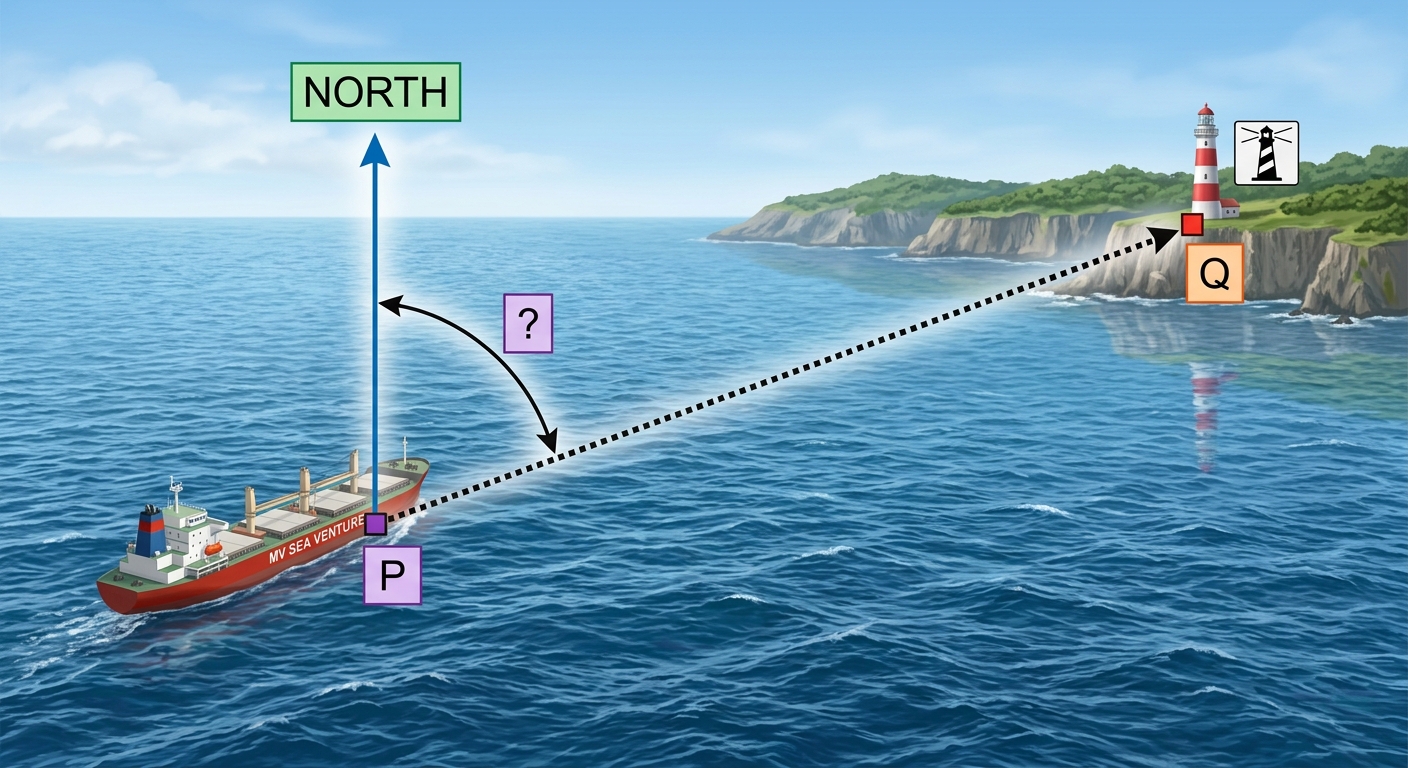
A coast guard vessel is at point and a lighthouse is at point . The diagram shows a north arrow at and the line .
The angle measured clockwise from north to line is .
The angle measured clockwise from north to line is .
a
Deduce the three-figure bearing of from . [1]
b
The coast guard must sail on a bearing between and to stay within a safe navigation corridor. Justify whether the vessel is heading within the safe corridor. [1]

Solutions
2QuestionSolving Bearings Questions Using TrigonometryAssessment Practice
4 marks~6 minCriterion D
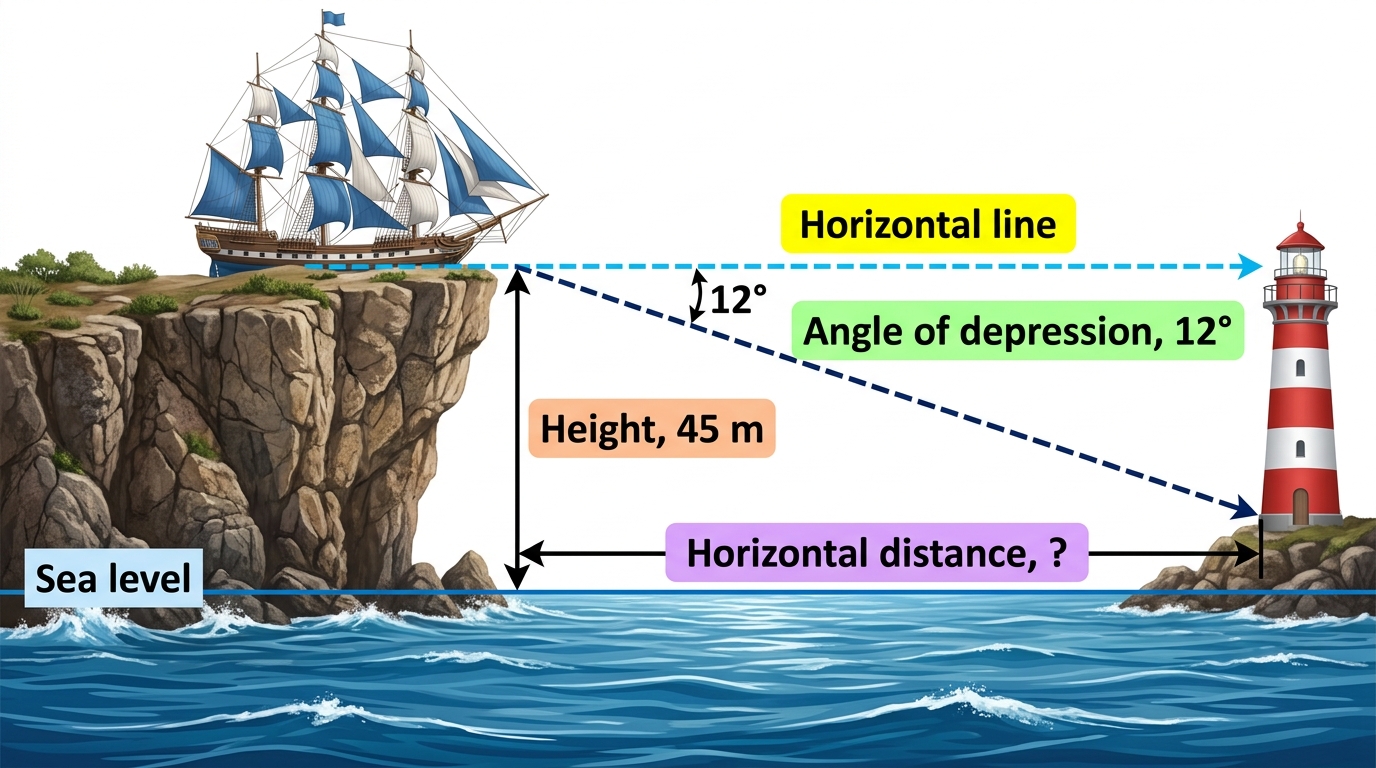
A coastguard ship is positioned 45 m above sea level on a cliff edge. The navigator observes a lighthouse at sea level at an angle of depression of .
a
Calculate the horizontal distance, , from the cliff edge to the lighthouse. [2]
b
A maritime safety regulation requires any vessel to maintain a horizontal clearance of at least 200 m from the lighthouse. Advise the navigator whether the ship satisfies this regulation, justifying your answer with reference to the margin of safety. [2]
Solutions
3QuestionUnderstanding Bearings as Directional AnglesAssessment Practice
6 marks~9 minCriterion C
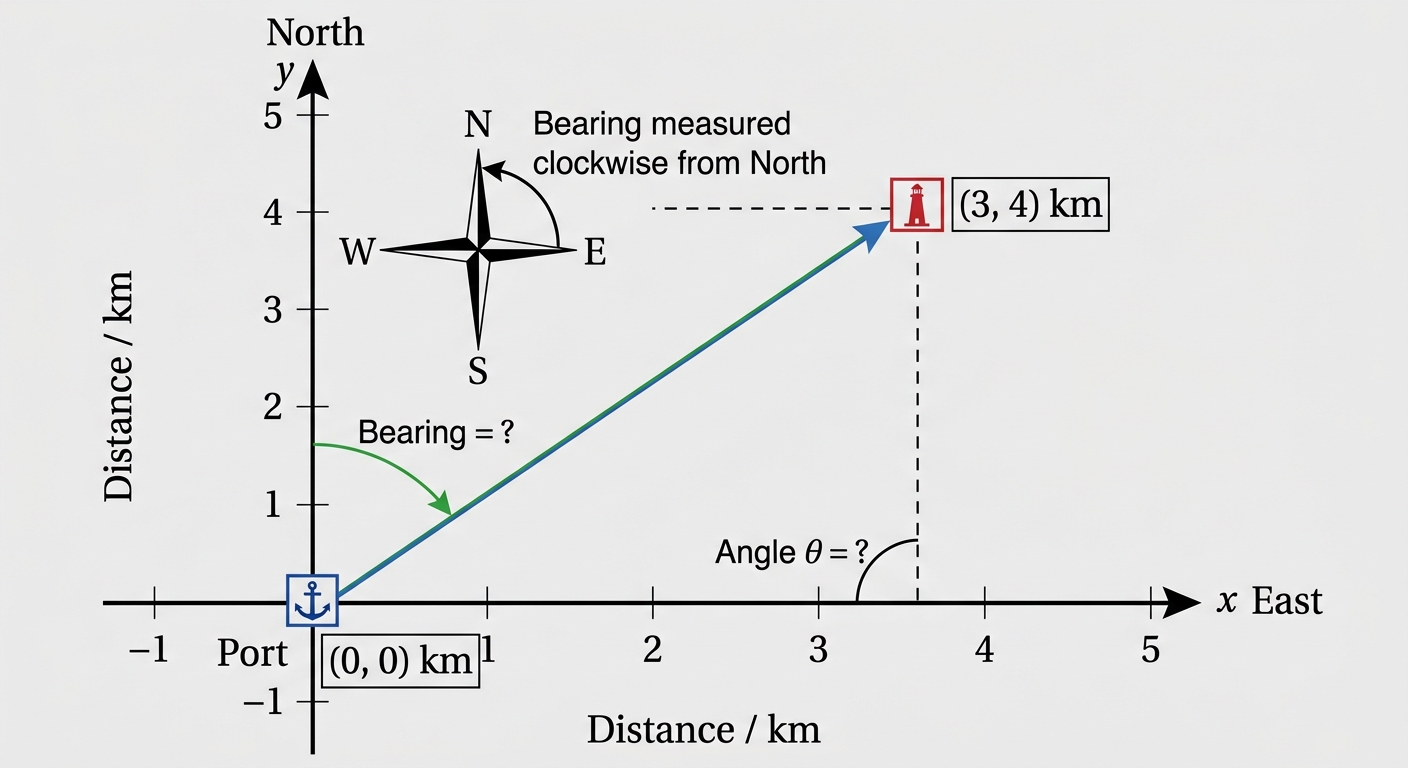
A port is located at the origin and a lighthouse is at coordinates km, where the positive -axis points east and the positive -axis points north. A student proposes the following model to calculate the bearing of the lighthouse from the port:
a
Calculate the bearing predicted by the student's model. [2]
b
Construct the correct bearing using a clearly labelled diagram and trigonometric reasoning. [2]
c
The lighthouse is the destination of a vessel that must follow a bearing accurate to within to avoid shallow waters. Advise the navigator whether the student's model should be used for this voyage, identifying the source of any error in the model. [2]
Solutions
4QuestionDrawing Diagrams from Bearings DescriptionsAssessment Practice
8 marks~12 minCriterion B
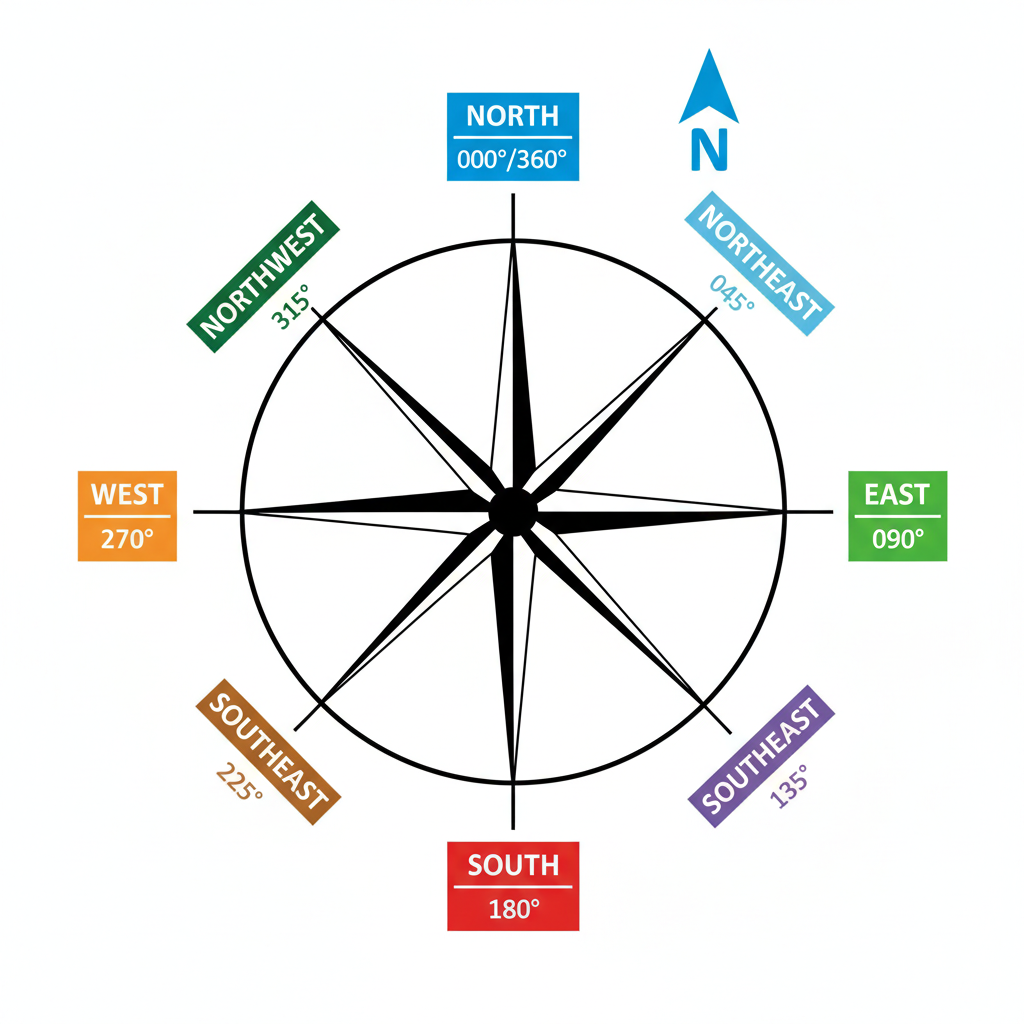
A surveyor maps four survey stations P, Q, R, and S using the following bearings:
P to Q:
Q to R:
R to S:
S to P:
All bearings are measured clockwise from north.
P to Q:
Q to R:
R to S:
S to P:
All bearings are measured clockwise from north.
a
Construct a clearly labelled diagram showing points P, Q, R, S and the four bearing lines. Mark a north arrow at each station and label each bearing. [2]
b
Deduce the interior angle at each vertex of quadrilateral PQRS using the bearing data. Present your results as four labelled values. [2]
c
Analyse the relationship between consecutive bearings and the interior angle formed at their shared vertex. Hence advise the surveyor whether this quadrilateral is suitable to represent a rectangular building plot, justifying your answer with reference to both the angle properties and the closure of the survey loop. [4]
Solutions
That's every free question here — 4 of 69.
+65 more questions, plus Mock Papers & Worksheets, are waiting in Premium.