You're viewing free preview questions — 4 questions previewing here — subscribe to unlock 7 more, plus the Full Question Bank, Mock Papers & Worksheets.Upgrade
Sin and Cos Rules — Free MYP4 Mathematics (Extended) Practice Questions

1QuestionSin and Cos rules based problemsConcept Practice
2 marks~3 minCriterion A
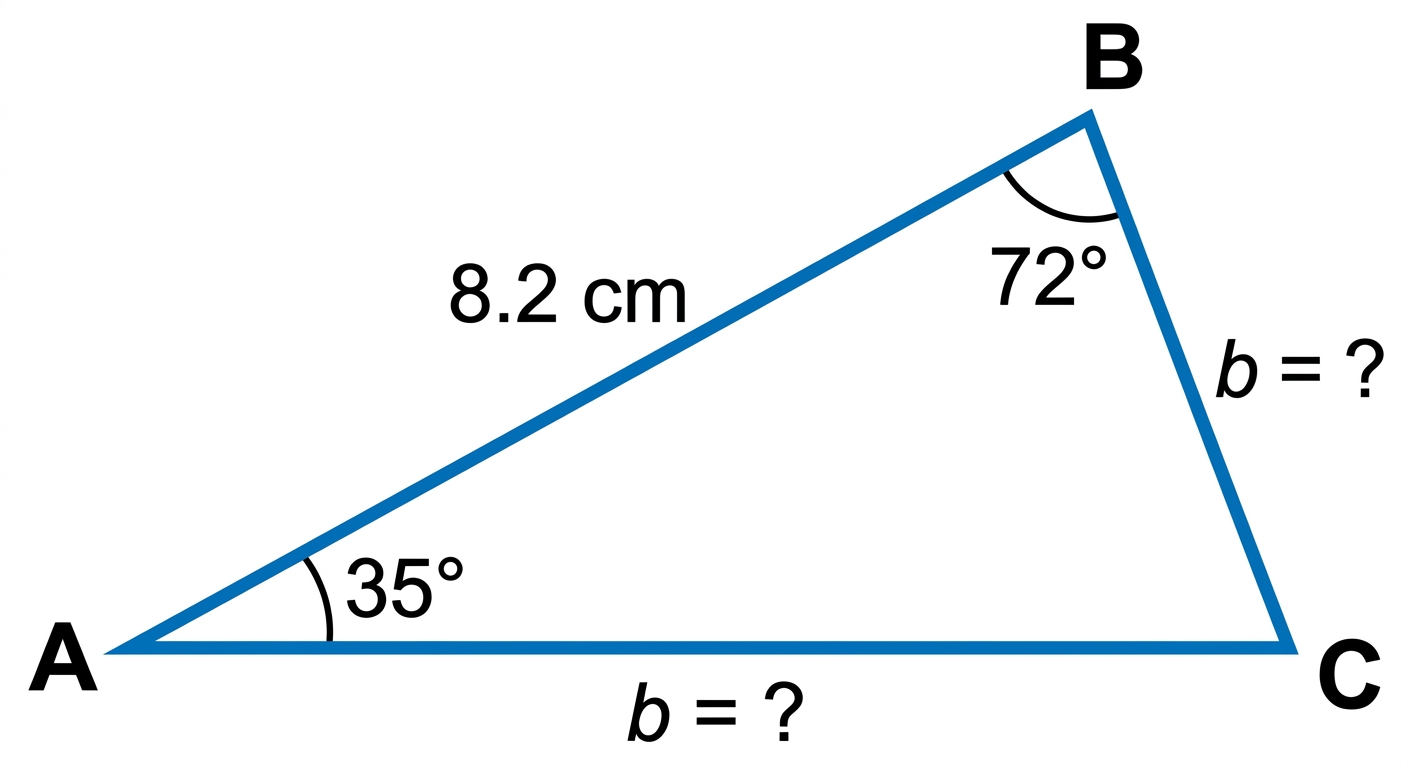
A surveyor measures a triangular plot of land, . Angle , angle , and side cm (opposite angle ).
Calculate the length of side , opposite angle , using the sine rule:
Give your answer in centimetres, correct to 3 significant figures. [2]
Calculate the length of side , opposite angle , using the sine rule:
Give your answer in centimetres, correct to 3 significant figures. [2]

Solutions
2QuestionSin and Cos rules based problemsAssessment Practice
2 marks~3 minCriterion D
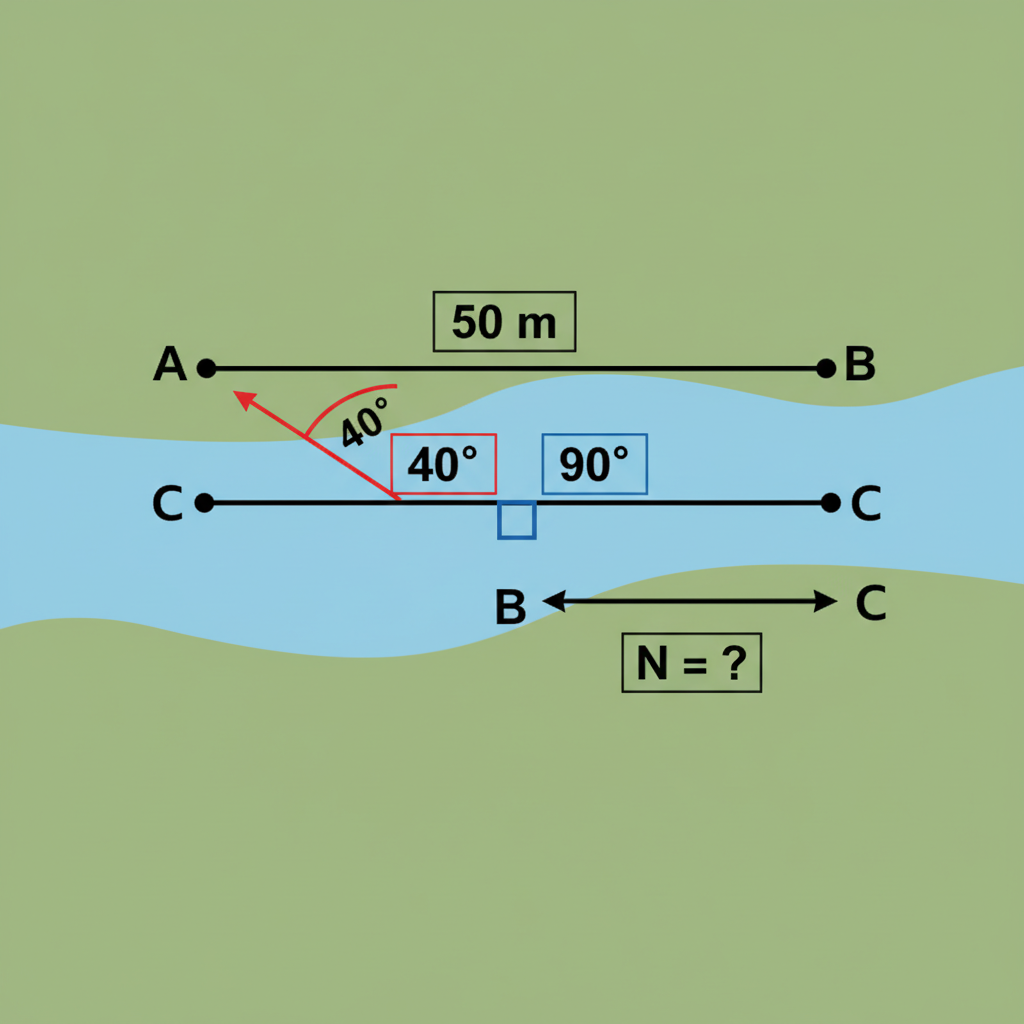
A surveying team needs to find the straight-line distance across a river to a landmark on the opposite bank. Direct measurement is impossible.
The team stands at two points, and , on the same bank, measuring a baseline . They record the angle to the landmark from each point: and .
Apply the Sine Rule to find the distance , then advise the team on whether a rope of length is sufficient to reach the landmark from point . [2]
The team stands at two points, and , on the same bank, measuring a baseline . They record the angle to the landmark from each point: and .
Apply the Sine Rule to find the distance , then advise the team on whether a rope of length is sufficient to reach the landmark from point . [2]
Solutions
3QuestionSin and Cos rules based problemsAssessment Practice
8 marks~12 minCriterion D
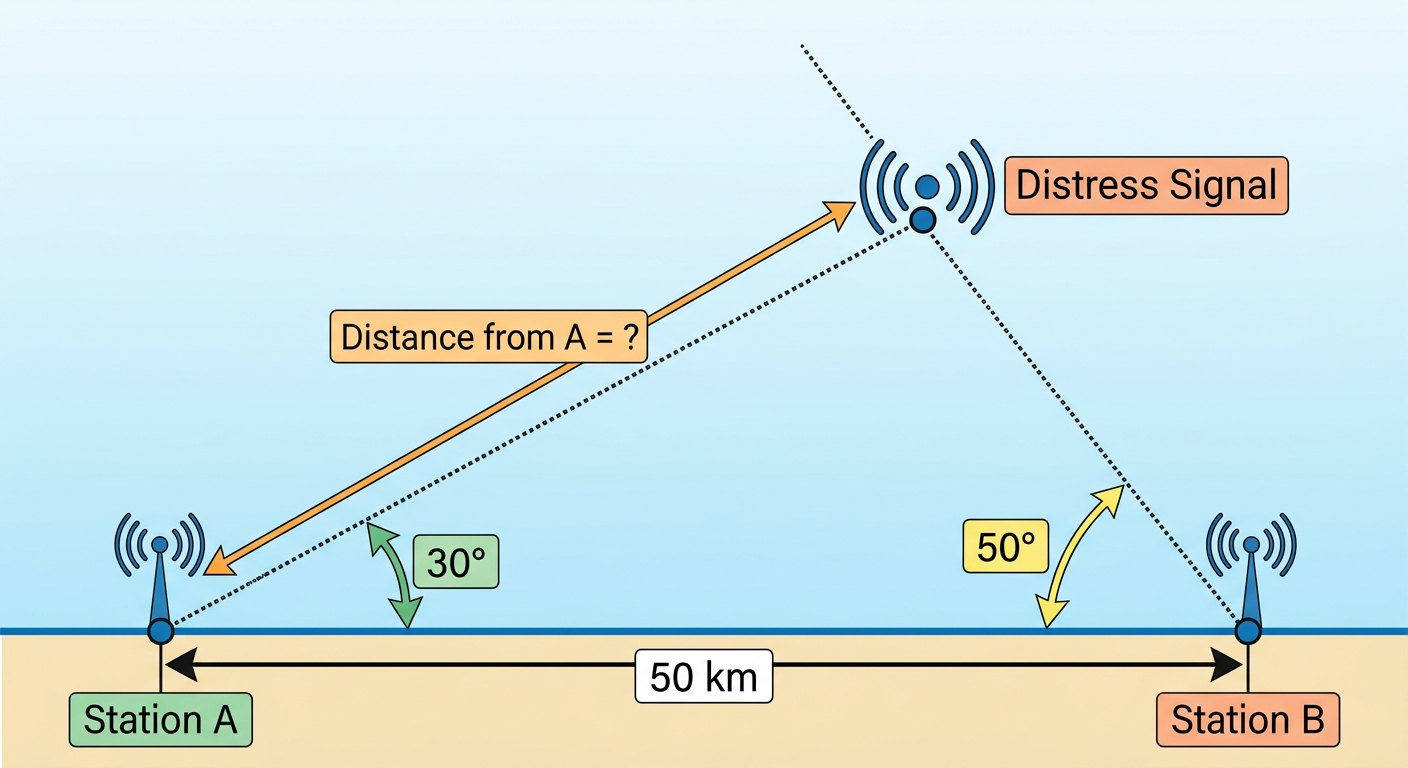
Two search-and-rescue stations, A and B, are positioned 50 km apart along a straight coastline. Station A records the bearing of a distress signal as from the coastline; station B records it as from the coastline. Each bearing has an uncertainty of due to equipment limitations.
a
Show that the distance from station A to the signal is approximately 38.9 km, using the Law of Sines with exact bearings of and . [2]
b
Deduce the maximum possible range of distances from station A to the signal when the worst-case bearing errors of are applied simultaneously at both stations. [2]
c
A rescue coordinator must decide whether two-station triangulation is reliable enough to direct a rescue vessel in rough seas. Advise the coordinator whether this method should be used alone or combined with supplementary positioning, using your results from parts (a) and (b) and at least two real-world limitations of the model. [4]
Solutions
4QuestionSin and Cos rules based problemsAssessment Practice
8 marks~12 minCriterion B
A surveying team records two side lengths and a non-included angle for four separate plots of land. For each plot, the team must determine how many distinct triangular boundaries are geometrically possible before construction can begin.
Here is the side opposite angle , and is the other given side.
| Plot A | cm | cm | |
|---|---|---|---|
| Plot B | cm | cm | |
| Plot C | cm | cm | |
| Plot D | cm | cm |
Here is the side opposite angle , and is the other given side.
a
Calculate all possible values of angle for each plot using the sine rule. State the number of distinct triangles possible in each case. [4]
b
Deduce a general rule, in terms of , , and , that predicts when exactly two distinct triangles are possible. [2]
c
A construction permit is issued only when a unique triangular boundary exists. Justify which plots receive a permit, using your rule from part (b) and the geometry of the sine ratio to explain why ambiguous cases must be rejected. [2]
Solutions
That's every free question here — 4 of 11.
+7 more questions, plus Mock Papers & Worksheets, are waiting in Premium.