You're viewing free preview questions — 4 questions previewing here — subscribe to unlock 113 more, plus the Full Question Bank, Mock Papers & Worksheets.Upgrade
Using Trigonometry in 3D Problems — Free MYP4 Mathematics (Extended) Practice Questions

1QuestionCombining Pythagoras and Trig in 3D GeometryAssessment Practice
8 marks~12 minCriterion D
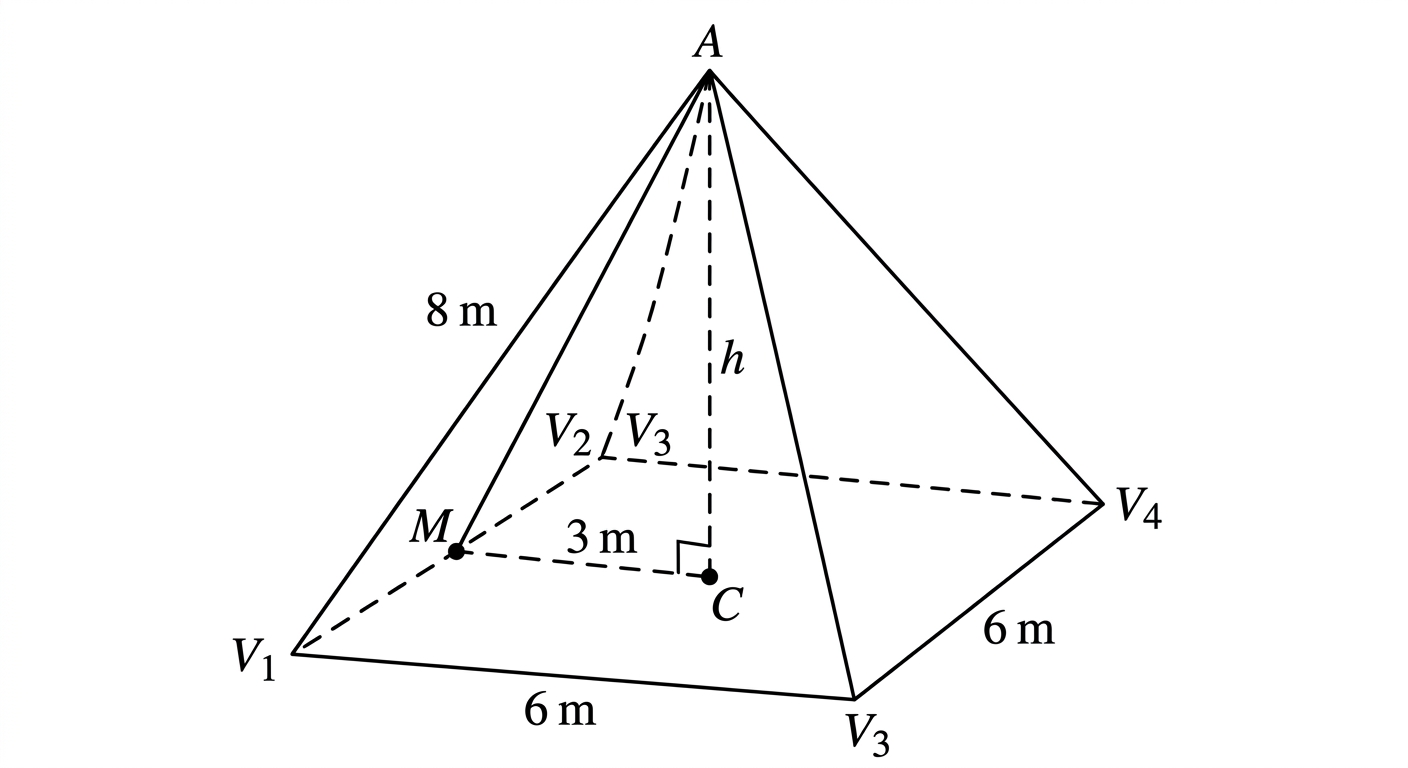
A designer models a square-based pyramid tent. The base is a square of side 6 m. Each triangular face has a slant height (the perpendicular distance from the midpoint of a base edge to the apex, measured along the face) of 8 m.
The diagram shows the tent with its key measurements labelled.
The diagram shows the tent with its key measurements labelled.
a
Show that the vertical height of the tent is m. [2]
b
Calculate the total canvas area of the four triangular faces. Give your answer in m to 3 significant figures.
The designer claims the total canvas area needed is at least 95 m. Justify whether the designer's claim is correct. [3]
The designer claims the total canvas area needed is at least 95 m. Justify whether the designer's claim is correct. [3]
c
In reality, the measured vertical height of a prototype tent is 7.2 m. Use the formula below to calculate the percentage error between the model's predicted height and the measured height. Give your answer to 3 significant figures.
Advise the designer whether the model is sufficiently reliable to use in production, justifying your advice with reference to your calculated percentage error. [3]
Advise the designer whether the model is sufficiently reliable to use in production, justifying your advice with reference to your calculated percentage error. [3]

Solutions
2QuestionApplications in Architecture and PhysicsAssessment Practice
8 marks~12 minCriterion C
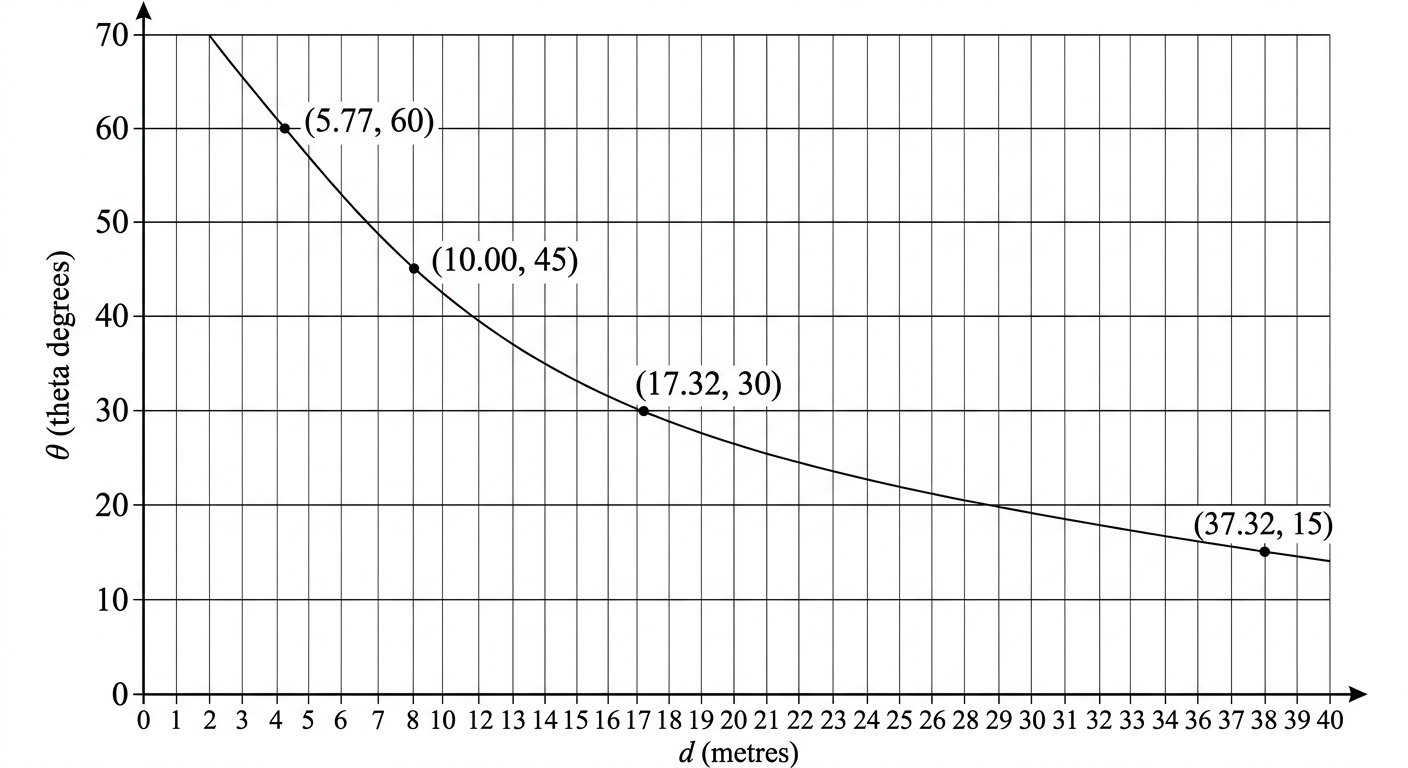
The diagram shows a vertical tower of height metres standing on horizontal ground. An observer at point P measures the angle of elevation to the top of the tower from four different horizontal distances metres from the base of the tower.
The recorded data are shown below.
(degrees): 15, 30, 45, 60
(metres): 37.32, 17.32, 10.00, 5.77
The recorded data are shown below.
(degrees): 15, 30, 45, 60
(metres): 37.32, 17.32, 10.00, 5.77
a
Show that , by referring to the right-angled triangle formed by the tower, the ground, and the line of sight. [2]
b
Using the row from the table, find the height of the tower. Hence find the horizontal distance when . Give both answers in metres to 3 significant figures. [3]
c
A student claims: "As the angle of elevation doubles, the horizontal distance halves."
Using at least two pairs of values from the table, justify whether this claim should be accepted or rejected. Your justification must refer to the formula to explain why the relationship between and is or is not proportional in the way the student describes. [3]
Using at least two pairs of values from the table, justify whether this claim should be accepted or rejected. Your justification must refer to the formula to explain why the relationship between and is or is not proportional in the way the student describes. [3]
Solutions
3QuestionCalculating Diagonals and Angles in CuboidsAssessment Practice
10 marks~15 minCriterion A
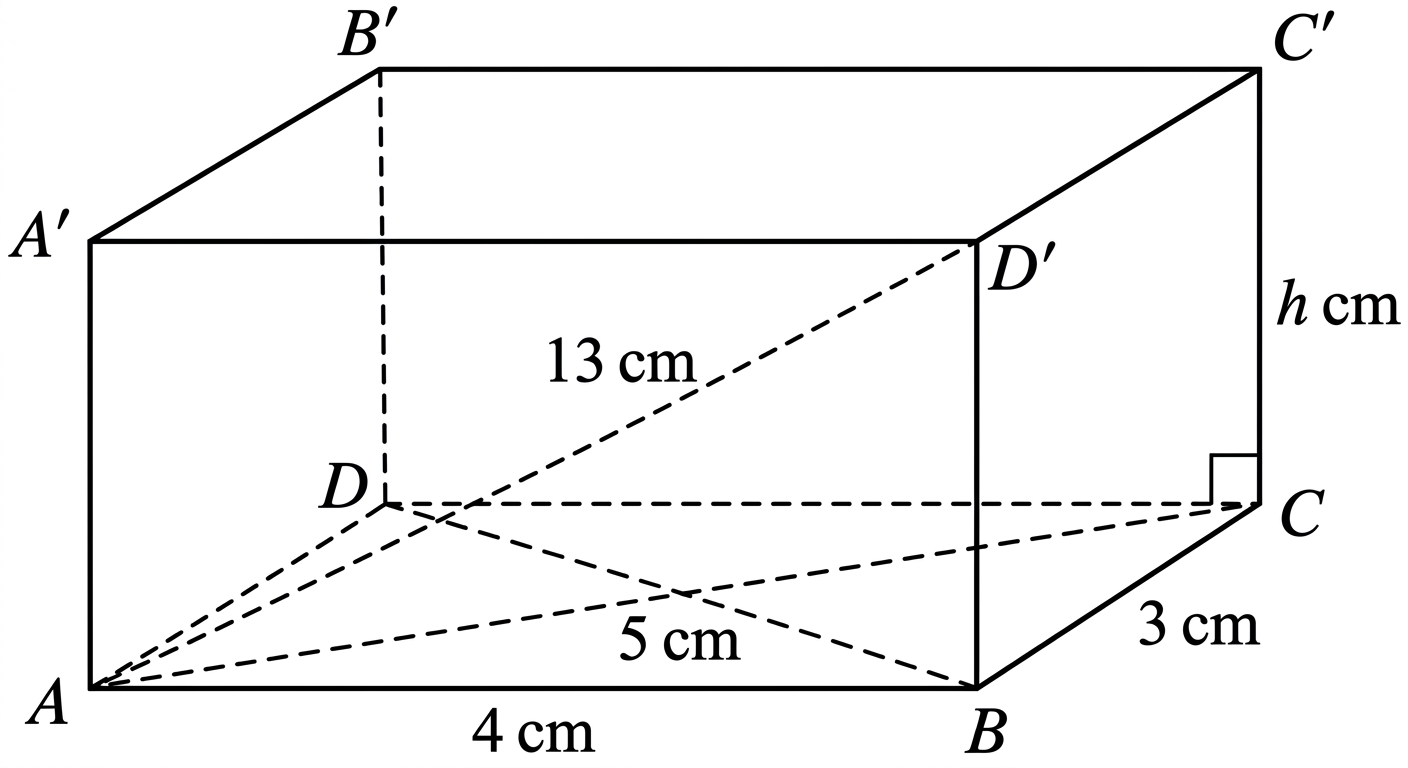
A rectangular box has a base measuring cm by cm and a height of cm. The space diagonal of the box has length cm.
The diagram shows the box with vertices , , , on the base and , , , directly above them, where is the base diagonal and is the space diagonal.
The diagram shows the box with vertices , , , on the base and , , , directly above them, where is the base diagonal and is the space diagonal.
a
Show that cm. [3]
b
Find the angle between the space diagonal and the base diagonal . Give your answer correct to one decimal place. [3]
c
A second rectangular box is geometrically similar to the first, with a space diagonal of length cm. The manufacturer claims the second box has a total surface area of cm. Justify whether this claim is correct. [4]
Solutions
4QuestionCalculating Diagonals and Angles in CuboidsAssessment Practice
10 marks~15 minCriterion B
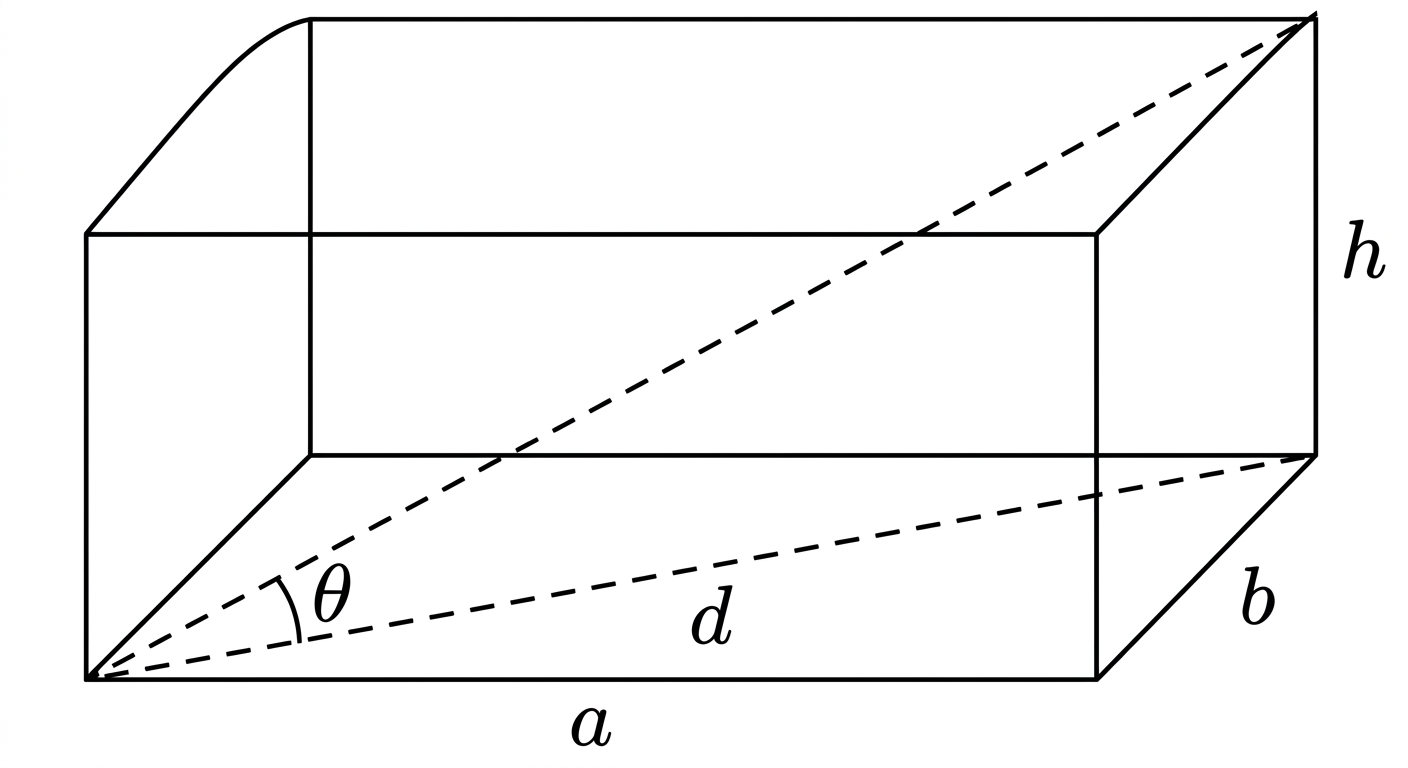
The table below shows three cuboids with integer edge lengths.
For each cuboid, the space diagonal connects one corner of the base to the diagonally opposite corner of the top face. The angle is measured between the space diagonal and the base plane.
| Base length (cm) | 3 | 5 | 8 |
|---|---|---|---|
| Base width (cm) | 4 | 12 | 15 |
| Height (cm) | 5 | 13 | 17 |
For each cuboid, the space diagonal connects one corner of the base to the diagonally opposite corner of the top face. The angle is measured between the space diagonal and the base plane.
a
Find the base diagonal and the angle for each cuboid. Give your answers for to the nearest degree. [3]
b
Show that for every cuboid in the table, and hence write a general formula for in terms of , , and . [3]
c
A fourth cuboid has base length cm, base width cm, and space diagonal of length 10 cm. Justify whether for this cuboid is greater than, equal to, or less than , without using a calculator. [4]
Solutions
That's every free question here — 4 of 117.
+113 more questions, plus Mock Papers & Worksheets, are waiting in Premium.