You're viewing free preview questions — 4 questions previewing here — subscribe to unlock 119 more, plus the Full Question Bank, Mock Papers & Worksheets.Upgrade
Combined Transformations 1 — Free MYP4 Mathematics (Extended) Practice Questions

1QuestionIdentifying Single Equivalent TransformationConcept Practice
4 marks~6 minCriterion A
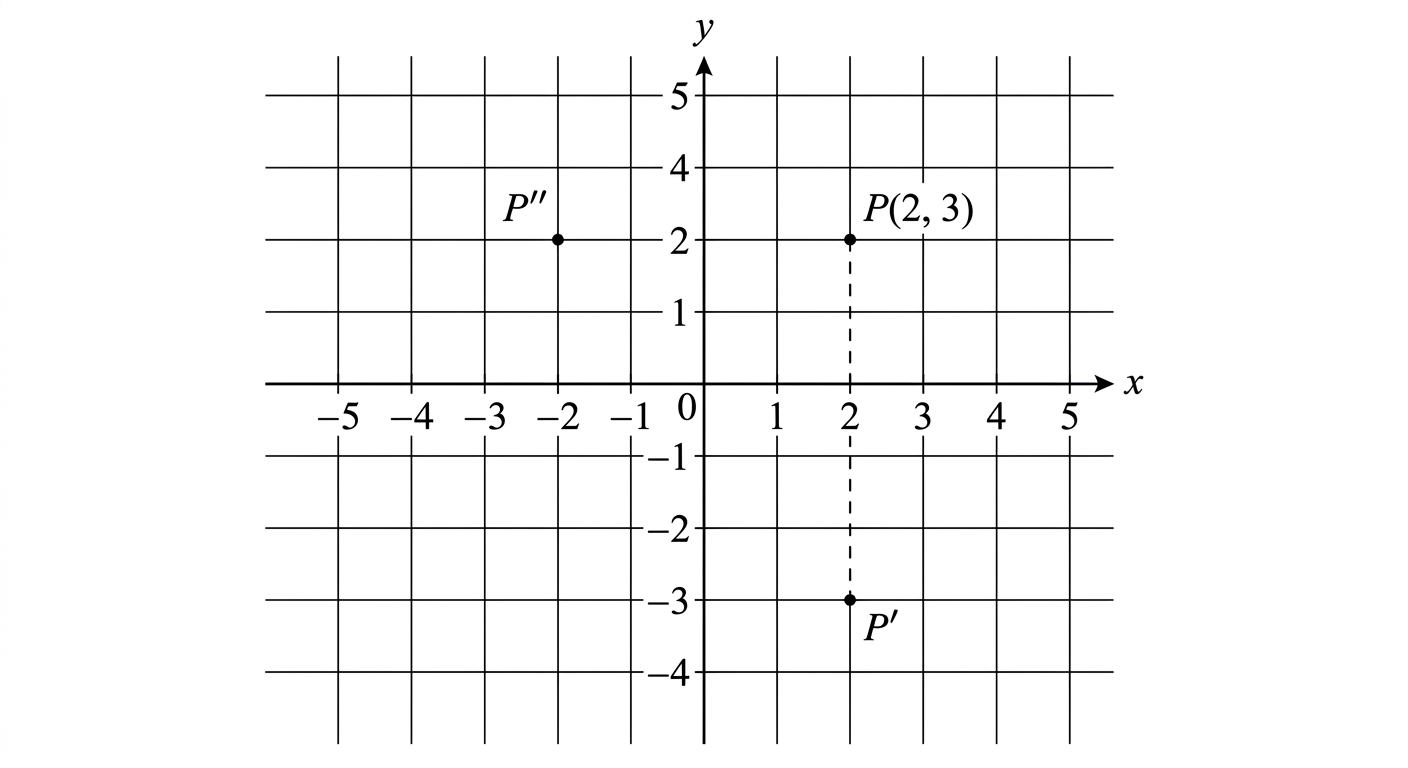
The diagram shows a coordinate grid with point , its image after reflection in the -axis, and its image after a further reflection in the -axis.
a
Write down the coordinates of , the image of after reflection in the -axis. [1]
b
Write down the coordinates of , the image of after reflection in the -axis. [1]
c
Justify, using correct transformation notation and by referring to the coordinates of and , that the combined effect of the two reflections is equivalent to a single rotation of about the origin. [2]

Solutions
2QuestionApplying Successive TransformationsAssessment Practice
5 marks~8 minCriterion C
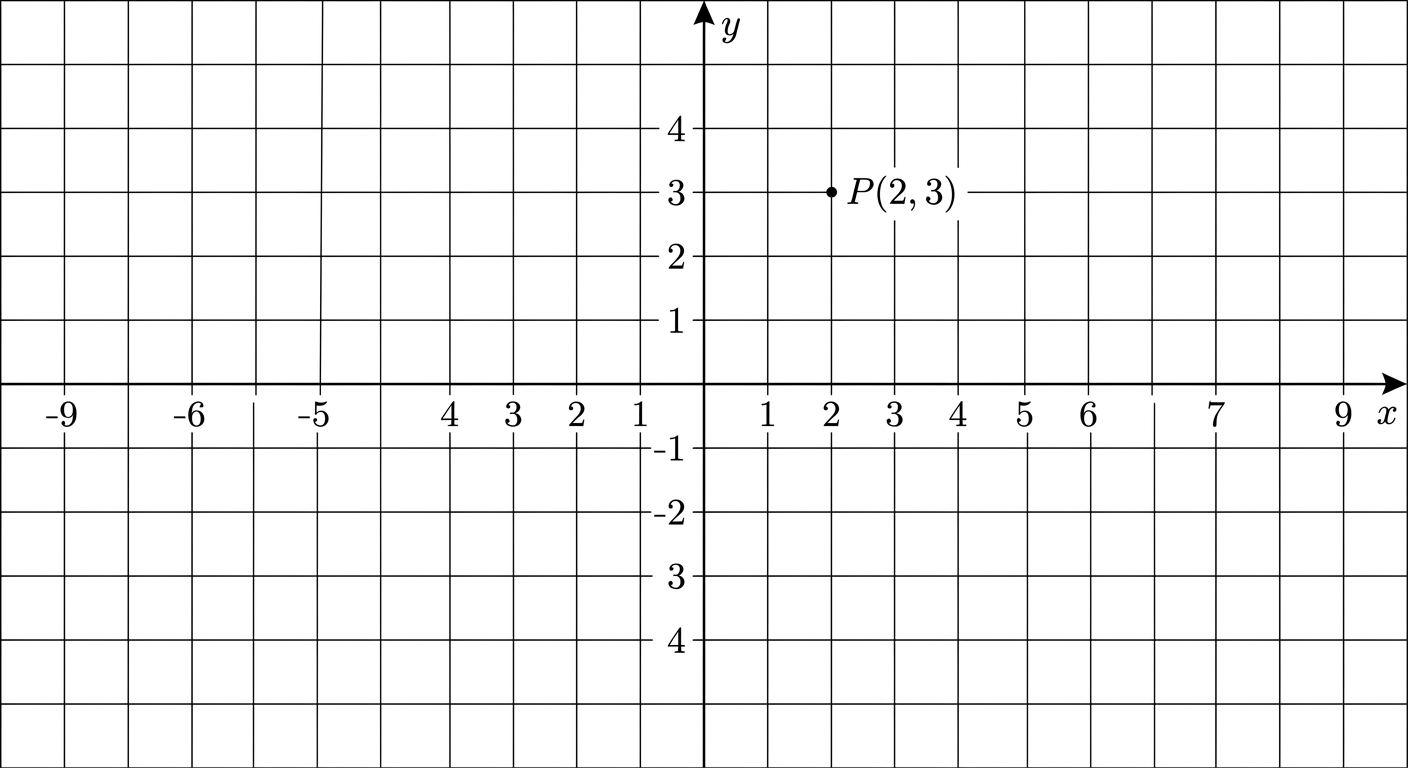
The diagram shows a coordinate grid with point .
Point is first rotated anticlockwise about the origin to give image , then is translated by to give final image .
Point is first rotated anticlockwise about the origin to give image , then is translated by to give final image .
a
Write down the coordinates of . [1]
b
Find the coordinates of . Show your working clearly. [2]
c
A classmate claims that applying the translation first and then the rotation gives the same final image . Justify whether this claim is correct, showing all working. [2]
Solutions
3QuestionUsing Matrices for Simple Transformations IntroductoryAssessment Practice
9 marks~14 minCriterion D
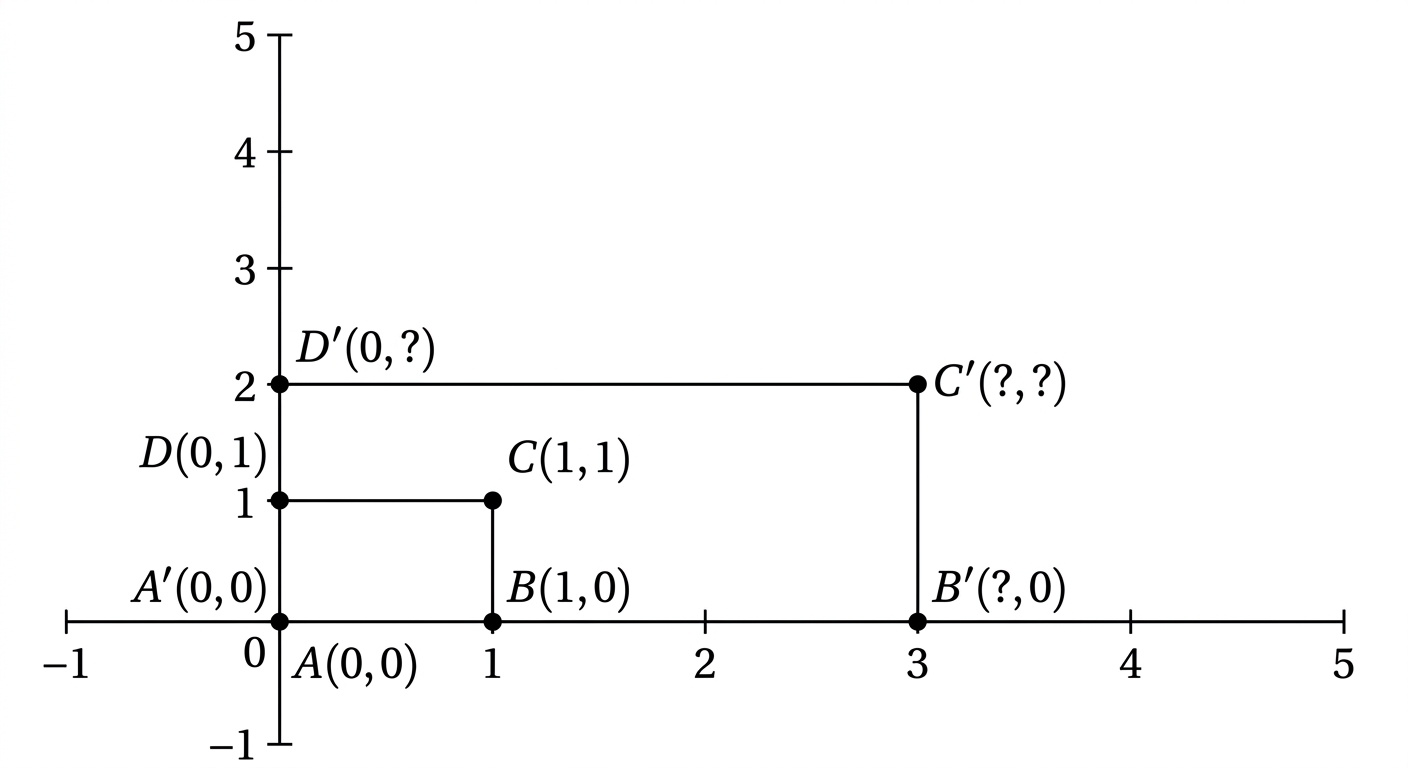
A game developer is designing a 2D platformer. The hero sprite starts as a unit square with vertices at , , and . To fit a widescreen display, the developer applies a stretch mapping each point to .
The diagram shows the original sprite and the image after the stretch.
The diagram shows the original sprite and the image after the stretch.
a
Write down the coordinates of , , and . [1]
b
The developer changes the stretch so that the horizontal factor is and the vertical factor is , where . The stretched sprite must fit exactly inside a screen region of area 30 square units. Find the value of , giving your answer to 3 significant figures. [3]
c
The developer tests three stretch settings and records the predicted sprite area alongside the actual rendered area:
: 3, 4, 6
Predicted area (): 6, 12, 30
Actual area: 5, 11, 28
The percentage error is defined as
Calculate the percentage error at each value of , giving your answers to 1 decimal place. [3]
: 3, 4, 6
Predicted area (): 6, 12, 30
Actual area: 5, 11, 28
The percentage error is defined as
Calculate the percentage error at each value of , giving your answers to 1 decimal place. [3]
d
Using your results from part (c), justify whether the developer should use the model to predict rendered sprite areas in production. [2]
Solutions
4QuestionApplying Successive TransformationsAssessment Practice
11 marks~17 minCriterion B
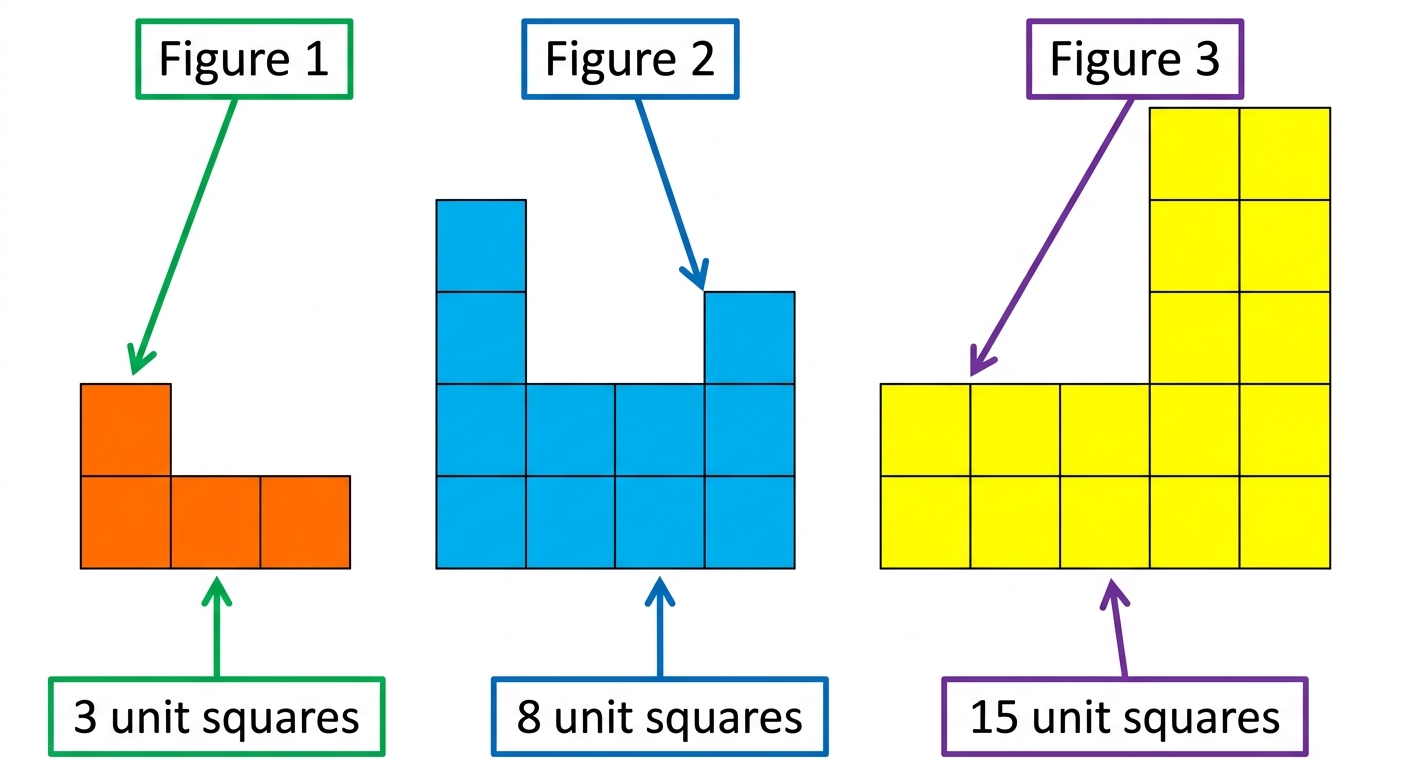
The diagram shows the first three figures of a pattern made from unit squares arranged in an L-shape.
Figure 1 has 3 unit squares, Figure 2 has 8 unit squares, and Figure 3 has 15 unit squares.
Figure 1 has 3 unit squares, Figure 2 has 8 unit squares, and Figure 3 has 15 unit squares.
a
Show that the number of unit squares in Figure 5 is 35 and find the number of unit squares in Figure 6. [3]
b
A student claims the number of unit squares in Figure is given by
Show that this formula is consistent with Figures 1, 2, and 3, and find the figure number that first contains more than 120 unit squares. [4]
Show that this formula is consistent with Figures 1, 2, and 3, and find the figure number that first contains more than 120 unit squares. [4]
c
Justify why the formula must contain an term by referring to the structure of the figures, and prove algebraically that the difference is always an odd number. [4]
Solutions
That's every free question here — 4 of 123.
+119 more questions, plus Mock Papers & Worksheets, are waiting in Premium.