You're viewing free preview questions — 6 questions previewing here — subscribe to unlock 162 more, plus the Full Question Bank, Mock Papers & Worksheets.Upgrade
Back

Geometrical Transformations — Free MYP4 Mathematics (Extended) Practice Questions

Free questions

Open in full, with answers, mark scheme and examiner insights.

Question 1Criterion A · Band 1-4 · Easy · 5 marksrevisionprep.com

Describing and Performing Translations
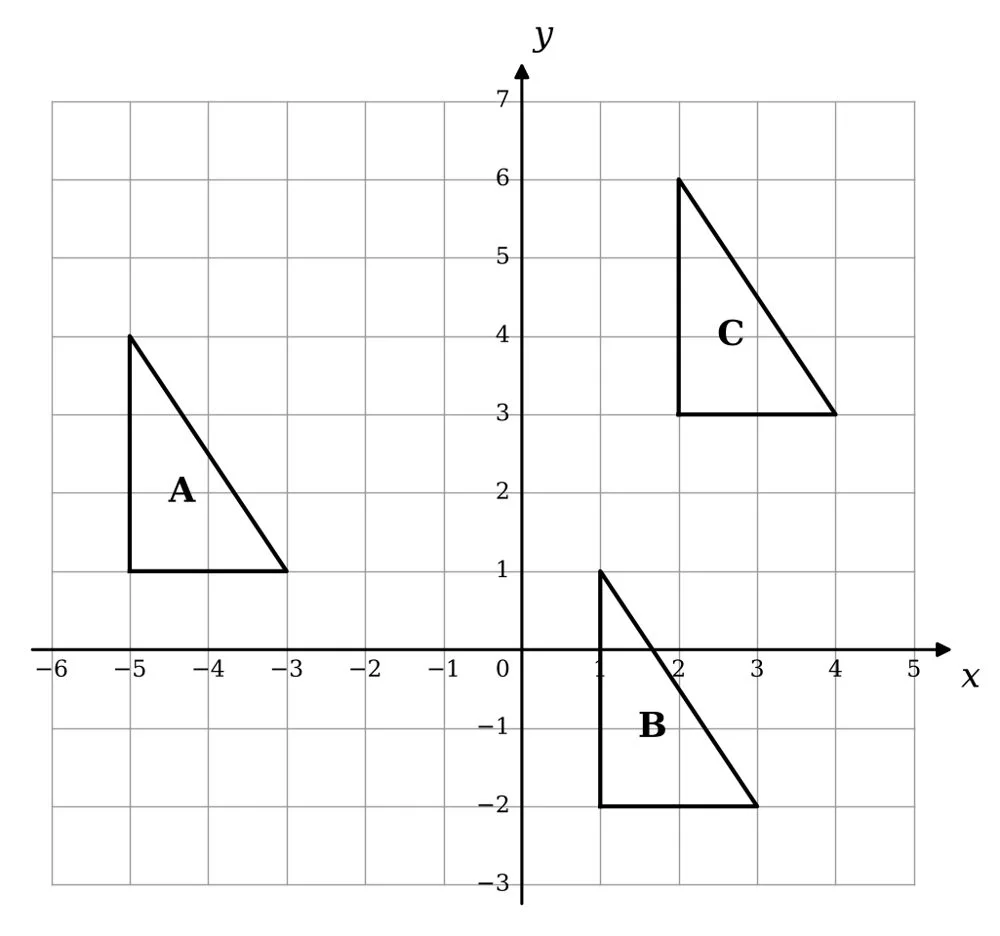
The diagram shows triangles AA, BB and CC on a coordinate grid.
Question diagram
(a)
Describe fully the single transformation that maps triangle AA onto triangle BB. [2]Criterion A (i) · Level 3-4
(b)
Write down the column vector of the translation that maps triangle AA onto triangle CC. [1]Criterion A (i) · Level 1-2
(c)
Find the column vector of the translation that maps triangle BB onto triangle CC. [2]Criterion A (ii) · Level 3-4

revisionprep.com

Summary Answer

Not available for this question.

Model Answer

Not available for this question.

Marking Scheme

Not available for this question.

Examiner Insights

Not available for this question.

Question 2Criterion C + A · Band 1-4 · Easy · 5 marksrevisionprep.com

Rotations About a Point and Angle

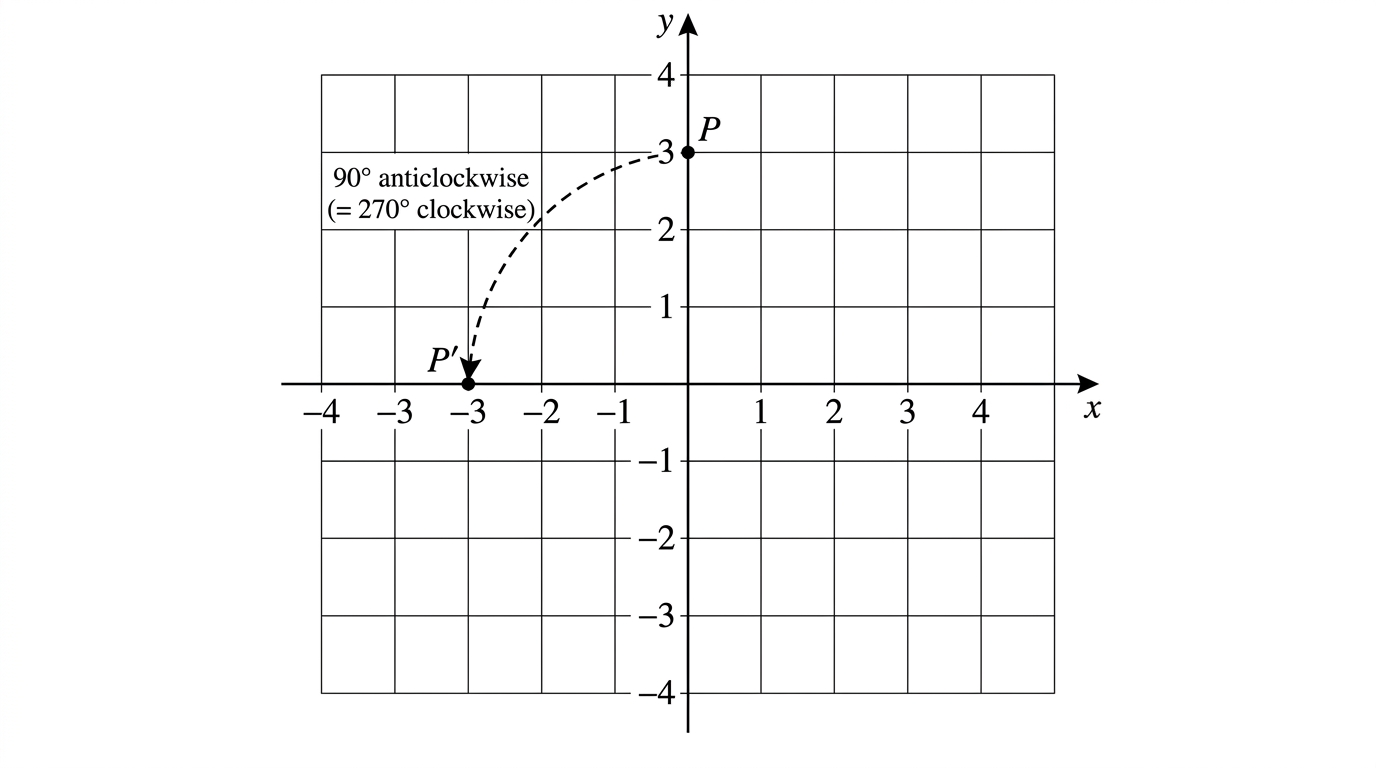
The diagram shows the point P(0,3)P(0, 3) rotated to P′(−3,0)P'(-3, 0) about the origin, labelled \"90∘90^\circ anticlockwise (=270∘= 270^\circ clockwise)\".
Question diagram
(a)
Explain why a rotation of 90∘90^\circ anticlockwise has the same effect as a rotation of 270∘270^\circ clockwise. [1]Criterion C (iv) · Level 1-2
(b)
Write down the image of Q(2,3)Q(2, 3) after a rotation of 270∘270^\circ clockwise about the origin. [1]Criterion A (ii) · Level 1-2
(c)
Describe fully the rotation about the origin, through less than 180∘180^\circ, that maps P′P' onto (0,−3)(0, -3). [1]Criterion A (i) · Level 3-4
(d)
Show that rotating PP through 90∘90^\circ anticlockwise and then 180∘180^\circ about the origin gives the same image as a single rotation of 90∘90^\circ clockwise. [2]Criterion C (iv) · Level 3-4

revisionprep.com

Summary Answer

Not available for this question.

Model Answer

Not available for this question.

Marking Scheme

Not available for this question.

Examiner Insights

Not available for this question.

Question 3Criterion A + C · Band 3-6 · Medium · 9 marksrevisionprep.com

Reflections in Lines x-axis y-axis y=x y=-x
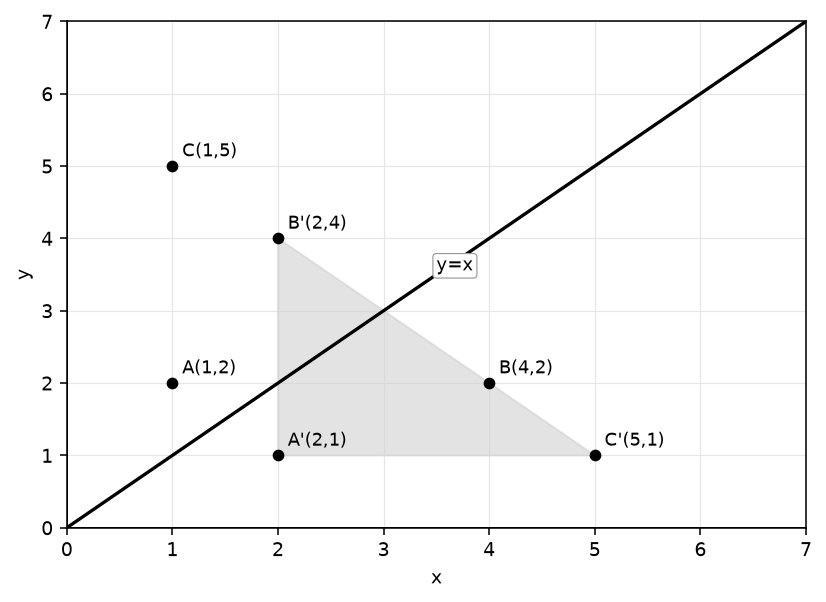
The diagram shows the line y=xy = x, triangle ABCABC with A(1,2)A(1, 2), B(4,2)B(4, 2) and C(1,5)C(1, 5), and the shaded triangle A′B′C′A'B'C', the image of triangle ABCABC under a single transformation.
Question diagram
(a)
Describe fully the single transformation that maps triangle ABCABC onto triangle A′B′C′A'B'C'. [2]Criterion A (i) · Level 3-4
(b)
Two points on the sides of triangle ABCABC are not moved by this transformation. Find their coordinates. [3]Criterion A (ii), A (iii) · Level 5-6
(c)
Find the perimeter of triangle A′B′C′A'B'C', correct to 3 significant figures. [2]Criterion A (ii) · Level 3-4
(d)
The vertices A→B→CA \to B \to C go round triangle ABCABC clockwise. Explain how the order A′→B′→C′A' \to B' \to C' shows that the image has been reflected, not rotated. [2]Criterion C (iv) · Level 5-6

revisionprep.com

Summary Answer

Not available for this question.

Model Answer

Not available for this question.

Marking Scheme

Not available for this question.

Examiner Insights

Not available for this question.

Question 4Criterion D · Band 1-6 · Medium · 7 marksrevisionprep.com

Enlargement with Positive and Negative Scale Factors

In a side view of a projector, 1 unit represents 10 cm. The lamp is at the origin L(0,0)L(0, 0). A picture on a slide runs from (2,1)(2, 1) to (2,4)(2, 4). Its image on a screen along the line x=10x = 10 is an enlargement of the picture with centre LL.
(a)
Write down the scale factor of the enlargement. [1]Criterion D (i) · Level 1-2
(b)
Find the end points of the image, and its height in metres. [2]Criterion D (iii) · Level 3-4
(c)
The screen covers heights from 0.4 m to 2.2 m. Determine whether the whole image fits on the screen. [2]Criterion D (iii) · Level 3-4
(d)
The screen is moved back to the line x=12x = 12. Determine whether the image still fits, and suggest one change that would make it fit. [2]Criterion D (ii), D (v) · Level 5-6

revisionprep.com

Summary Answer

Not available for this question.

Model Answer

Not available for this question.

Marking Scheme

Not available for this question.

Examiner Insights

Not available for this question.

Question 5Criterion A · Band 1-8 · Challenge · 9 marksrevisionprep.com

Describing and Performing Translations
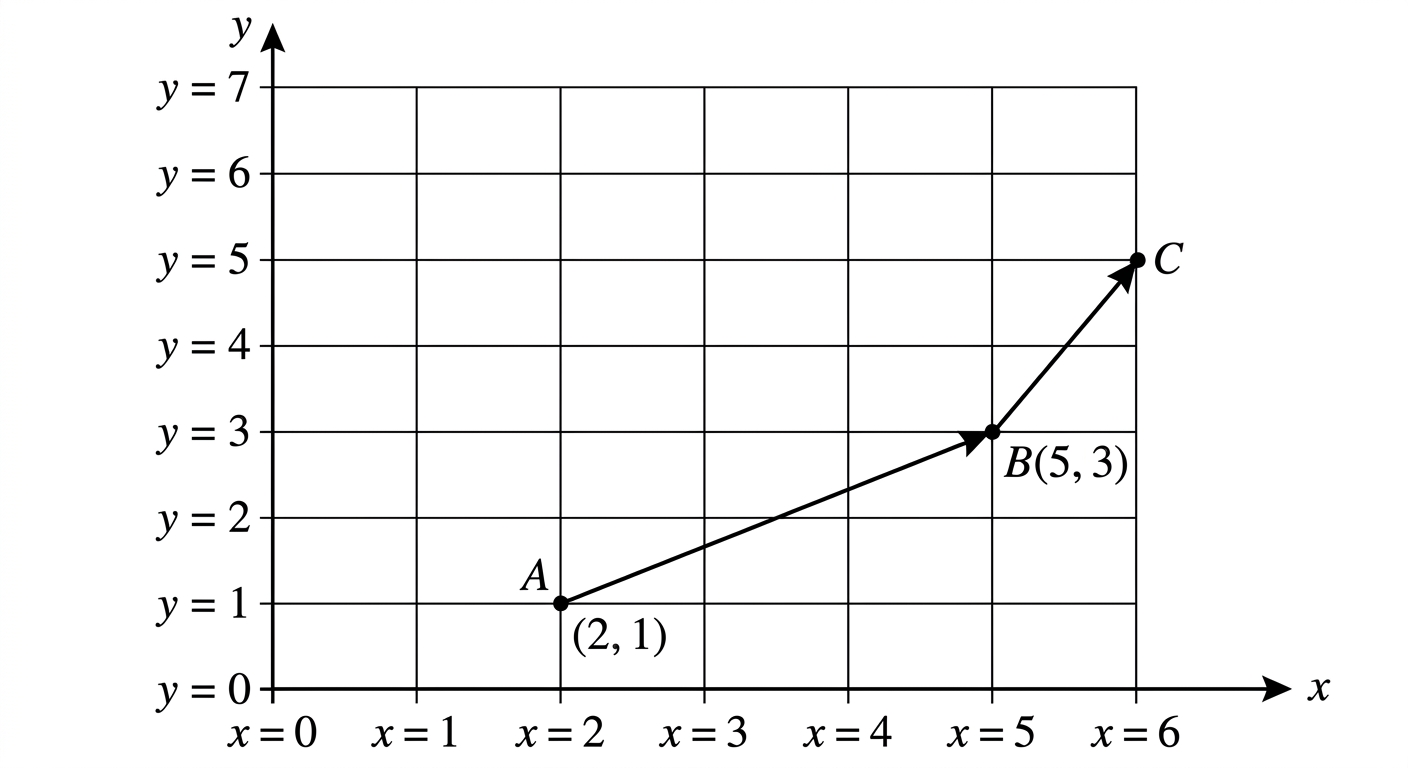
In a computer game a character moves on a square grid, from AA to BB and then from BB to CC, as shown in the diagram. Each move is a translation.
Question diagram
(a)
Write down the column vectors AB→\overrightarrow{AB} and BC→\overrightarrow{BC}. [2]Criterion A (i) · Level 1-2
(b)
Find AC→\overrightarrow{AC}, and the exact distance from CC back to AA. [2]Criterion A (ii) · Level 3-4
(c)
The character can use only the moves AB→\overrightarrow{AB} and BC→\overrightarrow{BC}, each a whole number of times, in any order. Starting at AA, it must finish at T(13,11)T(13, 11). Find how many times each move is used. [3]Criterion A (i), A (ii) · Level 5-6
(d)
Show that, using only these moves, the character can never finish at (13,10)(13, 10). [2]Criterion A (iii) · Level 7-8

revisionprep.com

Summary Answer

Not available for this question.

Model Answer

Not available for this question.

Marking Scheme

Not available for this question.

Examiner Insights

Not available for this question.

Question 6Criterion B · Band 3-8 · Challenge · 9 marksrevisionprep.com

Reflections in Lines x-axis y-axis y=x y=-x

The points (2,3)(2, 3), (−1,4)(-1, 4), (0,−2)(0, -2) and (5,−3)(5, -3) are reflected in the line y=xy = x.
(a)
Copy and complete a table showing each point and its image. [2]Criterion B (i) · Level 3-4
(b)
Write down a general rule for the image of the point (a,b)(a, b). [1]Criterion B (ii) · Level 3-4
(c)
Use your rule to find the image of (7,−6)(7, -6), and verify that y=xy = x passes through the midpoint of the point and its image. [2]Criterion B (iii) · Level 5-6
(d)
Prove that, for any point (a,b)(a, b) with a≠ba \ne b, the line y=xy = x is the perpendicular bisector of the segment joining (a,b)(a, b) to its image. [3]

(e) Using your rule, describe the points that are their own images. [1]
Criterion B (iii) · Level 7-8

revisionprep.com

Summary Answer

Not available for this question.

Model Answer

Not available for this question.

Marking Scheme

Not available for this question.

Examiner Insights

Not available for this question.

That's every free question here — 6 of 168.

+162 more questions, plus Mock Papers & Worksheets, are waiting in Premium.

Upgrade