You're viewing free preview questions — 4 questions previewing here — subscribe to unlock 64 more, plus the Full Question Bank, Mock Papers & Worksheets.Upgrade
Units Conversions and Compound Measures — Free MYP4 Mathematics (Standard) Practice Questions

1QuestionConverting Between Metric UnitsAssessment Practice
2 marks~3 minCriterion D
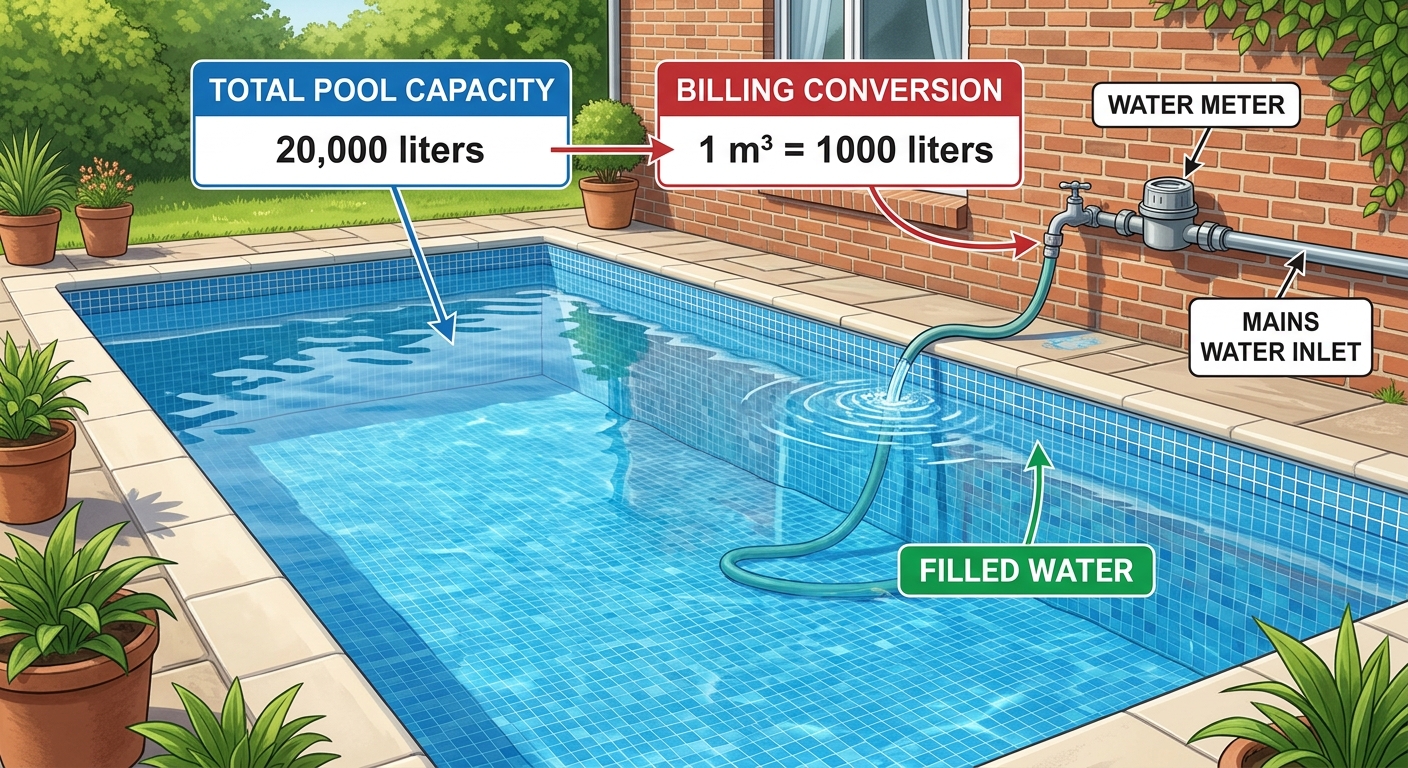
A municipal water authority bills customers in cubic metres (). A community swimming pool holds exactly litres of water, and the billing rate is per . The authority's system truncates all volumes to the nearest whole before calculating the charge.
Given that litres:
Given that litres:
a
Calculate the exact volume of the pool in cubic metres and the exact cost of filling it. [1]
b
Justify whether the authority should continue using truncation as its billing method, with reference to your calculated values. [1]

Solutions
2QuestionMulti-Step Problems with Compound MeasuresAssessment Practice
5 marks~8 minCriterion A
Two cars complete a 500 km journey. Car A takes 5 hours and uses 40 litres of fuel. Car B takes 5.5 hours and uses 45 litres in total; however, Car B has a fuel leak, losing fuel at a constant rate of 2 litres per hour throughout the journey.
a
Calculate the fuel consumption rate of Car A in litres per 100 km. [1]
b
Deduce the volume of fuel Car B actually used for propulsion, excluding leaked fuel, and hence calculate Car B's fuel consumption rate in litres per 100 km. [3]
c
A car manufacturer claims that any vehicle achieving under 7.5 litres per 100 km is classified as fuel-efficient. Advise a cost-conscious buyer which car to purchase, justifying your recommendation using your results. [1]
Solutions
3QuestionPressure Force Area ApplicationsAssessment Practice
6 marks~9 minCriterion C
A hydraulic press transmits pressure from a small piston to a large piston. Pascal's principle states that pressure applied to an enclosed fluid is transmitted equally throughout: . The relationship between pressure, force, and area is .
For three independent cases, the following data are given.
(N): 100, 250, 400
(Pa): 2000, 2500, 3200
(N): 5000, 15000, 28000
For three independent cases, the following data are given.
(N): 100, 250, 400
(Pa): 2000, 2500, 3200
(N): 5000, 15000, 28000
a
Calculate the area of the small piston for each case. [2]
b
Deduce the area of the large piston for each case, using Pascal's principle. [2]
c
A design engineer claims that doubling while keeping constant will always double . Justify whether this claim is correct. [2]
Solutions
4QuestionMulti-Step Problems with Compound MeasuresAssessment Practice
6 marks~9 minCriterion B
A manufacturer produces solid metal cubes of increasing side lengths, all from the same material. The side lengths and measured masses are recorded below.
Side length (cm): 1, 2, 3, 4, 5
Mass (g): 2, 8, 18, 32, 50
Side length (cm): 1, 2, 3, 4, 5
Mass (g): 2, 8, 18, 32, 50
a
Analyse the mass values to identify the relationship between and . Show the first and second differences between consecutive mass values and justify why the relationship is quadratic. [2]
b
Deduce a formula for the density (g/cm³) of a cube in terms of its side length , using . Show all working. [2]
c
The manufacturer requires a cube of side length 6 cm to have a density no greater than 0.30 g/cm³ to meet a safety specification. Using your formula from part (b), advise the manufacturer whether this cube meets the specification and recommend one practical course of action if it does not. [2]
Solutions
That's every free question here — 4 of 68.
+64 more questions, plus Mock Papers & Worksheets, are waiting in Premium.