You're viewing free preview questions — 4 questions previewing here — subscribe to unlock 58 more, plus the Full Question Bank, Mock Papers & Worksheets.Upgrade
Graphing Linear Equations — Free MYP4 Mathematics (Standard) Practice Questions

1QuestionParallel and Perpendicular Lines IntroductoryConcept Practice
2 marks~3 minCriterion A
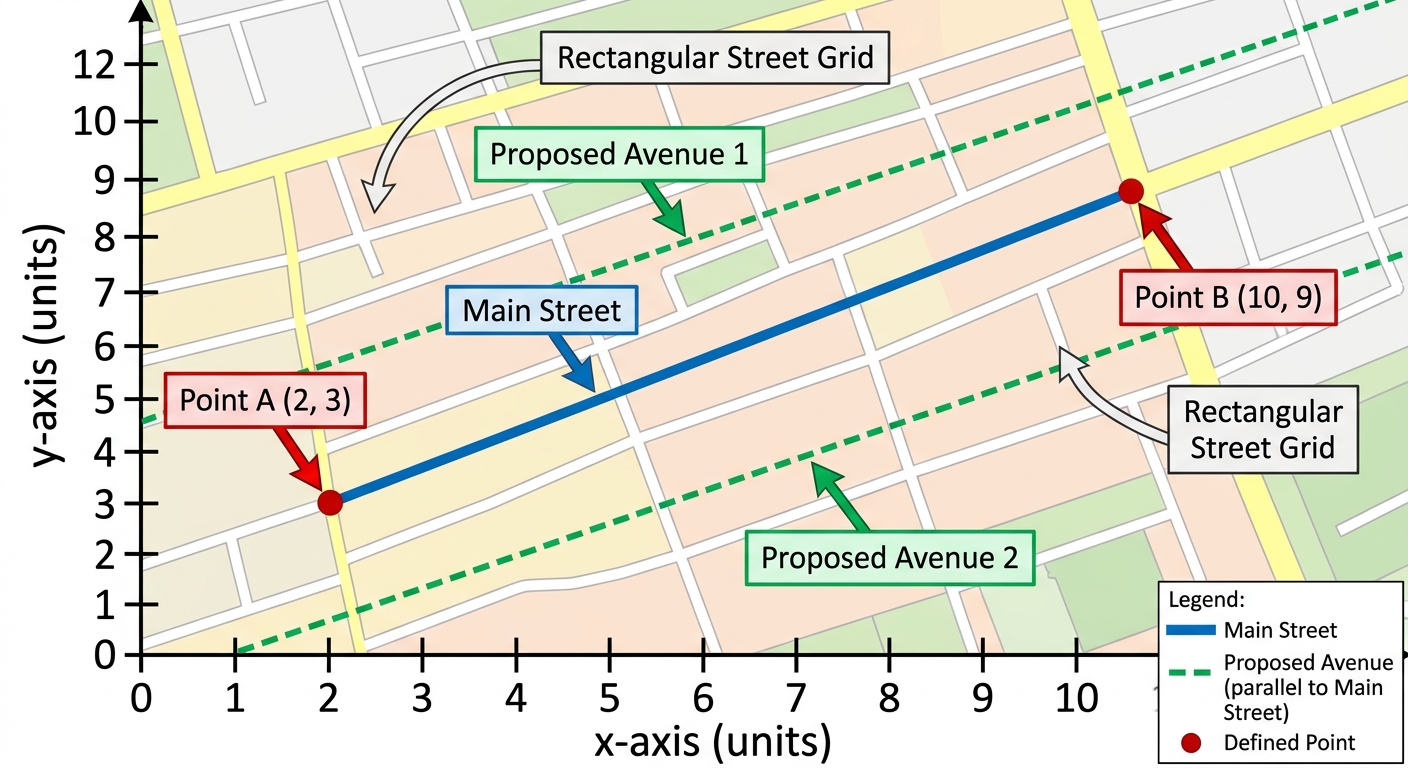
A city planner is designing a rectangular street grid. On a map, one main street passes through points and .
a
Calculate the slope of the main street. [1]
b
A proposed avenue has equation . Justify whether this avenue should be approved as a street running parallel to the main street. [1]

Solutions
2QuestionIdentifying Slope and Y-Intercept AI Generate Add Questions SummaryAssessment Practice
4 marks~6 minCriterion D
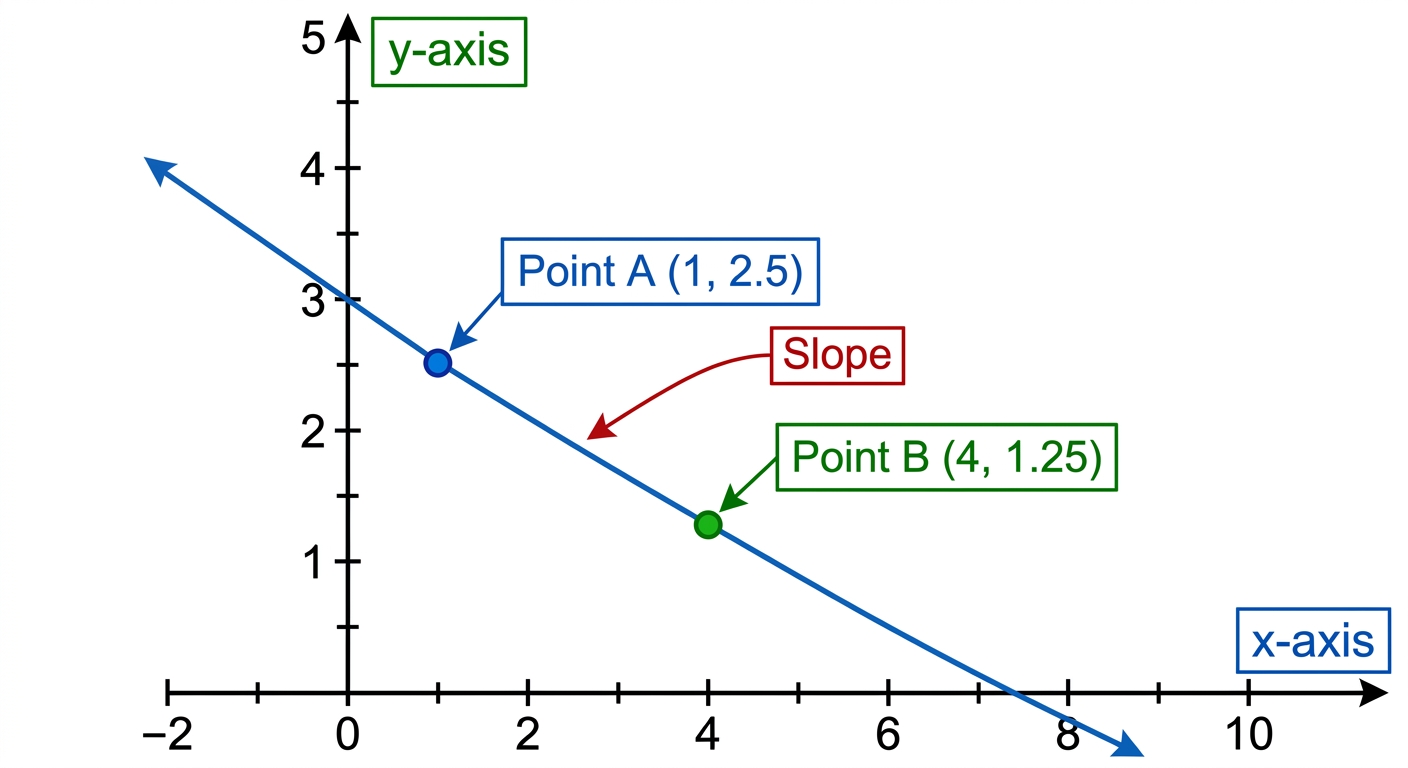
A delivery drone's battery charge (percent) decreases linearly with horizontal distance (km) from its base. At km the charge reads ; at km the charge reads .
a
Calculate the slope of the line passing through and . [1]
b
Determine the equation of the line in the form . [2]
c
Interpret what represents in this context, and justify whether this model should be used to predict battery charge over a long-distance flight. [1]
Solutions
3QuestionParallel and Perpendicular Lines IntroductoryConcept Practice
2 marks~3 minCriterion C
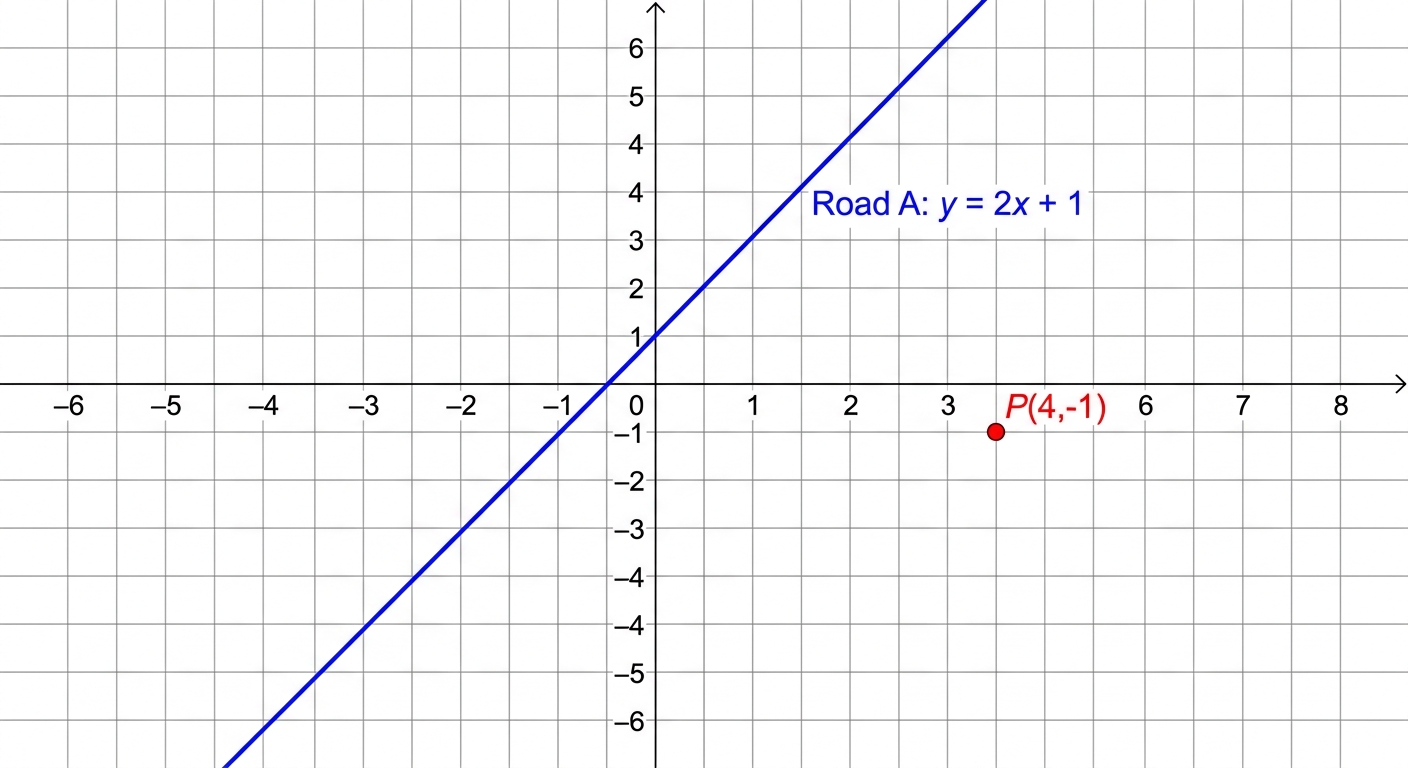
A city planner is designing two straight roads on a coordinate grid. Road A follows the equation .
Road B must be built perpendicular to Road A, passing through the point .
Road B must be built perpendicular to Road A, passing through the point .
a
Deduce the slope of Road B. [1]
b
The planner claims Road B can be written as . Justify whether this equation correctly represents Road B. [1]
Solutions
4QuestionParallel and Perpendicular Lines IntroductoryAssessment Practice
4 marks~6 minCriterion B
An urban planner is designing a pedestrian grid. Two straight paths must meet at a perfect right angle to satisfy accessibility regulations.
The four candidate path pairs are:
Pair 1: and
Pair 2: and
Pair 3: and
Pair 4: and
The four candidate path pairs are:
Pair 1: and
Pair 2: and
Pair 3: and
Pair 4: and
a
For each pair, calculate the product of the two slopes. State what you observe. [1]
b
The angle between two lines with slopes and is given by
Apply this formula to Pairs 1 and 3. Deduce the value of for each, and explain why the formula behaves as it does for these two pairs. [2]
Apply this formula to Pairs 1 and 3. Deduce the value of for each, and explain why the formula behaves as it does for these two pairs. [2]
c
The accessibility regulation requires paths to meet at exactly 90°. Justify whether all four pairs satisfy this regulation, and state the general algebraic condition that guarantees perpendicularity. [1]
Solutions
That's every free question here — 4 of 62.
+58 more questions, plus Mock Papers & Worksheets, are waiting in Premium.