You're viewing free preview questions — 4 questions previewing here — subscribe to unlock 64 more, plus the Full Question Bank, Mock Papers & Worksheets.Upgrade
Perimeter and Area of 2D Shapes — Free MYP4 Mathematics (Standard) Practice Questions

1QuestionArea of Rectangles Triangles and ParallelogramsConcept Practice
4 marks~6 minCriterion A
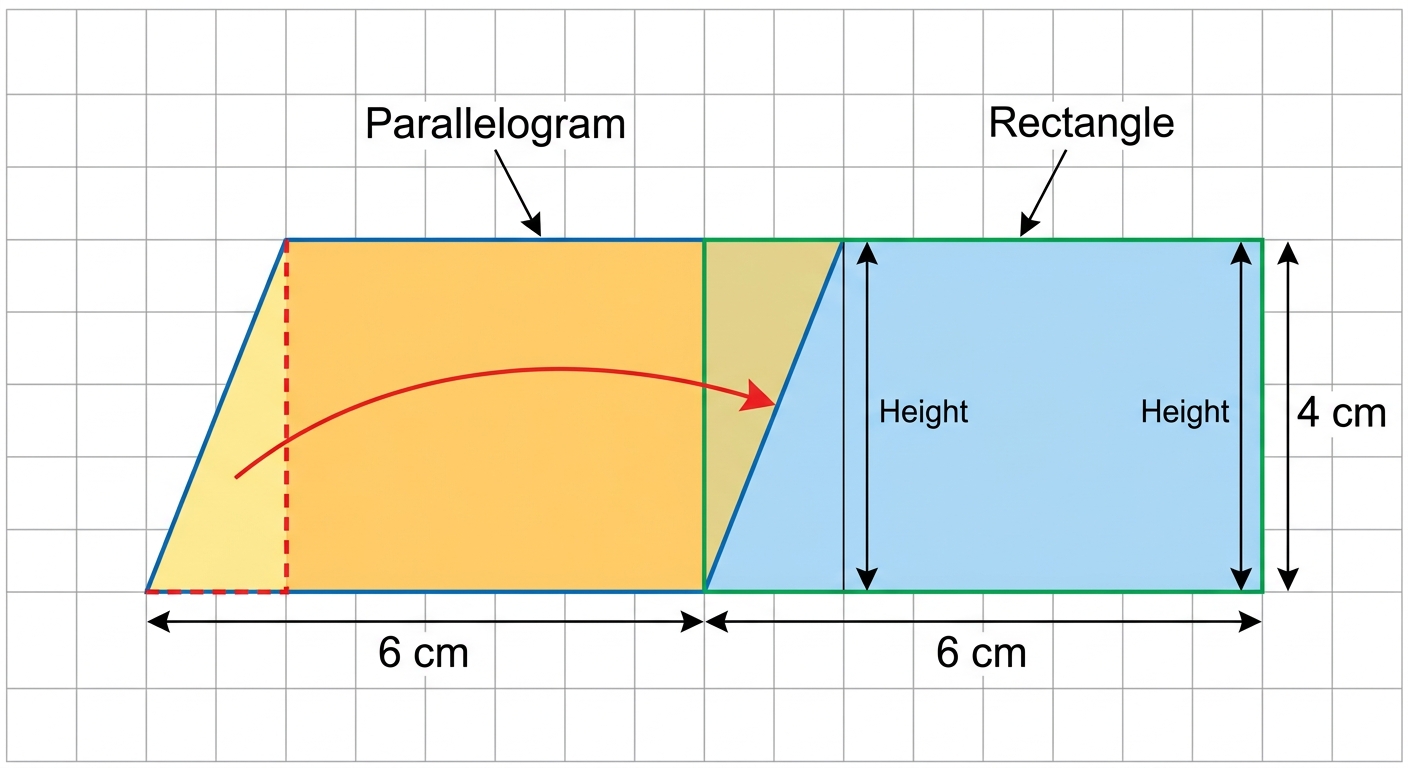
A landscape architect is designing a parallelogram-shaped lawn with a base of 6 m and a perpendicular height of 4 m. She explains to her client that cutting a triangular section from one end of the lawn and repositioning it at the other end produces a rectangular shape with the same area.
a
Calculate the area of the rectangular shape formed. [1]
b
Deduce a general formula for the area of any parallelogram in terms of its base and perpendicular height . [1]
c
A rectangular patio of area 20 m² is planned alongside the lawn. The architect claims the lawn has a greater area than the patio. Justify whether this claim is correct. [2]

Solutions
2QuestionArea of Rectangles Triangles and ParallelogramsAssessment Practice
5 marks~8 minCriterion C
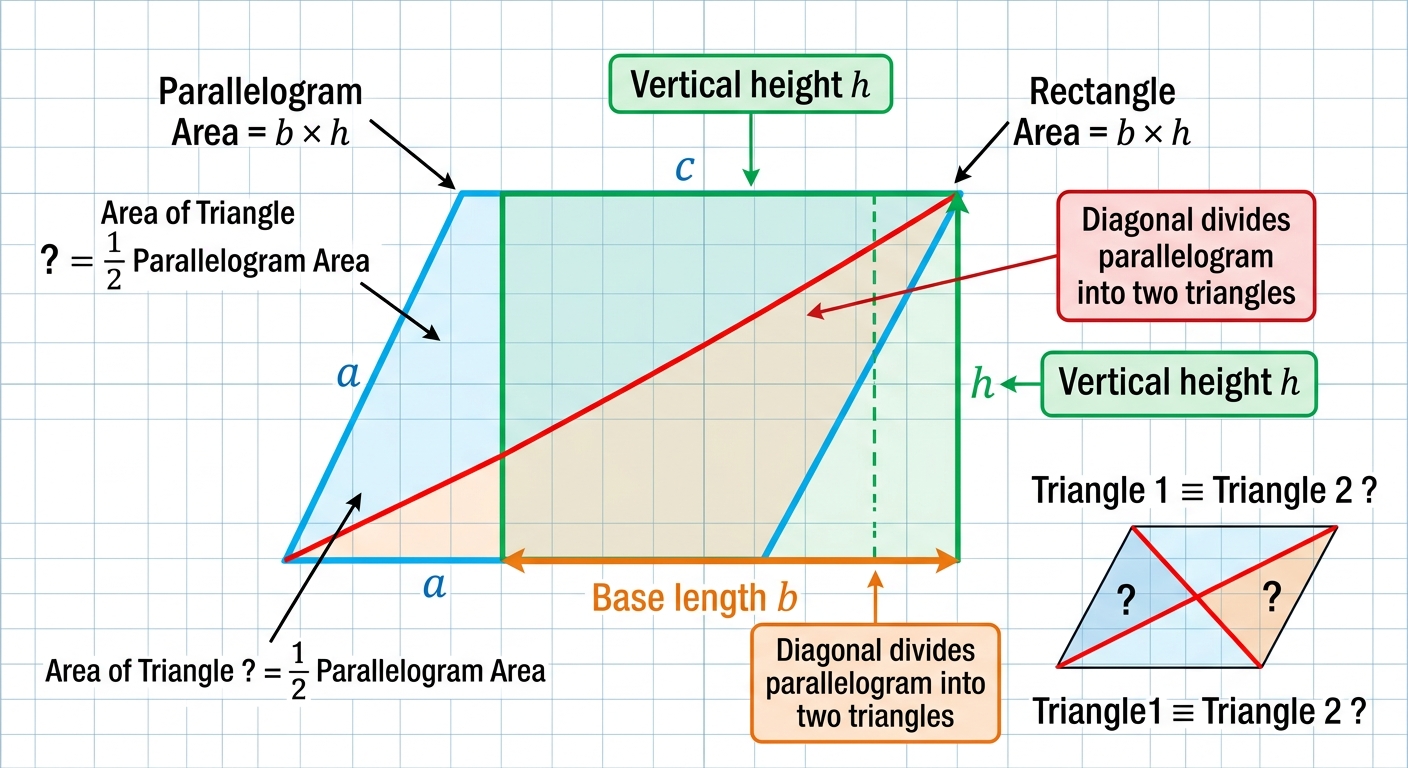
A parallelogram has base and perpendicular height . A rectangle shares the same base and perpendicular height .
a
State the area formula for the parallelogram using algebraic notation. [1]
b
A diagonal is drawn across the parallelogram, forming two triangles. Justify, using congruence and algebraic reasoning, that the area of each triangle equals . [2]
c
An architect claims that knowing the triangle area formula is sufficient to derive the rectangle area formula, without needing to treat the rectangle separately. Defend whether this claim is correct, showing your reasoning with algebraic notation. [2]
Solutions
3QuestionArea of Trapeziums and RhombusesAssessment Practice
5 marks~8 minCriterion B
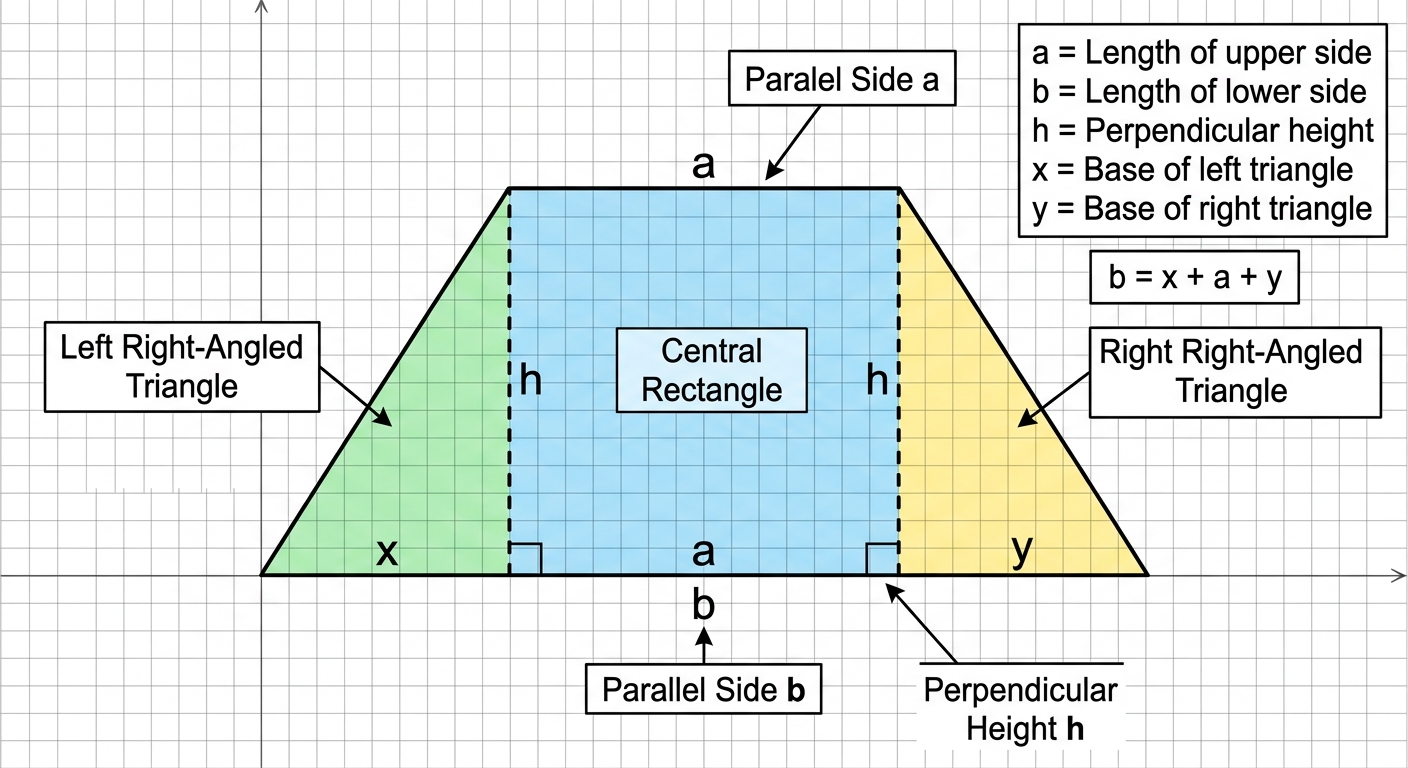
A landscape architect is designing a trapezoidal flower bed with parallel sides of length (top) and (bottom), where , and perpendicular height .
a
Construct a clearly labelled diagram showing the trapezium decomposed into one rectangle and two right-angled triangles. Label the parallel sides and , the height , and the horizontal bases of the two triangles (left) and (right). [1]
b
Using your diagram, justify that , write algebraic expressions for the area of each component shape, and show that their sum simplifies to . [3]
c
The architect states that a trapezoidal bed with m, m, and m has sufficient area to plant 20 lavender bushes, each requiring at least m² of space. Assess whether the architect's claim is correct. [1]
Solutions
4QuestionArea of Rectangles Triangles and ParallelogramsAssessment Practice
6 marks~9 minCriterion D
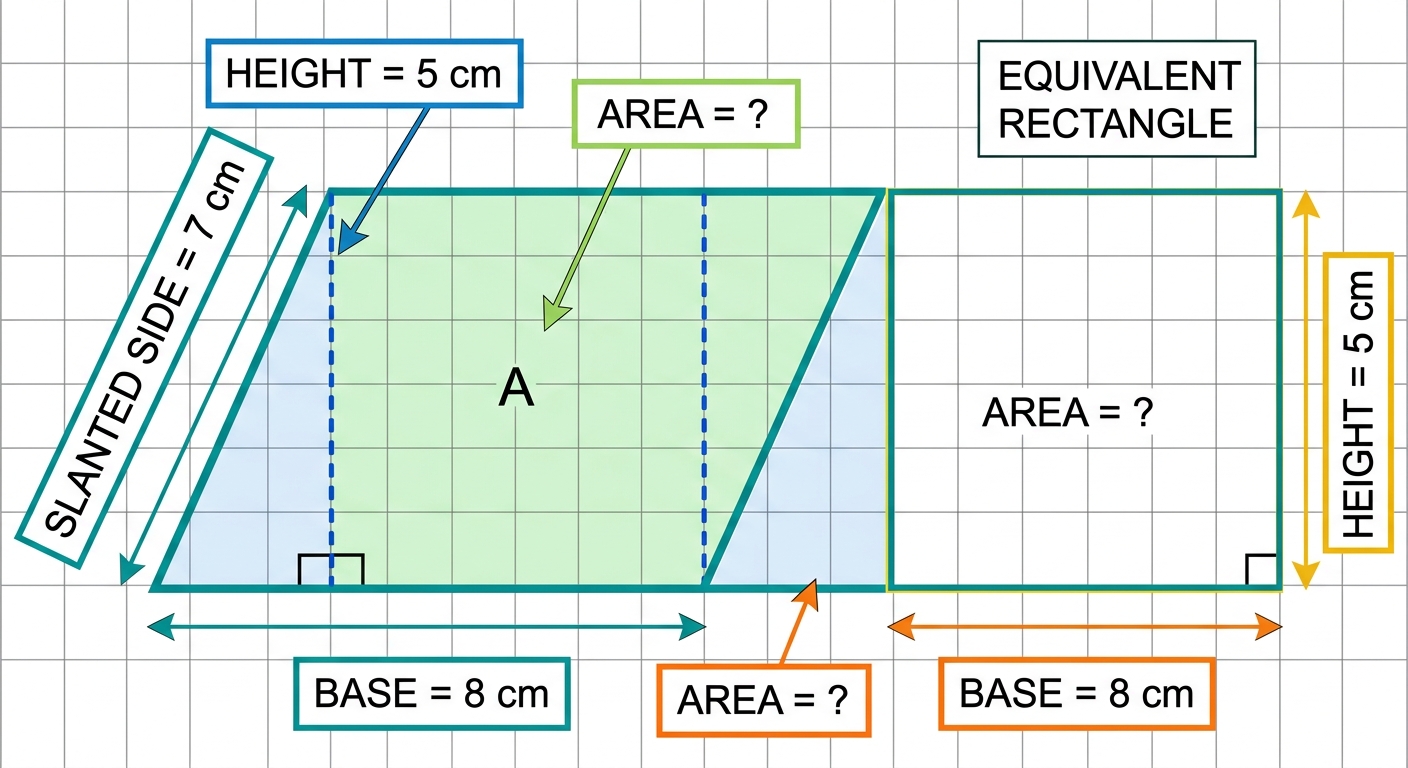
A rooftop garden is being designed on a parallelogram-shaped plot. The plot has a base of m, a perpendicular height of m, and slanted side lengths of m.
a
Decompose the parallelogram into one rectangle and two congruent right-angled triangles by dropping perpendiculars from each top vertex to the base. Use the Pythagorean theorem to find the horizontal leg of each right-angled triangle. [2]
b
Calculate the area of the rectangle and the combined area of the two right-angled triangles. Show that their sum equals . [2]
c
The garden designer claims that using a steeper slanted side of m (keeping base m and perpendicular height m unchanged) would increase the area available for planting. Advise the designer whether this change should be made, justifying your answer with reference to what the slanted side length determines about the shape. [2]
Solutions
That's every free question here — 4 of 68.
+64 more questions, plus Mock Papers & Worksheets, are waiting in Premium.