You're viewing free preview questions — 4 questions previewing here — subscribe to unlock 78 more, plus the Full Question Bank, Mock Papers & Worksheets.Upgrade
Surface Area and Volume of 3D Solids Summary — Free MYP4 Mathematics (Standard) Practice Questions

1QuestionNets and Surface Area of Cubes and CuboidsConcept Practice
3 marks~5 minCriterion A
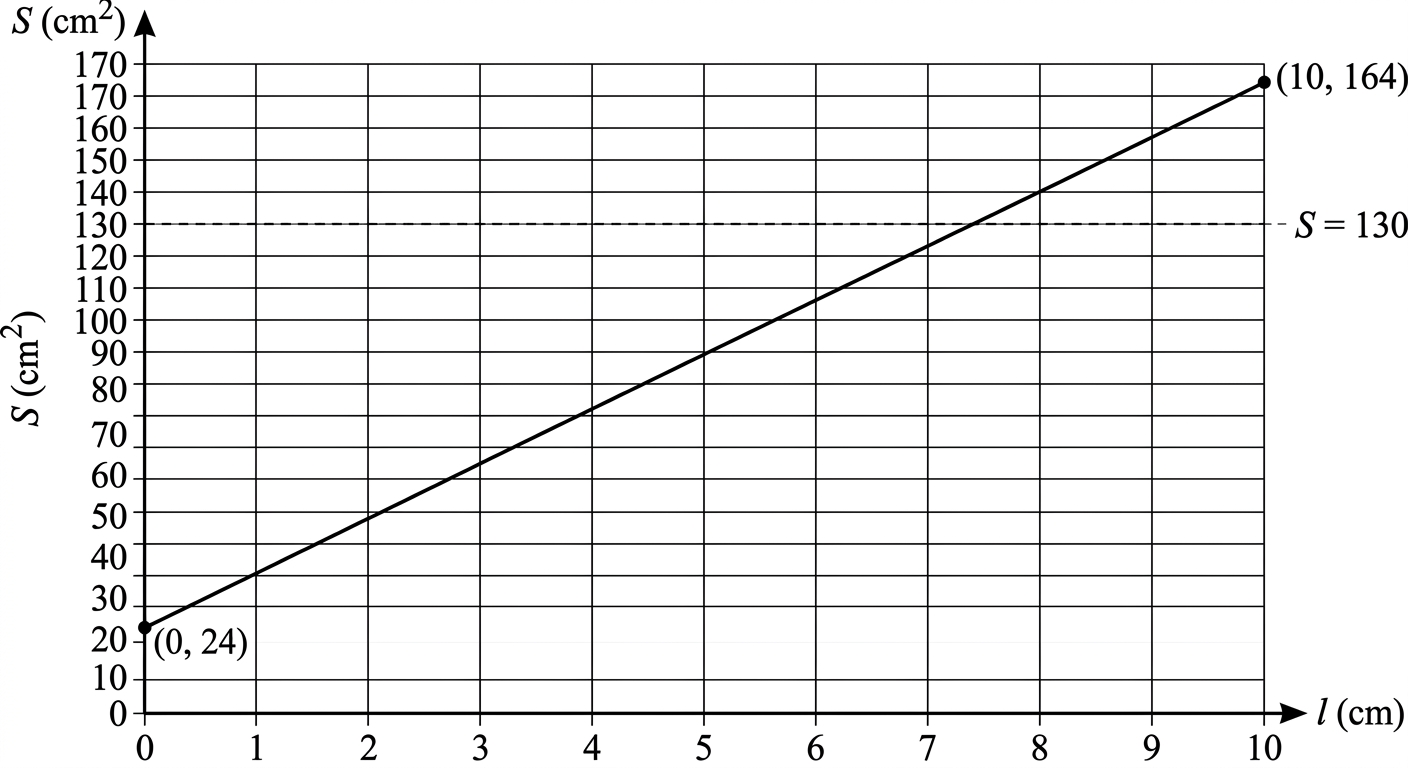
A packaging company designs cardboard trays. Each tray has a fixed width of 4 cm and a fixed height of 3 cm, but its length (in cm) varies. The graph below shows the total surface area (in cm²) of a closed cuboid tray as varies from 0 to 10 cm.
a
Show that the surface area of the cuboid can be written as . [1]
b
Explain why the graph of against is a straight line. [1]
c
The company requires a tray with surface area no greater than 130 cm². Justify whether a tray of length 8 cm satisfies this requirement. [1]

Solutions
2QuestionNets and Surface Area of Cubes and CuboidsAssessment Practice
4 marks~6 minCriterion D
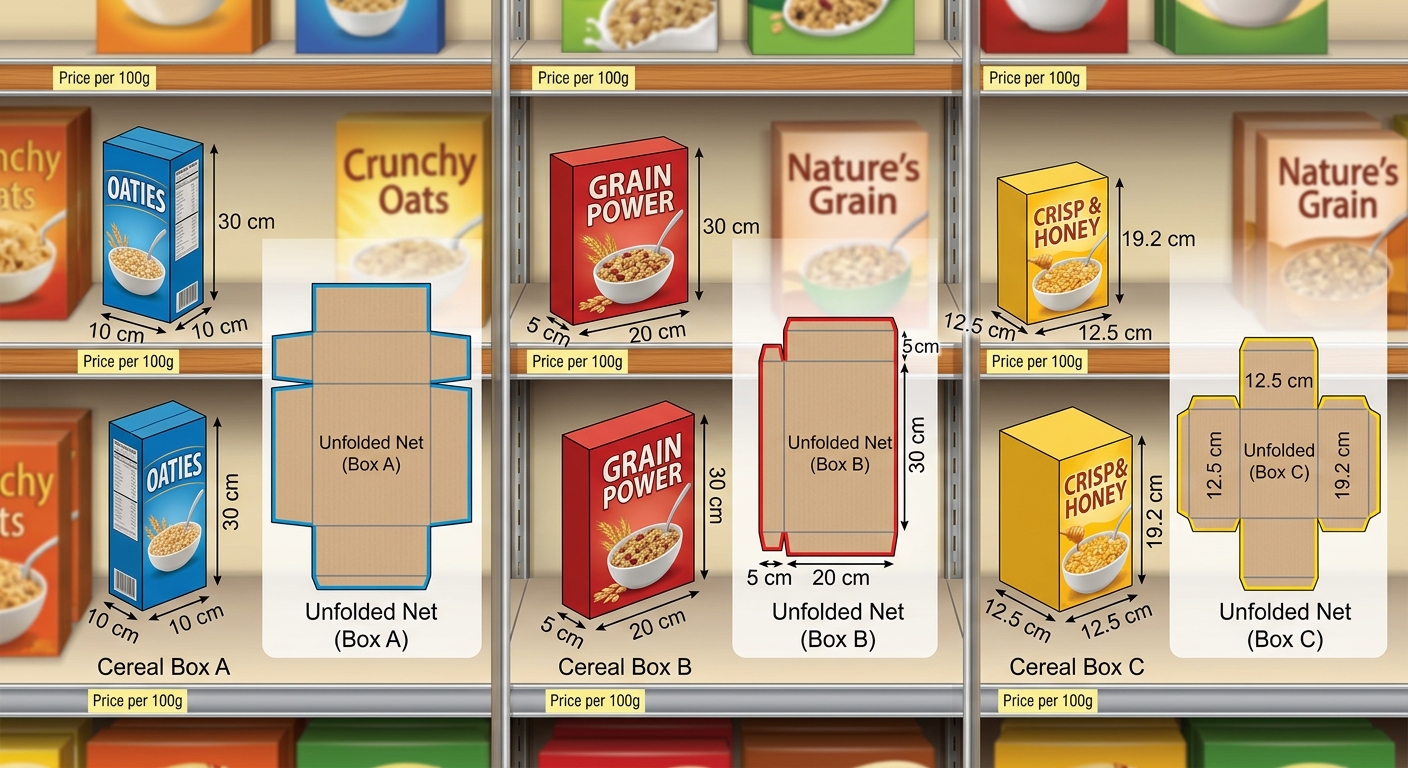
A cereal company is designing a cuboid-shaped box with a fixed volume of . Three sets of dimensions (length width height) are proposed:
Set A:
Set B:
Set C:
Set A:
Set B:
Set C:
a
Calculate the surface area of Set A and Set B. [1]
b
Calculate the surface area of Set C. [1]
c
Advise the company which set of dimensions to choose to minimise material costs, and identify two real-world factors that the surface area model does not account for, explaining why each matters. [2]
Solutions
3QuestionNets and Surface Area of Cubes and CuboidsAssessment Practice
6 marks~9 minCriterion B
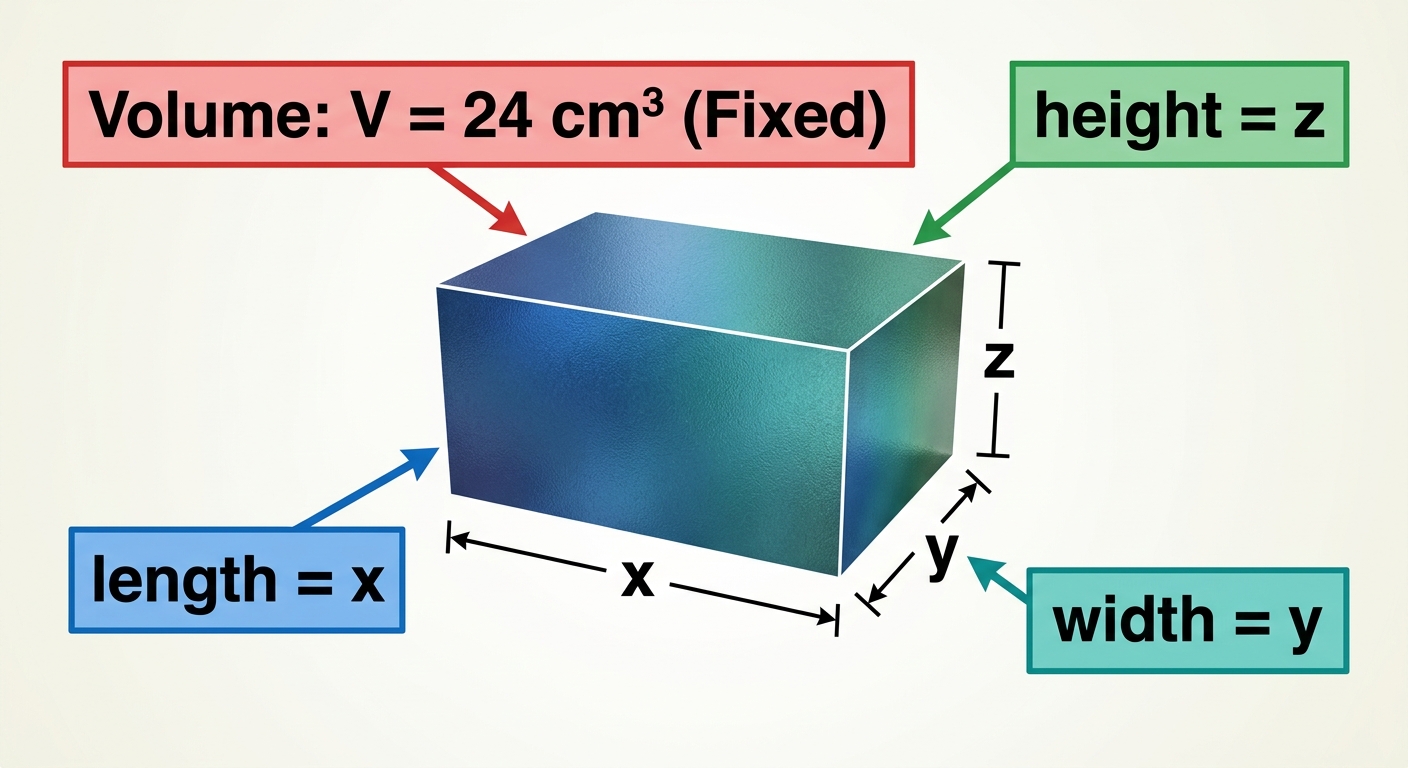
A packaging company designs closed rectangular boxes with a fixed volume of . Minimising surface area reduces material cost.
a
Calculate the surface area of each box using . [2]
Dimensions in cm: ; ; ; .
Dimensions in cm: ; ; ; .
b
Justify which set of dimensions minimises surface area by identifying a geometric property shared by those dimensions. [1]
c
Let the dimensions be , , with . Show that . Hence prove, using the AM–GM inequality, that surface area is minimised when all three dimensions are equal. Advise the company whether to use the box or commission a new cubic design, justifying your recommendation with reference to the theoretical minimum. [3]
Solutions
4QuestionNets and Surface Area of Cubes and CuboidsAssessment Practice
6 marks~9 minCriterion C
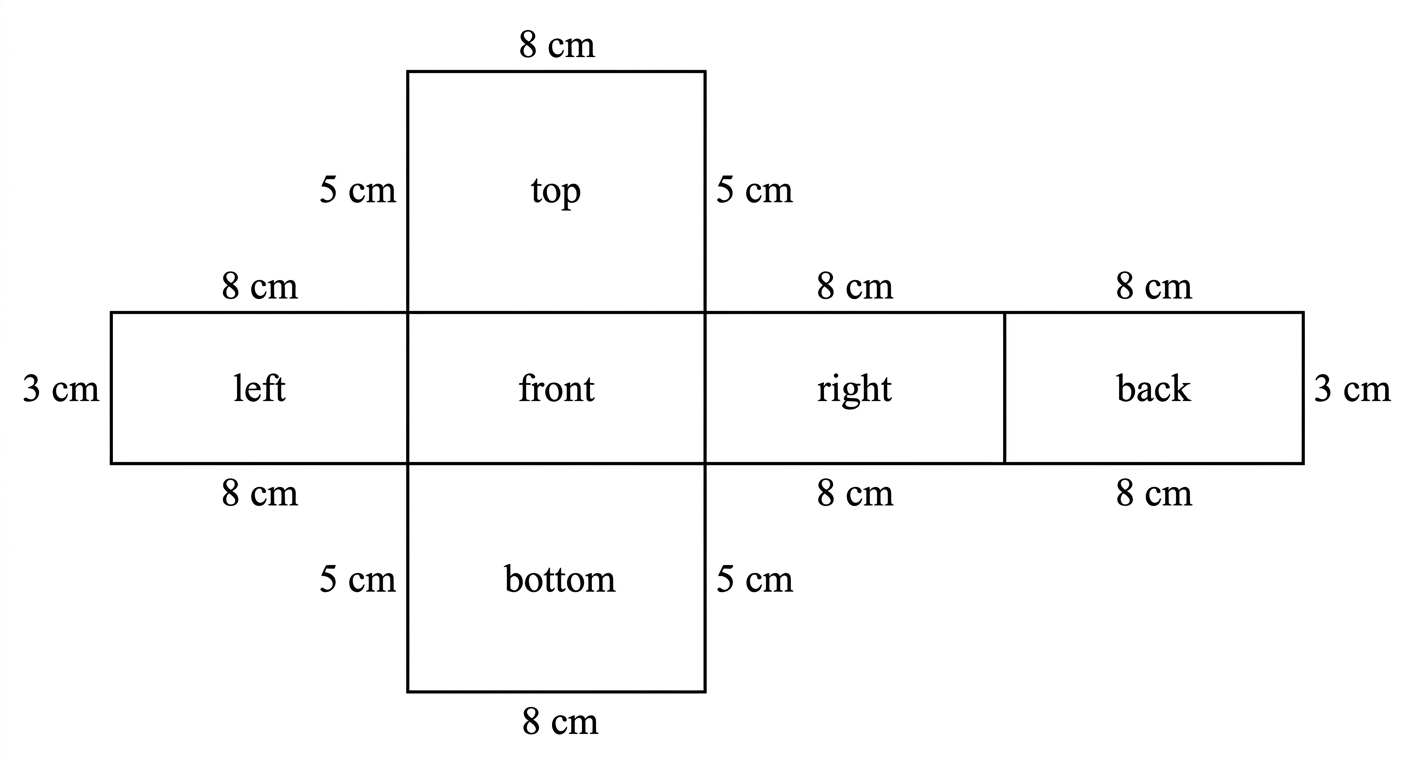
A packaging company is designing a cardboard box (a cuboid) with length cm, width cm, and height cm.
a
Construct a fully labelled net of the cuboid, showing the dimensions of all six faces. [2]
b
Show that the surface area of the cuboid is , using the formula . [2]
c
A trainee designer claims the surface area is and orders cardboard accordingly. Advise the packaging manager whether this order should be accepted, identifying the most likely source of the designer's error. [2]
Solutions
That's every free question here — 4 of 82.
+78 more questions, plus Mock Papers & Worksheets, are waiting in Premium.