You're viewing free preview questions — 4 questions previewing here — subscribe to unlock 75 more, plus the Full Question Bank, Mock Papers & Worksheets.Upgrade
Independent and Dependent Events — Free MYP4 Mathematics (Standard) Practice Questions

1QuestionUsing Probability Trees for Multi-Stage EventsConcept Practice
2 marks~3 minCriterion A
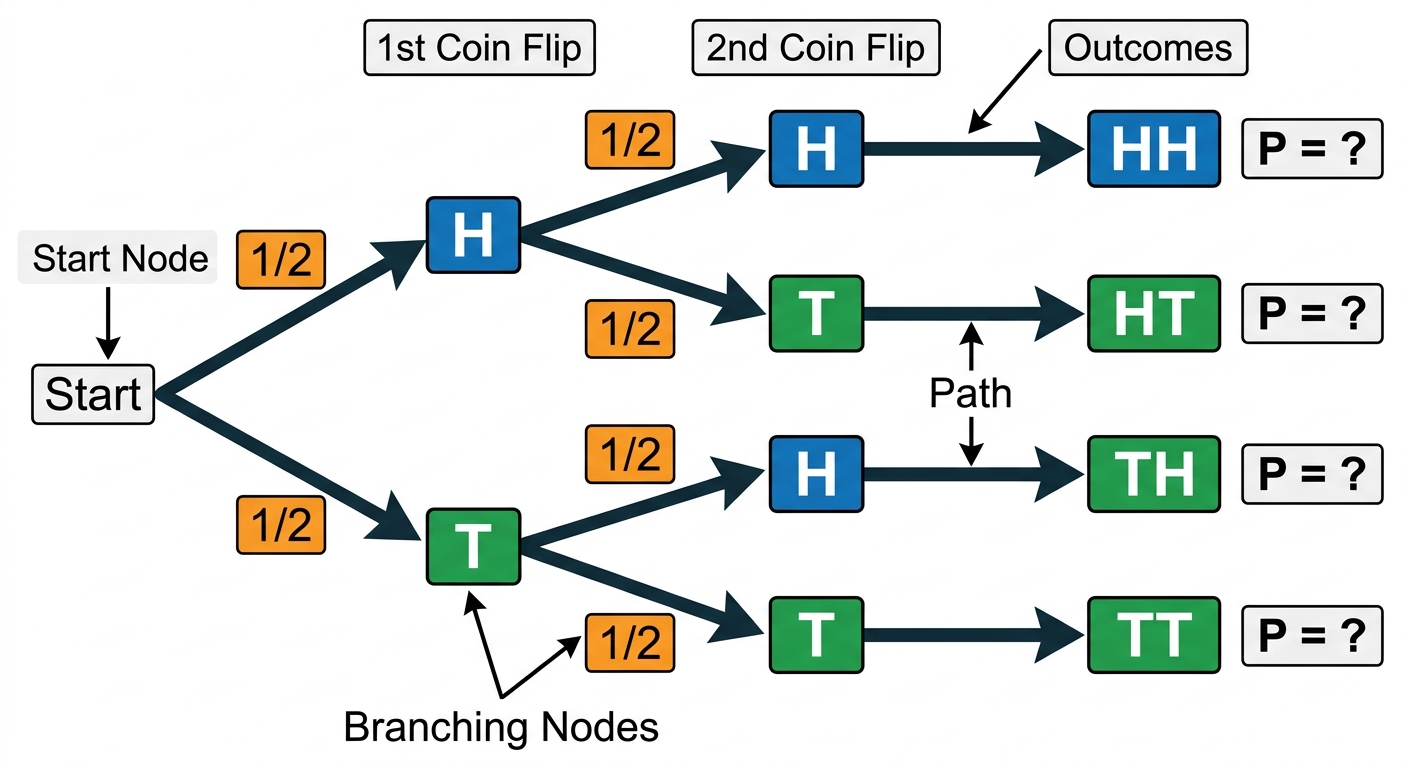
A quality-control engineer tests two components in sequence from a large batch. Long-run data show the probability that any single component is defective is , independent of all other components. A probability tree shows the two-stage process with branches labelled D (defective) and N (non-defective).
a
Interpret the meaning of the branch probability at the first stage, and use the multiplication rule to calculate , showing your substitution explicitly. [1]
b
Explain why the probabilities on the branches leaving any single node must sum to 1, and state what this implies about the outcomes at that node. [1]

Solutions
2QuestionReal-Life Applications Games Genetics and Decision-MakingAssessment Practice
2 marks~3 minCriterion C
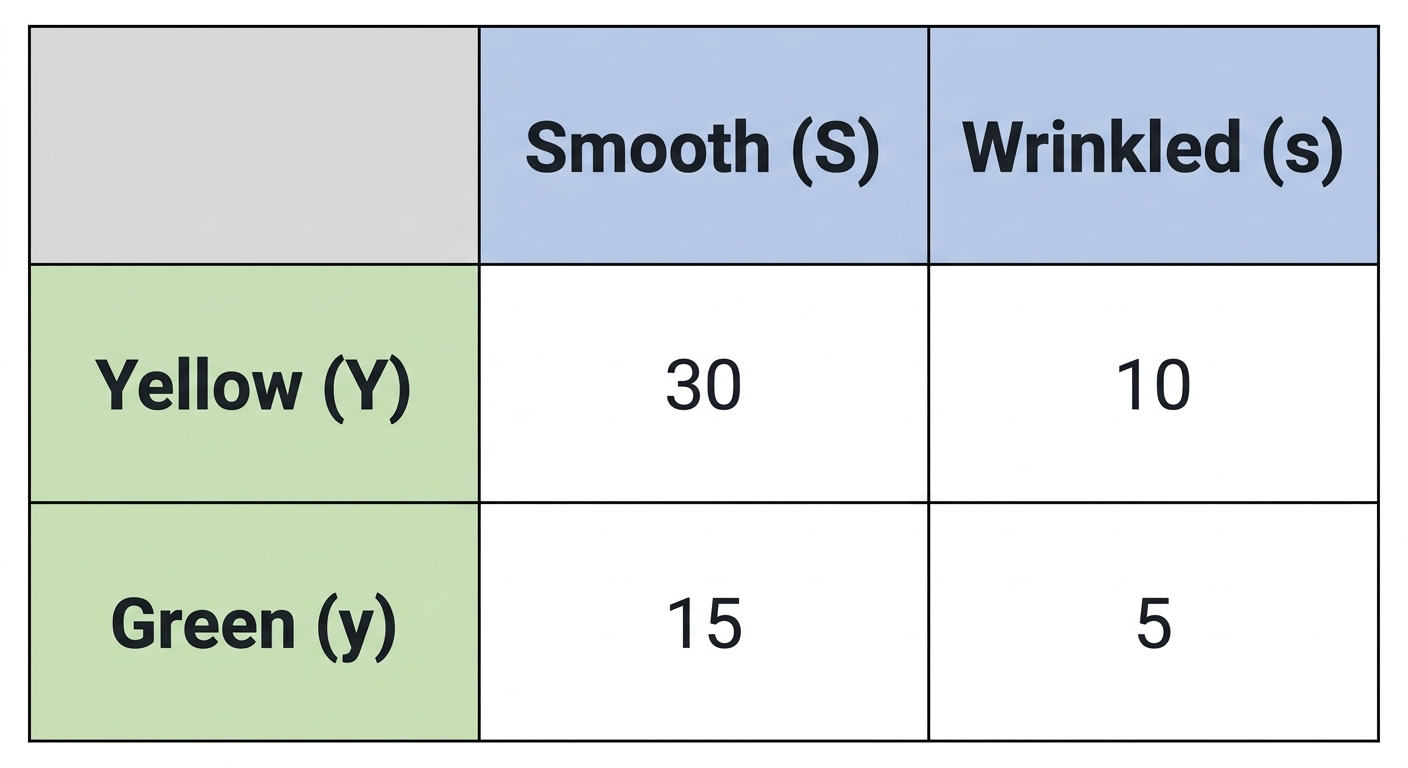
A genetic cross of pea plants produces 60 offspring. Their phenotypes are recorded below.
Smooth texture, Yellow colour: 30
Smooth texture, Green colour: 15
Wrinkled texture, Yellow colour: 10
Wrinkled texture, Green colour: 5
Smooth texture, Yellow colour: 30
Smooth texture, Green colour: 15
Wrinkled texture, Yellow colour: 10
Wrinkled texture, Green colour: 5
a
Calculate , the conditional probability that a randomly selected smooth plant is yellow. Show your working. [1]
b
The overall proportion of yellow plants in the dataset is . Justify whether the botanist's claim — that knowing a plant is smooth gives useful information about predicting its colour — is supported by the data. [1]
Solutions
3QuestionUsing Probability Trees for Multi-Stage EventsAssessment Practice
7 marks~11 minCriterion D
A quality-control engineer tests microchips by running them through a sequence of independent diagnostic checks. At each check, a chip either passes (P) or fails (F), each with probability .
a
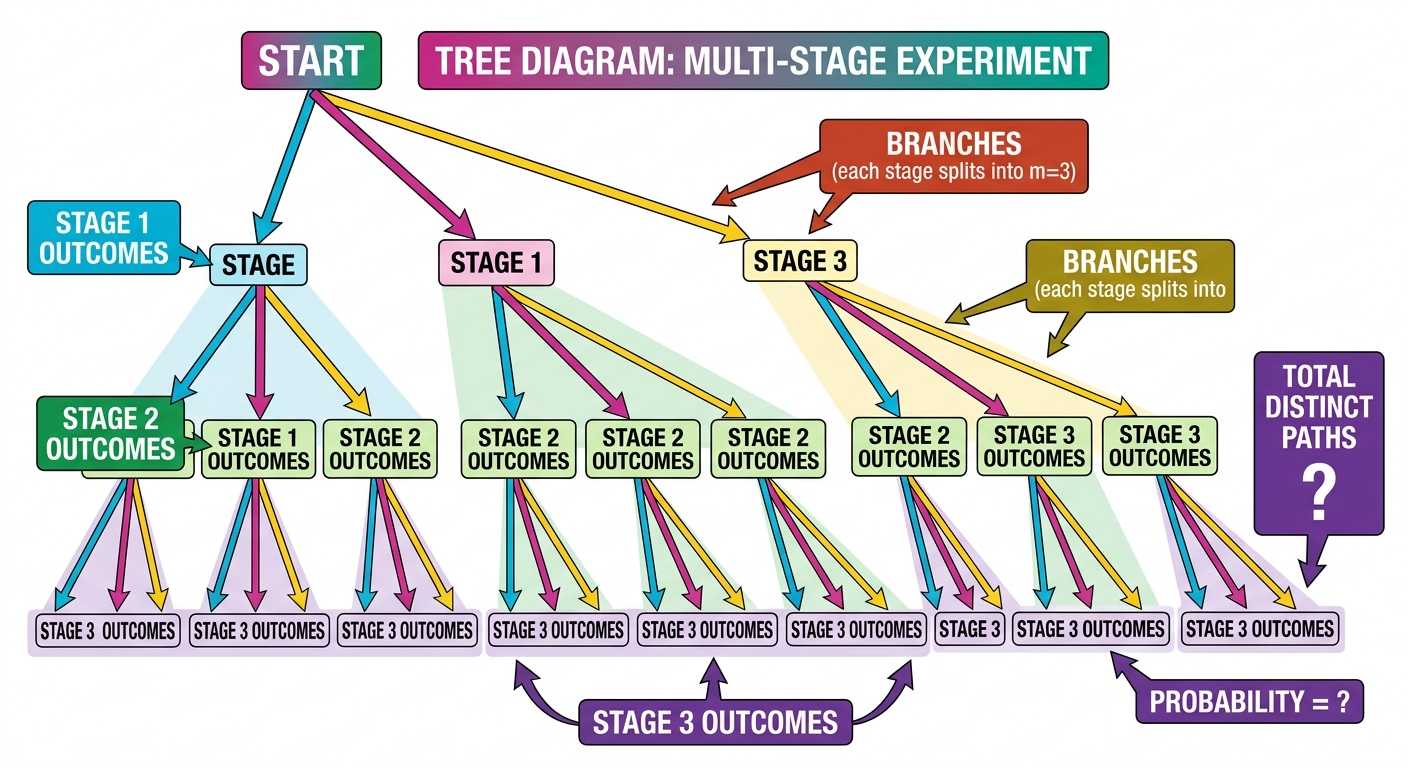
Write down the number of distinct outcomes after 1 check, after 2 checks, and after 3 checks. Identify the pattern in your sequence. [2]
b
Deduce a formula for the total number of distinct outcomes after checks, each with equally likely results. Justify your formula using the branching structure of a probability tree. [2]
c
The engineer runs 3 checks on each chip. Construct a probability tree for this 3-stage process. A chip is accepted only if it passes at least 2 of the 3 checks. Calculate the probability that a chip is accepted, and evaluate whether this acceptance criterion is suitable for a production line. [3]
Solutions
4QuestionRecognizing and Modeling Dependent EventsAssessment Practice
5 marks~8 minCriterion B
A quality-control technician samples marbles from a production batch. Each bag contains exactly 3 blue marbles and some red marbles, with marbles in total. Two marbles are drawn in succession without replacement.
: 3, 4, 5, 6
: , , ,
: , , ,
: , , ,
: 3, 4, 5, 6
: , , ,
: , , ,
: , , ,
a
Deduce a general formula for in terms of . [2]
b
Calculate for a bag of 10 marbles. [1]
c
The technician rejects any batch where the probability of drawing two blue marbles in succession is less than . Justify whether a bag of 12 marbles should be rejected, and advise the technician on what this threshold indicates about the production process. [2]
Solutions
That's every free question here — 4 of 79.
+75 more questions, plus Mock Papers & Worksheets, are waiting in Premium.