You're viewing free preview questions — 4 questions previewing here — subscribe to unlock 126 more, plus the Full Question Bank, Mock Papers & Worksheets.Upgrade
Probability Rules and Tree Diagrams — Free MYP4 Mathematics (Standard) Practice Questions

1QuestionSolving Problems using tree diagrams and Venn DiagramsAssessment Practice
4 marks~6 minCriterion C
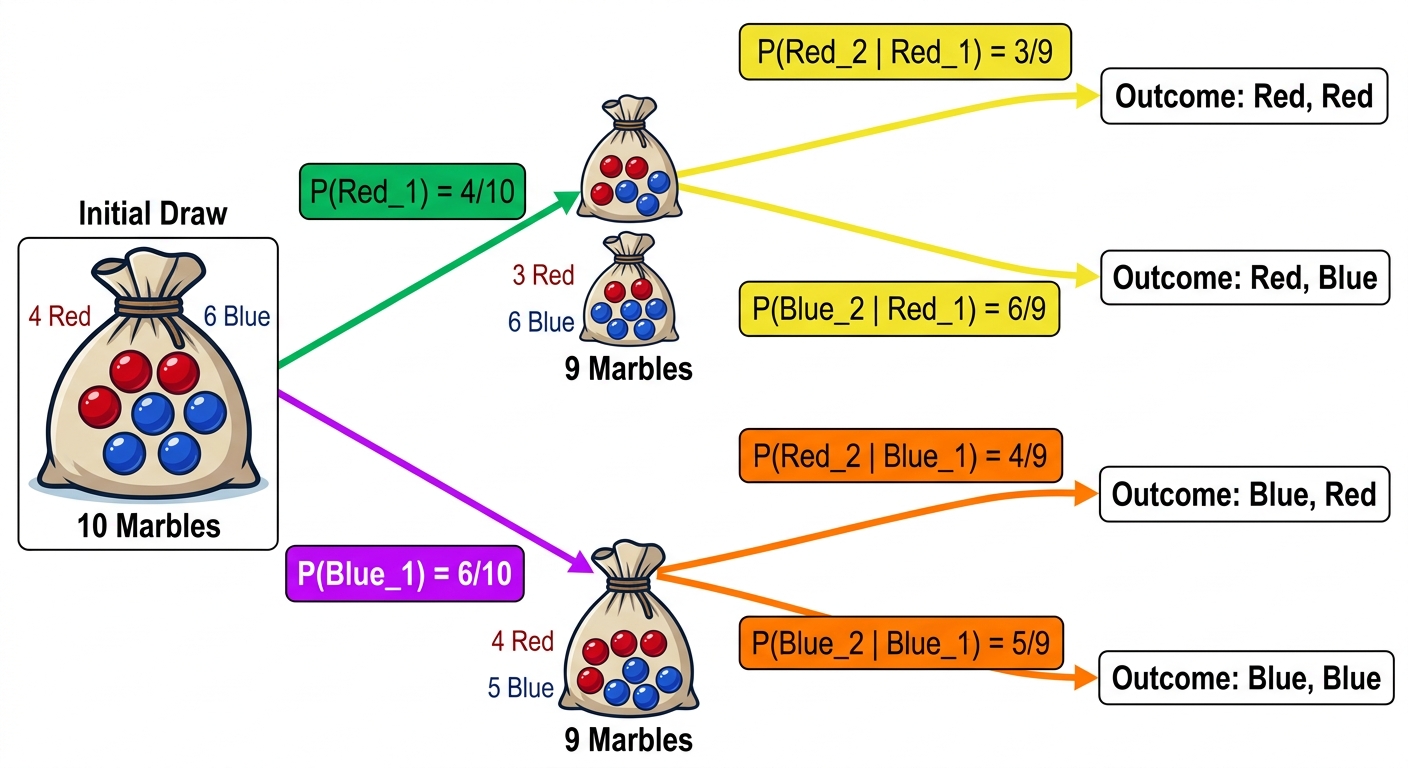
A bag contains 4 red marbles and 6 blue marbles. Two marbles are drawn without replacement. The partially completed tree diagram shows the first and second draws.
First draw: ,
Second draw (after Red): ,
Second draw (after Blue): ,
First draw: ,
Second draw (after Red): ,
Second draw (after Blue): ,
a
State , the probability of drawing a red marble second given that the first marble drawn was blue. [1]
b
Calculate the probability that exactly one red marble is drawn in the two draws. [2]
c
A quality-control inspector claims that, for a fair sampling process, the colour drawn first should have no influence on subsequent draws. Justify whether this bag of marbles satisfies that claim when sampling without replacement. [1]

Solutions
2QuestionTree Diagrams for Dependent EventsAssessment Practice
6 marks~9 minCriterion A
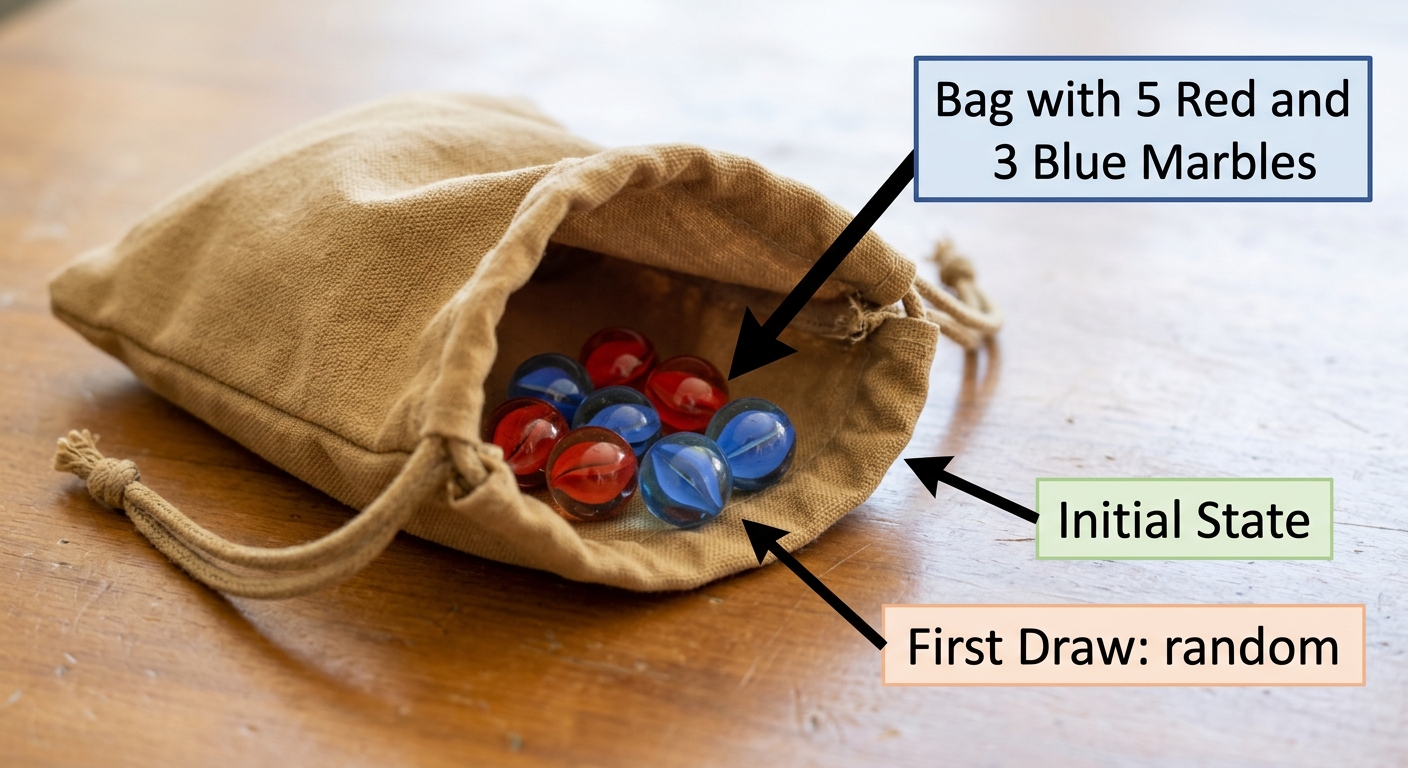
An inspection tray contains 5 conforming components and 3 defective components. Two components are selected at random without replacement.
a
Construct a tree diagram showing all possible outcomes of the two selections, with the probability of each branch clearly labelled. [3]
b
Deduce the probability that both components selected are conforming. [1]
c
A batch fails inspection if the probability of selecting at least one defective component exceeds . Calculate the probability of selecting at least one defective component and justify whether this batch passes or fails inspection. [2]
Solutions
3QuestionComplementary Events and Basic RulesAssessment Practice
6 marks~9 minCriterion D
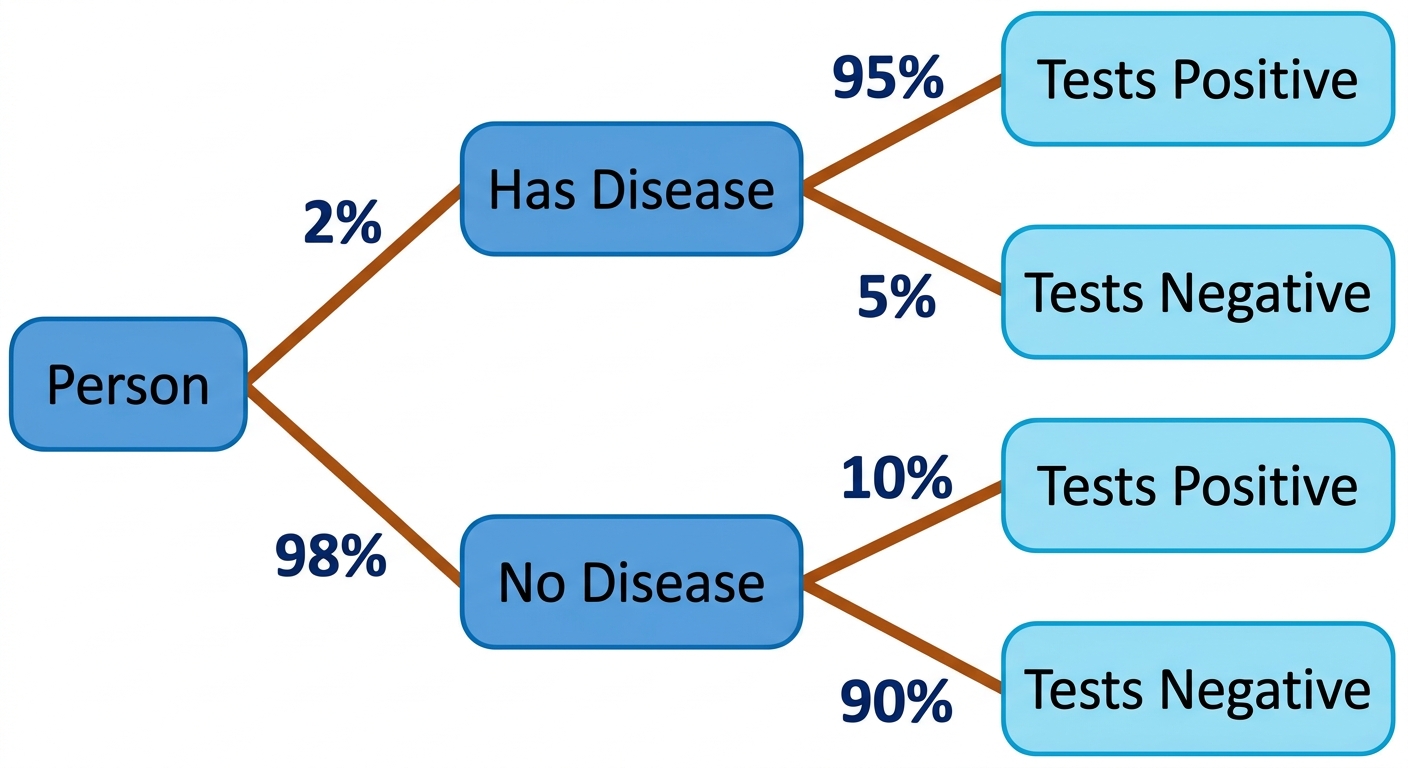
A hospital uses a rapid test for a rare disease. The test has a sensitivity of 95% (probability of testing positive given the disease is present) and a specificity of 90% (probability of testing negative given the disease is absent). The disease affects 2% of the population.
Let = has the disease and = tests positive.
Let = has the disease and = tests positive.
a
Using the complementary rule and the law of total probability, calculate , the probability that a randomly selected person tests positive. [2]
b
Calculate , the probability that a person who tests positive actually has the disease. [2]
c
A public health official proposes rolling out this test as a mass screening programme. Evaluate whether this proposal is justified, using your results from (a) and (b) to support your judgement. [2]
Solutions
4QuestionCalculating Combined ProbabilitiesAssessment Practice
8 marks~12 minCriterion B
A quality-control technician at a marble factory tests batches by drawing two marbles without replacement from a bag containing equal numbers of red and blue marbles.
Experiment 1: 2 red, 2 blue marbles
Experiment 2: 3 red, 3 blue marbles
Experiment 3: 4 red, 4 blue marbles
Experiment 1: 2 red, 2 blue marbles
Experiment 2: 3 red, 3 blue marbles
Experiment 3: 4 red, 4 blue marbles
a
Calculate the probability of drawing a red marble first and a blue marble second for each experiment. Write each answer as a simplified fraction. [3]
b
Deduce a formula for this probability when the bag contains red and blue marbles, where is a positive integer. [2]
c
The factory considers a batch "well-mixed" if the probability of drawing one marble of each colour (in either order) exceeds . Advise the factory whether this standard is a useful quality-control threshold, justifying your answer algebraically. [3]
Solutions
That's every free question here — 4 of 130.
+126 more questions, plus Mock Papers & Worksheets, are waiting in Premium.