You're viewing free preview questions — 4 questions previewing here — subscribe to unlock 65 more, plus the Full Question Bank, Mock Papers & Worksheets.Upgrade
Applications in Bearings and Navigation — Free MYP4 Mathematics (Standard) Practice Questions

1QuestionMulti-Step Navigation ProblemsConcept Practice
2 marks~3 minCriterion A
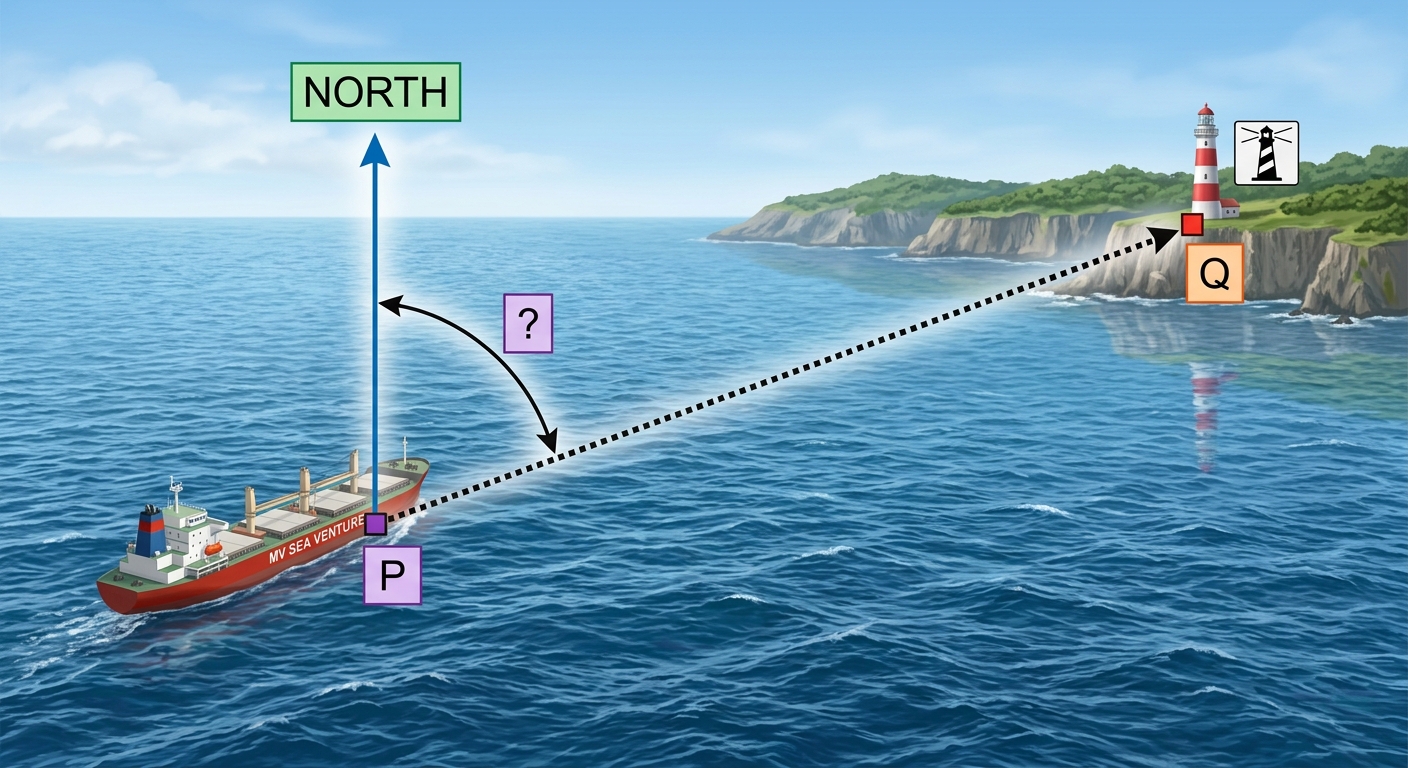
A coast guard vessel is at point and a lighthouse is at point . The diagram shows a north arrow at and the line .
The angle measured clockwise from north to line is .
The angle measured clockwise from north to line is .
a
Deduce the three-figure bearing of from . [1]
b
The coast guard must sail on a bearing between and to stay within a safe navigation corridor. Justify whether the vessel is heading within the safe corridor. [1]

Solutions
2QuestionSolving Bearings Questions Using TrigonometryAssessment Practice
6 marks~9 minCriterion D
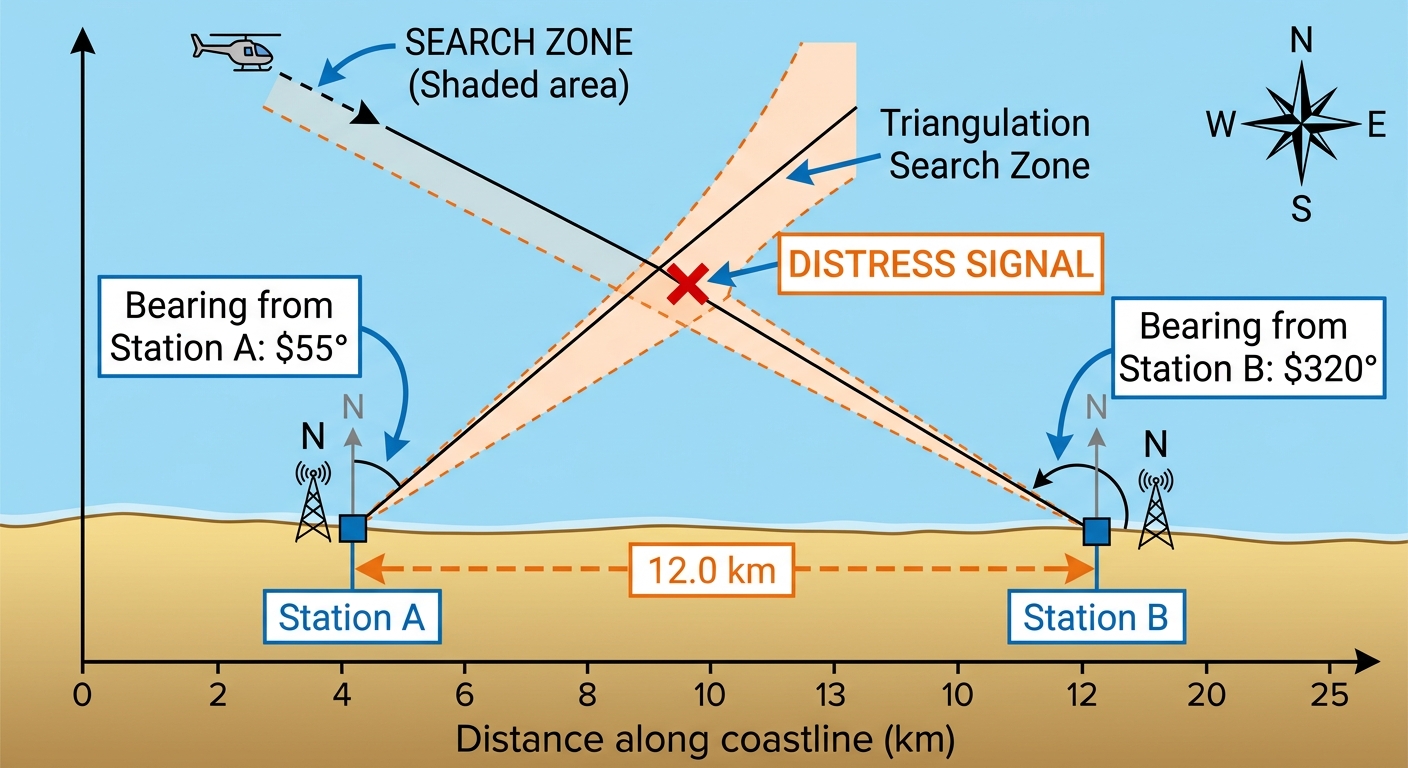
A search-and-rescue helicopter uses bearings from two coastal stations, A and B, which are 12 km apart along a straight coastline. Station A reports a distress signal at a bearing of , and station B reports it at a bearing of . The helicopter crew triangulates the signal position, assuming a flat Earth and that bearings are accurate to within .
a
Calculate the distance from station A to the distress signal. Show all working. [2]
b
Explain how the bearing uncertainty of affects the size of the search zone and how the flat-Earth assumption may limit the accuracy of this model. [2]
c
Justify whether bearing-based triangulation provides a sufficiently reliable method for directing the helicopter to the distress signal in this scenario. [2]
Solutions
3QuestionUnderstanding Bearings as Directional AnglesAssessment Practice
6 marks~9 minCriterion C
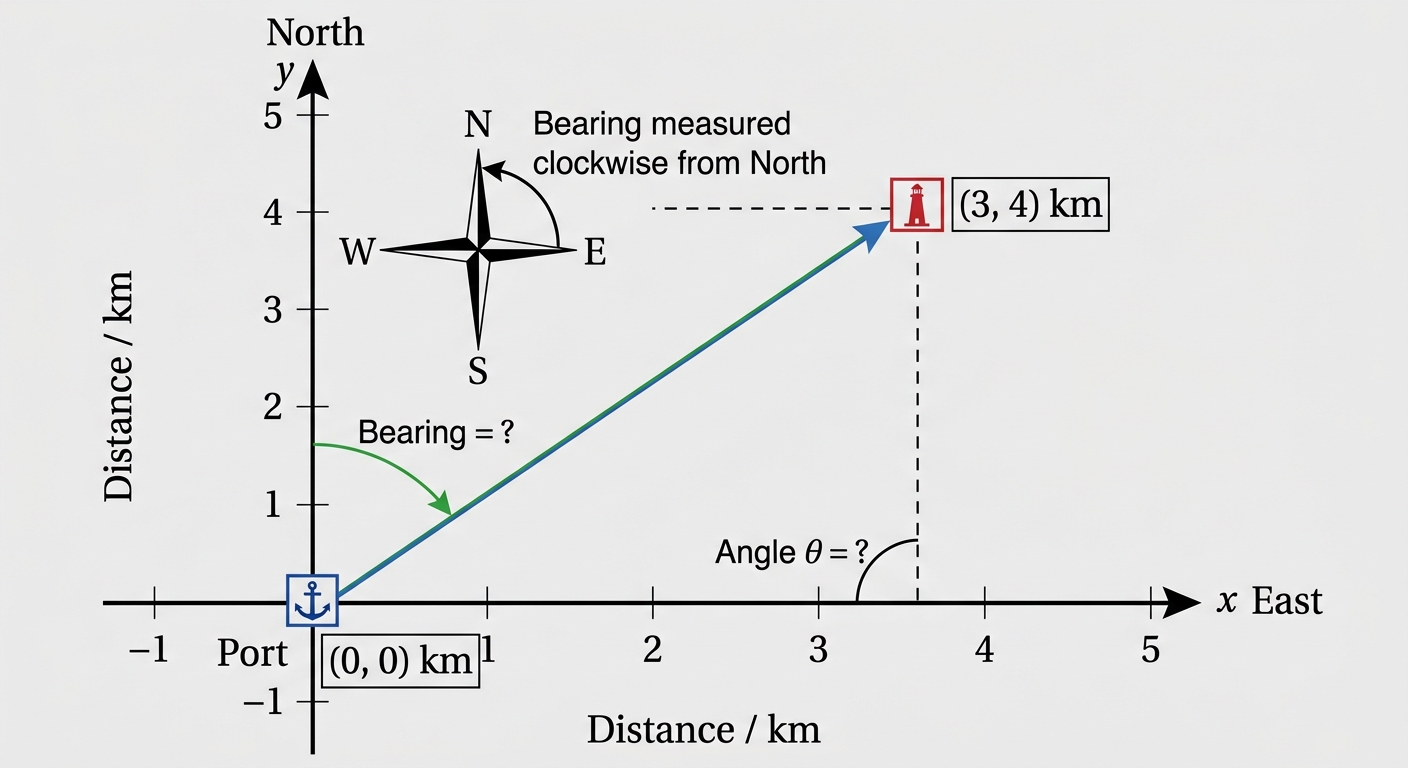
A port is located at the origin and a lighthouse is at coordinates km, where the positive -axis points east and the positive -axis points north. A student proposes the following model to calculate the bearing of the lighthouse from the port:
a
Calculate the bearing predicted by the student's model. [2]
b
Construct the correct bearing using a clearly labelled diagram and trigonometric reasoning. [2]
c
The lighthouse is the destination of a vessel that must follow a bearing accurate to within to avoid shallow waters. Advise the navigator whether the student's model should be used for this voyage, identifying the source of any error in the model. [2]
Solutions
4QuestionMulti-Step Navigation ProblemsAssessment Practice
12 marks~18 minCriterion B
A small boat completes two-leg voyages. The captain records the bearing and distance of each leg.
Voyage 1: Leg 1: , km; Leg 2: , km; Final displacement: km at
Voyage 2: Leg 1: , km; Leg 2: , km; Final displacement: km at
Voyage 3: Leg 1: , km; Leg 2: , km; Final displacement: km at
Voyage 4: Leg 1: , km; Leg 2: , km; Final displacement: km
Voyage 1: Leg 1: , km; Leg 2: , km; Final displacement: km at
Voyage 2: Leg 1: , km; Leg 2: , km; Final displacement: km at
Voyage 3: Leg 1: , km; Leg 2: , km; Final displacement: km at
Voyage 4: Leg 1: , km; Leg 2: , km; Final displacement: km
a
Calculate the sum of the two bearings for each voyage. Deduce what the four sums have in common. [2]
b
For Voyages 1–3, the two leg distances are equal and the bearing sums equal . Analyse the final displacement directions and formulate a general rule predicting the direction of the final displacement whenever two legs of equal distance have bearings summing to . [4]
c
A navigator plans Voyage 6: Leg 1: , km; Leg 2: , km. Using vector components, calculate the actual final displacement (magnitude and direction). Advise the navigator whether the rule from part (b) can be used to plan this voyage, justifying your advice with reference to both the bearing sum and the calculated result. [6]
Solutions
That's every free question here — 4 of 69.
+65 more questions, plus Mock Papers & Worksheets, are waiting in Premium.