You're viewing free preview questions — 4 questions previewing here — subscribe to unlock 31 more, plus the Full Question Bank, Mock Papers & Worksheets.Upgrade
Area of a Triangle using trigonometry — Free MYP4 Mathematics (Standard) Practice Questions

1QuestionFinding the Area of Any Triangle Using TrigonometryConcept Practice
2 marks~3 minCriterion B
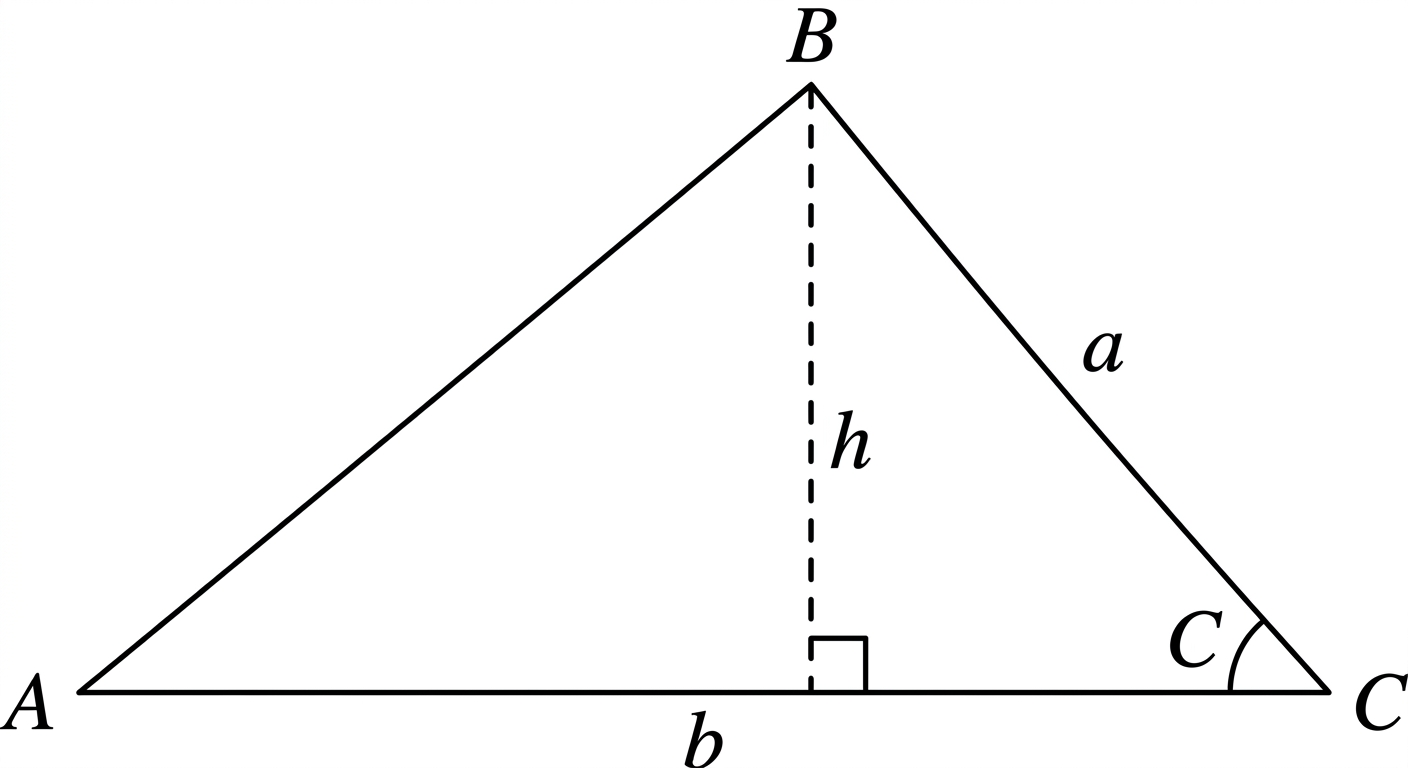
Triangle has sides and , with a perpendicular height drawn from vertex to side . The angle at vertex is denoted .
Show that the area of triangle can be written as
by starting from and substituting . [2]
Show that the area of triangle can be written as
by starting from and substituting . [2]

Solutions
2QuestionFinding the Area of Any Triangle Using TrigonometryAssessment Practice
4 marks~6 minCriterion C
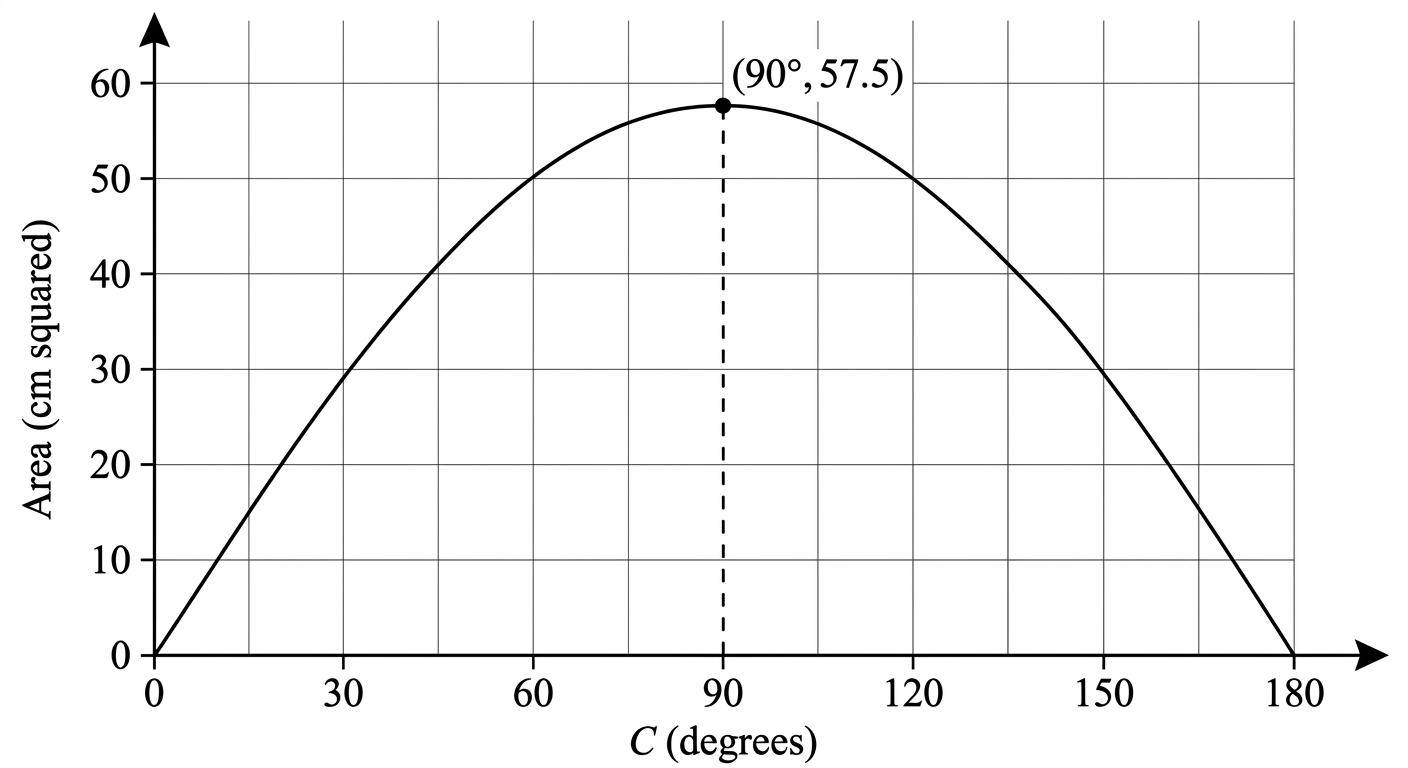
A landscape architect is designing a triangular garden bed with two fixed side lengths cm and cm (on a scale drawing). The graph below shows how the area of the triangle varies with the included angle , using .
a
Show that the area formula simplifies to . [1]
b
Explain how the shape of the graph shows that the maximum area occurs at . [2]
c
The architect claims a right-angled triangular bed gives the most efficient use of the fixed side lengths. Calculate the maximum area correct to 3 significant figures, and advise the architect whether this right-angle design should be adopted to maximise the garden bed area. [1]
Solutions
3QuestionFinding the Area of Any Triangle Using TrigonometryConcept Practice
2 marks~3 minCriterion A
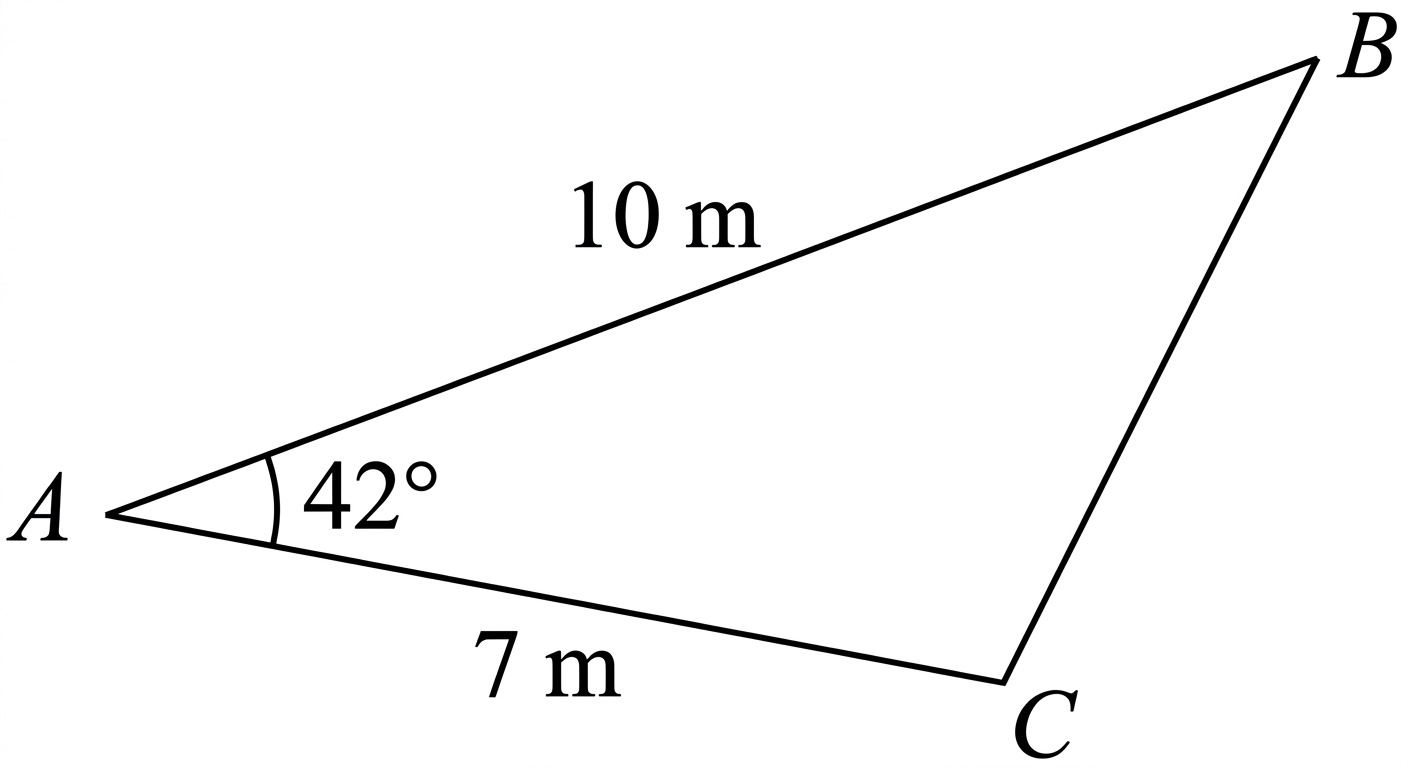
A landscape architect is designing a triangular garden plot. Two boundary fences meet at a corner, with lengths m and m enclosing an angle of at vertex .
a
Calculate the area of the triangular plot. [1]
b
Turf costs 18 dollars per m². The architect has a budget of 2 900 dollars. Advise the architect whether the budget is sufficient to turf the entire plot, justifying your answer with a cost calculation. [1]
Solutions
4QuestionProblem Solving with Non-Right TrianglesAssessment Practice
7 marks~11 minCriterion D
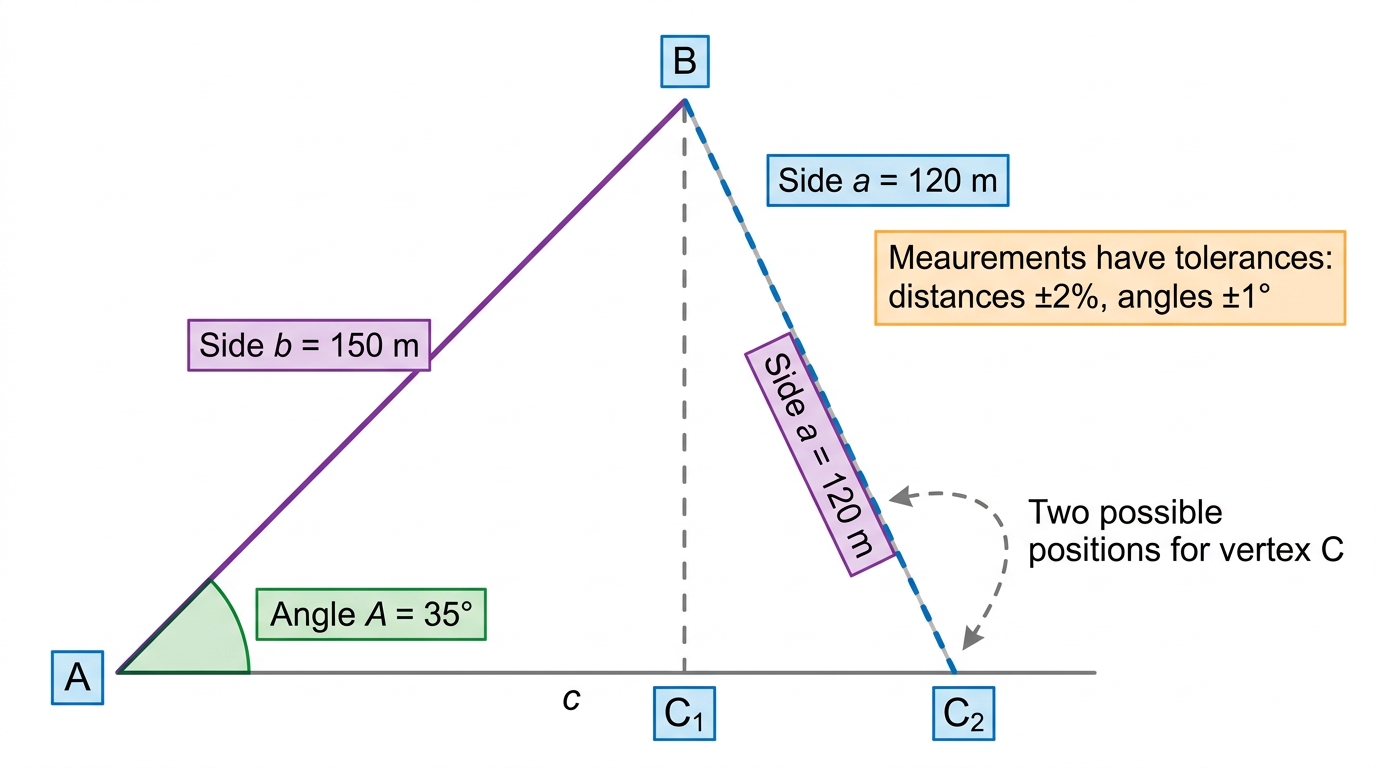
A surveyor records the following measurements for a triangular plot of land: side (opposite angle ), side (opposite angle ), and angle . The measurements carry known tolerances: distances , angles .
a
Deduce how many distinct triangles can be formed with these measurements, justifying your reasoning using the sine rule. [2]
b
Calculate the area of each possible triangle using . [2]
c
Advise the surveyor whether the area estimate is sufficient for legal land registration, taking into account the effect of measurement tolerances on both the number of possible triangles and the range of possible areas. [3]
Solutions
That's every free question here — 4 of 35.
+31 more questions, plus Mock Papers & Worksheets, are waiting in Premium.